Beethoven Frieze Auction History
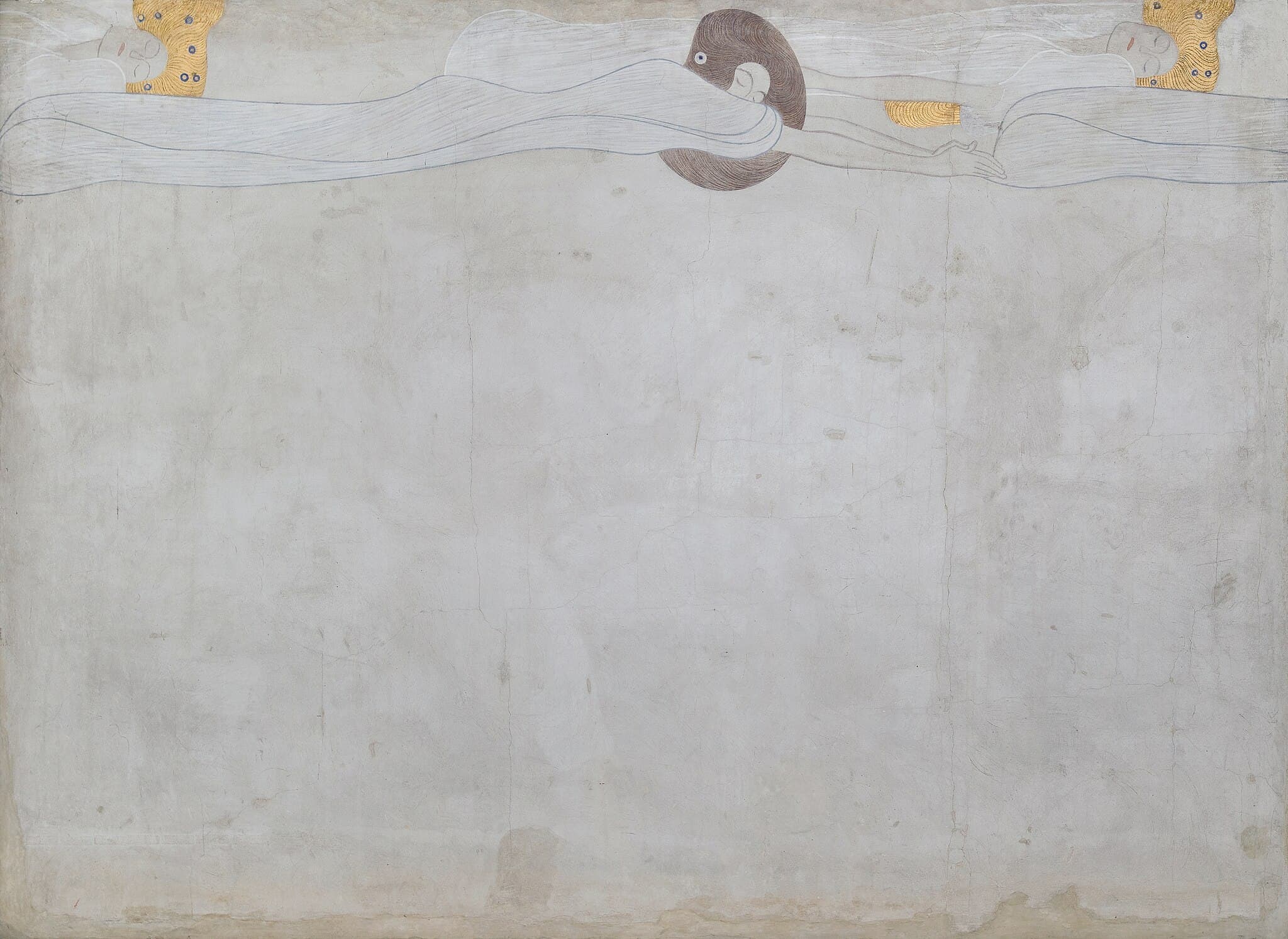
No public auction is recorded for Gustav Klimt’s Beethoven Frieze. Created for the Vienna Secession in 1902, it moved privately to Carl Reininghaus (c.1904) and to August and Serena Lederer (1915), was seized during the Nazi era, and after postwar restitution was purchased in 1972 by the Republic of Austria for 15,000,000 ATS. It is owned by Austria (Belvedere) and permanently displayed at the Secession.
- Artwork
- Beethoven Frieze
- Artist
- Gustav Klimt
- Best-known sale or transfer
- 1972: acquired by Austria for 15,000,000 ATS
- Sale type
- Museum acquisition
- Current location / owner
- Vienna Secession (permanent display); owned by the Republic of Austria (Belvedere)
Auction and Ownership Timeline
Created for the Secession XIV exhibition
Vienna Secession, Vienna
Klimt executed the monumental Beethoven Frieze in situ for the Vienna Secession’s XIV exhibition (15 April–27 June 1902), conceived as a temporary wall decoration [1].
Acquired by Carl Reininghaus; frieze removed and sectioned
Vienna
After the 1903 Klimt retrospective, collector Carl Reininghaus acquired the work; under Carl Moll it was detached, cut into eight panels, and stored at Möbelaufbewahrungsanstalt Wilhelm & Eisler in Vienna [2].
Sold to August and Serena Lederer
Vienna
Reininghaus sold the frieze to August and Serena Lederer, leading patrons of Klimt [2].
Attempted display for Klimt memorial show
Vienna Secession, Vienna
Plans to exhibit the frieze at the Secession’s 1928 Klimt memorial exhibition were curtailed at Serena Lederer’s request; a panel briefly moved was returned to storage [2].
Seized under Nazi administration
Vienna
Following Austria’s annexation, the Lederer collection was seized and placed under state administration; the frieze was not in private hands [2].
Transferred to Schloss Thürnthal wartime depot
Schloss Thürnthal, Lower Austria
The frieze was moved to the art-depot at Schloss Thürnthal in Lower Austria for wartime storage [2][4].
Postwar restitution recognized
Vienna
Seizure orders were lifted and the work was regarded as restituted to the Lederer estate/Erich Lederer; export applications were later denied [2].
Moved to Stift Altenburg
Stift Altenburg, Lower Austria
The frieze was stored at Stift Altenburg amid ongoing custodial administration [2].
Transferred to the Marstall, Lower Belvedere
Unteres Belvedere (Marstall), Vienna
By 1961 the work was transferred to the Marstall of the Unteres Belvedere in Vienna under official custody; export remained restricted [2].
Purchased by the Republic of Austria
ATS 15,000,000 · Österreichische Galerie Belvedere, Vienna
Following Council of Ministers approval (23 May 1972), Austria acquired the frieze from Erich Lederer by private treaty; the contract was signed 18 Nov 1972 for 15,000,000 Austrian schillings [2].
Belvedere inventory instruction
Vienna
The Belvedere was instructed to inventory the work, formalizing the state acquisition [2].
Provenance and Ownership
Commissioned and executed in situ for the Vienna Secession’s XIV exhibition in 1902, the Beethoven Frieze was intended as a temporary wall decoration [1]. After the 1903 Klimt retrospective, Carl Reininghaus acquired it; under Carl Moll it was detached, cut into eight panels, and stored at Möbelaufbewahrungsanstalt Wilhelm & Eisler in Vienna [2]. In 1915 it passed by private sale to August and Serena Lederer [2].
Following the 1938 annexation, the Lederer collection was seized and placed under state administration; in December 1943 the frieze was transferred to the wartime depot at Schloss Thürnthal [2][4]. Seizure orders were lifted in August 1946 and the work was regarded as restituted to the Lederer estate/Erich Lederer, though export applications were denied for years; it was stored successively at Stift Altenburg (1956) and at the Marstall of the Unteres Belvedere (1961) [2]. On 18 November 1972, after approval by the Council of Ministers, the Republic of Austria (Österreichische Galerie Belvedere) acquired the work from Erich Lederer for 15,000,000 Austrian schillings [2]. Since 1986 it has been on permanent display in a dedicated gallery at the Vienna Secession as a loan from the Belvedere [1][3].
Quick Facts
- Last known sale
- 1972-11-18
- Known sale price
- ATS 15,000,000
- Sale type
- Museum acquisition
- Venue / institution
- Republic of Austria (Österreichische Galerie Belvedere)
- Current owner or location
- Republic of Austria (Belvedere); on permanent loan to the Vienna Secession, Vienna
- Publicly viewable?
- Yes
Why This Sale Matters
No public auction has ever been recorded for Gustav Klimt’s Beethoven Frieze; the work was conceived as a site-specific, monumental ensemble for the Vienna Secession and entered Austrian state ownership in 1972 by private treaty, not under the hammer [1][2]. Its transfer to the Republic of Austria for 15,000,000 Austrian schillings followed decades of constrained custody, export restrictions, and negotiations with Erich Lederer after postwar restitution had been recognized in 1946 [2]. The frieze’s unique format, fragile construction, and public role mean it sits outside the market mechanisms that have driven headline prices for Klimt’s easel paintings.
While the 1972 price provides a historical data point, it is not a benchmark for current valuations: it occurred in a non-market context and under Austria’s export policy framework, which has been scrutinized in later restitution debates; in 2015 Austria’s Restitution Advisory Board reviewed the case and recommended against restitution, reinforcing that the work’s key significance is legal-historical rather than price-setting [1][2].
In contrast, Klimt’s auction market has surged: Sotheby’s reported a $236.4m record for the artist in 2025, and his Lady with a Fan realized £85.3m ($108.4m) in 2023, among other nine-figure results [5][6]. Major private sales, such as the reported $135m acquisition of Portrait of Adele Bloch-Bauer I in 2006, further underscore the top-tier demand for iconic Klimts [8]. Against this backdrop, the Beethoven Frieze remains effectively non-tradable—an anchor of Austria’s cultural patrimony rather than a market comparandum. Its provenance and 1972 state acquisition are thus more important to understanding cultural-property policy and restitution history than to setting auction comparables for Klimt’s market [1][2][3].
Related Pages
Other auction histories by Gustav Klimt
Sources
- Vienna Secession — Beethoven Frieze — Vienna Secession
- Austrian Restitution Advisory Board (Kunstrückgabebeirat) — Recommendation on the case of Erich Lederer (6 March 2015) — Provenienzforschung.gv.at
- Belvedere Museum — Press information (ownership and loans) — Belvedere
- Lexikon Provenienzforschung — Thürnthal (Schloss) — Lexikon Provenienzforschung
- Sotheby’s — Historic Night at Sotheby’s Continues as White-Glove Leonard A. Lauder Collection Totals $527.5m — Sotheby’s
- The Art Newspaper — Klimt’s Lady with a Fan becomes most expensive artwork sold at auction in Europe — The Art Newspaper
- The Washington Post — The $135 million Klimt portrait with a rich background — The Washington Post