How Much Is The Origin of the World Worth?
Last updated: July 18, 2026
Quick Facts
- Methodology
- comparable analysis
Indicative fair‑market value for Gustave Courbet’s The Origin of the World (1866) is $100–150 million, if hypothetically marketable today. This reflects its singular, canon‑defining status and global name recognition, calibrated against Courbet’s record and apex 19th‑century comparables.
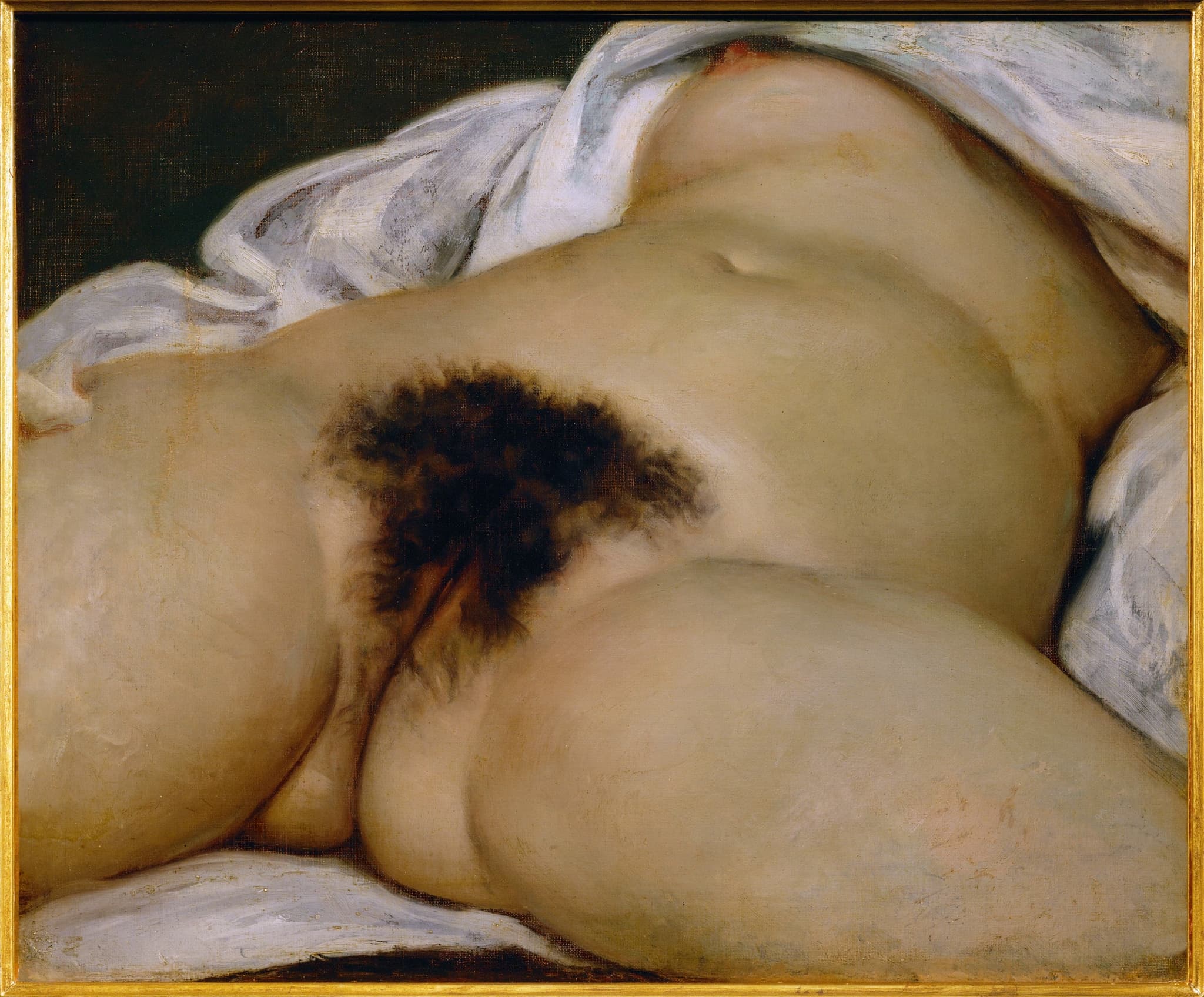
The Origin of the World
Gustave Courbet, 1866 • Oil on canvas
Read full analysis of The Origin of the World →Valuation Analysis
Conclusion: The Origin of the World warrants an indicative fair‑market value of $100–150 million, assuming the work were freely marketable. It is among the most iconic and debated images of the 19th century and a keystone of Courbet’s oeuvre. The painting resides in the French national collection (Musée d’Orsay) via a 1995 dation en paiement; no public transaction price or insured value has been disclosed, so this is a hypothetical, market‑informed estimate grounded in verifiable comparables and category behavior [1].
Method: We triangulate across three layers. First, within‑artist evidence: Courbet’s auction record is Femme nue couchée (1862) at $15.285 million (Christie’s, 2015)—about $21 million in 2025 dollars—setting the artist’s historical ceiling for a museum‑level nude [2]. Second, category benchmarks: apex 19th‑century, canon‑level works by more commercially dominant peers have achieved substantially higher prices; Manet’s Jeanne (Spring) realized $65.125 million in 2014—roughly $89 million in 2025 dollars—providing an anchor for what globally recognizable pictures from this period can command at auction [3]. Third, current demand for quality Courbets remains solid (e.g., La Trombe at $965,200 in 2025), underscoring a healthy base even for non‑trophy subjects [4].
Range setting: The lower bound at $100 million places the work decisively beyond both Courbet’s auction record and the public Manet benchmark once adjusted for inflation, reflecting its unique fame, scholarship, and cultural resonance. The upper bound at $150 million recognizes that singular, canon‑defining images can reset an artist’s price architecture in a competitive trophy market, while tempering the upside for two reasons: (i) Courbet’s market has not historically operated near nine‑figure territory; and (ii) the painting’s explicit subject can narrow the institutional buyer pool and complicate public display in certain jurisdictions, which can modestly dampen peak bidding dynamics despite intense private interest.
Key sensitivities: Excellent condition, authoritative scholarship, and high‑profile exhibition momentum would support the top of the band. Any condition or display restrictions would bias lower. Because there is no publicly disclosed price for the 1995 dation or subsequent insured values, this valuation rests on documented sales records, cross‑artist comparables, inflation context, and the painting’s unrivaled status within Courbet’s corpus and the broader art‑historical canon [1][2][3][4].
Key Valuation Factors
Art Historical Significance
High ImpactThe Origin of the World is a keystone of 19th‑century Realism and among the most reproduced and debated nudes in Western art. It crystallizes Courbet’s anti‑ideal, truth‑to‑nature program and sits alongside A Burial at Ornans and The Artist’s Studio as a pillar of his achievement. Its notoriety, dense critical literature, and decades of public discourse (censorship, psychoanalytic readings, modernity) place it in the rare class of images recognized far beyond specialist audiences. Works that anchor textbooks and museum narratives command premium pricing because they function as cultural touchstones as much as artworks. This extraordinary art‑historical centrality—unique within Courbet’s output—supports a substantial uplift over the artist’s historical price curve.
Rarity and Supply
High ImpactThe painting is a unique, museum‑level icon with effectively zero substitute supply. Courbet’s best works rarely come to market, and no other Courbet carries comparable global name recognition or art‑historical charge. The work’s presence in the French national collection virtually removes it from the trade, which in turn amplifies scarcity value in any hypothetical scenario. At the apex of the market, one‑of‑one status is decisive: collectors compete for irreplaceable images that define an artist and a period. Given the absence of plausible substitutes—whether within Courbet’s oeuvre or adjacent categories—the scarcity premium here is extreme, justifying a multiple well beyond the artist’s conventional auction range.
Market Comparables and Record Gap
High ImpactWithin‑artist pricing peaks at $15.285 million for a major 1860s nude (2015), while blue‑chip category comparables such as Manet’s Jeanne (Spring) have publicly realized $65.125 million (2014). Adjusted for inflation, these reference points sit around $21 million and $89 million respectively, illustrating the step change between Courbet’s record and what globally iconic 19th‑century works can achieve. Layering in current demand signals for quality Courbets (e.g., a 2025 marine near $1 million) shows a healthy base. The Origin of the World is materially more famous than any Courbet likely to trade; a trophy‑level, cross‑category premium over the artist’s record—extending into nine figures—is therefore warranted and consistent with observed behavior for singular, canon‑defining images.
Subject Matter and Display Constraints
Medium ImpactThe picture’s explicit subject is intrinsic to its significance but can narrow the institutional buyer pool and limit universal display in certain contexts. Some museums and jurisdictions apply stricter guidelines to explicit imagery, which can modestly reduce competitive depth versus other canonical pictures. That said, high‑end private collectors and progressive institutions often view the work’s transgressive history as a virtue, not a drawback. On balance, explicitness introduces a measured headwind to achieving extreme ($200m+) levels but does not negate trophy demand. This consideration informs the upper bound of the range while leaving ample room for a strong upside in a competitive, privately brokered context.
Sale History
The Origin of the World has never been sold at public auction.
Gustave Courbet's Market
Gustave Courbet is a cornerstone of 19th‑century French Realism with deep institutional representation and a mature, globally distributed collector base. His public auction record stands at $15.285 million for Femme nue couchée (Christie’s, New York, 2015), and most significant oils trade from the high six figures to low/mid seven figures, with only a handful reaching the eight‑figure band. Recent sales demonstrate solid demand for well‑provenanced marines and landscapes (e.g., La Trombe at $965,200 in 2025), while truly museum‑grade nudes and landmark subjects are exceptionally scarce. Overall, Courbet’s market is steady rather than speculative, with quality, condition, and subject driving outsized results; and singular masterpieces capable of resetting expectations beyond historical ceilings.
Comparable Sales
Femme nue couchée
Gustave Courbet
Same artist and subject (nude), close in date (1862 vs. 1866), establishes Courbet’s auction ceiling for a museum‑level nude.
$15.3M
2015, Christie's New York
~$20.9M adjusted
Jeanne (Spring)
Édouard Manet
Apex 19th‑century figurative masterwork by a closely related French modern pioneer; calibrates the trophy market for canonical images in this period.
$65.1M
2014, Christie's New York
~$89.2M adjusted
La Trombe
Gustave Courbet
Same artist, near‑contemporary date (1867), strong marine; shows current demand for high‑quality Courbets and the baseline for desirable non‑trophy subjects.
$965K
2025, Sotheby's New York
Le Guitarrero
Gustave Courbet
Same artist; mid‑19th‑century figure subject in oil with strong literature/condition; helps bracket typical seven‑figure context below the artist’s nude record.
$580K
2023, Christie's New York
~$614K adjusted
Le melon entamé
Jean Siméon Chardin
Top‑tier Old Master/French canon result (18th c.), used as a category benchmark for how museum‑grade, widely celebrated pre‑Impressionist works price at auction.
$28.8M
2024, Christie's Paris
~$29.7M adjusted
Current Market Trends
The Old Masters/19th‑century segment rebounded in 2025, with stronger sell‑throughs and renewed trophy‑lot competition as collectors rebalanced from more volatile ultra‑contemporary sectors. Category beacons—such as Manet’s Jeanne (Spring) at $65.1m in 2014 and subsequent high‑profile Old Master highlights—illustrate the depth available for canonical images with museum‑level provenance and scholarship. The market remains bifurcated: mid‑tier works are selective, while fresh, well‑documented masterpieces command premium pricing. Younger bidders’ growing presence and sustained institutional programming around core 18th–19th‑century narratives support liquidity at the top. Against this backdrop, a uniquely iconic Courbet is positioned to outperform the artist’s historical record by large multiples in any hypothetical sale.
Study print
Study this painting as a print
Pair the full artwork with a museum-style study sheet focused on one meaningful detail.