How Much Is Le bonheur de vivre (Joy of Life) Worth?
Last updated: July 29, 2026
Quick Facts
- Methodology
- comparable analysis
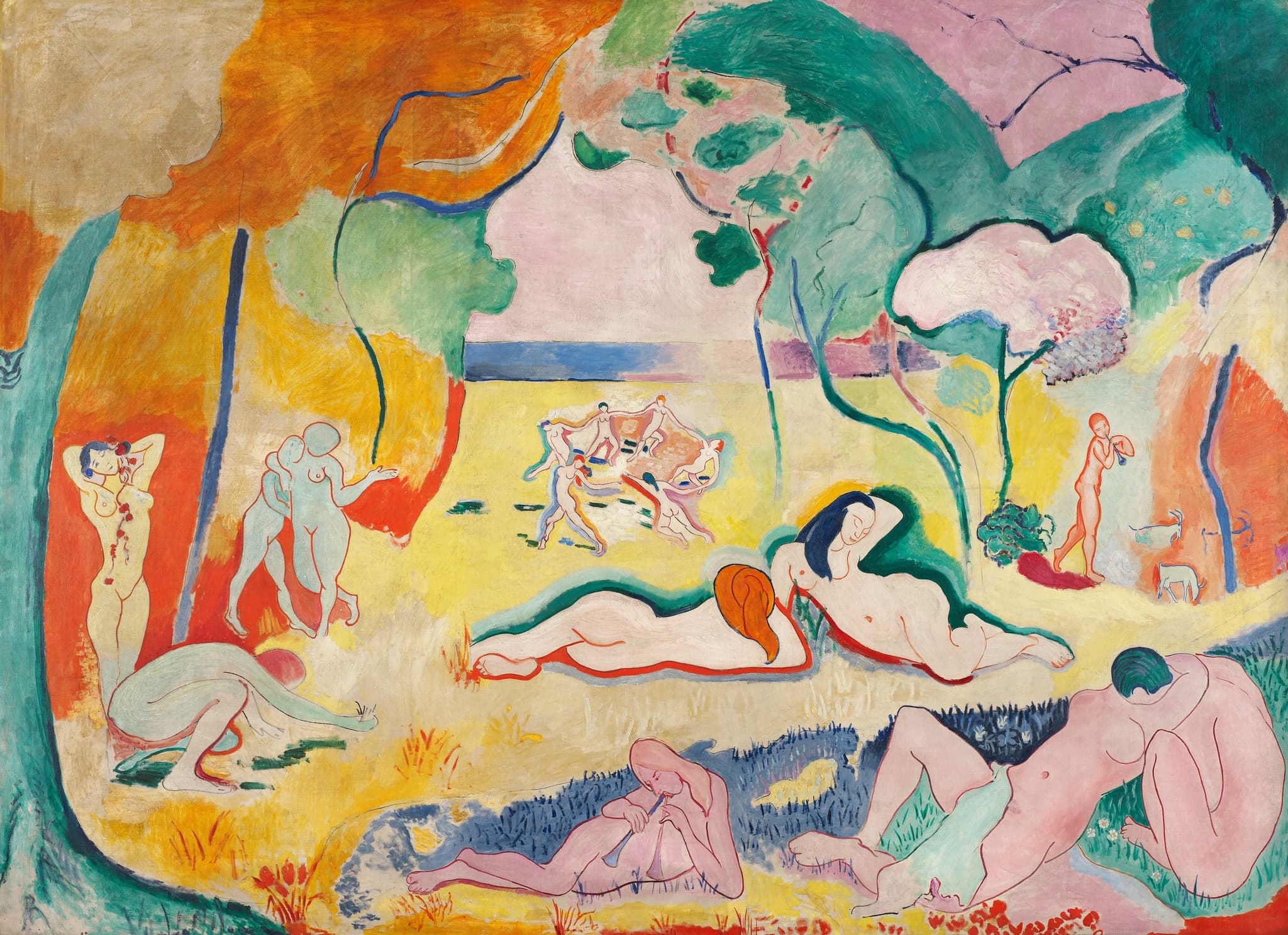
Henri Matisse’s Le bonheur de vivre (Joy of Life), 1905–06, is a canonical Fauvist masterpiece at the Barnes Foundation that has never been publicly sold. Benchmarked against recent ‘trophy’ results for peer modern icons and far exceeding any Matisse painting ever auctioned, a hypothetical open‑market value today is $200–400 million.
Valuation Analysis
Conclusion: In a hypothetical, unrestricted sale today, Henri Matisse’s Le bonheur de vivre (Joy of Life), 1905–06, would likely command $200–400 million. The estimate reflects the work’s singular art‑historical importance within Fauvism and early Modernism, its monumental scale (about 176.5 × 240.7 cm), and its extraordinary provenance and visibility in the Barnes Foundation’s collection, where it remains a cornerstone holding and is not commercially available [1].
Within-artist anchoring: The current auction ceiling for Matisse is $80.75 million (Christie’s, 2018, Odalisque couchée aux magnolias), achieved in a highly publicized single‑owner sale. That record pertains to a prime but later subject; Joy of Life’s art‑historical standing is considerably higher, warranting a multiple of the artist’s auction record in any credible extrapolation [2]. Recent marquee seasons also reaffirm robust demand for blue‑chip Matisse paintings, with fresh, well‑provenanced examples leading Modern evening sales and signaling depth at the top end of this market segment [3].
Cross-artist ‘trophy’ comparables: Price discovery for museum‑grade modern masterworks has clustered in the ~$110–$215+ million band publicly in recent years: Picasso’s Femme à la montre (1932) realized $139.4 million at Sotheby’s in 2023, Cézanne’s La Montagne Sainte‑Victoire achieved $137.79 million (Paul G. Allen sale, 2022), and Warhol’s Shot Sage Blue Marilyn made $195.04 million (Christie’s, 2022) [4][6][5]. Joy of Life is at least as consequential within early Modernism as these benchmarks and materially more important than any Matisse that has reached the market, supporting a value above the ~$150–$200 million tier and into the $200–$400 million range.
Supply, scale, and provenance: The supply of Matisse’s true masterpieces is effectively locked in museums; Joy of Life is among the most studied and reproduced images of the period and a touchstone for modern color and composition. Its exceptional scale, early fame, and storied provenance (Stein circle; Tetzen‑Lund; acquired by Albert C. Barnes in 1923) compound its desirability and scarcity premium [1]. In today’s global market, buyers for singular, museum‑grade works are deep and internationally diversified, with institutions and private foundations actively competing at the apex.
Risks and considerations: While the Barnes Foundation’s governance makes an actual sale exceedingly unlikely, the hypothetical valuation assumes clear title, normal marketability, and condition commensurate with major museum display. As with other Fauve works, pigment stability and conservation history would be pivotal in final pricing; no public disclosures suggest adverse issues. Given the recent strength of top-tier Modern art and the rarity of opportunities at this level, a $200–$400 million range today is well supported by both within‑artist extrapolation and cross‑artist trophy comparables [2][3][4][5][6].
Key Valuation Factors
Art Historical Significance
High ImpactLe bonheur de vivre is widely recognized as one of Matisse’s defining masterworks and a watershed in the development of Fauvism and early European Modernism. Its radical orchestration of color, contour, and arcadian motif set a new paradigm for expressive painting in the early 20th century, with direct influence on Matisse’s own Dance/Music cycle and on peers across Europe. Few modern works carry comparable art-historical weight within a single artist’s oeuvre; within Matisse, only a handful (e.g., The Red Studio) rival its status. This primacy underwrites exceptional cultural and financial value, placing the painting well above any Matisse that has reached the open market and aligning it with cross-artist masterpieces that routinely clear nine-figure prices.
Rarity and Supply Constraints
High ImpactThe supply of museum-caliber Matisse masterpieces is functionally fixed: the most important canvases are in the permanent collections of major institutions and seldom, if ever, deaccessioned. Joy of Life has been ensconced in the Barnes Foundation since 1923, with no possibility of ordinary market circulation. In the rarefied trophy segment, scarcity commands pronounced premiums; when comparable icons by peer modern masters do surface, they attract global bidding and elicit prices well into the nine figures. The combination of institutional status and irreplaceability amplifies the scarcity premium here, strongly supporting a $200–$400 million valuation in a hypothetical sale scenario.
Market Benchmarks and Trophy Dynamics
High ImpactRecent public results for peer masterpieces define the reference band for an object of this stature: Picasso’s Femme à la montre achieved $139.4 million (2023), Cézanne’s Sainte-Victoire reached $137.79 million (2022), and Warhol’s Shot Sage Blue Marilyn brought $195.04 million (2022). These outcomes confirm deep global liquidity and competitive intensity for singular, museum-grade pictures. While Matisse’s public record stands at $80.75 million (2018), that figure reflects the absence of works of Joy of Life’s magnitude on the market rather than a ceiling on demand. Extrapolating from the trophy cohort and from Matisse’s 2018 record supports a value comfortably above $150 million, consistent with a $200–$400 million range.
Scale, Visibility, and Provenance
High ImpactAt roughly 176.5 × 240.7 cm, Joy of Life is an imposing, immersive canvas whose scale and composition accentuate its landmark status. The painting’s illustrious provenance—early ownership by the Steins, passage through leading dealers, and acquisition by Albert C. Barnes—adds narrative depth and institutional luster. Decades of continuous display, scholarship, and reproduction in the Barnes galleries have cemented its image recognition among scholars and the public alike. High visibility and unimpeachable provenance are critical determinants of top-tier pricing; combined with the work’s condition and curatorial centrality, these attributes substantively reinforce an apex valuation in the $200–$400 million corridor.
Sale History
Private sale following the 1906 Salon des Indépendants (Paris)
Acquired by Leo and Gertrude Stein; price not publicly disclosed.
Private sale via Bernheim-Jeune/Paul Guillaume
To Christian Tetzen-Lund (Copenhagen); price not publicly disclosed.
Private sale via Paul Guillaume
Purchased by Albert C. Barnes; entered the Barnes Foundation collection. Price not publicly disclosed.
Henri Matisse's Market
Henri Matisse is a blue-chip pillar of 20th‑century art with broad global demand across paintings, sculptures, cut‑outs, and works on paper. The artist’s public auction record is $80.75 million (Christie’s, 2018, Odalisque couchée aux magnolias), a level achieved in a marquee single‑owner sale that underscores deep collector appetite for prime works. While major canvases are scarce, recent evening sales demonstrate renewed competition for top-quality Matisse paintings, with fresh, well‑provenanced examples leading Modern auctions. The relative absence of his true museum‑grade masterpieces from the market has constrained the public ceiling; accordingly, valuations for icons like Joy of Life must be extrapolated upward from the record using cross‑artist trophy benchmarks and demonstrated liquidity at the apex of the Modern category.
Comparable Sales
Odalisque couchée aux magnolias
Henri Matisse
Same artist; top auction record for a Matisse painting. Prime oil from a key period (Nice/odalisques) showing the market ceiling for the artist.
$80.8M
2018, Christie's New York
~$103.6M adjusted
La Chaise lorraine
Henri Matisse
Same artist; major oil (1919) and one of the strongest recent Matisse results. Indicates current demand for museum‑quality Matisse paintings.
$48.4M
2026, Sotheby's New York
~$47.2M adjusted
Femme à la montre
Pablo Picasso
Peer ‘trophy’ modern master; 1932 icon with museum‑level stature. Benchmarks what canonical early‑20th‑century masterpieces can achieve publicly.
$139.4M
2023, Sotheby's New York
~$148.0M adjusted
La Montagne Sainte‑Victoire
Paul Cézanne
Peer foundational modernist masterpiece sold publicly. Cézanne’s influence is pivotal to Matisse’s Fauvism; strong proxy for museum‑grade early modern art.
$137.8M
2022, Christie's New York
~$151.6M adjusted
Dame mit Fächer (Lady with a Fan)
Gustav Klimt
Peer European modern master; last portrait by Klimt and a recent European auction record. Demonstrates global appetite for singular, museum‑grade icons.
$108.4M
2023, Sotheby's London
~$114.3M adjusted
Shot Sage Blue Marilyn
Andy Warhol
Cross‑category ‘trophy’ benchmark. Shows the contemporary upper bound for instantly recognizable, museum‑grade masterpieces with deep global demand.
$195.0M
2022, Christie's New York
~$214.6M adjusted
Current Market Trends
The upper tier of the Modern market has proven resilient, with ‘trophy’ works by canonical masters attracting international demand and clearing nine-figure prices. Post‑2022 results for icons by Picasso, Cézanne, and Warhol confirm robust liquidity and strong institutional and private foundation participation. While broader markets experienced selectivity, blue‑chip Modern rebounded in recent marquee seasons, aided by concentrated supply in the U.S. and deep global bidder pools. Against this backdrop, the scarcity of museum‑caliber Matisse masterworks intensifies competition when comparably significant works by peer artists come to market, reinforcing a $200–$400 million framework for Joy of Life in a hypothetical, fully marketed sale.
Sources
- Barnes Foundation collection entry: Le Bonheur de vivre (The Joy of Life)
- Christie’s press: Rockefeller Evening Sale results (includes Matisse record)
- The Art Newspaper: Bidding battle for Matisse leads Sotheby’s $303.3m Modern Evening Sale (May 2026)
- Sotheby’s: Emily Fisher Landau Collection reaches $425m (includes Picasso’s Femme à la montre at $139.4m)
- Christie’s: May 2022 Marquee Week sale results (Warhol Shot Sage Blue Marilyn $195.04m)
- Christie’s press: Paul G. Allen sale totals $1.5bn (includes Cézanne at $137.79m)