How Much Is Woman with a Hat Worth?
Last updated: February 16, 2026
Quick Facts
- Insurance Value
- $200.0M (Proposed insurance benchmark based on extrapolation above the artist’s auction record and cross-artist trophy results.)
- Methodology
- extrapolation
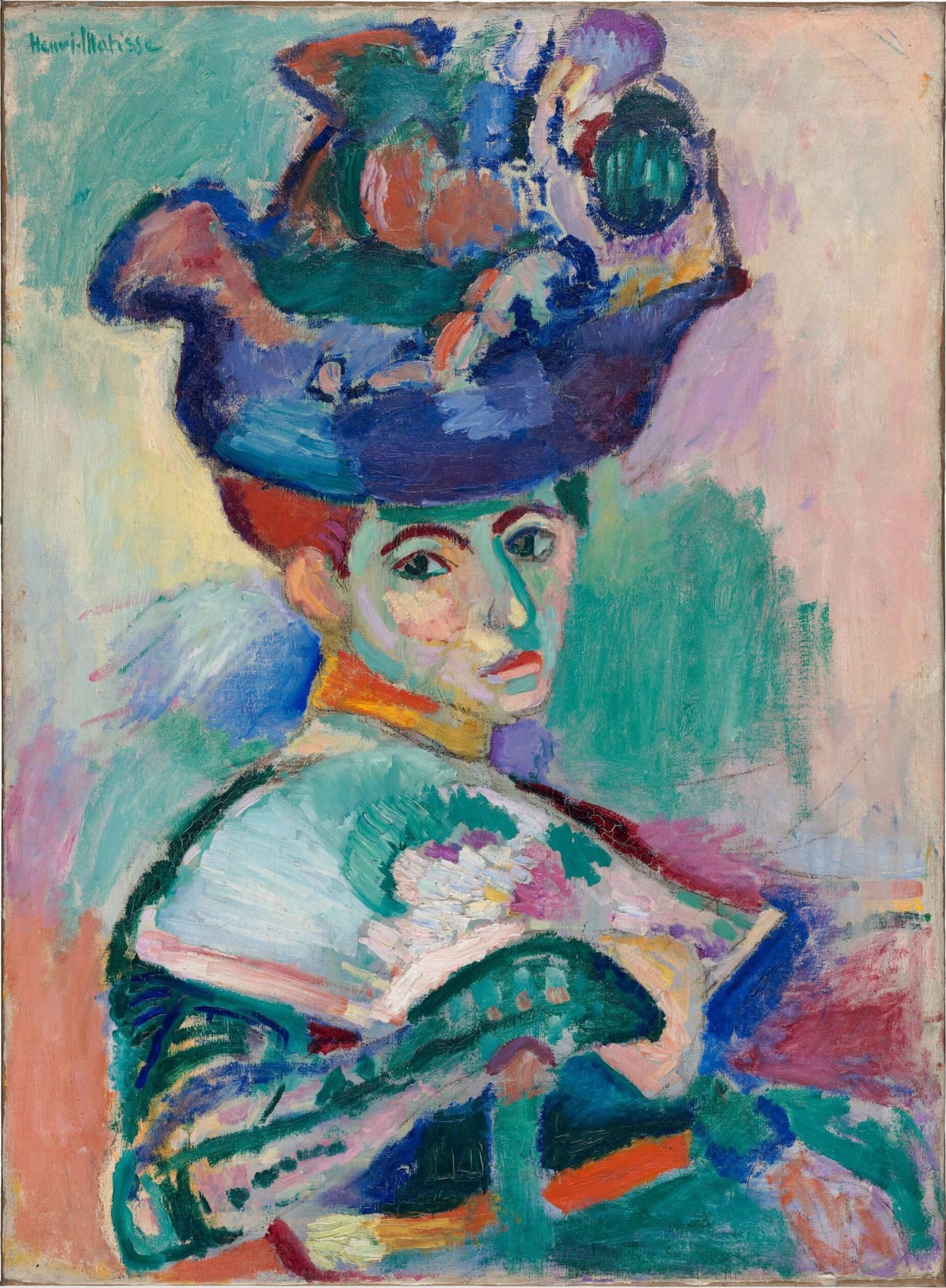
Estimated fair-market value: $120-180 million. This extrapolates above Matisse’s standing $80.75m auction record to reflect Woman with a Hat’s singular 1905 Fauvist importance, iconic status, impeccable provenance, and extreme scarcity outside museums. In an optimal, highly competitive sale, upside beyond $200 million is plausible.
Valuation Analysis
Conclusion. We estimate Henri Matisse’s Woman with a Hat (1905) at $120–180 million, with trophy-level upside in a peak, highly competitive sale. The work is a cornerstone of Fauvism, a canonical image that helped define Matisse’s breakthrough, and among the most widely reproduced pictures of early Modernism. It resides at SFMOMA via the Elise S. Haas bequest and is not realistically available; the valuation here is a benchmark for insurance and market context rather than a sale forecast [1][8].
Method and anchors. The estimate is derived by extrapolating from Matisse’s auction ceiling—Odalisque couchée aux magnolias (1923) at $80.75 million (with premium)—and applying an art-historical rarity premium appropriate to a 1905 Fauve icon [3]. Recent painting results for quality Matisses (e.g., $32.26 million in November 2025) show solid depth but do not capture the pricing power of a once-in-a-generation masterpiece [4]. To frame headroom, we reference nine-figure results for peer blue-chip modern trophies (Cézanne, Van Gogh, Picasso, Klimt), demonstrating sustained global capacity for museum-caliber works with landmark status and elite provenance [5][6][7].
Why a premium to the artist’s record is justified. Woman with a Hat is materially earlier and more historically consequential than the Nice-period odalisques that dominate Matisse’s price record. It is a textbook-defining Fauvist statement whose closest peers—The Open Window and The Green Stripe—are in museums, making direct private-market substitutes effectively nonexistent. This extreme scarcity, combined with the work’s role in the 1905 Salon d’Automne scandal and its foundational place in Matisse’s development, supports a substantial step-up over the current $80.75m artist record [2][3].
Provenance and institutional stature. First acquired by Leo Stein at the 1905 Salon d’Automne, the painting passed through the Stein family and was purchased by Elise S. Haas in 1948 before entering SFMOMA by bequest in 1991 [1][2]. SFMOMA notes the work “does not travel,” underscoring its status as a protected institutional icon and further reinforcing scarcity and demand friction that typically elevate insurance/fair-market benchmarks for such works [8].
Range setting and sensitivities. The $120–180 million band reflects: (i) a rarity/importance premium above the $80.75m record, (ii) the demonstrated nine-figure trophy bandwidth in the Modern market, and (iii) expected depth from a compact pool of top buyers. Upside beyond $200 million is achievable in a buoyant macro environment with pristine condition, marquee positioning, and robust third-party backing. Primary dampeners would be material condition issues or restrictive sale terms, though these affect transactability more than intrinsic value.
Key Valuation Factors
Art Historical Significance
High ImpactPainted and exhibited in 1905, Woman with a Hat is a defining Fauvist picture that catalyzed Matisse’s breakthrough and the wider recognition of the Fauves. It is featured in virtually every survey of early Modernism and is a touchstone for discussions of color, facture, and expressive portraiture. Works of this foundational importance are exceedingly rare and generally held by institutions. The painting’s outsized role in the 1905 Salon d’Automne narrative, and its frequent reproduction in scholarship and exhibitions, position it at the pinnacle of Matisse’s oeuvre—on par with The Open Window and The Green Stripe—warranting a substantial premium over later, stylistically different record-setting works.
Rarity and Supply Constraints
High ImpactComparable 1905 Fauvist masterpieces by Matisse are largely in museums, leaving the private market effectively without direct substitutes. This structural scarcity is compounded here by institutional status and bequest terms that restrict lending and preclude ordinary market circulation. In practice, such supply constraints increase the willingness of top collectors to pay exceptional premiums should an opportunity arise. Even as a benchmark rather than a near-term sale scenario, this level of rarity materially elevates fair-market and insurance valuations beyond the artist’s existing auction ceiling.
Provenance and Exhibition History
High ImpactThe painting’s provenance is exemplary: acquired from the 1905 Salon d’Automne by Leo Stein, subsequently in the Stein family, purchased by Elise S. Haas in 1948, and bequeathed to SFMOMA in 1991. This chain connects the work directly to the most important early patrons of Matisse and to a leading U.S. museum collection. Extensive exhibition and literature history, including its central role in scholarship on Fauvism, amplify confidence and trophy appeal. Such provenance reduces transactional risk, strengthens buyer conviction, and typically correlates with stronger performance in high-stakes sales and higher insurance benchmarks.
Cross-Artist Trophy Benchmarks and Market Depth
Medium ImpactNine-figure results for peer blue-chip modern masters (e.g., Picasso at ~$139m; Cézanne and Van Gogh in the $117–157m zone; Klimt at $236m) demonstrate durable, global demand for museum-caliber icons with landmark status and elite provenance. While Matisse’s auction record stands at $80.75m for a later odalisque, Woman with a Hat’s canonical 1905 status justifies extrapolation into the established nine-figure trophy bandwidth. Recent Matisse auction results in the $10–32m range show liquidity but are not true like-for-like comparables; the pricing step-up here is anchored in art-historical primacy, scarcity, and trophy dynamics evidenced across Modern masters.
Sale History
Salon d’Automne, Grand Palais (exhibition sale)
Sold to Leo Stein at approximately 400 francs (c. $80 in 1905 USD) following the 1905 Salon d’Automne exhibition.
Henri Matisse's Market
Henri Matisse remains a top-tier, globally collected modern master whose market shows resilient depth for high-quality works. The standing auction record is $80.75 million (Christie’s, 2018) for a 1923 odalisque; strong recent results include a $32.26 million painting in November 2025, alongside robust outcomes for important bronzes. While availability of prime oils is limited, well-provenanced, aesthetically compelling works attract competitive bidding. Price dispersion is wide by period and medium: Nice-period portraits and major bronzes lead current activity, while late works on paper and print suites provide accessible entry points. Against this backdrop, a canonical 1905 Fauvist masterpiece would command a meaningful premium to the existing record given scarcity, art-historical weight, and trophy appeal.
Comparable Sales
Odalisque couchée aux magnolias
Henri Matisse
Same artist; top-of-market oil by Matisse and current auction record; female figure subject; anchors the artist’s price ceiling even though it is a later Nice-period work (not Fauve).
$80.8M
2018, Christie's New York
~$102.6M adjusted
Figure et bouquet (Tête ocre)
Henri Matisse
Same artist; strong, late portrait with compelling provenance; best recent (last 5 years) painting result, indicating current depth of demand for quality Matisses.
$32.3M
2025, Christie's New York
Femme au chapeau fleuri
Henri Matisse
Same artist and closely related subject (female portrait with hat); later Nice-period oil showing market appetite for the motif, though far less historically pivotal than a 1905 Fauve icon.
$11.0M
2025, Christie's New York
Jeune fille en robe rose
Henri Matisse
Same artist; desirable Nice-period portrait that outperformed estimate; a recent, liquid benchmark for later portraits.
$9.7M
2024, Sotheby's New York
~$10.0M adjusted
Femme à la montre
Pablo Picasso
Trophy-level, canonical modern female portrait by a peer blue-chip master, demonstrating sustained nine-figure demand for museum-caliber icons with elite provenance.
$139.4M
2023, Sotheby's New York
~$149.2M adjusted
La Montagne Sainte-Victoire (Paul G. Allen Collection)
Paul Cézanne
Movement-defining masterpiece by a foundational modern master; nine-figure benchmark illustrating the premium for works that mark turning points in art history—akin to Matisse’s 1905 Fauve breakthrough.
$137.8M
2022, Christie's New York
~$157.1M adjusted
Current Market Trends
The Modern segment has polarized: broad volumes softened through 2024, but 2025 saw a pronounced rebound at the top, fueled by single-owner estates and landmark consignments. Multiple nine-figure results for blue-chip masters reaffirm deep global demand for museum-caliber trophies, even as mid-tier material remains selective. For Matisse, recent auctions show steady absorption of strong works and standout prices for bronzes and quality paintings, with estimates needing discipline. In this environment, art-historically pivotal icons—especially with impeccable provenance and institutional stature—are positioned to outperform, validating an extrapolated nine-figure benchmark for Woman with a Hat.
Study print
Study this painting as a print
Pair the full artwork with a museum-style study sheet focused on one meaningful detail.
Sources
- SFMOMA object page: Henri Matisse, Woman with a Hat
- Janet Bishop, SFMOMA Open Space: A Few More Stein Stories (1905 sale price and correspondence)
- Artsy Editorial: Matisse record at Christie’s Rockefeller ($80.75m)
- Christie’s: 20th/21st Century New York Results (Nov 2025) – Matisse at $32.26m
- Christie’s: Paul G. Allen Collection Sale Results (Cézanne, Van Gogh, Seurat nine-figure results)
- The Guardian: Picasso, Femme à la montre sells for $139.4m (2023)
- Wall Street Journal: Klimt Portrait sells for $236.4m (2025)
- SFMOMA Press Release: Exclusive venue for Matisse’s Femme au chapeau (does not travel)