How Much Is The Red Studio Worth?
Last updated: February 17, 2026
Quick Facts
- Last Sale
- $29K (1949, Museum of Modern Art (acquisition via Bignou Gallery/Georges F. Keller; Mrs. Simon Guggenheim Fund))
- Current Location
- The Museum of Modern Art (MoMA)
- Methodology
- comparable analysis
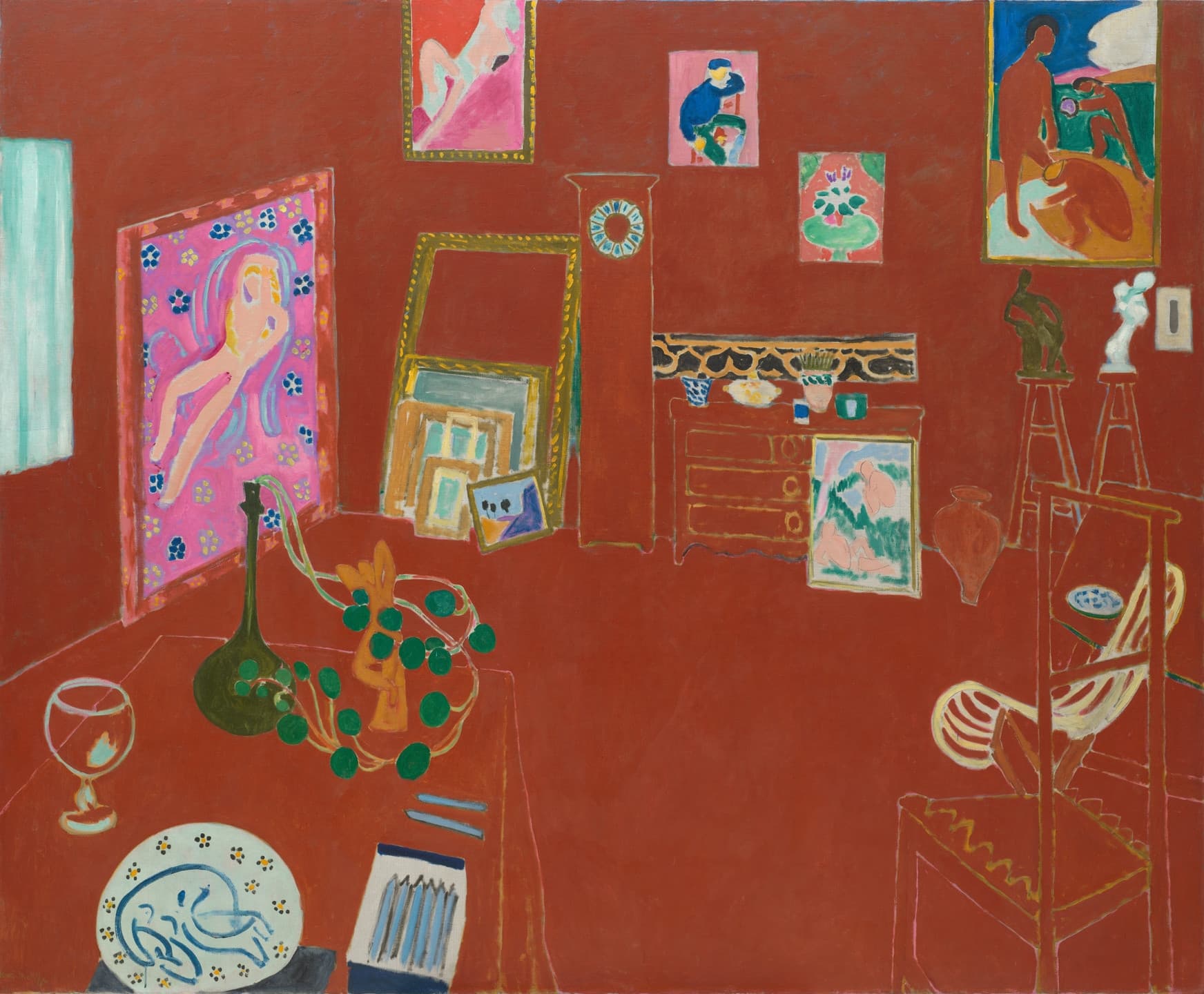
Hypothetical fair-market/insurance proxy for Henri Matisse’s The Red Studio is $260–340 million. This reflects its undisputed, textbook status and extreme scarcity, extrapolated from trophy-level benchmarks for museum-caliber masterpieces and far above the artist’s public auction record.
Valuation Analysis
Conclusion: If The Red Studio were hypothetically tradable today, a defensible fair‑market/insurance proxy is $260–340 million. The range reflects the painting’s singular art‑historical stature, its role as a MoMA icon, and cross‑artist trophy benchmarks achieved for epoch‑defining masterworks.
Significance and status: Painted in 1911, The Red Studio is among the most important works of the 20th century and a cornerstone of Matisse’s oeuvre. MoMA’s 2022 focus exhibition reiterated its radical color field, spatial flattening, and enduring influence, cementing its textbook status and global recognition [1]. The work has been an institutional anchor at MoMA since 1949.
Market framework and comps: Because the picture is museum‑held and has no modern auction record, valuation relies on cross‑artist trophy comparisons and observed buyer behavior for museum‑grade icons. At the artist level, Matisse’s public auction ceiling is $80.75 million (Christie’s, 2018), set by a prime 1920s odalisque [5]. For cross‑artist, like‑for‑like “epochal” comparables: Gustav Klimt’s Portrait of Elisabeth Lederer sold at auction in 2025 for $236.4 million, confirming deep demand at the very top of the Modern category [3]. Privately, Paul Cézanne’s The Card Players reportedly transacted around $250 million in 2011, a figure that would be substantially higher in today’s dollars [4]. These datapoints bracket a rational zone for a canonical, museum‑caliber painting with no true substitutes.
Why above the artist’s record: The Red Studio is a once‑in‑a‑generation icon whose cultural capital materially exceeds the artist’s auction ceiling. In market practice, such works command a “trophy” and “institutional icon” premium that lifts them into the cross‑artist band defined by the strongest Modern master results. Given the painting’s centrality to Matisse and to Modernism itself, informed competition among top private collectors and institutions would likely push well beyond $200 million and plausibly into the low‑to‑mid $300 millions.
Provenance, scale, and visibility: The painting’s unimpeachable provenance (long MoMA ownership) and extensive exhibition history amplify confidence and global demand. MoMA’s acquisition for $29,000 in 1949 underscores its early institutional recognition; today that history is a value enhancer in its own right [2]. The large scale and iconic imagery (the saturated red, the self‑referential studio) further support an apex valuation, consistent with how scale and recognizability correlate with pricing in this segment.
Positioning of the estimate: The $260–340 million range sits above the current observed auction apex for Modern masterpieces (Klimt, $236.4m) while allowing for private‑sale dynamics and the exceptional “museum symbol” premium unique to The Red Studio. It also recognizes disciplined top‑end liquidity: in the present market, only the most certified touchstones justify prices at or above $300 million. Taken together, these factors warrant the stated band as a confident, data‑driven proxy for a work that is, in practical terms, priceless [1][3][4][5].
Key Valuation Factors
Art Historical Significance
High ImpactThe Red Studio (1911) is a canonical statement of modern art: its radical monochrome, collapsed perspective, and reflexive studio subject fundamentally shaped later modernist developments. It is reproduced in virtually every survey of 20th‑century art and anchors Matisse scholarship. MoMA’s dedicated 2022 exhibition intensified scholarly and public focus, reinforcing its status as a global touchstone. Works with this level of cultural capital transcend an artist’s ordinary market bands, attracting competition from top private collectors and institutions. This singular, widely recognized significance is the primary driver of a valuation at the apex of the Modern category.
Scarcity and Substitutability
High ImpactTrue substitutes for The Red Studio do not exist. Museum collections hold nearly all comparably important Matisses; masterpieces of this caliber are effectively off-market. In pricing, the absence of supply and lack of near-peers produce nonlinear outcomes—especially when an artwork functions as a symbol for both an artist and an era. In a hypothetical offering, scarcity would catalyze intense competition, with bidders prioritizing uniqueness and long-term cultural value over price sensitivity. This structural scarcity justifies a substantial premium over the artist’s auction record and supports placement in the cross‑artist trophy band.
Provenance and Institutional Icon Status
High ImpactLong-term ownership by MoMA since 1949, with acquisition supported by the Mrs. Simon Guggenheim Fund, confers unimpeachable provenance and a world-class exhibition history. The painting has functioned for decades as a MoMA icon—an institutional identity work. Such “museum symbol” pieces carry an additional premium in valuation and insurance contexts because they embody institutional narratives and public memory. The combination of renowned provenance, exhibition pedigree, and brand-like recognizability materially elevates market appetite and price potential in any hypothetical transaction.
Market Benchmarks and Trophy Premium
High ImpactAt the artist level, Matisse’s auction record is $80.75 million (2018). Cross-artist trophy comparables provide the relevant frame: Klimt’s 2025 auction result at $236.4 million evidences deep demand for apex Modern works, while Cézanne’s reported $250 million private sale demonstrates the private market’s capacity at this tier. The Red Studio’s art-historical weight and brand-like fame place it squarely within—and plausibly above—this band. This justifies a range of $260–340 million, reflecting the observed trophy premium paid for epoch-defining, museum-grade masterpieces.
Sale History
Private sale to David Tennant (Gargoyle Club), London
Reported price £806; approx. $3,900 at late-1920s GBP/USD parity.
Museum of Modern Art, New York (acquired via Bignou Gallery/Georges F. Keller)
Purchased with the Mrs. Simon Guggenheim Fund; widely cited price $29,000.
Henri Matisse's Market
Henri Matisse is a blue-chip pillar of 20th‑century art with a deep global collector base spanning Fauvism, Nice interiors/odalisques, bronzes, and late cut‑outs. While quality offerings appear consistently, true masterpieces are rare because top examples reside in museums and a handful of long‑term private collections. The artist’s painting auction record is $80.75 million (Christie’s, 2018), with strong results clustered between ~$20–60 million for prime works by period and subject. Recent marquee seasons have reinforced demand for top-tier Matisse across media, with fresh-to-market, well‑provenanced works attracting competitive bidding. The scarcity of apex paintings creates a significant gap between the public auction ceiling and hypothetical prices for the artist’s most iconic works.
Comparable Sales
Odalisque couchée aux magnolias
Henri Matisse
Same artist; auction record for a Matisse painting; museum‑caliber trophy that anchors the public market ceiling for the artist even if a different subject/period than The Red Studio.
$80.8M
2018, Christie's New York
~$102.3M adjusted
Figure et bouquet (Tête ocre)
Henri Matisse
Same artist; strong 1930s painting sold in late‑2025 marquee season; evidences current depth of demand for high‑quality Matisse works.
$32.3M
2025, Christie's New York
Portrait of Elisabeth Lederer
Gustav Klimt
Early 20th‑century masterpiece with museum‑level stature; set the modern‑art auction record in 2025. Serves as a trophy benchmark for epochal modern works akin in cultural weight to The Red Studio.
$236.4M
2025, Sotheby's New York
The Card Players
Paul Cézanne
Canonical modern masterwork; often cited as a top private benchmark for museum‑grade paintings. Useful for bracketing what epoch‑defining works can command privately.
$250.0M
2011, Private sale (reported)
~$353.5M adjusted
Nafea Faa Ipoipo? (When Will You Marry?)
Paul Gauguin
Iconic late‑19th/early‑modern trophy with immense art‑historical profile; calibrates the upper private‑sale range for world‑class, museum‑grade paintings.
$300.0M
2015, Private sale (reported)
~$402.4M adjusted
Current Market Trends
The Modern and Impressionist segment softened in 2023–2024 at the very top end but rebounded in late 2025, highlighted by a new Modern auction apex for Klimt. Buyers remain highly selective, concentrating capital on museum‑exhibited, provenance‑rich masterpieces while exercising discipline on mid‑tier material. Private sales continue to play a large role for trophies, and global participation—especially from Asia—supports liquidity at the highest price bands. In this climate, historically important, instantly recognizable icons command premium pricing and can exceed artist-specific auction records by large margins, particularly when scarcity and institutional narratives align.
Study print
Study this painting as a print
Pair the full artwork with a museum-style study sheet focused on one meaningful detail.
Sources
- MoMA – Matisse: The Red Studio (Exhibition)
- CBS News – MoMA on acquiring The Red Studio for $29,000 (1949)
- AP News – Klimt portrait sets auction record for modern art at $236.4m (2025)
- Vanity Fair – Qatar’s $250m purchase of Cézanne’s The Card Players
- Artsy – Matisse auction record $80.75m (Christie’s, 2018)