How Much Is Le Bonheur de Vivre (The Joy of Life) Worth?
Last updated: March 30, 2026
Quick Facts
- Methodology
- comparable analysis
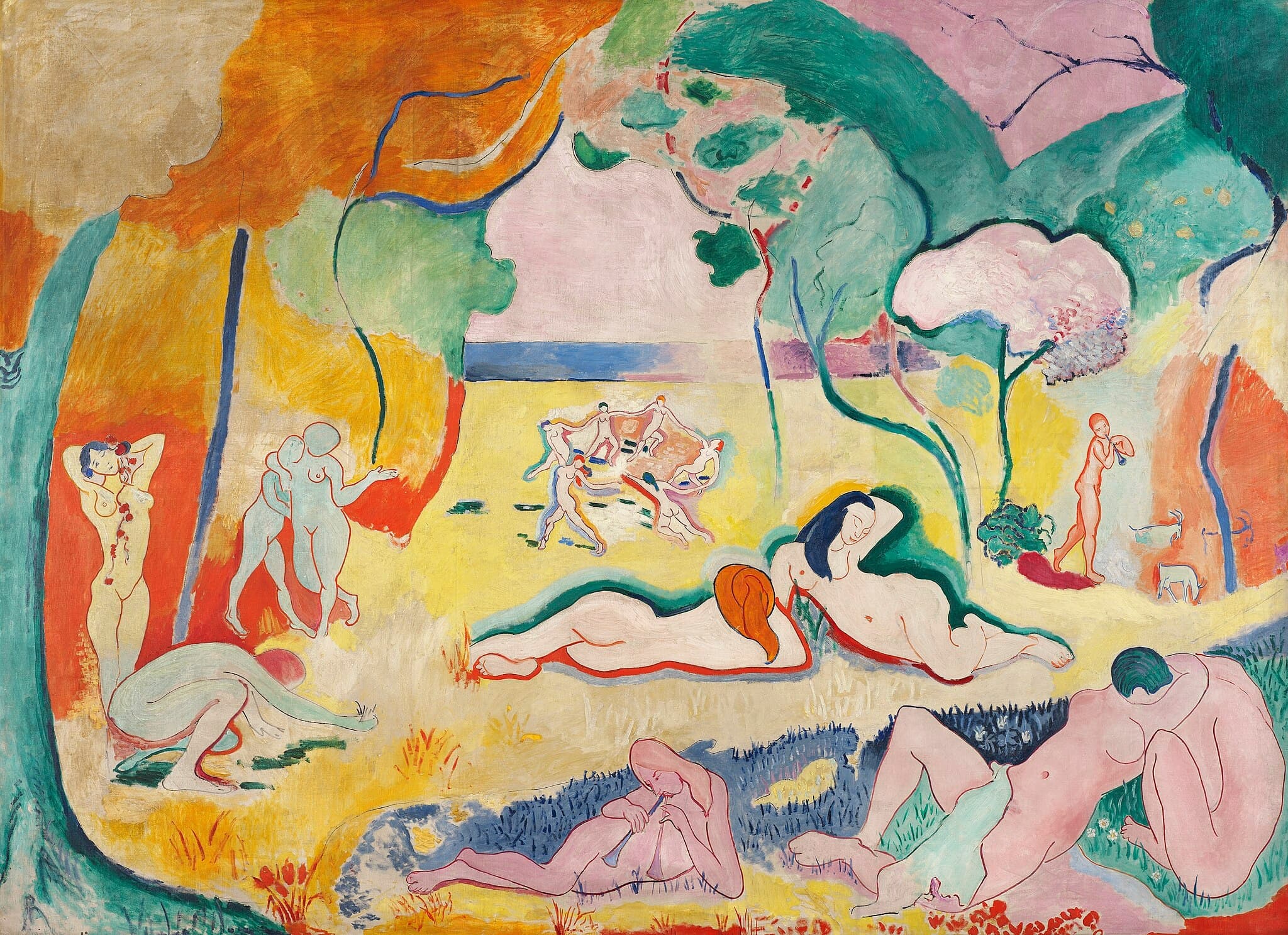
Le Bonheur de Vivre (1905–06) by Henri Matisse is a canonical Fauvist masterpiece and a museum‑held trophy work; if it were ever offered on the open market it would be a headline blue‑chip lot. Based on top public comparables, institutional ownership and extreme scarcity, a defensible market estimate at present is $100–150 million, subject to condition, legal/deaccession constraints and the level of competitive bidding.
Valuation Analysis
Valuation Basis and Overview: This valuation uses a comparable‑analysis approach focused on top public auction results for Henri Matisse and analogous early‑20th‑century masterpieces, adjusted for the exceptional historical importance and museum ownership of Le Bonheur de Vivre. The contemporary public auction ceiling for a major Matisse painting was set by the Rockefeller sale in 2018 (reported final price including premiums ≈ USD 80.8M), which I treat as a market anchor for the artist’s upper public‑sale band [2].
Provenance and Institutional Status: Le Bonheur de Vivre is a cornerstone of the Barnes Foundation collection and has an uninterrupted exhibition and scholarly history that enhances its value and desirability to museums and private collectors alike [1]. Museum ownership creates a pronounced scarcity premium: works of this caliber rarely appear for sale, and their appearance tends to trigger aggressive bidding from deep‑pocketed collectors and institutions.
How the $100–150M Range Was Derived: The lower bound (~$100M) reflects a premium above the artist’s public auction ceiling to account for the painting’s greater historical weight and exhibition pedigree compared with most works that have traded publicly. The upper bound (~$150M) is a conservative ceiling consistent with the way marquee modernist masterpieces have traded in private sales and high‑profile auctions when multiple institutional and private buyers compete — the upper end assumes optimal market conditions, a clean condition report and no legal/deaccession impediments.
Caveats and Value Drivers: Several factors could move this estimate materially. A formal, recent conservation report could either support the high estimate (if condition is excellent) or reduce it (if there are significant restorations or pigment instability). Donor covenants, deaccession restrictions, and legal encumbrances at the holding institution would likely prevent an open‑market sale and therefore make this valuation largely theoretical. Finally, buyer appetite and macroeconomic conditions at time of sale strongly influence final outcomes; private sales can exceed public records substantially where anonymity or strategic bidding exists.
Actionable Next Steps to Firm the Estimate: Obtain the Barnes Foundation accession/provenance paperwork, a current condition/conservation report, and confirmation of any donor or legal sale restrictions. Consult the private‑sales desks at major houses for confidential market interest—those desks often provide a realistic view of the ceiling for trophy modernist works. With those materials the range can be narrowed and a sale strategy (public auction vs. controlled private placement) can be recommended.
Conclusion: On a conservative, market‑facing basis and using public comparables as the anchor, Le Bonheur de Vivre would plausibly command between $100M and $150M if it ever reached the open market; however, that outcome is conditional on condition, legal ability to sell, and competitive buyer interest [1][2].
Key Valuation Factors
Art Historical Significance
High ImpactLe Bonheur de Vivre is one of Henri Matisse’s seminal Fauvist canvases and a defining early‑20th‑century modernist work. Its compositional audacity, chromatic innovation and early critical prominence make it a touchstone in scholarly literature and museum exhibitions. That stature elevates its market tier above the majority of the artist’s produced works: collectors and institutions prize canonical, epoch‑defining paintings because they confer curatorial and reputational value beyond aesthetics alone. The painting’s influence on subsequent artists and frequent reproduction in art‑historical texts further amplifies demand among institutions and leading private collectors, producing a clear premium in any hypothetical sale.
Provenance & Exhibition History
High ImpactThe painting’s provenance — early exhibition at Salon des Indépendants, association with prominent early collectors (the Steins), and long‑term stewardship by the Barnes Foundation — significantly strengthens market confidence. A continuous, well‑documented provenance reduces title risk and attracts institutional bidders; its exhibition history across major retrospectives enhances its scholarly cachet and buyer willingness to pay a premium. Conversely, any provenance gaps or unsettled restitution claims would materially depress value; however, current public records indicate a robust provenance that supports a top‑tier valuation.
Condition & Conservation
Medium ImpactTechnical and conservation matters are critical for a painting of this age and prominence. Published technical literature has noted pigment sensitivities in some Matisse works (for example, cadmium/yellow instability in early palettes), and any significant retouching or structural issues could reduce buyer confidence and price. A clean, recent condition report would be a prerequisite for a high estimate; conversely, documented instability, invasive restorations, or unresolved conservation issues could trigger meaningful discounts and limit institutional bidding.
Rarity & Market Availability
High ImpactBecause Le Bonheur de Vivre is museum‑held and has not circulated on the modern secondary market, its hypothetical availability would represent a once‑in‑a‑generation opportunity for collectors and institutions. Scarcity of museum‑quality, early Matisse masterpieces amplifies competition and tends to push prices above the artist’s typical auction results. The ‘trophy’ effect can produce outsized private sale outcomes when multiple motivated buyers compete; this scarcity premium is among the most important upward drivers of the estimate.
Comparables & Auction Records
High ImpactPublic auction records for Matisse provide the clearest market anchors: the highest public Matisse sale in recent years was the Rockefeller piece in 2018 (final price including premium ≈ USD 80.8M), and high‑profile estate and private sales have produced other landmark prices. These comparables establish a near‑term public market baseline; a painting of Le Bonheur de Vivre’s stature would be expected to clear those baselines, hence the $100M+ starting point. Cross‑artist sales of top modernist masterpieces demonstrate that truly iconic works can reach the low‑to‑mid hundreds of millions under competitive conditions.
Sale History
Le Bonheur de Vivre (The Joy of Life) has never been sold at public auction.
Henri Matisse's Market
Henri Matisse is an undisputed master of twentieth‑century art and a core blue‑chip artist in the modern/contemporary market. Demand for high‑quality, museum‑grade Matisse canvases remains strong among major institutions, family offices and ultra‑high‑net‑worth collectors. Public auction results show dispersion by period and subject—late cut‑outs and major portraits can sell for very different sums—but the market reliably rewards canonical, historically pivotal works. Because top Matisse paintings rarely come to market, realized prices often reflect scarcity and competition rather than a high‑frequency market trend.
Comparable Sales
Odalisque couchée aux magnolias
Henri Matisse
Highest public auction result for a Matisse painting; sets the contemporary auction ceiling for the artist and is a direct market benchmark for top‑tier Matisse canvases.
$80.8M
2018, Christie's, New York (The Collection of Peggy and David Rockefeller sale)
~$105.2M adjusted
Les coucous, tapis bleu et rose
Henri Matisse
Major early‑Matisse composition sold in a high‑profile sale; closer in date/style to Le Bonheur and useful for valuing early canonical Matisse works.
$46.4M
2009, Christie's, Grand Palais, Paris (Yves Saint Laurent / Pierre Bergé sale)
~$68.7M adjusted
Mademoiselle Matisse en manteau écossais
Henri Matisse
Recent auction of a 1918 Matisse portrait showing the dispersion of prices within the artist's market; useful as a lower‑end comparable illustrating variability by subject/quality.
$9.0M
2023, Christie's, New York
~$9.8M adjusted
Les Femmes d'Alger (Version 'O')
Pablo Picasso
Sale of a canonical Modernist masterpiece that reached the low‑to‑mid hundreds of millions; acts as a cross‑artist ceiling for exceptionally rare, museum‑quality early 20th‑century works.
$179.4M
2015, Christie's, New York (Contemporary Art Evening Sale)
~$242.3M adjusted
Current Market Trends
Demand for museum‑quality modernist masterpieces remains robust despite periodic macroeconomic volatility. Limited supply of canonical works and continued private‑sale activity among major dealers and auction houses keep price floors high; however, final outcomes depend on timing, buyer liquidity and geopolitical/financial conditions. For a trophy work like Le Bonheur de Vivre, the structural market dynamics favor a strong headline result if the work were legitimately available.