How Much Is Music Worth?
Last updated: March 30, 2026
Quick Facts
- Current Location
- The State Hermitage Museum
- Methodology
- extrapolation
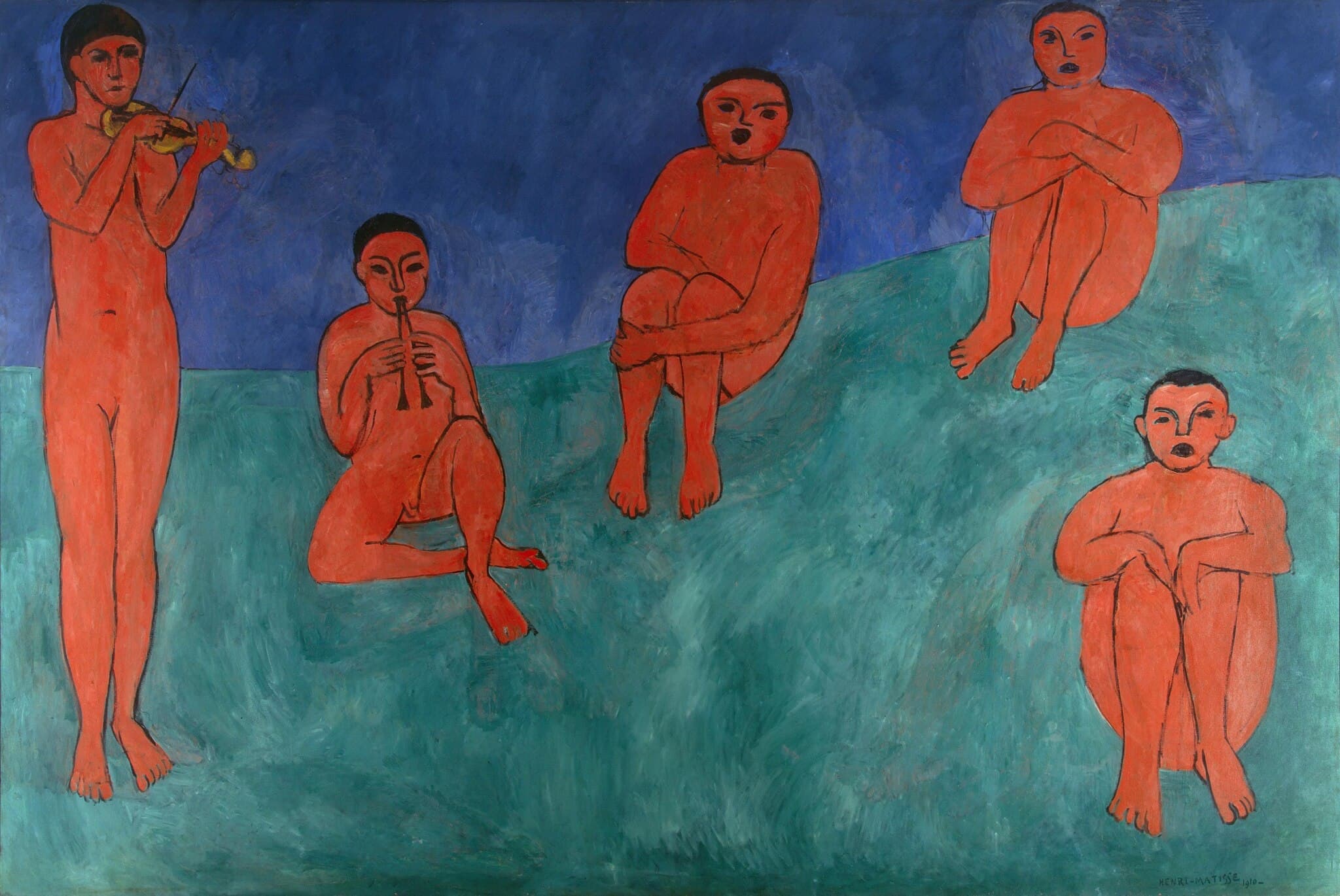
If this is the canonical, monumental 1910 La Musique (Hermitage, Shchukin commission) and is in museum‑quality condition with secure provenance, a reasonable public‑market extrapolation today is $100–150 million. This is an opinion based on Matisse auction ceilings, rarity premiums for Shchukin‑era masterpieces, and scale/provenance considerations.
Valuation Analysis
Overview: Henri Matisse’s La Musique (1910) is a monumental, museum‑quality canvas from the Shchukin commission now in the State Hermitage Museum (inventory ГЭ‑9674). As a decisive work from Matisse’s 1909–1910 period, it is historically central and extremely rare on the market — the picture is effectively not saleable in normal market conditions and therefore any price is an extrapolation based on comparables, rarity, and demand [1].
Why $100–150M: The public auction ceiling for Matisse is anchored by the 2018 Christie's Odalisque sale (US$80.75M nominal), which demonstrates institutional and private capacity to pay high tens of millions for top Matisse canvases [2]. A securely attributed, monumental 1910 La Musique would carry additional premiums for rarity, its role as part of the Shchukin decorative commissions, scale, and canonical status — all factors that push a fair public‑market estimate above the artist’s recorded hammer highs. The $100–150M band reflects an uplift from the public record to account for uniqueness, museum‑quality provenance and potential auction/private‑sale competition.
Upside and downside drivers: Upside above $150M is plausible if multiple highly motivated international bidders (major museums, ultra‑high‑net‑worth collectors) compete, if a high‑profile pre‑sale exhibition and catalogue raisonné affirmation are secured, or if sale mechanics include guarantees/third‑party underwriting. Downside from this band is driven by condition issues, doubts in attribution, missing provenance links, or legal restrictions (export/ownership limitations) which materially reduce marketability — in many of those cases the picture’s value would fall sharply.
Practical caveats: The Hermitage holding and likely national cultural‑property protections mean La Musique is unlikely to enter the open market; my figure is a hypothetical market valuation were it legally and practically saleable. For any specific object presented as “Music” (a photograph, study, studio repetition or later copy), an independent condition report, catalogue‑raisonné cross‑check and provenance audit are required to refine value — absence of those will push a market estimate far lower. If you want, I can proceed to vet photographs/provenance or compile a detailed comparables ledger to refine this range.
Key Valuation Factors
Art Historical Significance
High ImpactLa Musique (1910) is a cornerstone of Matisse’s breakthrough period and part of the Shchukin decorative programme that includes La Danse. Its significance in scholarship and museums is very high, making it a trophy asset. Collectors and institutions prize works that represent pivotal moments in an artist’s development; because there are so few of this scale and importance in private hands, the scarcity multiplier on market value is substantial. This historical centrality is therefore a primary upward driver of valuation, often outweighing stylistic or decade‑based comparables.
Provenance & Exhibition History
High ImpactDirect Shchukin provenance and long museum exhibition history (Hermitage/State Museum transfers) materially increase trust and value. Works with clean, documented provenance that have appeared in major exhibitions and catalogues command significant premiums at auction and in private sales because they reduce buyer risk and enhance institutional interest. Any gaps, contested ownership, or missing documentation would quickly reduce market appetite and price, so provenance clarity is a decisive factor here.
Market Comparables & Auction Ceiling
High ImpactThe artist’s public auction ceiling (notably the 2018 Odalisque sale) sets demonstrated buyer capacity. However, unique historical masterpieces often trade above an artist’s auction record when they become available because institutions and strategic private buyers compete strongly. Extrapolating from the auction record to a one‑off market offering produces the range provided; the comparables anchor marketplace expectations but must be adjusted for rarity, condition and legal saleability.
Condition & Conservation Risk
Medium ImpactLarge, century‑old canvases can have complex conservation histories (lining, relining, varnish, retouchings) that affect aesthetic presence and market price. Even with superb attribution and provenance, significant restoration needs or unstable condition will reduce buyer confidence and the final price. A current, detailed conservator’s report is necessary to quantify this risk and could move valuation materially within or below the band.
Legal/Marketability — Cultural Property & Export Controls
High ImpactWhen works originate from major public collections (and particularly from Russian imperial/early Soviet transfers), legal restrictions, export prohibitions, or restitution claims can prevent sale or severely limit the buyer pool. This factor is binary and powerful: a clean, transferable title supports the valuation band; legal encumbrances can make a work unsaleable or force steep discounts. The Hermitage context makes this a central consideration for any realistic market estimate.
Sale History
Music has never been sold at public auction. It has been held by The State Hermitage Museum.
Henri Matisse's Market
Henri Matisse is a blue‑chip modern master whose market is deep and institutionally anchored. High‑quality works by Matisse regularly achieve multi‑million prices at major houses, with the artist’s auction ceiling demonstrating strong buyer capacity. However, supply of canonical early masterpieces is extremely limited because many key works are museum‑held; availability of a museum‑quality, historically pivotal canvas would therefore trigger intense competition and upward price pressure. Provenance, subject, size and condition remain the primary determinants within the broader favorable market for Matisse.
Comparable Sales
Odalisque couchée aux magnolias
Henri Matisse
Artist's auction record and a prime odalisque from the 1920s — establishes the market ceiling for top-quality Matisse paintings.
$80.8M
2018, Christie's, New York
~$103.7M adjusted
Fleurs ou Fleurs devant un portrait
Henri Matisse
High-quality 1920s still-life/interior sold at major house in 2022 — shows the mid‑high market band for desirable (but not canonical) Matisse canvases.
$15.3M
2022, Sotheby's, New York
~$16.9M adjusted
Mademoiselle Matisse en manteau écossais
Henri Matisse
Post‑WWI portrait sold in 2023 — representative of single‑digit to low‑double‑digit million results for quality Matisse works that lack the museum‑level, Shchukin provenance.
$9.0M
2023, Christie's, New York
~$9.5M adjusted
Current Market Trends
The top end of the modern art market remains resilient: major museums, foundations and UHNW collectors continue to compete for museum‑quality works. Auction houses have shown appetite for trophy lots with strong provenance, and private sales/guarantees can push prices above public records. However, geopolitical, fiscal and regulatory factors (tax, export controls) can influence timing and ultimate realization. Short term, demand for canonical 20th‑century masterpieces stays robust, favoring works with unambiguous attribution and institutional histories.