How Much Is Odalisque couchée aux magnolias Worth?
Last updated: March 30, 2026
Quick Facts
- Last Sale
- $80.8M (2018, Christie's New York — The Collection of Peggy & David Rockefeller (Evening Sale))
- Methodology
- recent sale
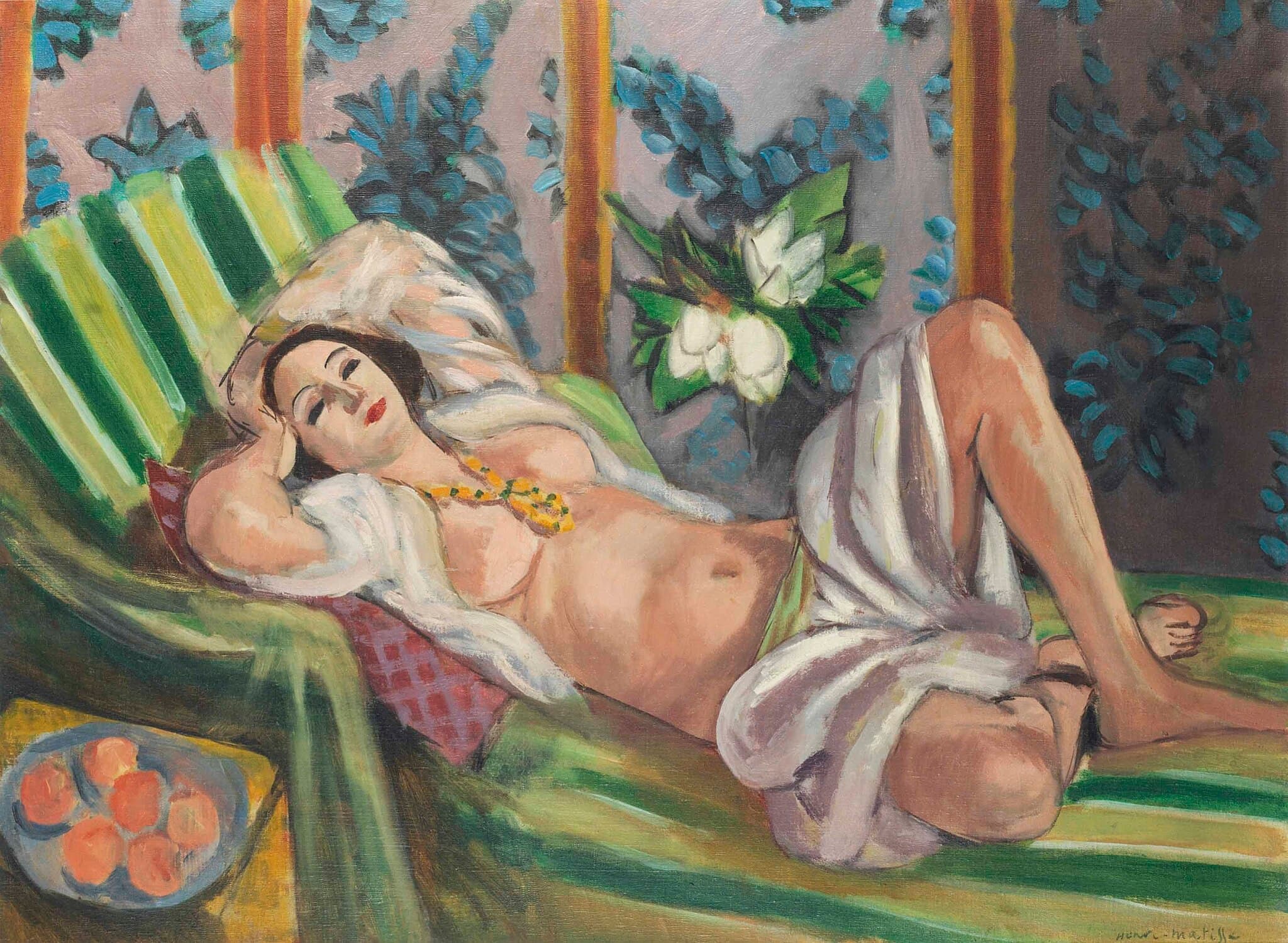
Anchored to the public auction of the identical composition (Christie’s New York, 8 May 2018; price realized $80,750,000), I place a conditional market valuation for Henri Matisse’s Odalisque couchée aux magnolias (1923) at $85–125 million. The range assumes authenticated attribution, good-to-excellent condition, and no title issues; provenance/exhibition can move the painting toward the top end.
Valuation Analysis
Anchor and headline conclusion: The principal market anchor is the identical composition sold at Christie’s New York on 8 May 2018 (price realized $80,750,000), which demonstrates the work’s proven high‑end demand and sets the upper-market benchmark for this canvas [1][2]. Accounting for carry‑forward inflation, sustained institutional interest in museum‑quality Matisse oils, and comparable evening‑sale outcomes, a reasoned conditional market valuation for this work today is approximately $85,000,000–$125,000,000, contingent on authentication, condition, provenance and sale venue.
Method and adjustments: This valuation is grounded in the recent public sale of the identical composition and informed by a comparable‑analysis of high‑quality Matisse oils sold in major‑house evening sales. The lower bound reflects a modest premium above the 2018 realized price to allow for conservatively adjusted market movement and the spectrum of buyer appetite; the upper bound reflects a trophy‑market outcome (major‑house evening sale, exemplary provenance, catalogue‑raisonné listing, important exhibition and publication history) that can produce material bidding competition and push results north of the 2018 price [1][2]. Where provenance, attribution or condition is weaker, expect meaningful downward adjustments toward the low‑case bands.
Key sensitivities: Authentication and catalogue‑raisonné confirmation are the single largest gatekeepers to value — a firm Schneider/Tout l’oeuvre peint entry and scholar sign‑off convert the painting from speculative to saleable at the high end. Provenance that traces to reputable early dealers and distinguished collections (Bernheim‑Jeune; major 20th‑century collectors) plus museum loans and major reproductions materially increase buyer confidence and price realized. Condition — original, stable paint surface and minimal historic overpainting — is essential to capture the top bracket. Sale venue also matters: evening sales at Christie’s or Sotheby’s with guarantees typically unlock the most buyer competition.
Risks and next steps: Title encumbrances, restitution claims, significant restorations, or an unresolved attribution will sharply reduce marketability and value. To tighten this range, obtain: high‑resolution images, a current condition/conservation report, technical imaging and pigment analysis, catalogue‑raisonné citation(s), and at least one written opinion from a recognized Matisse scholar. With those items the painting can be tested confidentially with major houses for pre‑sale estimates and potential guarantees or private‑sale alternatives.
In short: the 2018 Rockefeller sale is the direct market anchor; the $85–125M band reflects the painting’s demonstrated trophy potential offset by practical market and condition contingencies. If you supply images and provenance documents I will produce a narrowed, evidence‑based appraisal suitable for insurance or consignment discussions.
Key Valuation Factors
Art Historical Significance
High ImpactHenri Matisse’s odalisques are among the artist’s most iconic and marketable subjects. A 1923 odalisque sits in Matisse’s mature, interwar period when his handling of color, pattern and figure was highly developed; works from this era are widely reproduced and cited in monographs and exhibition histories. If the painting is a primary, unique composition (not a studio variant or study) and of substantial size, it ranks as a high‑tier object within the market for Matisse, attracting both institutional and high‑net‑worth collectors. Iconography and visibility in scholarship amplify demand and ceiling price.
Provenance & Exhibition History
High ImpactProvenance is a decisive price driver. A clear chain tracing to reputable dealers (e.g., Bernheim‑Jeune), prominent collectors, or major museum loans confers certainty and often a multimillion‑dollar premium. The 2018 Rockefeller provenance exemplifies this premium: notable private‑collection lineage plus documented exhibition/publication histories create bidder confidence and competitive tension at auction. Conversely, gaps in provenance, private ownership without exhibition history, or disputed title materially depress marketability and realized value.
Authentication & Catalogue Raisonné
High ImpactIn Matisse’s market, catalogue‑raisonné entry and written confirmation by recognized scholars or committees move a work from speculative to saleable at high levels. Technical analysis (infrared reflectography, X‑ray, pigment testing) and scholar sign‑off reduce attribution risk. Absence of a catalogue entry, unresolved attribution disputes, or circulating doubts about authorship will significantly reduce buyer confidence and therefore realized price; conversely, formal authentication is often the single largest uplift to value.
Condition & Conservation
Medium ImpactCondition affects both aesthetic impact and insurability. A stable original surface, minimal inpainting and sympathetic conservation history preserve value; extensive restoration, relining, or unstable paint layers require discounts. Condition reports and conservation histories are prerequisites for major‑house listings and institutional loans; unacceptable condition can deter major bidders and lower the final result by a substantial percentage, particularly for large, museum‑scale canvases where surface integrity contributes to visual authority.
Market Liquidity & Sale Venue
High ImpactThe venue and method of sale materially influence price. Evening sales at Christie’s and Sotheby’s, with robust marketing and possible guarantees, routinely produce the highest results for works of this caliber. Private sales can be faster but often yield lower public prices unless coupled with a guarantee or competitive bidding environment. Timing (season), marketing, and whether the lot is offered with a reserve or underwritten guarantee all determine the amount of bidding competition and the likely final outcome.
Sale History
Christie's New York — The Collection of Peggy & David Rockefeller: 19th & 20th Century Art (Evening Sale)
Henri Matisse's Market
Henri Matisse is a cornerstone of the 20th‑century market. His major oils and landmark works consistently perform strongly at auction and in the private market; top examples have realized tens of millions to over one hundred million dollars. Demand is anchored by institutional collecting and a deep global base of private collectors. Price dispersion is wide—ranging from low millions for works on paper to the very highest prices for iconic museum‑quality paintings—so attribution, condition and provenance disproportionately affect where any given Matisse will sit within that spectrum.
Comparable Sales
Odalisque couchée aux magnolias
Henri Matisse
Identical composition and same 1923 canvas; sold from the Peggy & David Rockefeller collection in a major-house evening sale — directly anchors the high end for this exact work.
$80.8M
2018, Christie's New York
~$103.2M adjusted
Figure et bouquet (Tête ocre)
Henri Matisse
High-quality Matisse oil sold in a major-house New York evening sale (2025) — shows continued strong demand for museum-quality Matisse canvases in the multi‑tens of millions, though less iconic/significant than the Rockefeller Odalisque.
$32.3M
2025, Christie's New York
Nymphe et faune rouge
Henri Matisse
Matisse oil sold in a Paris sale (Collection Jacqueline Matisse Monnier) at mid-single‑digit millions — illustrates pricing for less-iconic/comparatively lower‑impact works and the wide dispersion in Matisse auction values.
$5.6M
2022, Christie's Paris
~$6.1M adjusted
Current Market Trends
High‑end blue‑chip works by canonical modern masters remain relatively resilient: top examples attract institutional and private buyers even through macroeconomic uncertainty. Since 2018 there has been sustained appetite for museum‑quality Matisse oils, though market sensitivity to provenance, condition and sale venue has increased. Sellers should target major‑house evening sales or well‑capitalized private placements to realize maximum value.