How Much Is The Dessert: Harmony in Red (The Red Room) Worth?
Last updated: March 30, 2026
Quick Facts
- Methodology
- comparable analysis
La Desserte rouge (The Red Room), 1908, is a canonical, museum-held Matisse (State Hermitage) and effectively off‑market. Were it ever offered, it would be a blue‑chip trophy likely to realize between $50,000,000 and $150,000,000 depending on condition, provenance, and legal/export constraints.
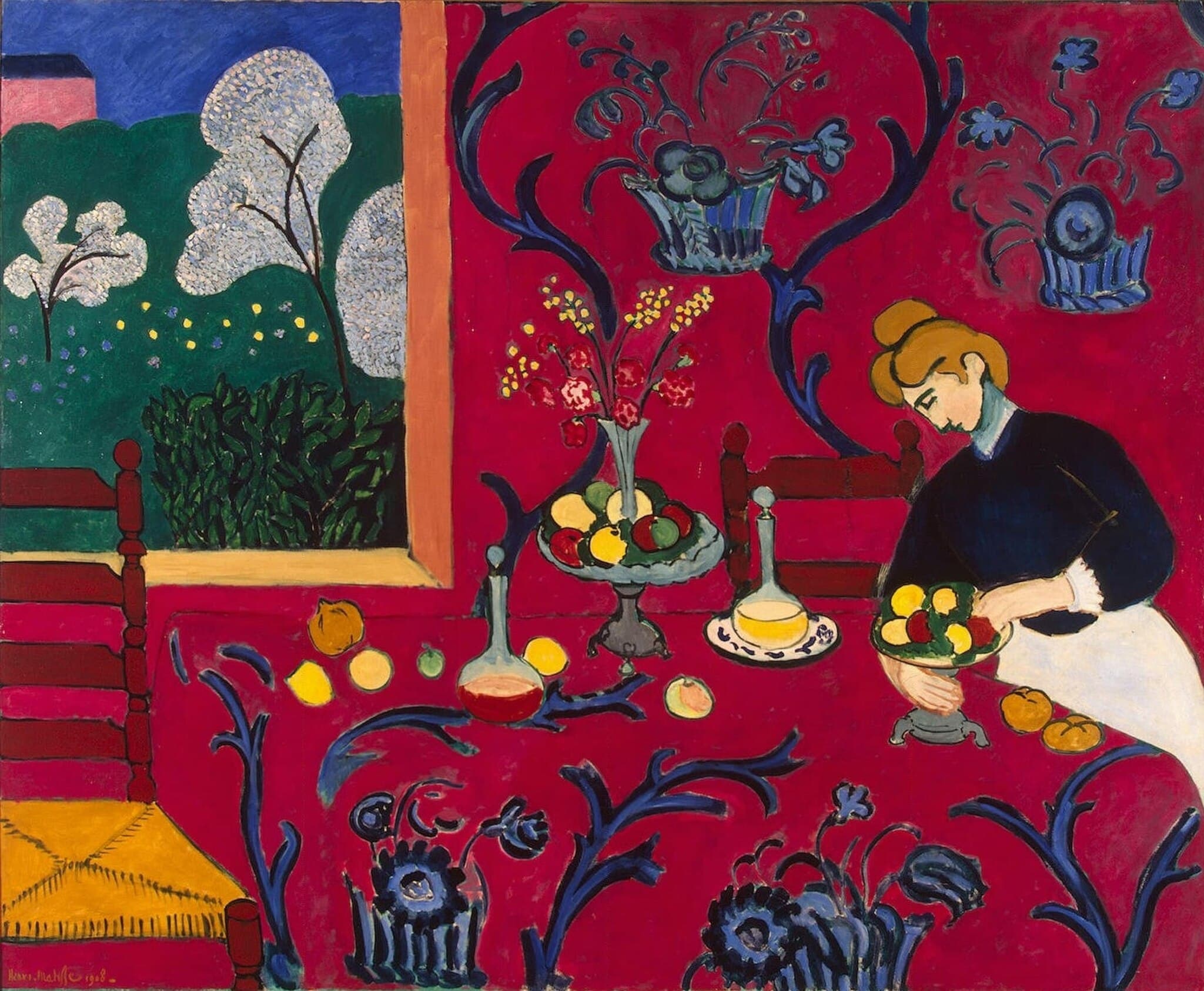
The Dessert: Harmony in Red (The Red Room)
Henri Matisse, 1908 • Oil on canvas
View more by Henri Matisse →Valuation Analysis
Valuation conclusion: Based on auction comparables, the painting's canonical status, and its museum holding, a defensible market window for Henri Matisse’s The Dessert: Harmony in Red (La Desserte rouge), 1908, is approximately $50 million to $150 million. That band recognizes both the clear trophy potential of a museum‑quality Matisse and the material uncertainties that would apply to any hypothetical sale.
The work is in the collection of the State Hermitage Museum, St. Petersburg (inventory ГЭ‑9660), and there is no record of this specific painting appearing at public auction in the modern market; it is therefore effectively off‑market [1]. Museum ownership both confirms the work’s institutional importance and explains the absence of sale comparables specific to this canvas.
Primary market anchors come from public auction results for comparable, museum‑quality Matisse canvases. The artist’s public painting record—Odalisque couchée aux magnolias (1923)—realized US$80.75 million at Christie’s New York in May 2018, demonstrating the market’s capacity to pay into the high‑eight‑figure range for canonical Matisse works [2]. Earlier high points (for example, major Matisse works that have realized tens of millions) and a spread of lower‑tier results show a two‑tier market: a small set of trophies and a much broader group of works that trade at substantially lower levels.
The lower bound of $50M reflects realistic scenarios in which legal, export, or condition constraints materially reduce the competitive bidder pool (for example, restrictions associated with Russian state ownership or unclear title). The upper bound of $150M reflects trophy upside: in an optimal commercial environment—clear provenance, excellent condition, unencumbered exportability and strong institutional/private competition—a canonical, large Matisse of this stature could challenge or exceed prior public records when sold into a concentrated, trophy‑seeking buyer base. Private sale premiums, guarantees and cross‑border demand can materially push outcomes above public records.
Key caveats that could compress or erase value include disputed provenance, restitution claims, conservation issues, and any legal or geopolitical impediments to transfer (all of which are plausible considerations for a Hermitage holding). To tighten this estimate, the next critical steps are to obtain the Hermitage accession/provenance documentation, secure a current condition/conservation report, and solicit a confidential market check with senior specialists at a major auction house. With those inputs a formal, narrower estimate can be produced. In short: La Desserte rouge is an institutional masterpiece that, if marketable, would attract high‑eight‑figure attention but its practical realizable price is heavily conditional on legal, conservation and provenance clearances.
Key Valuation Factors
Art Historical Significance
High ImpactLa Desserte rouge (The Red Room) is one of Matisse’s most recognizable and frequently reproduced canvases, emblematic of his Fauvist period and his radical rethinking of interior space and color. Its date (1908), scale, and compositional clarity place it at the heart of Matisse scholarship and exhibition programming; museums and high‑end private collectors prize such canonical works because they can anchor narratives and lending relationships. Iconic status translates to tangible market premium: canonical, museum‑quality works by top modernists typically attract a far larger and deeper bidder pool than comparable non‑canonical works, and that structural demand is the single strongest uplift factor for the painting’s value.
Museum Ownership and Supply Rarity
High ImpactLong‑term museum ownership makes the work effectively off‑market, which has two opposing effects on value. Rarity and institutional provenance typically elevate a work’s desirability and potential trophy premium if offered, because such pieces are scarce and carry exhibition pedigree. Conversely, deaccession of landmark holdings is rare and often politically sensitive; the improbability of sale can limit realistic marketability. If a museum like the Hermitage were to sell, competitive bidding would likely be intense, but the procedural, curatorial and legal hurdles associated with deaccession reduce the practical chance of a clean open-market realization.
Comparable Auction Evidence
High ImpactPublic auction outcomes for top‑tier Matisse works provide the principal empirical anchors. The May 2018 Christie’s painting record (Odalisque couchée aux magnolias, US$80.75M) demonstrates the market ceiling for a canonical Matisse canvas under optimal conditions; prior high results (e.g., major Matisse works realizing in the tens of millions) and a spread of mid/low results for less significant works illustrate a bifurcated market. Because direct like‑for‑like comparables are scarce, valuers rely on the highest‑quality anchors and then adjust for condition, provenance, and transferability to derive a defensible window.
Legal / Export / Provenance & Geopolitical Risk
High ImpactThe Hermitage is a Russian state museum; works in state collections can be subject to export controls, national cultural property protections, and geopolitical complications that impede saleability or reduce the eligible buyer pool. Since 2014 and again after 2022 there have been increased legal and political sensitivities around Russian cultural assets in certain jurisdictions; those sensitivities can make title insurance difficult and deter institutions and major private buyers. Any suggestion of disputed title or restitution claims would drastically reduce market value and could preclude sale entirely, making this one of the most important negative value drivers.
Condition and Conservation
Medium ImpactCondition is a fundamental value determinant for any canonical painting. Structural issues (canvas tension, lining, punctures), historic restorations, inpainting, varnish discoloration or unstable paint layers can all depress price materially. Even when a work is unquestionably important, poor or uncertain condition increases buyer risk and reduces competitive bidding. Conversely, a pristine conservation report supports upper‑band pricing. For an off‑market Hermitage painting, obtaining a full conservation history and an up‑to‑date condition report is essential for converting theoretical market interest into a realizable high‑end price.
Sale History
The Dessert: Harmony in Red (The Red Room) has never been sold at public auction.
Henri Matisse's Market
Henri Matisse is one of the highest‑tier names in 20th‑century modern art; his market is deep at the top and wide at the middle. A small number of canonical canvases produce trophy outcomes (the public painting record sits in the high‑eight‑figures), while a larger volume of works (studies, works on paper, later/fewer significant canvases) trade in the low‑ to mid‑millions. Institutional demand, white‑glove private collectors and legacy estates sustain strong pricing for museum‑quality examples. Because the market concentrates around a limited supply of masterpieces, any genuinely comparable Matisse canvas can draw exceptional bidding and private sale premiums.
Comparable Sales
Odalisque couchée aux magnolias
Henri Matisse
Artist auction record for a canonical, museum-quality large Matisse painting — indicates the market ceiling for top Matisse canvases.
$80.8M
2018, Christie's New York
~$102.8M adjusted
Nu de dos, 4e état (Back IV)
Henri Matisse
Major prior high for the artist (sculpture) — shows collector willingness to pay tens of millions for canonical Matisse works and marks a historic pricing anchor.
$48.8M
2010, Christie's New York
~$71.0M adjusted
Danseuse dans un intérieur, carrelage vert et noir
Henri Matisse
Mid-market example of a large painting by Matisse (sold from a major private collection) — demonstrates range and that not all large Matisse canvases fetch trophy prices.
$8.6M
2020, Sotheby's London (Rembrandt to Richter sale)
~$10.5M adjusted
Matisse landscape (Christie's reported top lot)
Henri Matisse
Illustrative small/works-on-paper result from recent seasons — underscores the two-tiered structure of the Matisse market (few trophies; many works trade in low millions).
$2.2M
2022, Christie's
~$2.6M adjusted
Current Market Trends
The high‑end fine art market has shown resilience for canonical works, with concentrated demand among ultra‑high‑net‑worth collectors and major institutions. Trophy paintings continue to outperform in a bifurcated market where middle‑market liquidity can lag. Macro uncertainty and geopolitical events create episodic headwinds, and cross‑border legal or sanctions issues can materially affect realizable prices. In this environment, clear title, pristine condition and aggressive auction representation are key to achieving top outcomes.
Sources
- Wikidata / State Hermitage Museum entry for La Desserte rouge
- Christie's press release — Matisse painting (Odalisque couchée aux magnolias) result, May 8, 2018
- Christie's press materials — Impressionist & Modern high‑value sale examples (2010)
- Sotheby's lot page — example of a mid‑market Matisse sale (2020)