How Much Is The Pink Studio (The Artist’s Studio) Worth?
Last updated: March 30, 2026
Quick Facts
- Methodology
- comparable analysis
Based on comparable analysis anchored to top public sales and the painting’s institutional Shchukin → Pushkin provenance, an autograph The Pink Studio (1911) by Henri Matisse would—if hypothetically offered—be valued at approximately $30–100 million. Final placement within that band depends critically on condition, documented exhibition/publication history, and the legal/marketability constraints of a state‑held work.
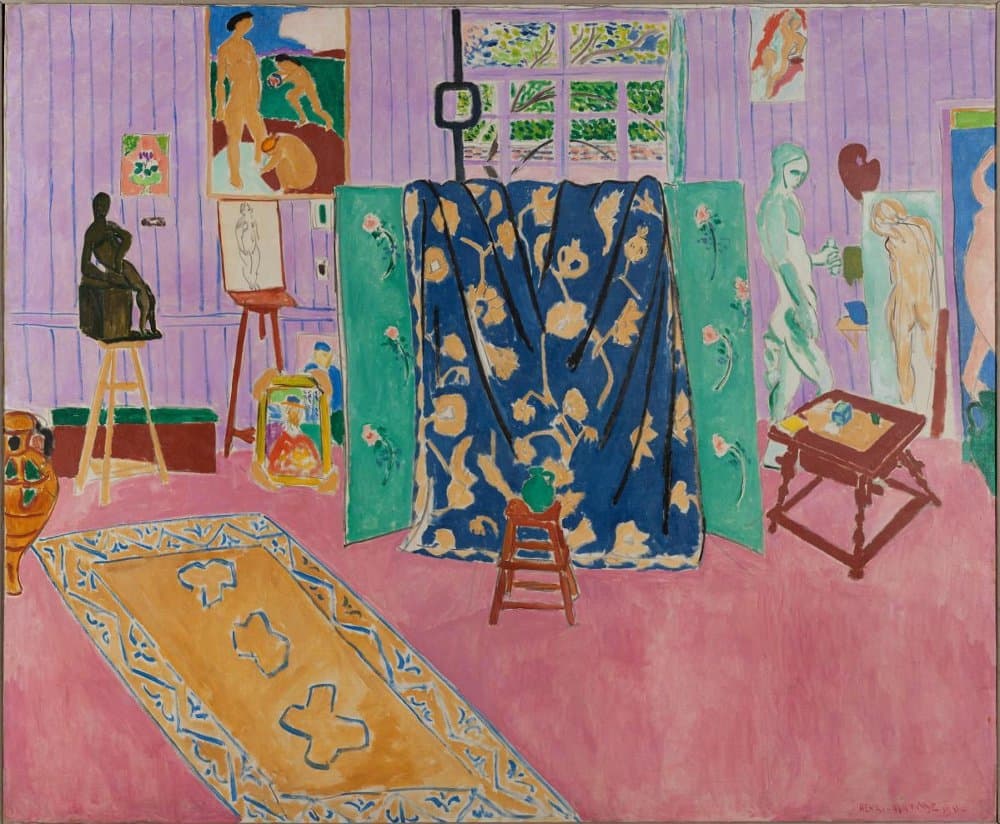
The Pink Studio (The Artist’s Studio)
Henri Matisse, 1911 • Oil on canvas
View more by Henri Matisse →Valuation Analysis
Overview: Henri Matisse’s The Pink Studio (The Artist’s Studio), 1911, oil on canvas (ca. 182 × 222 cm), is catalogued in the Pushkin State Museum of Fine Arts and originates from Sergei Shchukin’s celebrated collection [1]. As an autograph, large‑scale studio interior produced in the pivotal year 1911, it belongs to the same 'symphonic interiors' group that anchors Matisse scholarship and commands exceptional institutional interest. Because the work is museum‑held and has not been offered publicly, any monetary estimate is hypothetical and must be derived from comparables and adjustments for provenance, scale and condition.
Method and comparables: This valuation uses a comparable‑analysis approach anchored to the best available public sale benchmarks for Matisse canvases and adjusted for the painting’s provenance and presumed quality. The Christie's 2018 sale of Odalisque couchée aux magnolias (final price $80.75M) provides a contemporary ceiling for fully authenticated, museum‑quality Matisse oils and demonstrates the market ceiling for blue‑chip canvases [2]. Other high‑end and mid‑tier Matisse sales (major Sotheby’s/Sotheby’s/Christie’s lots in the 20–40M range) inform the lower/mid portion of the band; together these comparables support a realistic market window of roughly $30–100M depending on condition and documentation.
Key adjustments and sensitivities: Principal variables shaping a final hammer price are (1) technical condition and conservation history (lining, overpaint, structural repairs), (2) exhibition and publication record (catalogue‑raisiné entry, major retrospective loans), (3) legal/marketability constraints deriving from state ownership and provenance, and (4) current market appetite for top‑tier Modern masters. A well‑conserved, extensively published Pink Studio with incontrovertible Shchukin → Pushkin provenance would command strong institutional and private collector interest and likely sit toward the upper part of the range. Conversely, significant conservation needs, gaps in documentation, or restricted marketability would push a realized price toward the lower bound.
Conclusion and recommended next steps: Practically, the Pushkin stewardship means this valuation is hypothetical: deaccessioning state museum holdings is rare and procedurally complex, and market access would be constrained. To refine this estimate into a formal pre‑sale or insurance figure, obtain high‑resolution photography (recto/verso), a current condition and conservation report, technical imaging (X‑ray/IRR/pigment analysis), and catalogue‑raisonné confirmation; then request a pre‑sale market check from a major auction house. These steps will permit a confident placement within the $30–100M band and enable a formal estimate appropriate for sale planning or insurance purposes.[1][2]
Key Valuation Factors
Art Historical Significance
High ImpactMatisse’s 1911 studio interiors mark a decisive moment in his development of spatial compression, colour orchestration and compositional synthesis; works from this year are central to narratives about his mature style. The Pink Studio, as an autograph canvas from that cycle, carries substantial scholarly weight: it elucidates Matisse’s approach to object placement, flattening of space and chromatic relationships. Art‑historical significance directly translates to market desirability because canonical works inform museum displays, monographs and retrospectives. Collectors and institutions pay a premium for works that materially advance understanding of an artist’s pivotal period, so this factor strongly elevates the painting’s prospective market value.
Provenance (Shchukin → Pushkin)
High ImpactClear ownership history from Sergei Shchukin’s distinguished collection into state stewardship and the Pushkin Museum is a major positive. Shchukin provenance carries academic authority and market cachet—works from his group are intensively studied and highly sought. Institutional provenance also reduces attribution risk and generally supports higher pre‑sale estimates. However, museum ownership simultaneously reduces the likelihood of market appearance and introduces deaccession/legal constraints: while provenance increases theoretical value, it may complicate practical saleability if the work is legally or politically vested in a state collection.
Condition & Technical State
High ImpactCondition is a principal determinant of price for any historic oil; the presence of stable paint film, minimal intrusive restorations, and original ground/edges preserves value. Conversely, extensive relining, heavy overpaint, structural compromise or paint loss can materially reduce bids and deter institutional buyers. Technical analysis (X‑ray/IRR/pigment testing) and a current conservation report are essential: they establish both authenticity markers and the scale of conservation required. Price sensitivity to condition is acute at the top of the market—even canonical works can be penalized for significant conservation liabilities.
Rarity & Market Supply
High ImpactLarge, autograph 1911 Matisse studio interiors in private hands are extremely scarce; most canonical examples reside in museums. Scarcity tightens competition among eligible buyers (major museums and deep‑pocketed private collectors) when such a work becomes available, supporting higher prices. The relative absence of comparable lots increases the influence of single‑lot comparables (record sales) on value formation. Low supply coupled with strong demand for canonical Matisse canvases is a structural upward pressure on price and supports the upper segment of the valuation band.
Exhibition & Publication History
Medium ImpactInclusion in key exhibitions, major retrospectives and authoritative monographs (catalogue‑raisonné entries and plate illustrations) materially increases a work’s market value by signaling scholarly acceptance and visibility. A documented exhibition history and frequent reproduction in literature reduce buyer risk and expand prospective institutional buyers aware of the work. Conversely, a lack of published citations or exhibition loans can depress perceived importance and buyer confidence. For The Pink Studio, an established publication and loan record would support a premium within the stated range.
Sale History
The Pink Studio (The Artist’s Studio) has never been sold at public auction.
Henri Matisse's Market
Henri Matisse is a blue‑chip Modern master whose museum‑quality oils command consistent demand among institutions and high‑net‑worth collectors. Public auction records and private sales demonstrate strong ceilings—Christie’s 2018 $80.75M sale of a major Matisse oil is the contemporary benchmark—while a larger set of high‑quality works trade in the multi‑millions. Supply of canonical, large‑scale Matisse canvases is limited, which concentrates buyer competition and preserves price resilience. The market rewards clear attribution, seminal subject matter and robust provenance.
Comparable Sales
Odalisque couchée aux magnolias
Henri Matisse
Record public‑market benchmark for a museum‑quality, large Matisse oil — shows the ceiling for top‑tier Matisse canvases.
$80.8M
2018, Christie's New York
~$103.0M adjusted
Bouquet pour le quatorze juillet
Henri Matisse
Example of a high‑quality Matisse canvas achieving a strong mid‑tier price at major auction — useful for the lower/mid end of the range for large museum‑quality works.
$28.6M
2010, Sotheby's (May 2010)
~$41.3M adjusted
The Red Studio (L'Atelier Rouge)
Henri Matisse
Direct stylistic/chronological peer (1911 studio interior). Although not a sale, it demonstrates the historical and scholarly importance of Matisse's 1911 studio interiors — a strong reason Pink Studio would sit at the top end of the market if offered.
Price unknown
1970, Museum collection (not a market lot)
Current Market Trends
Top‑tier Modern works remain in demand, though realized prices are sensitive to macroeconomic conditions and liquidity among high‑net‑worth collectors. Auction houses continue to facilitate record results for blue‑chip artists, but sales outcomes can vary by season and buyer appetite. For museum‑quality Matisse canvases, scarcity and institutional interest keep the market resilient; however, legal, geographic or political constraints tied to provenance and ownership can materially affect marketability and timing of any sale.