How Much Is Belisarius Begging for Alms (Bélisaire) Worth?
Last updated: March 18, 2026
Quick Facts
- Methodology
- comparable analysis
Hypothetical market value for Jacques‑Louis David's Belisarius Begging for Alms (1781) is estimated at US$2,000,000–US$12,000,000. This range reflects the work's high art‑historical importance, the artist's demonstrated auction ceiling, and the fact that the prime canvas is museum‑held (Palais des Beaux‑Arts, Lille), making an actual market transaction unlikely without a rare deaccession.
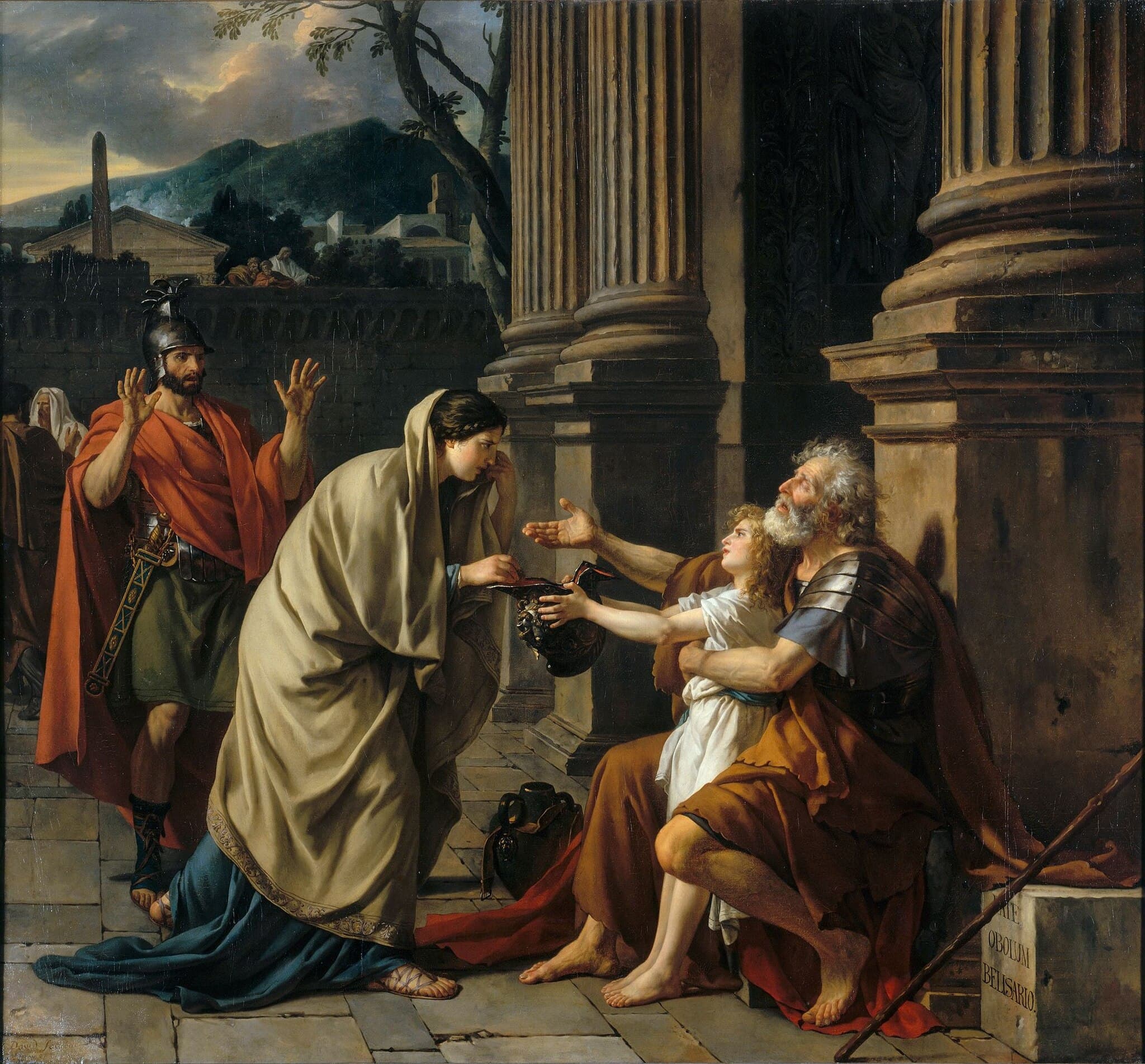
Belisarius Begging for Alms (Bélisaire)
Jacques-Louis David, 1781 • Oil on canvas
View more by Jacques-Louis David →Valuation Analysis
Valuation overview: The full‑scale Belisarius (1781), currently recorded in the Palais des Beaux‑Arts, Lille (inventory P 436), is a major early history work by Jacques‑Louis David and therefore of high art‑historical importance but effectively off‑market while institutional ownership persists [1]. Because the Lille canvas has no modern public‑auction sale history, the valuation below is a hypothetical market price if an authenticated, saleable example were to reach the international market.
Method and anchors: I used a comparable‑analysis methodology anchored to documented public outcomes for autograph David oils and observable pricing for studio/workshop material. The artist's commonly cited auction record is Christie's Portrait of Ramel de Nogaret (NY, 15 Apr 2008), realized at US$7.209M; that sale functions as a demonstrated ceiling for high‑quality David oils in private hands [2]. More recent trade tone is illustrated by major‑house estimates for autograph portraits in the US$3–4M range and studio/workshop sales in the low five‑figure band, which help define the mid‑ and lower parts of the range [3][4].
Range rationale: Top‑end scenario (approx. US$6–12M): an authenticated, unrestored, museum‑quality Belisarius with exemplary provenance, major exhibition history and institutional buyer interest could approach or modestly exceed earlier high marks in an exceptional competitive sale. Mid scenario (approx. US$3–6M): a securely attributed autograph canvas in good condition but with less stellar provenance or without a dramatic institutional bidding environment. Low scenario (US$100k–US$1.5M): workshop, studio replica, small reduction or a work with major condition/attribution/legal problems.
Caveats and next steps: The painting is recorded in a public French collection and was acquired by Lille in 1863; French inalienability and export controls make an actual market sale unlikely absent formal deaccession and state approval [1]. A transaction‑grade valuation would require confirmed attribution (catalogue raisonné / technical analysis), exact dimensions and condition report, full provenance, and an auction‑house market opinion. Given these constraints, I present US$2,000,000–US$12,000,000 as a defensible hypothetical market band for an autograph, saleable Belisarius, with a central working expectation in the US$3–8M bracket under normal competitive market conditions.
Key Valuation Factors
Art Historical Significance
High ImpactBelisarius Begging for Alms (1781) belongs to David's important pre‑Revolutionary phase and is a rare, large‑scale history painting from his early career. While not as immediately famous as The Oath of the Horatii or The Death of Marat, the composition and subject place it squarely within David's development as a canonical history painter. The work's academic importance elevates institutional interest and scholarly demand, which tends to support higher valuations when such works come onto the market. Because major examples are concentrated in public collections, scarcity amplifies the premium for any genuinely saleable, museum‑quality canvas.
Attribution & Authenticity
High ImpactPrice sensitivity to autograph status is acute: an uncontested David autograph commands multi‑million prices, whereas studio copies, later replicas or workshop reductions are priced orders of magnitude lower. Definitive attribution requires catalogue‑raisonné confirmation, provenance documentation, and technical testing (infra‑red reflectography, X‑ray, pigment analysis). A confirmed autograph with exhibition history and scholarly citations materially increases the value; any residual attribution doubt or attribution to the studio will depress the estimate dramatically. There are known reductions and workshop versions of David compositions, so clarity here is essential.
Condition & Conservation
Medium ImpactCondition of a large late‑18th‑century canvas affects marketability and price. Issues such as severe craquelure, relining, overpaint, or historic restorations reduce value and deter top bidders; conversely, sound structural condition and well‑documented, conservative conservation support the higher bands of the estimate. Given the scale (c. 288 x 312 cm for the Lille canvas), transportation and conservation costs are non‑trivial and factor into buyer bids. A full conservation report is required to refine the valuation for sale planning.
Provenance & Legal Status
High ImpactThe known provenance shows the prime canvas was acquired by Palais des Beaux‑Arts, Lille in 1863 and remains in institutional ownership [1]. Works in French public collections are subject to strict inalienability and export restrictions; a sale would require a rare formal deaccession and state oversight. Clear, continuous provenance to an important public or private collection supports institutional buyer confidence and price; conversely, gaps, contested title or public ownership/legal encumbrances can preclude marketability or force steep discounts.
Market Liquidity & Comparable Sales
High ImpactThe modern market for David oils is low volume and episodic: autograph canvases rarely appear, and when they do they attract institutional and specialist collectors. The artist's modern auction record (Christie's 2008, Ramel de Nogaret, US$7.209M) provides a real‑world ceiling anchor [2]. Recent major‑house activity suggests current seller expectations in the mid‑millions for high‑quality portraits and low five‑figures for workshop pieces [3][4]. Low liquidity means valuations are heavily event‑driven: a single high‑profile sale can push realized prices upward, while long absences from the market limit comparables.
Sale History
Belisarius Begging for Alms (Bélisaire) has never been sold at public auction.
Jacques-Louis David's Market
Jacques‑Louis David is a blue‑chip, canonical figure in Neoclassical painting; his name carries strong institutional interest but comparatively thin secondary‑market liquidity because many of his most important works are held in major museums. Auction activity is infrequent for major oils; the best public sale anchor is Christie's 2008 Ramel de Nogaret at US$7.209M. Drawings and studies circulate more often at lower price points. Overall, the market rewards securely attributed, well‑provenanced canvases with institution‑level quality, and otherwise places studio/workshop material in a much lower price tier.
Comparable Sales
Portrait of Ramel de Nogaret
Jacques‑Louis David
Autograph oil by David and the commonly cited modern auction high for the artist (Christie's NY, 15 Apr 2008). Good anchor for top‑end market value for an autograph David oil. Portrait (narrower historical significance and smaller scale than Belisarius), so useful for pricing artist-level demand but probably LESS significant than the large 1781 Belisarius history painting.
$7.2M
2008, Christie's, New York
~$10.8M adjusted
Portrait of General Baron Claude‑Marie Meunier (pre‑sale)
Jacques‑Louis David
Recent high‑quality David oil offered at a major house (Sotheby's London, 5 July 2023). The public lot page shows a GBP estimate of £2.5–3.5M (midpoint ≈ £3.0M → ~US$3.75M used here). Realized/hammer price not publicly available on the lot page; the figure above is an indicative pre‑sale estimate converted to USD and inflation‑adjusted to 2025. Portrait (rather than a large history canvas), so likely LESS significant than Belisarius but useful for current market tone for autograph oils.
$3.8M
2023, Sotheby's, London (Old Master & 19th Century Evening Sale) — pre‑sale estimate
~$4.0M adjusted
Bonaparte Crossing the Alps (workshop/after David)
Workshop after Jacques‑Louis David
Workshop/studio version of David's Napoleon subject sold at Millon (23 Nov 2023) for €91,000 (≈ US$106,470). Shows market levels for studio/copy material of David's large compositions — typically orders of magnitude below autograph oils. Useful lower‑end comparable to distinguish autograph-pricing vs workshop/copy pricing; clearly LESS significant than the autograph Belisarius.
$106K
2023, Millon (Drouot), Paris
~$112K adjusted
Workshop/Studio version after Jacques‑Louis David
Workshop after Jacques‑Louis David
Another recent Millon sale (Nov 2022) of a studio/workshop version (reported €52,000 → ≈ US$60,840). Reinforces the price band for non‑autograph workshop works after David. Not comparable in attribution, quality or significance to the autograph Belisarius (LESS significant).
$61K
2022, Millon (Drouot), Paris
~$67K adjusted
Current Market Trends
Current market conditions are selective and low volume for David and late‑18th‑century French Neoclassicism. The Louvre retrospective (2025) increased scholarly visibility and demand for related drawings and studio works, but the supply constraint of museum‑held major canvases keeps the painting market episodic. Expect steady but cautious demand among institutional and specialist private buyers rather than broad speculative activity.
Sources
- Palais des Beaux‑Arts, Lille — collection entry for Belisarius (Bélisaire, 1781)
- Christie's press release — Important Old Masters sale: Portrait of Ramel de Nogaret (Jacques‑Louis David), 15 April 2008 (auction record anchor)
- Sotheby's lot page — Portrait of General Baron Claude‑Marie Meunier (Jacques‑Louis David), Old Master & 19th Century Evening Sale (pre‑sale estimate cited)
- Millon (Drouot) — examples of workshop/studio sales after David, Nov 2023 (lower‑end comparables)