How Much Is The Death of Marat Worth?
Last updated: February 18, 2026
Quick Facts
- Methodology
- comparable analysis
Hypothetical fair‑market value for Jacques‑Louis David’s The Death of Marat is $150–250 million if legally transferable. This nine‑figure range reflects the work’s canonical status, extreme rarity of autograph David history paintings, and demonstrated depth for Old Master ‘trophies.’ The painting is held by the Royal Museums of Fine Arts of Belgium and is effectively non‑marketable; any price is necessarily hypothetical.
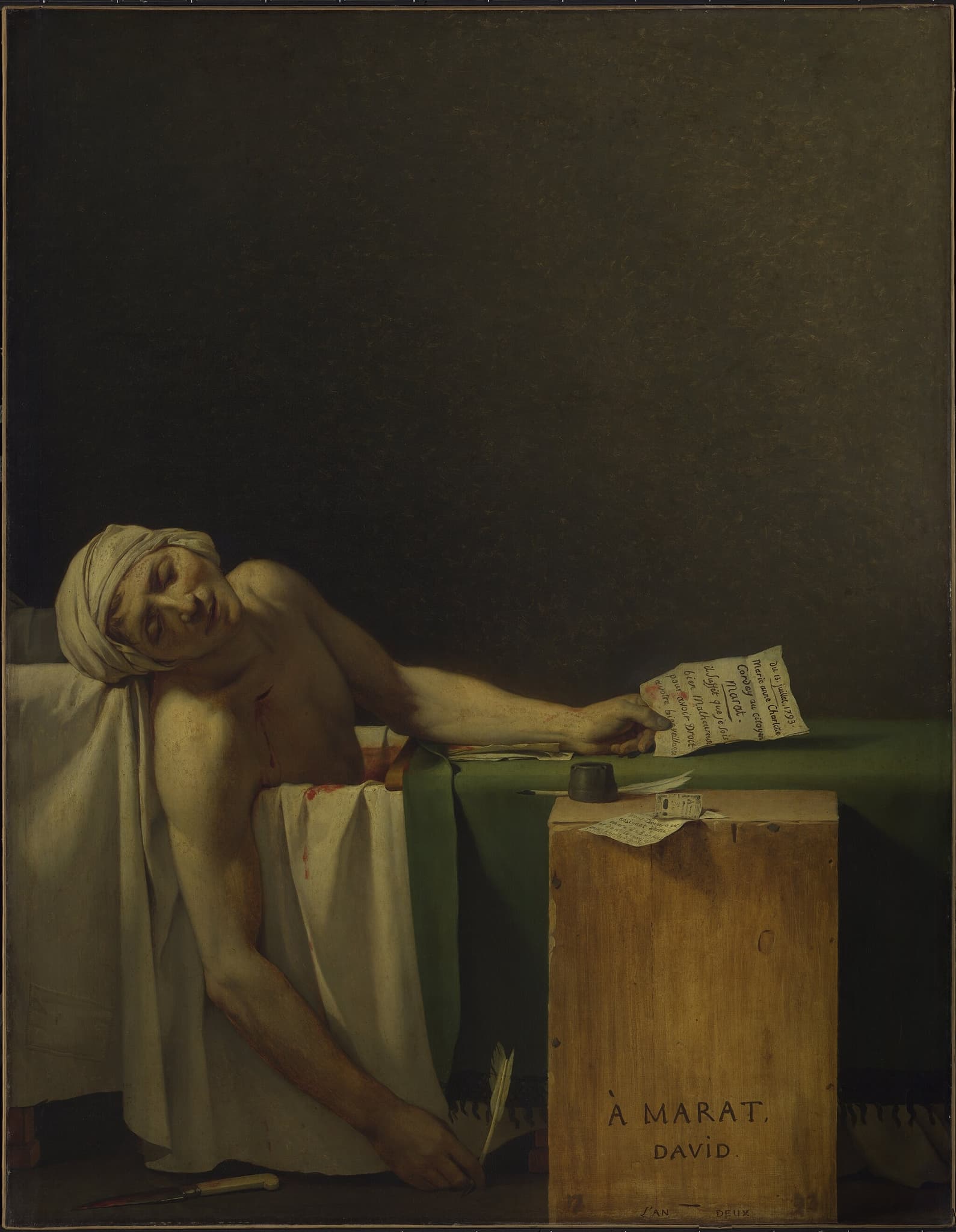
The Death of Marat
Jacques-Louis David, 1793 • Oil on canvas
Read full analysis of The Death of Marat →Valuation Analysis
Conclusion: The Death of Marat (1793) by Jacques‑Louis David is valued at a hypothetical fair‑market range of $150–250 million, contingent on lawful deaccession and export. The estimate synthesizes the painting’s apex art‑historical stature, total scarcity of comparable David masterworks in private hands, and recent nine‑figure demand for category‑defining Old Master icons.
Work status and uniqueness: The prime Marat belongs to the Royal Museums of Fine Arts of Belgium, having entered via the artist’s family legacy (1886) and accessioned in 1893; it has no modern public sale history [1][2]. The museum and the Louvre have reiterated its primacy within David’s oeuvre, with related studio replicas in French museums underscoring the uniqueness of the Brussels canvas [1][6]. Its 2025–26 loan to the Louvre’s David bicentenary further confirms its central, emblematic standing in Revolutionary imagery [6].
Market framing and comparables: Direct David price evidence at the top end is thin: the artist’s auction record is $7,209,000 for a late portrait (Christie’s New York, 2008) [3]. However, the Old Master trophy market has repeatedly supported nine‑figure prices for widely recognized, textbook‑level images—e.g., Botticelli’s Portrait of a Young Man Holding a Roundel at $92.2m [4], and Leonardo’s Salvator Mundi at $450.3m (an outlier but illustrative of capacity) [5]. Marat is David’s most iconic Revolutionary subject, reproduced and taught globally, and would command a substantial “icon premium” above the artist’s record while remaining below the absolute Renaissance peaks. That positioning, combined with near‑zero supply of autograph David history paintings, supports the $150–250m range.
Demand, buyer pool, and constraints: The likely buyer universe for a work of this stature comprises a handful of global museums and UHNW collectors capable of engaging at nine figures. While Neoclassical history painting is a narrower niche than High Renaissance or Baroque masters, the cultural resonance, political symbolism, and unrivaled textbook presence of Marat elevate it beyond normal David market ceilings. The painting’s public‑collection status and strict heritage protections in Belgium make an actual sale extraordinarily unlikely; thus the valuation is necessarily hypothetical and framed for context.
Insurance/replacement context: For outbound loans, masterpieces of this rank are typically covered by state indemnity and/or high replacement‑value policies. Although no figure has been publicly disclosed, a notional replacement band above fair‑market value is consistent with museum practice, which further contextualizes a nine‑figure valuation [1][6].
Key Valuation Factors
Art Historical Significance
High ImpactThe Death of Marat is the defining image of the French Revolution and a cornerstone of Neoclassicism. It distills David’s political engagement, formal rigor, and modernizing clarity into a composition that has become globally canonical, reproduced in textbooks and museums worldwide. Its cultural afterlife—as a symbol of martyrdom, propaganda, and the power of visual rhetoric—sets it apart even within David’s illustrious oeuvre. This extraordinary art‑historical weight creates an “icon premium,” pushing expected value far above the artist’s auction record and aligning it with the rare Old Master works that transcend typical market segment boundaries.
Rarity and Supply
High ImpactAutograph, major‑scale David history paintings are virtually absent from the market; most are in national museums. While studio replicas of Marat exist, the Brussels canvas is recognized as the prime version. This near‑zero supply of true substitutes profoundly elevates price expectations in any hypothetical sale scenario. In market terms, the combination of absolute scarcity, universal recognition, and absence of recent comparables for top‑tier David oils necessitates extrapolation from broader Old Master trophy benchmarks—producing a justified nine‑figure valuation range.
Provenance and Legal/Marketability Context
High ImpactThe work entered the Royal Museums of Fine Arts of Belgium through the artist’s family legacy and has remained in public hands since the 19th century. As a national‑collection masterpiece, it is effectively inalienable and subject to stringent heritage and export controls. While this means an actual sale is extraordinarily unlikely, the impeccable provenance and uninterrupted institutional stewardship reinforce confidence in authorship, condition management, and scholarly status—factors that, in a hypothetical, legally transferable scenario, would enhance willingness to pay among the world’s most sophisticated buyers.
Market Benchmarks and Buyer Pool
Medium ImpactDavid’s own public record ($7.2m, 2008) underrepresents the value of his greatest works, because prime canvases rarely, if ever, reach auction. Pricing must therefore be triangulated against category benchmarks: Botticelli’s $92.2m portrait and Leonardo’s $450.3m Salvator Mundi demonstrate substantial nine‑figure capacity for universally iconic Old Masters. While Neoclassical history painting commands a narrower collector base than High Renaissance masterpieces, Marat’s singular renown, reinforced by marquee exhibitions and loans, expands the potential buyer pool beyond the typical David market, justifying a $150–250m framework.
Sale History
The Death of Marat has never been sold at public auction.
Jacques-Louis David's Market
Jacques‑Louis David is the central figure of French Neoclassicism, with a market defined by extreme scarcity of autograph paintings. His public auction record—$7,209,000 for Portrait of Ramel de Nogaret (Christie’s New York, 2008)—reflects the fact that major canvases are almost entirely held by museums. Recent public activity has concentrated in drawings and studio works, typically trading from low to mid five figures, underscoring the gulf between ordinary material and prime masterpieces. Consequently, any hypothetical pricing for David’s top‑tier paintings must look beyond the artist’s record to broader Old Master trophy benchmarks, where buyer capacity at nine figures has been repeatedly demonstrated.
Comparable Sales
Salvator Mundi
Leonardo da Vinci
Top Old Master trophy sale; demonstrates nine-figure depth for singular, canon-defining icons (upper-bound benchmark for a masterpiece like Marat).
$450.3M
2017, Christie's New York
~$576.0M adjusted
Portrait of a Young Man Holding a Roundel
Sandro Botticelli
Recent Old Master ‘trophy’ portrait that reset market expectations for iconic, textbook images; a realistic nine‑figure comparator below Leonardo.
$92.2M
2021, Sotheby's New York
~$107.0M adjusted
Portrait of Ramel de Nogaret
Jacques-Louis David
Artist auction record; only major modern-era David oil at high level. Same artist, but late portrait genre—helps anchor David’s public-market ceiling for autograph works.
$7.2M
2008, Christie's New York
~$10.5M adjusted
Bonaparte Crossing the Alps (studio version)
Studio of Jacques-Louis David
Closely related Napoleonic subject and David workshop production; indicates liquidity for David imagery but underscores the vast premium for autograph, prime masterpieces.
$99K
2023, Millon, Drouot (Paris)
~$105K adjusted
David with the Head of Goliath
Guido Reni
Recent high-profile Old Master painting record in Europe; shows strong appetite for rediscovered, high-quality Baroque icons—useful category proxy for top-tier demand.
$13.4M
2025, Artcurial (Paris)
Current Market Trends
Old Masters have shown resilient demand at the top end, with landmark prices for category‑defining works and renewed institutional focus via major exhibitions. Supply remains chronically tight, which concentrates bidder interest on best‑in‑class objects with clear attribution, strong provenance, and cultural resonance. While mid‑market material can be selective, trophy‑level works continue to attract global UHNW collectors and museums, often transcending typical artist‑record ceilings. Within this context, a canonical, museum‑grade David would command an exceptional premium, even as Neoclassical history painting remains a narrower niche than High Renaissance or Baroque. The resulting price dynamic supports a confident nine‑figure valuation for Marat.
Study print
Study this painting as a print
Pair the full artwork with a museum-style study sheet focused on one meaningful detail.

Sources
- Royal Museums of Fine Arts of Belgium – Marat assassiné (exhibition/museum page)
- Scientific Reports (Nature) – Multiscale analysis of Jacques‑Louis David’s The Death of Marat
- Christie’s – Jacques‑Louis David, Portrait of Ramel de Nogaret (Lot 72, 2008) – Price realized $7,209,000
- Sotheby’s – Botticelli’s Portrait of a Young Man Holding a Roundel sells for $92.2m
- Wikipedia – Salvator Mundi (Leonardo) – Auction price $450.3m
- Musée du Louvre – Jacques‑Louis David (1748–1825) exhibition/loan information