How Much Is The Oath of the Horatii Worth?
Last updated: February 18, 2026
Quick Facts
- Methodology
- comparable analysis
The Oath of the Horatii is an inalienable Louvre masterpiece with no sale history; any figure is necessarily hypothetical. Benchmarked against cross‑category, museum‑level trophies (Leonardo’s Salvator Mundi, Botticelli’s Roundel portrait, Cézanne’s Card Players) and adjusted for David’s canonical status and absolute rarity, a prudent working range is $200–500 million.
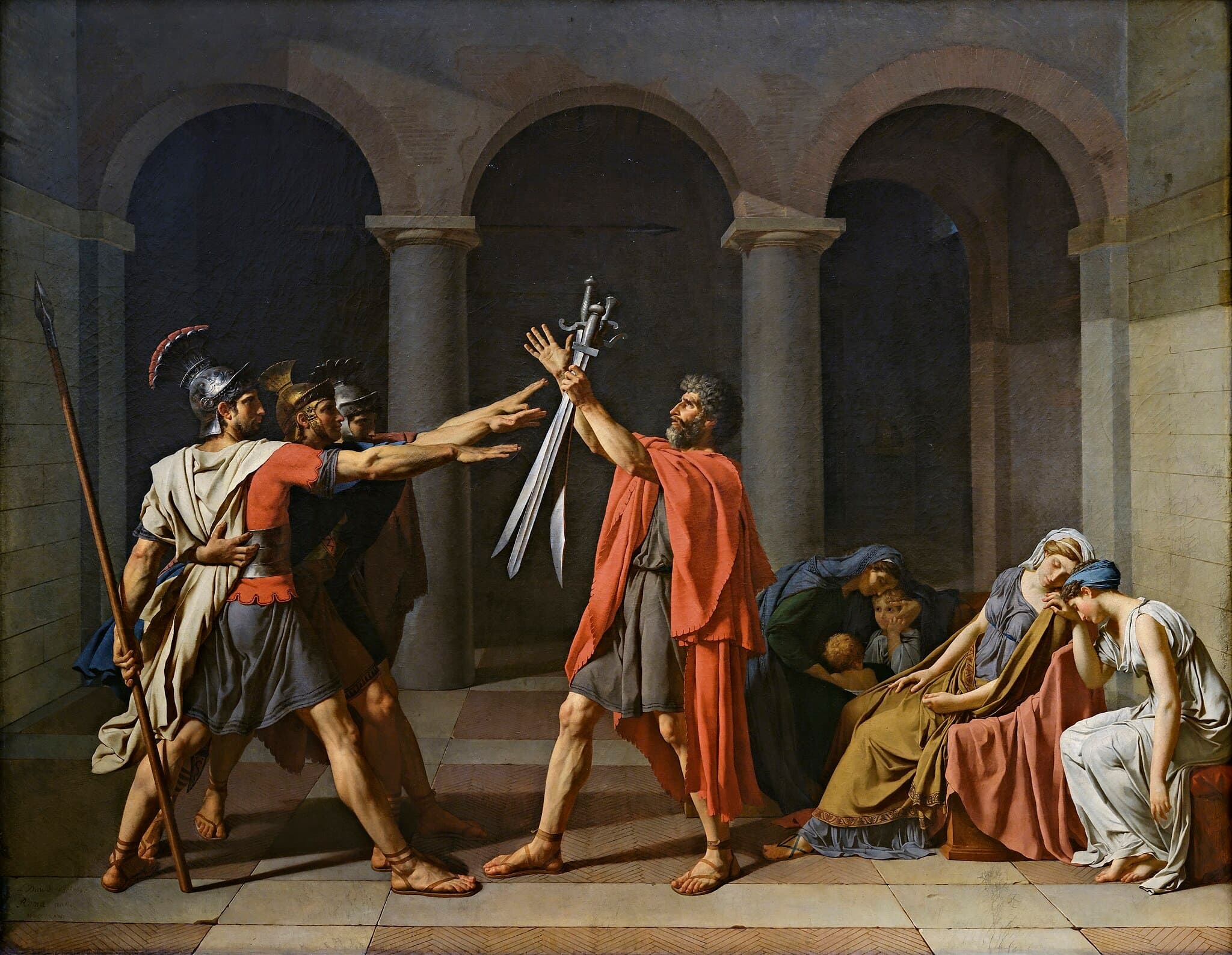
The Oath of the Horatii
Jacques-Louis David, 1784 (exhibited 1785) • Oil on canvas
Read full analysis of The Oath of the Horatii →Valuation Analysis
Work status and premise. Jacques‑Louis David’s The Oath of the Horatii (1784) is a cornerstone of French Neoclassicism and one of the Louvre’s most emblematic canvases. Commissioned under the Ancien Régime, it entered the French national collections and is today held by the Musée du Louvre, where it is permanently on view [1]. As part of the French State collections, it is legally inalienable and imprescriptible under the Code du patrimoine; no conventional market sale can occur, and there is no public sale price [2]. This valuation therefore addresses a hypothetical insurance or unconstrained market scenario.
Artist market context. David’s prime history paintings are overwhelmingly institutional. The artist’s public auction record—$7.21 million for the Portrait of Ramel de Nogaret (Christie’s, 2008)—reflects the scarcity of autograph oils of consequence in private hands, not a ceiling for a canonical masterpiece such as the Oath [6]. In other words, the observable David market cannot by itself price this painting; cross‑category benchmarking is required.
Cross‑category comparables. When singular, globally recognized Old Master or pre‑Modern masterpieces do reach the market, they can command several hundred million dollars. Leonardo da Vinci’s Salvator Mundi realized $450.3 million at Christie’s in 2017, demonstrating unconstrained, worldwide demand for a unique, museum‑level icon [3]. Sotheby’s sold Sandro Botticelli’s Portrait of a Young Man Holding a Roundel for $92.2 million in 2021, a modern high‑water mark for an early Renaissance portrait [4]. Outside Old Masters, the widely reported private sale of Paul Cézanne’s The Card Players around $250 million underscores what top collectors pay for textbook, museum‑defining works [5].
Calibrating a range for the Oath. The Oath of the Horatii is among David’s two or three most important paintings—arguably the textbook image of French Neoclassicism—combining monumental scale, pristine classical architecture, and a narrative charged with civic virtue. Its art‑historical centrality, the near‑total absence of comparable Neoclassical history paintings in private hands, and the Louvre seal of quality place it in the same valuation conversation as the small cohort of cross‑category “trophies” cited above. While Old Masters as a category often price below peak Modern/Contemporary in aggregate, truly iconic, globally legible images are outliers. On that basis, a prudent working band of $200–500 million is supported by the Leonardo/Botticelli/Cézanne benchmarks, with upward risk in a fully global, unrestricted sale.
Conclusion and use. Because the work is inalienable State property, any number here is administrative rather than market‑derived. For insurance, indemnity, or forced‑valuation purposes, $200–500 million appropriately balances the painting’s singular stature and irreplaceability against the realized prices for the closest available trophy comparables [1][2][3][4][5][6]. In a hypothetical, legally unconstrained auction with broad geopolitical participation, bidding could plausibly exceed this range; in normal circumstances, however, the work remains not for sale.
Key Valuation Factors
Art Historical Significance
High ImpactThe Oath of the Horatii is a canonical statement of French Neoclassicism and a touchstone of late‑18th‑century art. Its austere architecture, moral narrative of civic virtue, and rigorously staged, multi‑figure composition crystallize David’s program and profoundly influenced Revolutionary and Napoleonic visual culture. It is among the artist’s two or three most famous works, reproduced in textbooks and surveys worldwide, and it sits at the center of scholarship on both David and the period. That level of significance creates demand far beyond the usual Old Masters collector base, positioning the painting as a global cultural icon rather than merely an important historical work.
Rarity and Market Supply
High ImpactPrime, autograph history paintings by David of comparable ambition and scale are effectively absent from the market; the great majority reside in national museums. David’s public auction record—$7.21 million for a late portrait—reflects supply constraints, not demand for a masterpiece. Because the work’s closest substitutes are already in public collections, collectors and institutions have almost no opportunities to acquire anything comparable. This extreme scarcity produces a substantial rarity premium in any hypothetical valuation, requiring extrapolation from the handful of cross‑category masterpieces that do trade at the top of the market.
Legal/Patrimonial Status and Provenance
High ImpactThe painting is part of France’s inalienable national collections, with secure provenance from its 18th‑century commission to its current home at the Louvre. While this status precludes a conventional sale, it simultaneously affirms unimpeachable authenticity, significance, and state‑level custodianship—qualities that strengthen an insurance or theoretical valuation. In any counterfactual disposal scenario, national preemption and export controls would apply, but if legal constraints were lifted and global bidders could compete without restriction, the work’s unimpeachable history and national‑treasure aura would amplify demand and price.
Global Trophy Demand and Cross‑Category Benchmarks
High ImpactIn the last decade, a small number of universally recognized masterpieces—spanning Old Masters to Post‑Impressionism—have achieved prices from ~$100 million to $450 million. Results for Leonardo’s Salvator Mundi, Botticelli’s Roundel portrait, and Cézanne’s Card Players demonstrate deep, cross‑category capital ready to pursue singular works with broad cultural resonance. The Oath of the Horatii fits this profile: a museum‑defining, globally legible image by a pivotal artist. These benchmarks, adjusted for period taste and the painting’s scale, support a valuation in the low‑ to mid‑hundreds of millions, with upside under unconstrained conditions.
Sale History
The Oath of the Horatii has never been sold at public auction.
Jacques-Louis David's Market
Jacques‑Louis David is the preeminent painter of French Neoclassicism; his major canvases are largely institutional, and authenticated oils of consequence seldom reach the market. The standing auction record for a securely attributed oil—Portrait of Ramel de Nogaret at $7.21 million (Christie’s, 2008)—is modest relative to the artist’s historical stature because prime works do not trade. When autograph paintings and important drawings do appear, they attract strong institutional and private interest. Demand is fueled by David’s central role in Revolutionary and Napoleonic imagery, while supply scarcity compels valuers to benchmark his top masterpieces against cross‑category trophies rather than against his own limited public auction history.
Comparable Sales
Salvator Mundi
Leonardo da Vinci
Public record for a trophy Old Master painting; shows unconstrained global demand for a canonical pre‑Modern masterpiece—useful upper‑bound signal for a museum‑icon like Oath.
$450.3M
2017, Christie's New York
~$584.5M adjusted
The Card Players
Paul Cézanne
Widely reported private price for a textbook, museum‑level masterpiece; cross‑category benchmark for what top collectors pay for the rarest canonical works.
$250.0M
2011, Private sale
~$354.0M adjusted
Portrait of a Young Man Holding a Roundel
Sandro Botticelli
Top public price for an early Renaissance master; strong proxy for trophy‑level Old Master demand even when not a history painting.
$92.2M
2021, Sotheby's New York
~$108.3M adjusted
The Massacre of the Innocents
Peter Paul Rubens
Monumental Baroque multi‑figure history painting; closer in subject/scale to Oath and a key public benchmark for large narrative Old Masters.
$76.7M
2002, Sotheby's London
~$135.6M adjusted
Portrait of Elisabeth Lederer
Gustav Klimt
Recent marquee price for a canonical pre‑Modern masterpiece; signals current willingness to pay >$200m for museum‑level works.
$236.4M
2025, Sotheby's New York
Portrait of Ramel de Nogaret
Jacques‑Louis David
Same artist; standing auction record for a securely attributed oil by David—anchors the scarcity of autograph oils on the market (though far below Oath in importance).
$7.2M
2008, Christie's New York
~$10.7M adjusted
Current Market Trends
Old Masters remain the smallest segment of the fine‑art market, but the top end is highly responsive when truly exceptional, ‘trophy’ works emerge. Landmark results such as Leonardo’s Salvator Mundi (2017) and Botticelli’s Roundel portrait (2021) showed deep, global demand for singular, museum‑grade pictures. Category-wide averages can understate outlier potential: supply is the main constraint, and rediscoveries or fresh, canonical works can command prices rivaling Modern and Contemporary blue chips. Against this backdrop, a textbook, institution‑defining David of monumental scale would likely price in the low‑ to mid‑hundreds of millions under unconstrained sale conditions.
Study print
Study this painting as a print
Pair the full artwork with a museum-style study sheet focused on one meaningful detail.
Sources
- Musée du Louvre Collections – The Oath of the Horatii
- French Ministry of Culture – Inalienability of Musées de France collections
- Christie’s – Leonardo da Vinci’s Salvator Mundi sells for $450.3m
- Sotheby’s – Botticelli Portrait of a Young Man Holding a Roundel sells for $92.2m
- Forbes – Qatar Buys World’s Most Expensive Painting (Cézanne’s Card Players)
- Antiques and the Arts Weekly – World Auction Records Tumble at Christie’s Old Masters Sale (David record)