How Much Is Napoleon Crossing the Alps Worth?
Last updated: February 19, 2026
Quick Facts
- Methodology
- comparable analysis
Hypothetical open-market value: $120–180 million. This range is supported by nine-figure Old Master trophy benchmarks and the painting’s status as David’s most iconic Napoleonic image. Although inalienable under French law, an insurance or indemnity proxy at this level is justified by its cultural primacy and zero market supply.
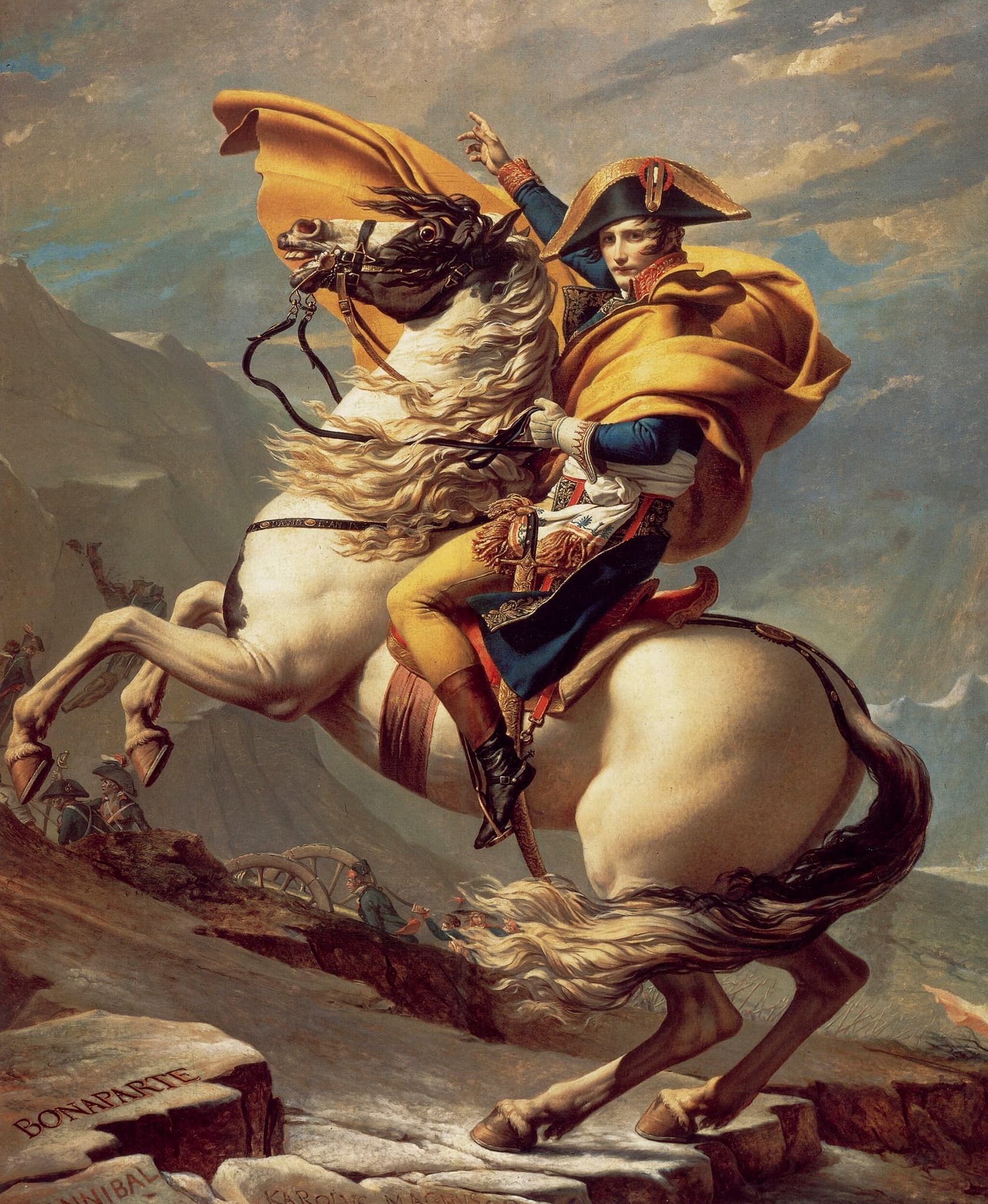
Napoleon Crossing the Alps
Jacques-Louis David, 1801–1805 (series of five versions) • Oil on canvas
Read full analysis of Napoleon Crossing the Alps →Valuation Analysis
Conclusion and range. We estimate a hypothetical market value of $120–180 million for Jacques-Louis David’s Napoleon Crossing the Alps (Malmaison version). This is a notional figure suitable for insurance or state indemnity, since the work is a French national museum holding and thus inalienable under the Code du patrimoine [1]. The estimate reflects the painting’s status as a canonical image of Western art, its centrality within David’s oeuvre, and the complete absence of comparable works in private hands [5].
Methodology and comparables. With no direct sale history for any of the five autograph versions, we anchor the estimate to recent nine-figure outcomes for universally recognized Old Master trophies. Botticelli’s Portrait of a Young Man Holding a Roundel achieved $92.2 million at Sotheby’s (2021), demonstrating current depth of demand for singular, museum-grade Renaissance and Old Master portraits [2]. At the upper benchmark for iconic portraiture with national significance, the Louvre and Rijksmuseum’s joint private purchase of Rembrandt’s pendant full-lengths at approximately €160 million underscores institutional capacity to transact at this level [3]. Against these, an autograph, museum-iconic David of equal public recognition and historical gravitas reasonably commands a $120–180 million bracket.
Artist-specific calibration. Jacques-Louis David’s auction record of $7.21 million (Christie’s, 2008) is not indicative of the ceiling for a masterpiece of this stature; it reflects chronic undersupply of prime paintings rather than limited demand [4]. When strong David works surface, they draw intense institutional and top-tier private interest, but the market has had virtually no opportunity to price a universally known, autograph, monumental composition like Napoleon Crossing the Alps.
Rarity, version status, and significance. All five autograph versions (1801–1805) are in public collections in France, Germany, and Austria, so market supply is effectively zero [5]. While multiplicity can sometimes diffuse uniqueness, each version is historically important; the Malmaison canvas is widely regarded as a prime iteration and the definitive equestrian emblem of Napoleonic statecraft. Its subject, scale, and cultural imprint place it alongside David’s Oath of the Horatii and Death of Marat in art-historical prominence, supporting a trophy-level valuation.
Constraints and sensitivities. Because the Malmaison version is inalienable public property in France, any sale is purely hypothetical and an export would be barred [1]. In a theoretical trade, price realization would still hinge on condition and the precise share of David’s hand versus studio assistance, but given the icon’s cultural weight and comparative benchmarks, the $120–180 million range remains an appropriate, defensible proxy for insurance or indemnity purposes.
Key Valuation Factors
Art Historical Significance
High ImpactNapoleon Crossing the Alps is the defining equestrian state portrait of the Napoleonic era and one of the most reproduced images in Western art. Within David’s oeuvre, it ranks with his most consequential canvases, shaping public memory of Napoleon as a heroic, destiny-forging leader. Its composition, rhetorical clarity, and political function exemplify French Neoclassicism at its apogee. This cultural centrality materially elevates value beyond the artist’s typical record levels, placing the work in the rarefied group of paintings whose recognition extends far outside the Old Master field and which can attract cross-category buyers, institutions, and state-backed capital.
Rarity and Supply
High ImpactThere are five autograph versions of this composition, all in European public collections, leaving no practical private-market supply. The Malmaison canvas sits among the prime versions and carries sterling institutional provenance. Absolute scarcity typically amplifies competition when a proxy value is set for insurance or indemnity and, in the purely hypothetical case of tradability, would likely catalyze global interest. While multiplicity can sometimes temper uniqueness, each autograph version is historically important; the market would prize subject, scale, and authorship over concerns about more than one iteration when confronting such an iconic image.
Market Comparables and Benchmarks
High ImpactRecent nine-figure outcomes for canonical Old Masters validate the depth of demand for universally recognized, museum-grade pictures. Botticelli’s $92.2m portrait (2021) and the Louvre/Rijksmuseum’s €160m private acquisition of Rembrandt pendants illustrate the pricing zone for culturally defining portraits with national resonance. David’s own auction record is far lower due to scarce supply of masterpieces, not lack of demand. Calibrated against these comparables, an autograph, marquee David with global recognition and zero market availability justifies a $120–180 million estimate in today’s environment, acknowledging that Leonardo-level outliers define a separate ceiling not required to support this range.
Legal and Export Constraints
Medium ImpactAs an inalienable work in a French national museum, the Malmaison version cannot be sold or exported under the Code du patrimoine. This makes the valuation notional—relevant for insurance or state indemnity rather than an actual sale. In a theoretical disposal, one would need to consider state preemption and export controls, which can complicate private liquidity. However, these constraints do not diminish intrinsic value; they merely shift the context of pricing to indemnity surrogates. The estimate therefore reflects what the picture would reasonably achieve in a frictionless, international market, then serves as a prudent proxy for risk coverage.
Sale History
Napoleon Crossing the Alps has never been sold at public auction.
Jacques-Louis David's Market
Jacques-Louis David is the preeminent painter of French Neoclassicism, with most masterpieces locked in museums, resulting in vanishingly thin supply. When autograph paintings of quality emerge, they draw strong institutional and top-tier private demand. David’s standing auction record is $7.21 million (Christie’s New York, 2008, Portrait of Ramel de Nogaret), a figure that reflects limited availability rather than a true ceiling for a trophy-picture price. Routine drawings trade in the low thousands, and secondary studio works can bring five figures, but the market has had virtually no chance to price a universally iconic, autograph historical canvas—hence the need to extrapolate from cross-artist Old Master trophies.
Comparable Sales
Portrait of a Young Man Holding a Roundel
Sandro Botticelli
Museum-grade Old Master trophy portrait by a canonical master; shows 9-figure demand for singular, iconic pre-19th-century works with universal recognition and zero supply—useful proxy for a marquee David.
$92.2M
2021, Sotheby's New York
~$110.6M adjusted
Portraits of Maerten Soolmans and Oopjen Coppit (pendant full-lengths)
Rembrandt van Rijn
Nine-figure state-backed acquisition of landmark Old Master portraits; closest benchmark for institutional willingness to pay for culturally defining portraiture with national importance.
$174.0M
2016, Private sale (joint purchase by the Louvre and Rijksmuseum)
~$235.6M adjusted
The Massacre of the Innocents
Peter Paul Rubens
Record-setting Baroque masterpiece at auction; demonstrates the upper band for undisputed, dramatic Old Master history paintings—relevant for calibrating a heroic, canonical composition.
$76.7M
2002, Sotheby's London
~$138.5M adjusted
Salvator Mundi
Leonardo da Vinci
Market ceiling for a singular Old Master icon; while sui generis, it evidences the capital available for universally recognized masterpieces and sets an outer bound for trophy pricing.
$450.3M
2017, Christie's New York
~$597.5M adjusted
Portrait of Ramel de Nogaret
Jacques-Louis David
Artist auction record; same artist benchmark showing how rare strong David paintings are at auction—underscores the step-change between routine portraits and a museum-icon like Napoleon Crossing the Alps.
$7.2M
2008, Christie's New York
~$10.9M adjusted
Current Market Trends
At the top of the Old Masters market, demand for fresh, museum-grade works with strong provenance has strengthened, with buyers willing to pay nine figures for culturally emblematic pictures. While mid-tier material remains selective and condition-sensitive, institutional and cross-category private capital concentrate on blue-chip names and iconic subjects. This barbell dynamic benefits a work like Napoleon Crossing the Alps, whose recognition rivals the most famous images in the category. In this context, a $120–180 million proxy aligns with recent trophy outcomes and acknowledges the global depth of capital for singular, historically resonant Old Master masterpieces.
Study print
Study this painting as a print
Pair the full artwork with a museum-style study sheet focused on one meaningful detail.
Sources
- Légifrance — Code du patrimoine, Art. L451-5 (inalienability of national collections)
- Sotheby’s — Botticelli portrait sells for $92.2m (Jan 28, 2021)
- DW — France and the Netherlands buy two Rembrandts together for €160m (2016)
- Antiques and the Arts — World auction records tumble at Christie’s Old Masters (David record $7.21m)
- Musée national des châteaux de Malmaison — Chefs-d’oeuvre en mouvement (collection notice)