How Much Is The Coronation of Napoleon (Le Sacre) Worth?
Last updated: March 18, 2026
Quick Facts
- Methodology
- extrapolation
The original Coronation of Napoleon (Le Sacre) by Jacques‑Louis David (Louvre, inv. 3699) is a museum‑held national masterpiece and not a practical market object. As a purely hypothetical market exercise (assuming legal/political barriers were lifted), a reasoned valuation range is US$100–150 million based on extrapolating high‑quality David comparables, the painting's singular cultural importance, and buyer‑pool dynamics.
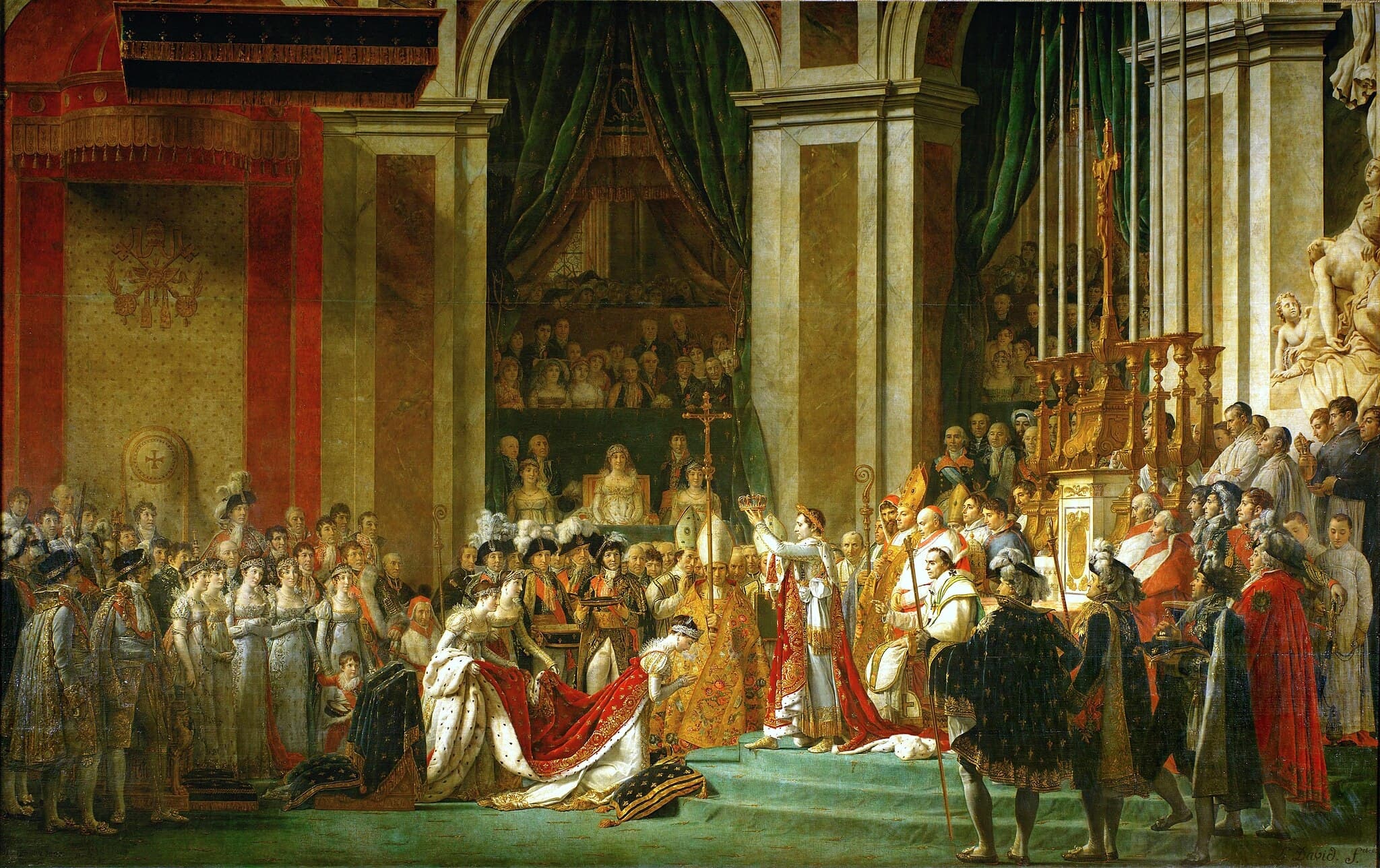
The Coronation of Napoleon (Le Sacre)
Jacques-Louis David • Oil on canvas
View more by Jacques-Louis David →Valuation Analysis
Context and status: Jacques‑Louis David's monumental Coronation (c.1805–07) is held by the Musée du Louvre (inv. 3699) and functions as a national, museum‑defining work rather than a tradable market lot [1]. The canvas's scale, central place in Napoleonic iconography and continuous public exhibition history place it at the apex of David's oeuvre and effectively remove it from normal commercial circulation.
Comparable evidence and approach: Because the full‑scale canvas has never been offered on the open market, this valuation uses an extrapolative method anchored to market evidence from the closest available comparables — foremost a major autograph oil sketch on the Coronation subject which realised US$2,535,000 at Christie’s (2019) — then applies reasoned multipliers and institutional premia to reach a hypothetical price for the canonical canvas [2]. Smaller studio copies and workshop variants (low five‑figures) and preparatory drawings (mid five‑ to low six‑figures) demonstrate market tiers but cannot on their own set a price for a museum‑defining, monumental canvas.
Adjustments applied: Key upward adjustments include (a) the cultural and historical premium attached to a canonical state‑held masterpiece, (b) replacement/insurance cost and conservation/transport loading given the painting's extreme physical scale, and (c) scarcity and competitive bidder dynamics should national institutions or sovereign collectors seek acquisition. Downward or constraining effects include patrimonial and export restrictions, which make an open, frictionless market sale hypothetical and therefore increase valuation uncertainty.
Final band and justification: Balancing these inputs, the realistic hypothetical market band is US$100–150 million. The lower bound models a conservative institutional acquisition scenario (some political friction, limited number of deep‑pocket bidders); the upper bound models a contested sale where institutional, state and private actors compete and pay a cultural premium well above private comparables. This range is intentionally wide to reflect legal/political constraints, transport/insurance costs and the lack of direct full‑canvas sale comparators.
Uncertainty and recommended next steps: This estimate is provisional. To tighten it would require (1) confirmation of the exact object you mean (the Louvre original versus a studio/replica/study), (2) a current conservation and condition report, (3) formal legal/patrimonial clearance analysis, and (4) targeted searches of auction house private‑sale records and institutional interest. With those inputs a finer, evidence‑based price model and sale strategy could be produced.
Key Valuation Factors
Art Historical Significance
High ImpactThe Coronation of Napoleon is David’s signature masterpiece and one of the central images of early‑19th‑century Europe. As a monumental history painting commissioned by the state, it anchors scholarly narratives, exhibition programming and public recognition of David’s career. That cultural and iconographic primacy creates a substantial non‑market premium: museums and states treat such canvases as strategic patrimony rather than ordinary trade goods. In valuation terms this translates to a multiplicative uplift well above the artist’s auction comparables (studies and drawings). Any hypothetical buyer would be prepared to pay a material premium for ownership and the attendant prestige and display value.
Legal / Patrimony Status
High ImpactThe painting is part of the French national collection and is subject to the French Code du patrimoine and associated administrative and export controls. These legal protections render the canvas effectively unsaleable in ordinary commercial terms without extraordinary legislative or administrative action. The consequence is dual: (1) near‑zero liquidity in the open market (limiting conventional comparables), and (2) a higher theoretical valuation if a sale were artificially enabled because exceptional purchases attract state actors, major museums and sovereign funds willing to pay premiums. Legal constraints therefore both depress tradability and increase the potential headline price in a hypothetical sale.
Provenance & Exhibition History
High ImpactContinuous state ownership, long public exhibition at Versailles and the Louvre, and extensive scholarly publication constitute a near‑perfect provenance profile. This provenance minimizes title risk and enhances the work’s attractiveness to institutional bidders. Exhibition history and catalogue presence are highly valuable in the Old Master/19th‑century market; they materially increase buyer confidence and justify higher bids. In addition, repeated requests for loans and centrality to major exhibitions raise the painting’s practical utility and therefore its valuation in a hypothetical competitive acquisition environment.
Physical Scale & Conservation
Medium ImpactAt roughly 6.21 × 9.79 metres, the canvas is extraordinarily large; that imposes substantial conservation, transport and installation costs and risks. Only major institutions have the infrastructure to accommodate the painting, which constrains the buyer pool to a small set of museums and well‑equipped private venues. The scale raises insurance and handling premiums and can deter some bidders, but when major museums compete the scale can also intensify willingness to pay. Conservational provenance and a current condition report are therefore essential inputs to valuation.
Market Supply & Comparables
High ImpactThere is acute scarcity of autograph, museum‑quality David canvases on the open market; most high‑importance works are institutional. Public comparables are therefore limited to oil sketches and drawings (top autograph studies can reach low millions, while workshop/copy works trade in five figures). This supply scarcity, combined with institutional demand, supports a large premium in a hypothetical sale. However, limited numbers of capable bidders (museums, states, a few ultra‑wealthy collectors) also create volatility — a contested sale could exceed the band while limited competition could produce lower outcomes.
Sale History
The Coronation of Napoleon (Le Sacre) has never been sold at public auction.
Jacques-Louis David's Market
Jacques‑Louis David is a canonical Neoclassical master whose most consequential canvases are largely sequestered in museum collections. The commercial market for David is therefore focused on drawings, preparatory studies and occasional oil sketches; those categories have recently realised from mid five‑figures into low millions at major houses. True autograph, exhibition‑quality canvases rarely appear, so headline records are constrained by supply. Institutional demand and scholarly attention remain the principal drivers of value; when a high‑quality David study appears with strong provenance it draws competitive bids from museums and specialist collectors.
Comparable Sales
Study for The Coronation of Napoleon (oil sketch)
Jacques-Louis David
Autograph oil sketch by David directly on the Coronation subject — closest subject/medium comparable available on the market and a clear example of top-tier pricing for a museum-quality David study.
$2.5M
2019, Christie's New York
~$3.2M adjusted
Study for The Intervention of the Sabine Women ("Nude soldiers gesticulating…") — drawing
Jacques-Louis David
High-quality preparatory drawing by David sold at a major house — shows demand and pricing for important works on paper by David, useful for valuing preparatory material related to Le Sacre.
$401K
2015, Sotheby's New York (Old Master Drawings)
~$550K adjusted
Important David painting (reported historic sale)
Jacques-Louis David
Historic public-sale high-water mark reported for a David painting (1987) — a dated but useful precedent for how significant David oil paintings have performed when leaving institutional/collector contexts.
$4.0M
1987, Sotheby's (reported in Washington Post)
~$11.4M adjusted
Workshop copy after The Coronation of Napoleon (after David)
Workshop/Circle of Jacques-Louis David
Studio/workshop variant sold in a regional Paris sale — represents the lower end of the market for after-David canvases and illustrates the large gap between copies/workshop pieces and autograph museum works.
$98K
2023, Millon, Paris
~$104K adjusted
Current Market Trends
Current market conditions favour high‑quality, well‑provenanced works on paper and oil studies by canonical 18th–19th‑century artists, supported by museum retrospectives and renewed Napoleonic interest. Supply of major David canvases remains negligible, so prices for study‑level works are the clearest market signal. Institutional demand is steady; the overall Old Master/19th‑century segment is quieter than Contemporary art but resilient for museum‑grade material. Scarcity of canonical canvases means hypothetical sales are dominated by institutional and sovereign buyers, not the broader collector base.
Sources
- Musée du Louvre — Collection entry for Le Sacre (Jacques‑Louis David), inv. 3699
- Christie’s — Feature / sale notice: Jacques‑Louis David sketch of Napoleon’s Coronation (2019 sale)
- Millon — Example workshop copy sale (Paris, Nov 2023)
- French Senate report / patrimony overview — legal and export protections for national collections