How Much Is The Death of Socrates Worth?
Last updated: March 18, 2026
Quick Facts
- Methodology
- comparable analysis
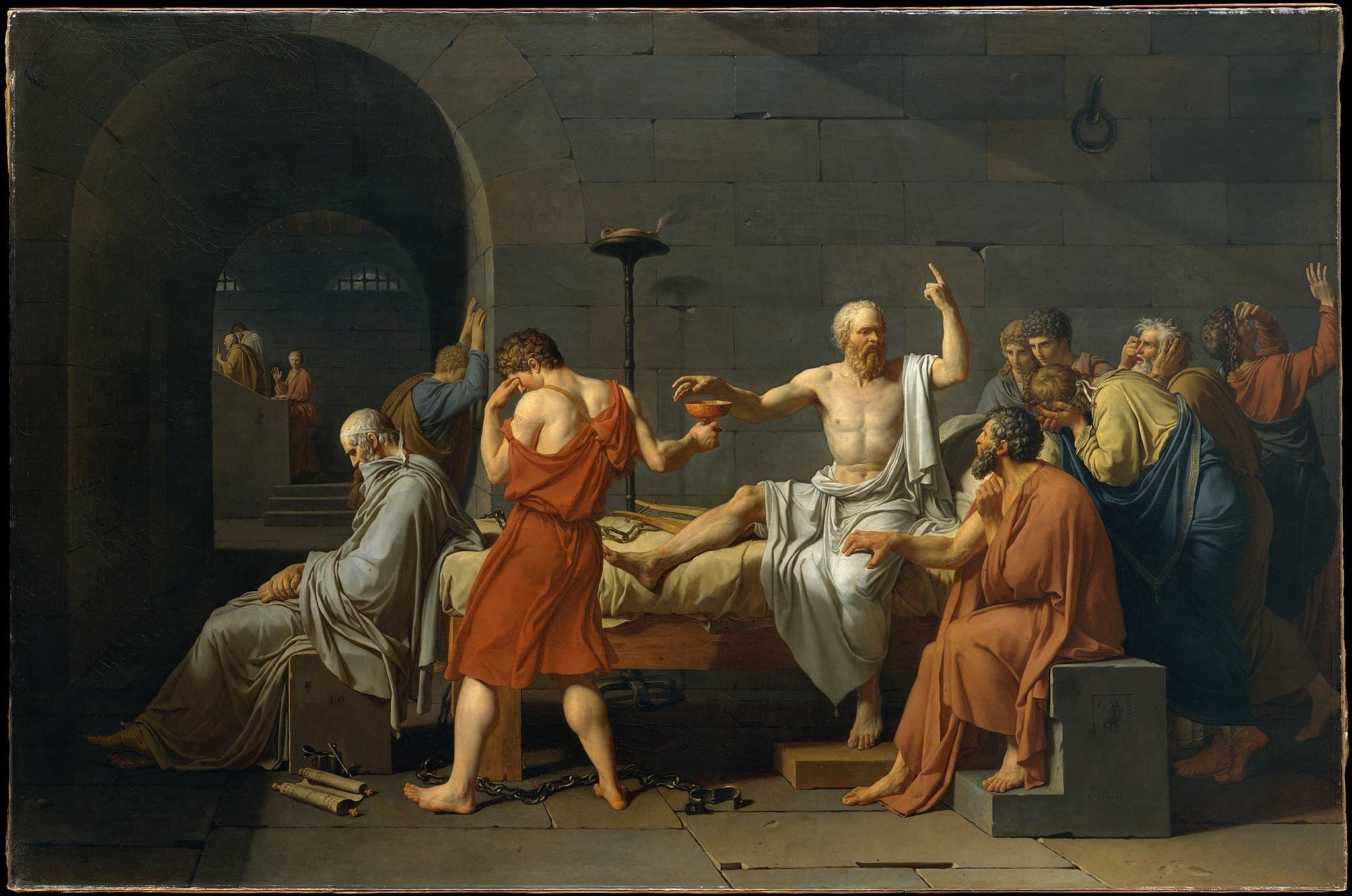
The canonical 1787 oil The Death of Socrates by Jacques‑Louis David (Metropolitan Museum of Art, acc. no. 31.45) is museum‑held and has no modern public sale history. If hypothetically marketable (autograph, sound condition, exportable), a reasoned market estimate is USD 30–60 million based on scarcity, significance and proxied comparables.
Valuation Analysis
Valuation conclusion: The autograph 1787 oil The Death of Socrates by Jacques‑Louis David (Metropolitan Museum of Art, acc. no. 31.45) has not been offered on the modern open market and, if hypothetically saleable in private treaty or auction to a deep‑pocketed museum or private collector, I estimate a market value in the range $30–60 million (USD). This band assumes a fully autograph canvas in sound condition, documented provenance, and normal exportability.[1]
The estimate synthesizes three inputs: the painting’s canonical status within David’s oeuvre; the extreme scarcity of comparable large autograph David canvases at auction; and proxy comparables from (a) the artist’s public auction record (Christie’s 2008 Portrait of Ramel de Nogaret, ~USD 7.21M) and (b) select, museum‑quality 18th‑century French canvases that have reached high‑tens of millions when truly rare examples came to market. Preparatory drawings tied to this composition have sold in the mid‑six‑figure band, demonstrating collector interest in material connected to the canvas and supporting a scarcity premium in extrapolation.[2]
Why $30–60M? The lower bound reflects a conservative application of a scarcity uplift to David’s thin market and the likelihood that an institutional buyer could acquire the work without a frenzied auction. The upper bound reflects a competitive scenario in which several deep‑pocket buyers (major museums, sovereign/blue‑chip private collectors) contest the work, producing a significant premium. Exceptional vintage 18th‑century sales show that when top‑tier canvases become available the market will pay multi‑tens of millions; that evidence anchors the high side of this band.[3]
Key caveats: this valuation is hypothetical. The Met’s ownership makes a sale unlikely; donor restrictions, national patrimony/export controls and institutional deaccession policy materially constrain marketability. Condition and attribution are decisive—studio copies, workshop variants or heavily restored canvases would trade at far lower levels. Macro liquidity, buyer appetite at the time of sale, and legal/exportability issues could push a realized price well outside this band.[2]
For transaction‑grade assurance I recommend confirming the exact object (Met autograph vs copy), obtaining a recent condition/conservation report with technical imaging, and engaging a major auction‑house specialist or accredited appraiser for confidential market testing. I can compile provenance, exhibition bibliography and a detailed comparable‑lot list on request.
Key Valuation Factors
Art Historical Significance
High ImpactDavid’s The Death of Socrates (1787) is one of his signature masterworks and a touchstone of French Neoclassicism. Its moral narrative, classical composition and intellectual program have been repeatedly discussed in major monographs and retrospectives; the work is central to pedagogical and curatorial narratives about late‑18th‑century art. This cultural prominence creates disproportionate collector and institutional demand relative to non‑canonical David works. In practice, significance converts directly to value by expanding the buyer pool to museums and leading collectors who prize cornerstone pieces and are prepared to pay a premium to acquire or secure such a canonical painting.
Rarity / Market Scarcity
High ImpactLarge, museum‑quality autograph canvases by Jacques‑Louis David very rarely reach the open market; most of his most important works are in national or major public collections. That rarity produces a scarcity premium: when a canonical canvas appears it appeals to a small set of deep‑pocket buyers rather than a broad market, which can materially elevate prices above what the artist’s more common works realize. The thin‑market dynamic also increases volatility—an exceptional sale can drive outsized realizations, but institutional and legal constraints can effectively prevent many transactions.
Provenance & Exhibition History
High ImpactThe Met accession (Catharine Lorillard Wolfe Collection, Wolfe Fund, 1931) supplies an exceptionally clean provenance and a long exhibition/publication history. Such provenance reduces attribution risk, increases scholarly interest and enhances institutional confidence—factors that support higher valuations and smoother due diligence. Conversely, long museum custody also lowers the probability of market appearance; when a museum painting does come to market, negotiations are frequently private and price setting reflects both market demand and curatorial/legal constraints.
Condition & Conservation
Medium ImpactCondition is a decisive commercial factor for an 18th‑century canvas of this scale. A structurally stable, well‑conserved, minimally retouched original paint surface will command a premium; conversely, heavy overpainting, unstable paint layers, major relining or invasive restoration will reduce competitive buyer interest and depress price. Technical reports (X‑ray, IRR, pigment analysis) that confirm originality and document conservation interventions materially strengthen a sale case and are generally required by major museums and insurers.
Market Comparables & Demand
High ImpactDirect public‑market comparables for large David canvases are limited (Christie’s 2008 portrait record ~$7.21M; important preparatory drawings have reached mid‑six‑figure sums). Where the broader 18th‑century French market has produced high‑tens of millions for rare, museum‑quality canvases, buyers demonstrated willingness to pay at that scale. The interplay of modest direct auction comps for David and strong proxy results elsewhere is why a significant scarcity premium is applied in this valuation. Demand is concentrated among museums and ultra‑high‑net‑worth collectors and is highly sensitive to sale format and exportability.
Sale History
The Death of Socrates has never been sold at public auction.
Jacques-Louis David's Market
Jacques‑Louis David (1748–1825) is a central figure in French Neoclassicism whose market is institutionally anchored and low in liquidity. Drawings and studies constitute the majority of public auctions (frequently in five‑ to low‑seven‑figure ranges), while large canonical canvases seldom appear. The public auction record for a David canvas (~USD 7.21M, 2008) reflects scarcity more than low demand; a true autograph, museum‑quality canvas would be a once‑in‑a‑generation sale attracting museums and a handful of deep‑pocket private buyers.
Comparable Sales
Portrait of Ramel de Nogaret
Jacques-Louis David
David's modern public auction record for an autograph canvas — useful as a market ceiling from the public record for the artist.
$7.2M
2008, Christie's New York (Important Old Masters sale, 15 Apr 2008)
~$10.6M adjusted
Preparatory drawing for The Death of Socrates (study)
Jacques-Louis David
Directly related study by David — demonstrates strong demand for high-quality preparatory sheets and establishes mid‑six‑figure realized prices for important drawings linked to canonical canvases.
$593K
2015, Christie's New York (Old Master & British Drawings, 29 Jan 2015)
~$795K adjusted
Le Melon Entamé
Jean-Siméon Chardin
A marquee sale of an exceptional 18th‑century French painting that reached high‑tens of millions — shows market willingness to pay strong sums for rare, museum‑quality works from the period.
$28.9M
2024, Christie's Paris (12 Jun 2024)
~$29.8M adjusted
Current Market Trends
Recent market trends (2024–2026) show renewed institutional attention to Old Masters and French Neoclassicism—major retrospectives and donations have increased visibility. Demand for top‑quality, historically significant works is healthy but concentrated; liquidity remains thin and prices depend heavily on buyer composition, sale format and export/regulatory constraints.
Sources
- The Metropolitan Museum of Art — The Death of Socrates (object no. 31.45)
- Christie's — Important Old Masters sale, New York, 15 Apr 2008 (Portrait of Ramel de Nogaret; artist public auction record) / Christie's & major auction databases
- Auction results and market coverage for related works (preparatory drawing sale and 18th‑century market examples)
- Market reports and press coverage on exceptional 18th‑century French sales and sector trends (2024–2025)