How Much Is The Lictors Bring to Brutus the Bodies of His Sons Worth?
Last updated: March 18, 2026
Quick Facts
- Methodology
- extrapolation
If lawfully marketable and exportable, The Lictors Bring to Brutus the Bodies of His Sons (Jacques‑Louis David, 1789) is reasonably valued at approximately $10–50 million. This band is an extrapolation from David auction anchors (notably a $7.21M autograph oil, and mid‑million oil sketches) adjusted for rarity, scale and canonical importance; in practice the work is held by the Musée du Louvre and is effectively non‑marketable under French patrimony rules.
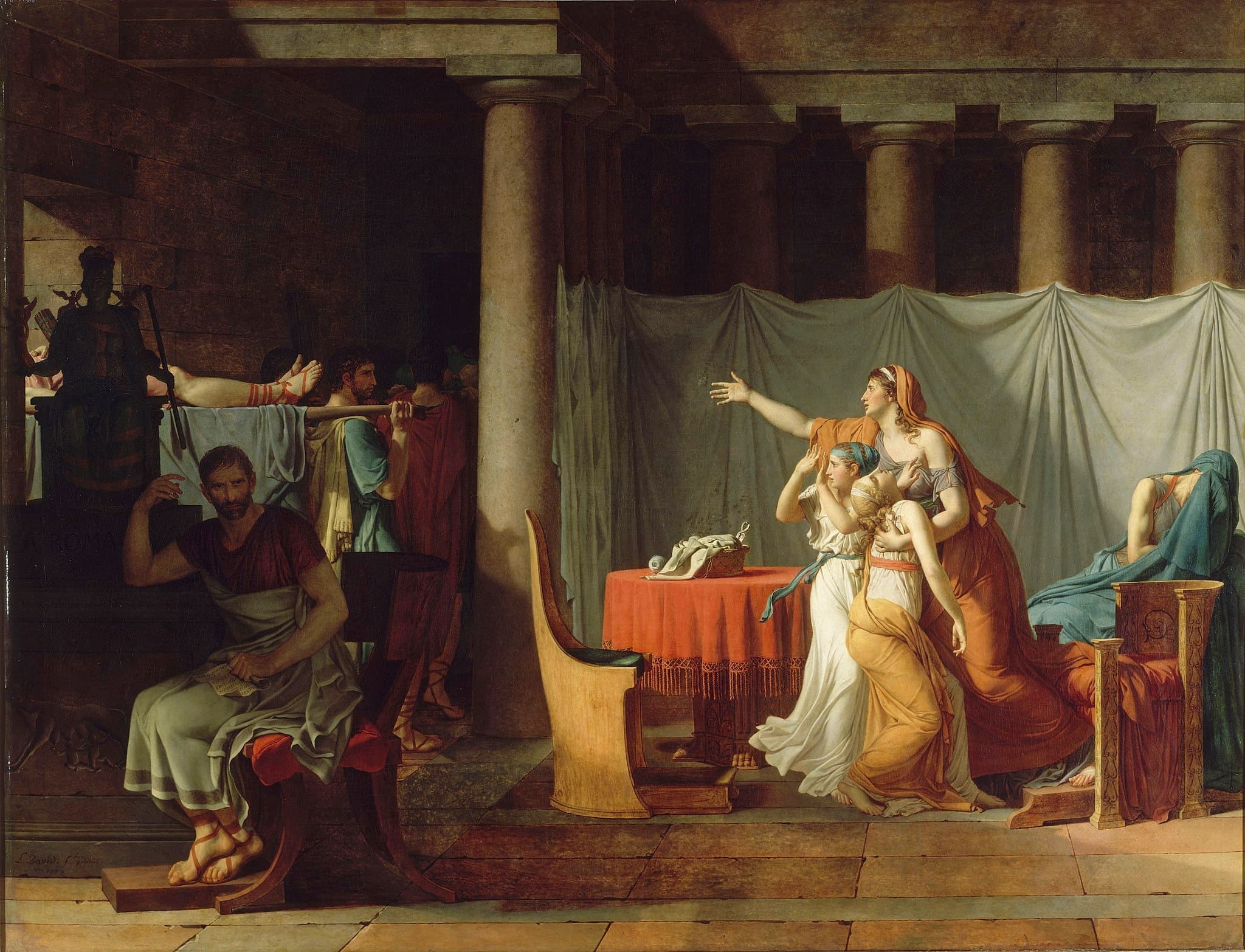
The Lictors Bring to Brutus the Bodies of His Sons
Jacques-Louis David, 1789 • Oil on canvas
View more by Jacques-Louis David →Valuation Analysis
Valuation conclusion: On a hypothetical open market where the painting could be legitimately sold and exported, a defensible value range for David’s The Lictors Bring to Brutus the Bodies of His Sons is approximately $10,000,000–$50,000,000. This opinion is an extrapolation from available market anchors and the premium normally attached to large, canonical history paintings, while explicitly recognising that the work is currently part of the Musée du Louvre’s holdings and that French patrimonial law makes an actual sale highly unlikely [1][4].
Basis and comparables: There are almost no direct public‑sale comparables for a museum‑scale David history canvas because such works remain overwhelmingly in public collections. The artist’s modern public‑market anchor for an autograph oil is the Portrait of Dominique‑Vincent Ramel de Nogaret (sold at Christie’s New York, 2008, reported ~US$7.21M) [2]. Major preparatory oil sketches/modelli by David have achieved mid‑million results (for example a modello sold at Christie’s in 2019 for ~US$2.54M), confirming institutional and private willingness to pay strong sums for authentic David material [3]. Given those anchors, the scale and narrative importance of the Brutus composition justify a material premium over typical portrait or sketch lots — but the premium is bounded by the paucity of precedent sales of finished, museum‑quality David history canvases.
Constraints and caveats: The Louvre ownership and French export/patrimony regime (Code du patrimoine) impose decisive constraints. A lawful market sale would require exceptional deaccession, governmental approvals, and almost certainly an export certificate — circumstances that rarely occur for core national masterpieces and that materially reduce practical marketability and price certainty [4]. Condition, conservation needs, and the painting’s provenance/exhibition history would further adjust value; absent an up‑to‑date condition report and full provenance the estimate remains necessarily indicative rather than definitive.
Practical implication: Treat this as a theoretical market band for valuation, not a liquidation expectation. If you require a formal, market‑grade appraisal (for insurance, gift‑in‑kind, or a deaccession feasibility study) the immediate next steps are: confirm Louvre accession and legal status; obtain a full condition/conservation report; secure complete provenance documentation and exhibition/publication history; and commission written opinions from Old Masters specialists at major auction houses or independent appraisers. Those elements will materially narrow the range and convert this extrapolation into a defensible market valuation.
Key Valuation Factors
Art Historical Significance
High ImpactJacques‑Louis David’s The Lictors Bring to Brutus the Bodies of His Sons (1789) is a large, programmatic history painting addressing republican virtue and civic sacrifice at a pivotal moment in David’s career and in French political history. Its narrative weight, scale (museum‑format canvas), and role in David’s revolutionary‑era output place it among the artist’s canon of major history works. Such paintings are institutionally prized and carry a premium because they are essential to museum narratives about Neoclassicism and the French Revolution. That high scholarly status directly supports the upper end of any market estimate.
Market Scarcity & Comparables
High ImpactThere are very few auction comparables for a finished, museum‑scale David history painting. The artist’s modern auction high for an autograph oil (a late portrait) is roughly US$7.21M (Christie’s, 2008) and major modelli/ sketches have realised mid‑million prices, demonstrating demand for autograph David material. Scarcity of finished canvases creates both upside (premium for rarity) and uncertainty (lack of clear market precedent). This dynamic justifies a sizeable premium above portrait/sketch anchors but also enforces a broad estimate range.
Legal / Patrimonial Constraints
High ImpactThe painting’s institutional location (Musée du Louvre) and French patrimonial law (export certificates, trésor national designation) are the single largest constraints on realizable market value. Works of this cultural significance are rarely deaccessioned and face administrative/export blocks. Even if a theoretical market value can be estimated, the probability of a lawful international sale is extremely low: this reduces the estimate to a primarily hypothetical exercise and means any price band should be treated as contingent on extraordinary legal/administrative outcomes.
Condition & Conservation
Medium ImpactLarge 18th‑century canvases often require significant conservation; previous restorations, lining, or structural issues can materially affect saleability and price. Without a current, detailed conservation report the estimate remains provisional. Excellent condition and minimal intervention will support the upper part of the band; conversely, heavy conservation requirements or unstable paint could depress realizable value and complicate export/loan permissions.
Provenance & Exhibition History
High ImpactAn unbroken, well‑documented provenance, together with major exhibition and publication history, amplifies institutional and private demand and narrows valuation uncertainty. A Louvre accession, sustained display, and inclusion in scholarly catalogues raisonné or major retrospectives materially enhance market desirability. Any gaps, contested title, or wartime displacement would reduce market confidence and lower the achievable price — provenance clarity is therefore a key determinant of where within the band a sale would realistically settle.
Sale History
The Lictors Bring to Brutus the Bodies of His Sons has never been sold at public auction.
Jacques-Louis David's Market
Jacques‑Louis David is among the most important French Neoclassical painters; his name carries strong institutional and scholarly demand. However, David’s public‑market activity is dominated by drawings, studies and occasional portraits; large history canvases are overwhelmingly museum‑held and rarely appear for sale. The artist’s auction anchor for an autograph oil canvas dates to 2008 (~US$7.21M), while autograph modelli and sketches have achieved mid‑million results. This combination of canonical importance and extreme market scarcity produces substantial theoretical value when a major canvas could be offered, but also large uncertainty in practical price discovery.
Comparable Sales
Portrait of Dominique‑Vincent Ramel de Nogaret
Jacques‑Louis David
Artist's modern auction record for an autograph oil canvas (portrait, 1820). Serves as a high public‑market anchor for David's autograph oils, though it is a late-career portrait rather than a large Revolutionary history painting.
$7.2M
2008, Christie's New York
~$10.8M adjusted
The Distribution of the Eagle Standards (oil sketch / modello)
Jacques‑Louis David
Autograph oil sketch/modello for a major David commission (Versailles). Illustrates realized mid‑million prices for preparatory history‑painting studies by David — a useful comparator for market demand in lieu of finished canvases.
$2.5M
2019, Christie's New York
~$3.2M adjusted
After Jacques‑Louis David: 'The Lictors Bring to Brutus the Bodies of His Sons' (studio/copy)
After Jacques‑Louis David (studio/copy)
Example of a workshop/after version of the same composition offered at auction. Such copies and studio pieces typically trade in the five‑to‑low‑six‑figure band and demonstrate secondary‑market liquidity for derivative works, but they are not direct evidence for the value of an autograph, museum‑scale David canvas.
Price unknown
1970, Bonhams (example lot listing)
Current Market Trends
The current market (2023–2026) shows selective demand: top‑end cautiousness with pockets of institutional interest. Old Masters and Neoclassical works are prized by museums but liquidity is low; drawings and studies are the most active segment for David. Major retrospectives (e.g., Louvre and Met programming) temporarily raise interest in David material, but French patrimony controls and overall top‑end softness limit the frequency of headline sales that would reset market benchmarks.
Sources
- Musée du Louvre – collection entry / educational dossier for Jacques‑Louis David, 'Les Licteurs rapportent à Brutus les corps de ses fils'
- Christie's press release: Important Old Master Paintings sale (Portrait of Ramel de Nogaret, 15 Apr 2008)
- Christie's: David oil sketch (The Distribution of the Eagle Standards) – sale story/lot (May 2019)
- French Code du patrimoine / Legifrance – patrimony and export control provisions
- Bonhams – example ‘after David’ studio/copy listing (illustrative of secondary‑market copies)