How Much Is Vitruvian Man Worth?
Last updated: May 7, 2026
Quick Facts
- Methodology
- extrapolation
Hypothetical open‑market valuation for Leonardo da Vinci’s Vitruvian Man: $650 million–$1.1 billion. The estimate is extrapolated above Leonardo’s $450.3m auction record, reflecting the drawing’s singular global fame, absolute scarcity of autograph works, and likely trophy‑lot competition. Note: under Italian cultural heritage law, the work is effectively inalienable; this valuation assumes sale and export were fully permitted.
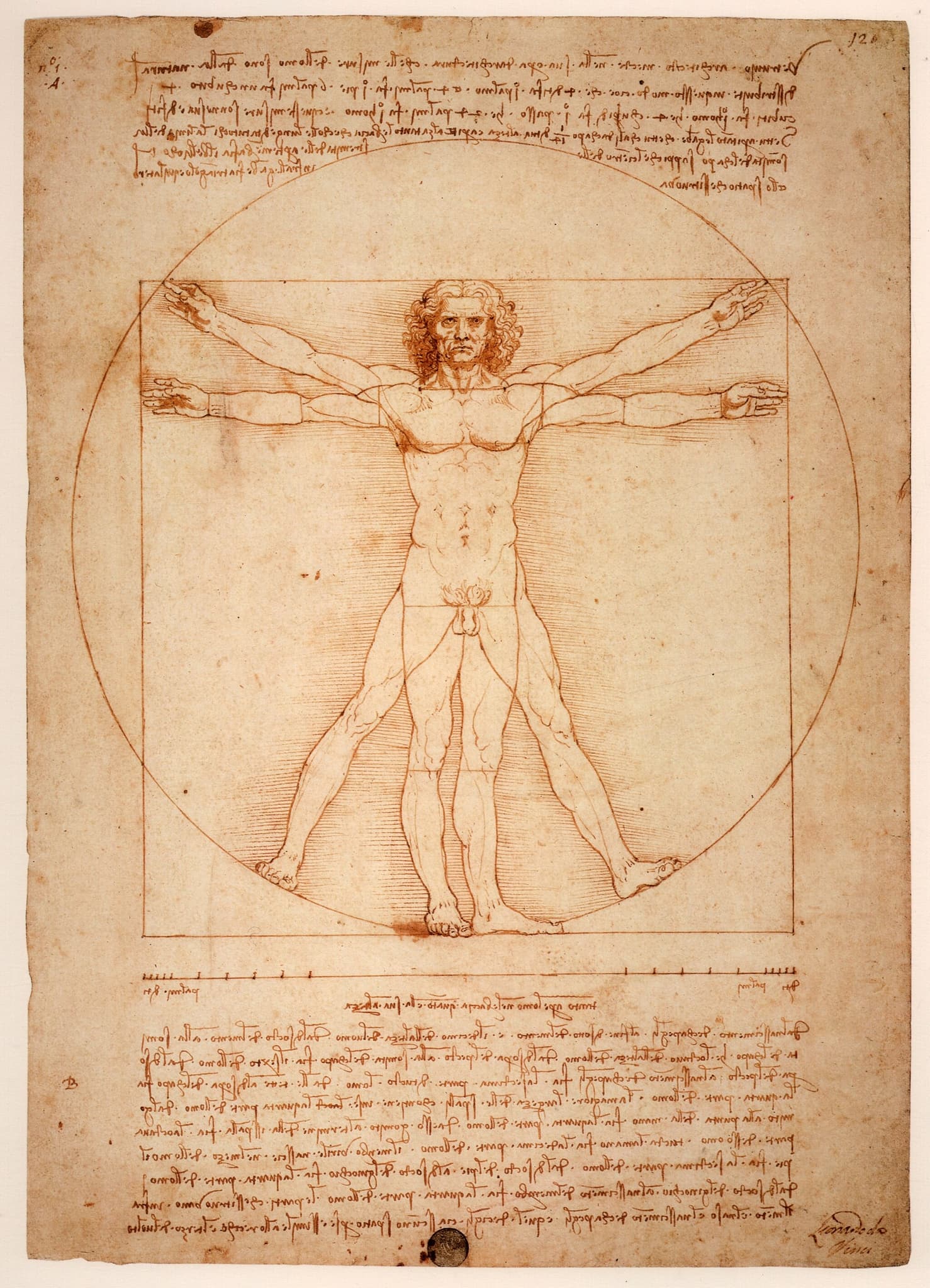
Vitruvian Man
Leonardo da Vinci, 1498 (museum catalog; often cited traditionally as c. 1490) • Metalpoint, pen and ink, touches of watercolor on white paper
Read full analysis of Vitruvian Man →Valuation Analysis
Conclusion: In a hypothetical, unrestricted international sale, we estimate Leonardo da Vinci’s Vitruvian Man at $650 million–$1.1 billion. This range places the work decisively above the $450.3 million price realized by Salvator Mundi, the current auction record for any artwork, reflecting Vitruvian Man’s unmatched cultural status, secure authorship, and the extremity of demand for autograph Leonardo material [1].
Methodology and benchmarks: We extrapolate from (i) Leonardo’s top painting result (Salvator Mundi, $450.3m) as a hard market anchor [1]; (ii) the autograph drawing record for Leonardo (Head of a Bear, c.$12.2m) that demonstrates appetite despite tiny supply in this medium [2]; (iii) the high‑water marks for Old Master works on paper—Raphael’s Head of a Muse at c.$48m (≈$72m in today’s dollars) and Leonardo’s Codex Leicester at $30.8m (≈$60m+ today) [3][4]. While single‑sheet drawings typically trade at a discount to paintings, Vitruvian Man is an outlier: it is arguably the most famous drawing in Western art and one of Leonardo’s most emblematic images, collapsing art, anatomy, and mathematics into a universal icon.
Why the estimate exceeds painting records: Several forces justify a price above the Salvator Mundi benchmark. First, iconicity: Vitruvian Man is globally recognizable across disciplines and cultures; it functions as a “brand” for Renaissance humanism. Second, attributional certainty: unlike the debated Salvator Mundi, Vitruvian Man’s authorship is not in serious scholarly doubt—critical for top‑tier buyers. Third, scarcity: autograph Leonardo drawings of this caliber almost never come to market; the 2021 drawing record at ~$12m underscores how microscopic the supply is, not the ceiling of demand [2]. The result is a plausible “trophy premium” that can compress or even invert the usual medium discount against paintings.
Market context: After a softer 2024, Old Masters rebounded in 2025, with masterpiece‑grade lots drawing concentrated, global competition. Institutional and sovereign buyers, foundations, and UHNW collectors are all natural bidders for a work of this stature, supporting both depth and aggressiveness at the very top of the market [6]. In such conditions, an iconic Leonardo drawing could attract unprecedented guarantee structures and cross‑category bidding.
Legal status and salability: Vitruvian Man is held by the Gallerie dell’Accademia, Venice, and, as Italian State cultural property, is effectively inalienable under the Italian Code of Cultural Heritage; permanent export is prohibited save for regulated loans [5]. Our valuation therefore represents a theoretical fair‑market estimate assuming a legal pathway to sale and export. For insurance or indemnity settings under current law, values may be administratively set but are typically confidential.
Key Valuation Factors
Art Historical Significance
High ImpactVitruvian Man sits at the apex of Leonardo’s oeuvre and is arguably the single most famous drawing in Western art. Created c.1490, it synthesizes classical proportion (Vitruvius), empirical observation, and Renaissance humanism into an image taught across art, science, and design. Its didactic clarity and profound symbolism make it more than a study; it is a foundational statement linking art and mathematics. Among Leonardo’s works on paper, nothing rivals its cultural reach or scholarly centrality. This singular stature underpins demand that transcends the usual drawing market, inviting participation from museums, foundations, and sovereign buyers and justifying an estimate above even record‑setting painting results for the artist.
Artist Market Standing and Scarcity
High ImpactLeonardo’s market is defined by vanishingly scarce supply and unparalleled global demand. The $450.3m Salvator Mundi result is the all‑time auction record for any artwork, illustrating the competition for an autograph Leonardo even amid attribution debate. By contrast, autograph drawings by Leonardo hardly appear publicly; the small silverpoint Head of a Bear fetched about $12.2m in 2021, a price that reflects rarity more than any intrinsic ceiling. Most autograph works reside in institutions, leaving virtually no path to price discovery. In this context, an unquestionably autograph, universally recognized Leonardo would catalyze extraordinary bidding beyond standard Old Master parameters.
Medium, Condition, and Display Constraints
Medium ImpactAs an ink drawing on paper, Vitruvian Man is inherently light‑sensitive and fragile, and it is displayed only rarely to preserve its condition. In classical market logic, works on paper trade at a discount to oil paintings due to durability, scale, and display flexibility. However, for an outlier of this symbolic power, restrictions can heighten mystique and scarcity value rather than suppress demand. The work’s conservation‑driven exhibition limits would be fully acknowledged in due diligence and insurability, but at the trophy level they are unlikely to deter top buyers, especially institutional and sovereign collectors accustomed to managing high‑sensitivity works through rotational display and tight environmental protocols.
Legal Status and Marketability Constraints
High ImpactVitruvian Man is property of the Italian State in the Gallerie dell’Accademia, Venice. Under the Italian Code of Cultural Heritage, qualifying state cultural assets are inalienable, and permanent export of protected cultural goods is prohibited except under specific frameworks for loans. Practically, this means the drawing is not saleable today. Our estimate explicitly assumes a counterfactual in which alienation and international export are permitted. While such constraints can depress a theoretical fair‑market value in some cases, here the extraordinary fame, depth of global demand, and the potential for government‑to‑government or foundation‑led bids support a valuation that prioritizes cultural primacy over legal friction in the hypothetical scenario.
Cultural Iconicity and Trophy Premium
High ImpactVitruvian Man is a universal emblem—its image circulates far beyond art circles into medicine, architecture, education, and popular culture. At the ultra‑trophy level, such brand‑like recognition reliably amplifies price through intense cross‑category competition. Buyers include museums seeking once‑in‑a‑generation opportunities, mission‑driven foundations, and sovereign entities for whom cultural capital and national prestige justify aggressive bidding. In this arena, price formation often leaps beyond conventional comparables. The work’s instant recognizability, combined with unimpeachable authorship and historical gravitas, supports a premium that not only eclipses drawing records but plausibly surpasses Leonardo’s painting record in a fully competitive, globally marketed sale.
Sale History
Vitruvian Man has never been sold at public auction.
Leonardo da Vinci's Market
Leonardo da Vinci occupies a unique peak in the art market. The 2017 sale of Salvator Mundi at $450.3 million remains the highest auction price ever achieved for any artwork, setting a powerful reference point for the artist’s demand [1]. Autograph Leonardo works on paper are extraordinarily rare; the auction record for a Leonardo drawing, Head of a Bear, stands at roughly $12.2 million (Christie’s, 2021) [2]. Major autograph manuscripts—most notably the Codex Leicester, sold in 1994 for $30.8 million—demonstrate willingness to pay substantial premiums for Leonardo’s intellectual output [3]. With most autograph works held by institutions and minimal public supply, collector and institutional demand far exceeds availability, making any credible autograph Leonardo a magnet for unprecedented competition.
Comparable Sales
Salvator Mundi
Leonardo da Vinci
Same artist and ultimate trophy benchmark for Leonardo demand; demonstrates the upper bound of competition for an autograph Leonardo, albeit in a different medium (painting) with attribution debate.
$450.3M
2017, Christie's New York
~$594.9M adjusted
Head of a Bear (silverpoint drawing)
Leonardo da Vinci
Same artist and same broad category (autograph drawing on paper); the current auction record for a Leonardo drawing, showing market appetite for small autograph sheets.
$12.2M
2021, Christie's London
~$14.6M adjusted
Head of a Muse (black chalk drawing)
Raphael
Top-tier Old Master drawing benchmark (Renaissance master, similar period and medium). Establishes the high end for single-sheet drawings at auction.
$48.0M
2009, Christie's London
~$72.6M adjusted
Codex Leicester (scientific manuscript)
Leonardo da Vinci
Same artist; autograph scientific manuscript closely aligned with Leonardo’s theoretical investigations. A key precedent for high-value Leonardo works on paper (though multi-leaf, not a single iconic sheet).
$30.8M
1994, Christie's New York
~$66.7M adjusted
Current Market Trends
Old Masters experienced a softer 2024 but rebounded in 2025, with quality bifurcation intensifying: masterpiece‑grade works drew broad, global competition and strong sell‑through, while secondary material lagged. Institutional and foundation buyers remained active, and guarantees were frequently employed to secure headline lots. Within this context, Renaissance masterpieces continued to set or challenge records when truly best‑in‑class examples surfaced. For an icon on the order of Vitruvian Man, buyer depth would extend beyond traditional collectors to include museums and sovereign entities, reinforcing the likelihood of a trophy premium and aggressive bidding in any fully marketed, unrestricted sale [6].
Study print
Study this painting as a print
Pair the full artwork with a museum-style study sheet focused on one meaningful detail.
Sources
- The Guardian – Leonardo da Vinci’s Salvator Mundi sells for $450.3m
- The Art Newspaper – Head of a Bear sets new record for a Leonardo drawing
- Los Angeles Times – Bill Gates buys Leonardo da Vinci notebook for $30.8 million
- Guinness World Records – Most expensive Old Master drawing sold at auction (Raphael)
- Italian Cultural Heritage Code (Legislative Decree 42/2004)
- Art Basel & UBS Art Market Report 2026