How Much Is The Human Condition Worth?
Last updated: July 5, 2026
Quick Facts
- Insurance Value
- $160.0M (Assistant estimate based on 2024 Magritte record and standard insurance uplifts)
- Methodology
- comparable analysis
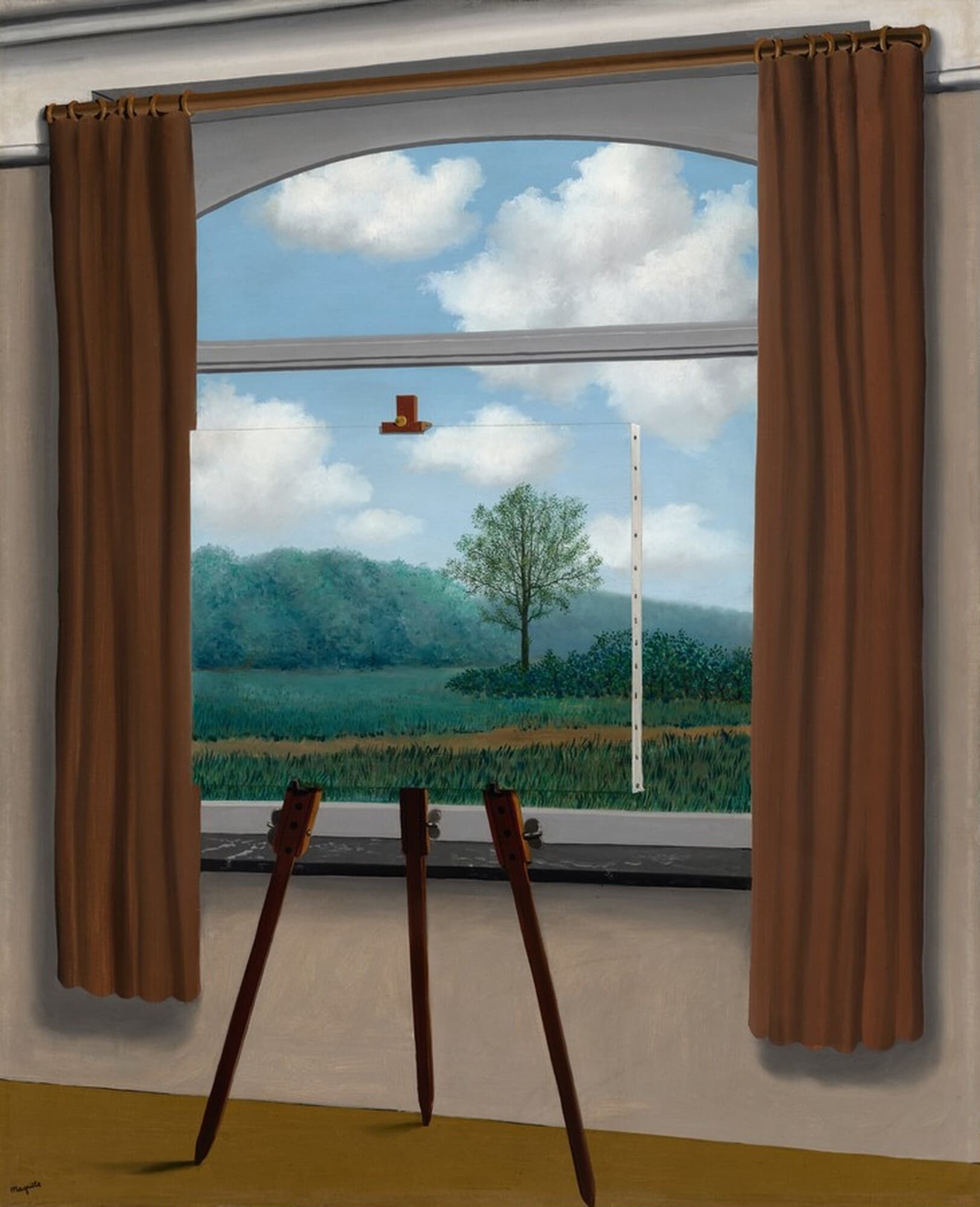
A prime, early-1930s oil-on-canvas from René Magritte’s canonical Human Condition series is valued at $100–140 million. This range is anchored to the artist’s 2024 record and the series’ top-tier art-historical stature, rarity, and global demand.
Valuation Analysis
Scope of valuation. This estimate prices a prime early-1930s oil-on-canvas from René Magritte’s Human Condition (La condition humaine) series—the signature window–easel motif that crystallizes his investigations into perception and representation—at $100–140 million. The best-known 1933 version is in the National Gallery of Art, Washington, D.C., and defines the motif’s canonical status within Magritte’s oeuvre and within Surrealism more broadly [1].
Comparable sales and triangulation. The range is calibrated to landmark Magritte auction benchmarks. In November 2024, an apex example of L’empire des lumières sold for $121.2 million, resetting the artist and category record and establishing the current ceiling for truly museum-caliber Magritte paintings [2]. Additional series examples and dates show the depth and gradation of demand: a 1961 L’empire des lumières achieved roughly $79.7 million in 2022, while a 1951 canvas realized $42.3 million in 2023, illustrating how date, scale, and image rank modulate outcomes [3][5]. Human Condition belongs to the top tier of Magritte imagery alongside Treachery of Images and Empire of Light, warranting a valuation that sits close to the current record under optimal sale conditions.
Rarity and period quality. Canonical, pre‑war Human Condition oils are exceptionally scarce in private hands. Museum retention underscores their importance: the 1933 NGA painting is institutionally held, and the 1935 Norwich Museum version has been the subject of technical scholarship (including the discovery of an earlier composition beneath), reinforcing its art-historical gravity [1][4]. Works of this period and calibre rarely surface; when they do, they attract broad, cross‑border demand, which materially compresses discounting and lifts price velocity at auction.
Assumptions and positioning. This estimate assumes a prime-scale canvas (approximately 100 × 81 cm), excellent condition, strong provenance and literature, and placement in a New York or London marquee Evening sale supported by robust third‑party interest/guarantee. Under these conditions, $100–140 million reflects the series’ centrality, the scarcity of A‑period oils, and the current market’s demonstrated capacity at the ultra‑trophy level. Lesser iterations (later dates, smaller formats, or compromised condition) would transact at meaningful discounts; conversely, an unimpeachable, fresh, early example could credibly challenge the upper half of this band given the 2024 high-water mark [2][5].
Conclusion. On a comparable‑driven, quality‑weighted basis, a museum‑caliber Human Condition oil from 1933–35 justifies a $100–140 million valuation today. This places the work squarely among the most valuable Surrealist paintings, aligned with the top echelon of Magritte’s market history and the image’s enduring cultural resonance [1][2].
Key Valuation Factors
Art Historical Significance
High ImpactThe Human Condition is a cornerstone of Magritte’s philosophy of seeing, staging the paradox of representation via the easel-in-front-of-a-window conceit. Its 1933 formulation fixed the image in the canon, making it one of the artist’s most cited and reproduced motifs. For museums, scholars, and collectors, it stands beside Treachery of Images and Empire of Light as a definitive statement of Surrealist thought. Works from the series are staples of survey exhibitions and textbooks, ensuring high cultural salience and long-term demand. This depth of recognition translates directly into market value, concentrating global bidding on rare opportunities to acquire a top-quality oil from the formative 1930s period.
Rarity and Supply
High ImpactCanonical early-1930s Human Condition oils are exceptionally scarce and are disproportionately retained by institutions. The best-known 1933 canvas resides in the National Gallery of Art, and another 1935 variant is held in Norwich, with a conservation history that has been closely studied and published. This scarcity intensifies competition when a major example emerges, compressing discount factors for condition, scale, or provenance. Compared with more numerous postwar iterations or works on paper, prewar oils of this subject have a much tighter float in the market, a core driver of the six- to nine-figure outcomes observed for Magritte’s most recognized images.
Provenance, Publication, and Exhibition
High ImpactFor a Human Condition oil at this level, blue-chip provenance (early private collections, thoughtful ownership chains) and extensive literature/exhibition history are expected and are price-positive. Canonical examples have been thoroughly published and frequently loaned to major institutions. Comprehensive documentation reduces transactional friction, while museum exposure amplifies reputational equity that bidders capitalize into price. Conversely, gaps in the ownership record or undisclosed restorations would trigger risk discounts. The valuation here assumes the strong, well-documented profile typical of premier examples and aligns with institutional-grade standards demanded by the top end of the market.
Market Benchmarks and Sale Context
High ImpactThe $121.2 million record for L’empire des lumières (2024) established current buying power for museum-caliber Magritte paintings, while earlier and adjacent benchmarks ($79.7 million in 2022; $42.3 million in 2023) chart the influence of series rank, date, and scale. A Human Condition oil of 1933–35 stature naturally prices near the top of this spectrum. Realization of the high estimate requires an optimal set-up: marquee New York or London evening sale, sophisticated global outreach, and a quality guarantee structure to catalyze bidder confidence. Under these conditions, competitive tension historically pushes A+ Magrittes toward record-adjacent outcomes.
Sale History
The Human Condition has never been sold at public auction.
Rene Magritte's Market
René Magritte is a blue-chip bellwether of the Surrealist market, with deep, global demand and constrained supply of A+ works. The artist’s auction ceiling was reset in November 2024 when L’empire des lumières achieved $121.2 million, the highest price ever paid for a Surrealist painting. Additional high-profile results—such as a 1961 Empire of Light at roughly $79.7 million in 2022 and a 1951 canvas at $42.3 million in 2023—map a robust, tiered market responsive to image rank, date, and scale. Top-period, museum-caliber oils reliably command eight- and nine-figure prices, while works on paper and later iterations attract strong but distinctly lower levels. Overall liquidity and cross-category collector interest remain strong.
Comparable Sales
L’empire des lumières (The Empire of Light), 1954
René Magritte
Same artist; apex, museum‑canonical motif. Benchmarks the current ceiling for A+ Magritte oils and brackets what a prime 1933–35 Human Condition could command under marquee conditions.
$121.2M
2024, Christie's New York
~$124.2M adjusted
L’empire des lumières (The Empire of Light), 1961
René Magritte
Same artist; iconic series but later variant. Indicates pricing for blue‑chip Magritte imagery below the absolute trophy example; useful discount reference versus a prime early‑1930s Human Condition.
$79.7M
2022, Sotheby's London
~$94.8M adjusted
L’empire des lumières (The Empire of Light), 1951
René Magritte
Same artist; top‑tier, widely recognized motif in a strong but not record example. Calibrates mid‑to‑high tier pricing for iconic Magritte imagery.
$42.3M
2023, Sotheby's New York
~$44.8M adjusted
Le seize septembre (September 16th), 1957
René Magritte
Same artist; iconic late‑1950s image. Useful to set the lower bound for important but non‑A+ Magritte oils compared to a canonical Human Condition.
$19.6M
2019, Christie's New York
~$24.7M adjusted
La reconnaissance infinie (Infinite Recognition), 1933
René Magritte
Same artist; same early‑1930s pre‑war period as The Human Condition and conceptually aligned. Benchmarks what strong 1933 works fetch when not from the artist’s very top motifs.
$13.3M
2025, Christie's London
La magie noire (Black Magic), 1934
René Magritte
Same artist; early‑to‑mid‑1930s oil close in period and ambition to Human Condition. Shows demand for blue‑chip 1934 imagery below the absolute canonical series.
$12.4M
2025, Sotheby's Paris
Current Market Trends
Surrealism has enjoyed sustained momentum, with institutional programming, scholarship, and high-profile auctions drawing new collectors and reinforcing top-tier valuations. Within this category, Magritte leads both in cultural visibility and price depth, and landmark results have expanded the ceiling for museum-grade examples of his most iconic motifs. Market behavior is highly selective at the top: freshness, prime period, and ironclad provenance capture outsize premiums, while later or secondary variants transact at rational discounts. Marquee New York and London evening sales continue to be the preferred venues for record-level results, with guarantees and global outreach serving as effective catalysts for competitive bidding.
Sources
- National Gallery of Art – La condition humaine (1933) object page
- Bloomberg – Magritte sells for $121 million, sets Surrealism auction record (Nov 2024)
- Sotheby’s – 9 René Magritte (includes $42.3m 1951 Empire of Light result)
- npj Heritage Science – Technical study of La condition humaine (1935), Norwich
- Bloomberg – 1961 Empire of Light sells for £59.4m (~$79.7m) at Sotheby’s London (Mar 2022)