How Much Is This is Not a Pipe Worth?
Last updated: February 10, 2026
Quick Facts
- Last Sale
- $115K (1978, Sotheby's Parke-Bernet, New York)
- Methodology
- extrapolation
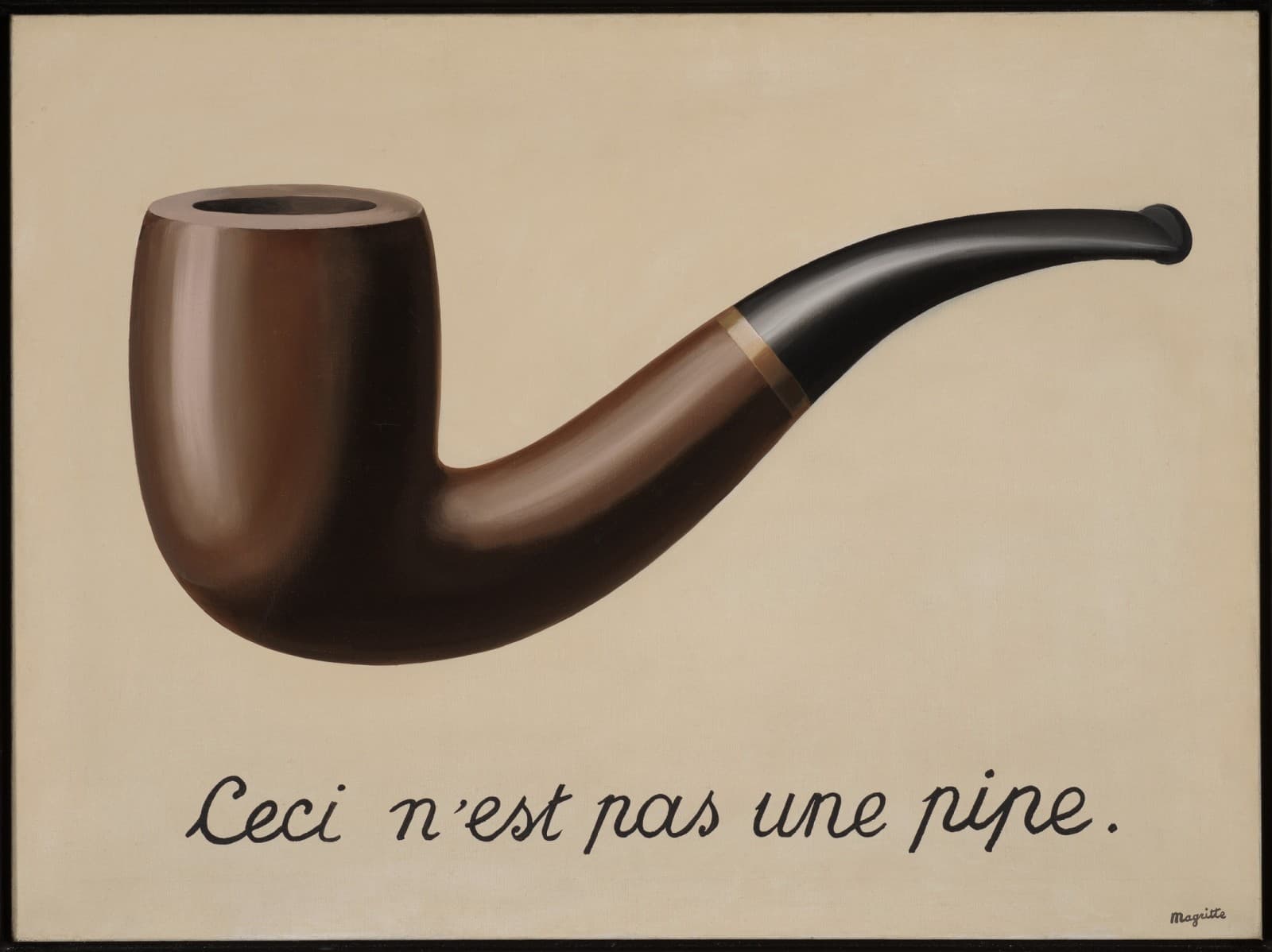
We estimate René Magritte’s The Treachery of Images (Ceci n’est pas une pipe), 1929, at $160–220 million. This range extrapolates above the artist’s $121.2 million auction record, reflecting the work’s singular, canonical status in 20th-century art and near-zero supply of equivalents.
Valuation Analysis
Overview. René Magritte’s The Treachery of Images (Ceci n’est pas une pipe) (1929) at LACMA is the definitive articulation of the artist’s investigation into language and representation—arguably his most conceptually important image and one of the most cited works of the 20th century [1]. It is a museum cornerstone with an unimprovable exhibition and publication history, and it has not appeared on the market since the 1970s.
Ownership and sale history. The painting’s provenance passes through key Surrealist promoter E.L.T. Mesens and the seminal collectors William and Noma Copley before entering LACMA, which acquired it at Sotheby’s Parke‑Bernet, New York, on May 17, 1978, for $115,000 [1][2]. Since then, no public sale has occurred. Any valuation is therefore hypothetical, but trophy-level comparables and recent record-setting Magritte results provide a robust pricing framework.
Market anchors. Magritte’s ceiling reset decisively in November 2024 when Christie's New York sold L’empire des lumières (1954) for $121.16 million, establishing both the artist’s and Surrealism’s first nine‑figure auction result [3][5]. This followed the March 2022 record of £59.4 million (~$79.8 million) in London for another L’empire des lumières, marking a step-change in pricing for top-tier Magritte masterpieces across market cycles [4]. High-quality works in the next tier—e.g., L’ami intime at ~$43 million (2024)—demonstrate strong depth below the apex [5], while dedicated Surrealism sales in 2025 posted 96% sell-through, underscoring category resilience [6].
Extrapolation to the estimate. Within Magritte’s oeuvre, The Treachery of Images is uniquely canonical: it is more central to art history and cultural discourse than any L’empire des lumières, despite that series’ broader decorative appeal. On significance alone, it merits a premium to the $121.2 million benchmark. Supply is effectively non-existent—this is the singular 1929 oil, museum-held, with no direct substitute—further supporting scarcity pricing. Balancing that premium against the narrower liquidity band above $150 million and normalizing for today’s selective, guarantee-driven trophy market, we underwrite a $160–220 million range. In a competitive setting with institutional or cross‑category private capital, it would be positioned to set a new Magritte record [3][6][7].
Positioning and sensitivities. Key value drivers include unmatched art-historical importance, iconic recognizability, bulletproof provenance, and sustained demand for masterworks of Surrealism during and after the centenary cycle [6][8]. Usual trophy-lot sensitivities apply: condition particulars (not publicly disclosed) and any deaccession restrictions can shift underwriting. Nonetheless, relative to all available benchmarks, The Treachery of Images occupies the absolute apex of Magritte’s market, justifying an estimate clearly above the current record and consistent with the proposed range [1][3][6].
Key Valuation Factors
Art Historical Significance
High ImpactThis 1929 painting is the canonical statement of Magritte’s investigation into the slippage between words, images, and things—arguably his most influential idea and one of the most reproduced images in modern art. It anchors scholarship on semiotics in painting and underpins much of conceptual art’s later discourse. Within Magritte’s oeuvre, it outranks even the celebrated L’empire des lumières series in intellectual primacy, giving it singular cultural weight. That centrality materially increases its scarcity premium and justifies extrapolating above the artist’s auction record. In valuation terms, this positions the work at the absolute apex of the Magritte market and the broader Surrealist category.
Rarity and Supply Constraints
High ImpactThis is the definitive 1929 oil of the ‘pipe’ motif; while related drawings, prints, and later variants exist, there is no true substitute for this composition. It is held by a major museum (LACMA), making an actual sale exceedingly unlikely. Effective market supply for an equivalent is therefore near zero. In auction dynamics, such structural scarcity commands a steep premium above even top‑series comparables, because trophy‑level buyers cannot replicate the narrative or art‑historical leverage elsewhere. That supply profile strongly supports a range comfortably above the existing $121.2m Magritte benchmark, even in a selective macro environment.
Market Benchmarks and Demand Depth
High ImpactMagritte’s market established a nine‑figure ceiling in 2024 ($121.16m) and demonstrated resilience across tiers: ~$43m for a late‑1950s icon in 2024 and mid‑teens for strong pre‑war works in 2025. Dedicated Surrealism sales achieved high sell‑through, indicating sustained depth even as broader evening sales became more selective. Cross‑category collectors, institutions, and guarantors consistently back prime Magrittes, creating robust underwriting conditions. Against this backdrop, a masterpiece of greater historical centrality than the current record-holder warrants an extrapolated premium, supporting a $160–220m range with plausible competitive upside.
Provenance, Exhibition, and Literature
Medium ImpactThe provenance chain—artist; Galerie Le Centaure; E.L.T. Mesens; William & Noma Copley; LACMA—reads as a who’s‑who of Surrealist stewardship. The 1978 acquisition by LACMA at Sotheby’s Parke‑Bernet confirms clean market passage, and the work’s continuous museum custody since has ensured top‑tier exposure, scholarship, and conservation oversight. Publication and exhibition saturation elevate confidence for trophy‑level bidders and often compress discount rates applied to uncertainty. While these factors are already capitalized in the work’s fame, they remain critical supports for pricing at and above the artist’s current record.
Sale History
Sotheby's Parke-Bernet, New York
La trahison des images (Ceci n’est pas une pipe), oil on canvas, Lot 70, Sale 4124; acquired by LACMA.
Rene Magritte's Market
René Magritte is the market leader of historical Surrealism, with deep global demand from cross‑category collectors and institutions. His auction record stands at $121.16 million for L’empire des lumières (1954), sold at Christie’s New York on November 19, 2024, the first nine‑figure result for Surrealism. A prior record at ~$79.8 million in 2022 and a $43.2 million result in 2024 for L’ami intime illustrate a clear price ladder from strong mid‑tier to apex trophies. Supply of prime oils is constrained, with third‑party guarantees often supporting top lots. In this context, Magritte’s icons are widely viewed as blue‑chip anchors with resilient liquidity at the high end.
Comparable Sales
L’empire des lumières
René Magritte
Same artist; most market-dominant, trophy-tier Magritte motif. Establishes the current ceiling for blue-chip Magritte oils and is the best market proxy for an icon of comparable stature to 'Pipe'.
$121.2M
2024, Christie's New York
~$123.6M adjusted
L’empire des lumières
René Magritte
Same artist; prior record before 2024. Another top example from the artist’s signature series, useful to bracket pricing for masterpiece-level Magrittes across differing market climates.
$79.8M
2022, Sotheby's London
~$86.2M adjusted
L’ami intime
René Magritte
Same artist; late‑1950s, museum‑caliber oil demonstrating demand for non‑'Empire of Light' icons. Shows where high‑quality but less universally emblematic Magrittes transact.
$43.2M
2024, Christie's London
~$44.1M adjusted
La reconnaissance infinie
René Magritte
Same artist; early‑1930s Surrealist oil closer in period to the 1929 'Pipe'. Indicates pricing for strong pre‑war works outside the absolute top tier.
$13.3M
2025, Christie's London
Le Banquet
René Magritte
Same artist; recurring 1950s motif with broad collector appeal. Useful for calibrating the upper‑mid tier below the artist’s canonical icons.
$18.1M
2024, Sotheby's New York
~$18.5M adjusted
Le Jockey perdu
René Magritte
Same artist; wartime variation on a signature, early motif. Benchmarks the liquid mid‑tier and helps define the broader demand curve beneath trophy level.
$12.3M
2025, Sotheby's New York
Current Market Trends
The top end of the 20th‑century market is selective but robust for irreplaceable masterpieces. Surrealism, boosted by its 2024 centenary and high‑profile institutional shows, has enjoyed strong sell‑through and headline results, with Magritte functioning as a category bellwether. Guarantees and cross‑category bidding underpin nine‑figure outcomes even as overall volumes and mid‑tier appetite normalize. In 2025, dedicated Surrealism sales posted high sell‑through, and blue‑chip Magrittes continued to meet or beat estimates. Against this backdrop, a uniquely canonical work such as The Treachery of Images commands a premium above the artist’s record, reflecting both its cultural centrality and near‑zero supply.
Study print
Study this painting as a print
Pair the full artwork with a museum-style study sheet focused on one meaningful detail.
Sources
- LACMA Collections: René Magritte, The Treachery of Images (Ceci n’est pas une pipe), 1929
- Los Angeles Times: The Big Art Sales of 2006 (archive note referencing LACMA’s 1978 price)
- Christie’s Press: MICA—The Collection of Mica Ertegun Part I (Magritte record $121,160,000)
- Bloomberg: Magritte’s The Empire of Light sells for record ~$80m (Mar 2, 2022)
- Wall Street Journal: Christie’s $486m Evening Sale led by Magritte record
- Christie’s: 20th/21st Century London Results (Mar 2025) – Surrealism sale performance
- The Art Newspaper: Sotheby’s Modern Evening Sale – Surrealism and Carrington record
- Apollo Magazine: Surrealism at the Centre Pompidou – Centenary exhibition