How Much Is The Menaced Assassin Worth?
Last updated: March 18, 2026
Quick Facts
- Methodology
- comparable analysis
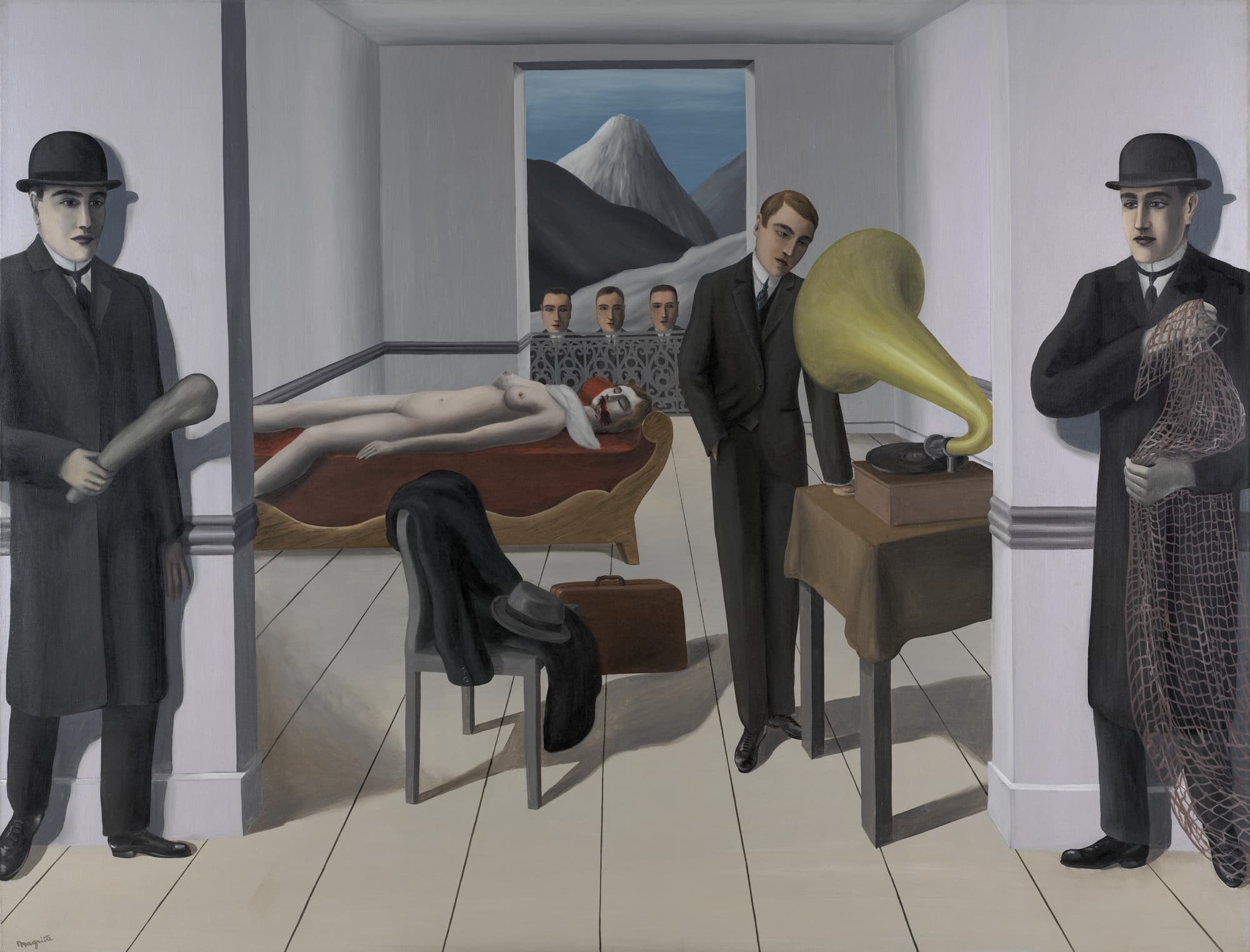
René Magritte’s The Menaced Assassin (1927), a large, canonical early Surrealist oil now in MoMA’s collection, would—if ever offered—most plausibly realize in the range of $20–60 million. This range is built from direct auction comparables for museum‑quality Magritte oils, the work’s strong provenance/exhibition record, and standard condition/provenance adjustments.
Valuation Analysis
Estimate and context. The Menaced Assassin (1927), currently in the Museum of Modern Art’s permanent collection, is a major early Surrealist narrative canvas. Treated as a hypothetical market offering, the defensible realized range is approximately $20–60 million. The range rests on a direct comparables approach—anchoring to recent high‑profile Magritte auction outcomes, adjusted downward for the painting’s early‑period position relative to later masterpieces and upward for institutional provenance and exhibition history [1][2].
Why this band is credible. The upper and lower anchors come from realized auction behavior for canonical Magritte oils. A later‑period masterpiece reset the market ceiling in 2024, creating a demonstrable buyer willingness to pay many tens of millions for museum‑quality Magritte canvases [2]. Mid‑period comparables in the $10–45M band show active demand for single‑owner, well‑provenanced works. Placing The Menaced Assassin in the $20–60M band recognizes that it is an emblematic 1927 painting—important, large, frequently published and exhibited—but not part of the later, marquee series (e.g., Empire of Light) that have recently realized the top record prices [2][3].
Provenance and exhibition support the upper end. The MoMA acquisition history (purchase from E.L.T. Mesens; accession no. 247.1966) and prominent inclusion in Magritte retrospectives materially strengthen market confidence in authenticity and provenance, which are decisive at this price level [1]. A clean, continuous provenance and strong exhibition history typically add premium value; were the painting to be offered in an evening sale with institutional bidders and competitive private buyers, it would be positioned toward the top of the stated range.
Caveats and downside risks. The primary practical downgrades are: (1) the work is museum‑held and deaccessioning of canonical works is rare and tightly regulated (likely reducing liquidity), (2) any undocumented restorations or condition issues discovered in a pre‑sale report would lower realized value, and (3) market sentiment at the sale moment (macro liquidity, buyer appetite for genre) can compress or expand final results. These considerations justify the width of the band and the conservative lower bound.
Final practical view. In a competitive major‑house evening auction the painting could reasonably reach the mid‑to‑upper part of this range ($30M+); in a more constrained sale scenario or with condition/provenance questions it could settle nearer the lower bound. Because The Menaced Assassin is effectively non‑market while in MoMA, this remains a hypothetical, market‑tested estimate rather than a price established by a recent public sale [1][2].
Key Valuation Factors
Art Historical Significance
High ImpactThe Menaced Assassin is one of Magritte’s emblematic early Surrealist narrative canvases (1927). It is large, theatrically composed and frequently reproduced in scholarship and exhibition catalogues, giving it above‑average cultural capital within the artist’s oeuvre. Early, canonical works that are both visually distinctive and well documented carry a premium because they are scarce in market circulation; collectors prize narrative, museum‑quality canvases from formative moments in an artist’s career. This high art‑historical standing directly supports a multi‑million dollar market placement and justifies positioning the work near the upper‑mid tier of Magritte offerings.
Provenance & Exhibition History
High ImpactA clear, institutional provenance—Galerie provenance to E.L.T. Mesens and acquisition by MoMA in 1966—materially reduces title and authenticity risk and increases buyer confidence. The painting’s inclusion in major Magritte retrospectives and standard reproduction in scholarly literature strengthens pedigree and marketability. Institutional ownership is a double‑edged factor: it signals top quality (supporting higher value) but also means the work is effectively off the market unless deaccessioned, which restricts liquidity and the practical likelihood of a sale.
Market Comparables & Recent Record Sales
High ImpactRecent realized prices for museum‑quality Magritte oils create the primary market anchors. A late‑period masterpiece reset the auction ceiling in 2024, demonstrating buyer willingness to pay well into the tens of millions for canonical works; other notable sales in the $10–45M range show consistent demand for high‑quality canvases. These comparables allow a reasoned interpolation: Menaced Assassin’s early date and canonical status place it above routine works but below the very few series‑defining masterpieces that set extreme records.
Condition & Conservation
Medium ImpactCondition statements and conservation history are determinative at this price level. Museum stewardship typically implies stable condition, but any documented overpainting, structural issues or major restoration would directly depress market value. Conversely, pristine or well‑documented conservation can add a premium. Absent a public condition report, valuation includes a conservatively sized downward adjustment to reflect potential unknowns.
Market Liquidity & Deaccessionability
Medium ImpactBecause the painting resides in a major public collection, practical liquidity is limited; deaccession procedures and institutional policy make bona fide market offerings improbable. If deaccessioned, the sale would be highly visible and attract both museums and top private buyers, potentially increasing competitive bidding and realized price. The rarity of such events is a moderating factor on near‑term marketability and is incorporated into the lower bound of the estimate.
Sale History
Rene Magritte's Market
René Magritte occupies blue‑chip status among 20th‑century Surrealists. Recent years have produced record, headline results—most notably a 2024 sale that reset the auction ceiling for the artist—while a steady stream of multi‑million dollar sales for museum‑quality oils demonstrates sustained collector demand. Price dispersion is wide: a handful of masterpieces trade for tens of millions (or more), while important but less iconic oils and large high‑quality works more commonly trade in the mid‑seven to low‑eight‑figure band. Provenance and exhibition history remain decisive in moving works to the higher end.
Comparable Sales
L'empire des lumières (1954)
René Magritte
Same artist; large, canonical Magritte oil that set the auction ceiling in Nov 2024—useful as an upper‑end benchmark for top‑quality museum‑caliber Magritte works (though it is a later‑period masterpiece, 1954, versus Menaced Assassin, 1927).
$121.2M
2024, Christie's New York
~$124.8M adjusted
L'ami intime (1958)
René Magritte
Same artist; high‑profile late‑period Magritte sold March 2024 for ~US$43.2M—demonstrates multi‑tens‑of‑millions demand for single, well‑provenanced canonical oils and a realistic mid/high market reference for museum‑quality works.
$43.2M
2024, Christie's London
~$44.5M adjusted
La Statue volante (1958)
René Magritte
Same artist; sold in a high‑profile single‑owner sale (Pauline Karpidas collection) in Sept 2025 for ~US$13.7M—represents a strong upper‑mid market outcome for a quality Magritte canvas and a plausible lower bound for important works offered at auction.
$13.7M
2025, Sotheby's London
Current Market Trends
Surrealism enjoyed renewed institutional attention around the 2024 centenary and a wave of high‑profile sales that increased collector visibility. The top end is selective—exceptional pictures attract outsized prices—while the broader high‑end market has shown caution. Continued institutional programming and controlled supply of museum‑quality works will be the key drivers of sustained price momentum.