The Inscription in This is Not a Pipe
A closer look at this element in Rene Magritte's 1929 masterpiece
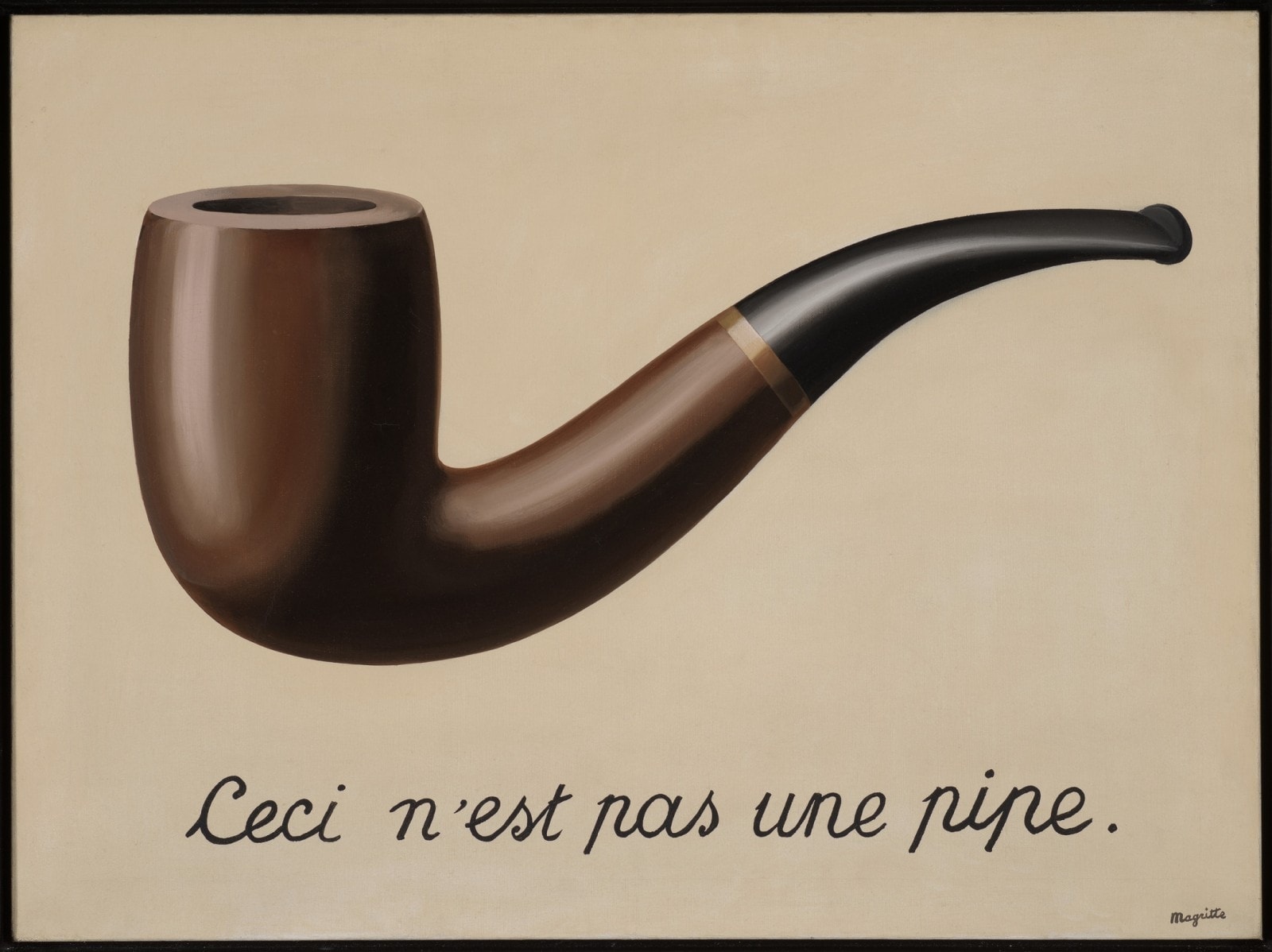
Magritte’s painted sentence—“Ceci n’est pas une pipe”—turns a faithful image into a sharp proposition about how pictures and words relate. Rendered like a tidy advertisement caption, the inscription denies the painting’s identity with a real pipe and launches a modern lesson in representation.
Historical Context
Magritte painted The Treachery of Images in 1929 while living in Paris, a period when he probed the volatile bond between names, images, and things. That December he published “Les mots et les images” in La Révolution surréaliste, a set of pointed theses showing that pictures do not say the same thing as words and that captions can complicate, not clarify, what we see. The canvas stages this investigation directly: a meticulously rendered pipe is paired with the cursive sentence “Ceci n’est pas une pipe,” a textual intervention that makes the painting an argument rather than a mere likeness 1.
Museum scholarship groups the work with Magritte’s late‑1920s “word paintings,” devised to sever automatic equivalences between seeing and saying. In this framework, the inscription functions as an analytical device: it blocks the viewer’s habitual leap from image to object and invites reflection on how language operates within visual culture. MoMA describes the project as liberating painting from the expectation that an image is the same as what it represents—precisely the claim the inscription enforces 2.
Symbolic Meaning
The inscription’s statement—“This is not a pipe”—is not a paradox but a precise assertion of difference: a painted pipe cannot be packed, lit, or smoked. It is a sign, not a thing. Magritte himself articulated this blunt logic—no one could smoke the pipe in his picture—making the sentence literally true and turning the painting into a didactic demonstration about representation 3. In this way, the inscription foregrounds the arbitrariness of signs and the gap between depiction, naming, and reality, a problem that would become central to modern semiotics.
Michel Foucault later described the work as an “unraveled” or undone calligram, where image and text refuse to fuse into a single, self-confirming sign. The deictic “This” in the sentence destabilizes reference: does it point to the painted pipe, the sentence itself, or the entire canvas? By withholding a stable anchor, the inscription forces viewers to recognize that words and images circulate in distinct systems that only sometimes align 4. Within Surrealism’s broader project of estranging the everyday, the phrase is a cool, logical tool: it punctures the illusion that pictures deliver the things they depict and trains the eye to read, and doubt, simultaneously 53.
Artistic Technique
Magritte renders the inscription in neat, schoolbook French cursive across a flat, warm tan ground. The even baseline, generous letter spacing, and dark, ink-like strokes give the words the clarity of a slogan, mirroring the canvas’s poster-like layout 63. Positioned beneath a crisply modeled pipe—lit to emphasize its volume and smooth finish—the line of text functions like a commercial caption, but one that negates rather than sells.
The restrained palette and planar background suppress painterly incident so the sentence reads with maximum legibility. Smarthistory notes that the combination of hyper-clear object plus caption evokes catalog illustrations or classroom flashcards, a deliberately didactic presentation that makes the inscription feel authoritative even as it contradicts expectation 76.
Connection to the Whole
Compositionally, the inscription anchors the image like a baseline in a poster, stabilizing the pipe above it. Conceptually, it is the painting’s hinge: without the words, the canvas would be an exemplary still-life; with them, it becomes a proposition about the “treachery” of images and the non-identity of representation and object 63.
The sentence reframes the viewer’s encounter with the entire work, redirecting attention from mimetic skill to the logic of signs. Its decisive negation—“not a pipe”—performs the title’s claim and sets a template Magritte would revisit in later variations (such as Les Deux mystères), continually testing how text can unmoor or reframe what pictures seem to state 3.
Explore More from This Painting
This detail is one part of This is Not a Pipe. Use the links below to return to the full interpretation, browse the full set of details, or view the painting's valuation if available.
Sources
- MoMA audio/labels on Magritte’s words-and-images investigations
- MoMA press release: Magritte—The Mystery of the Ordinary (on image vs. representation)
- Encyclopaedia Britannica: The Treachery of Images
- University of California Press: Michel Foucault, This Is Not a Pipe
- Centre Pompidou teacher resource on image and word (Magritte/Foucault context)
- LACMA collection record for The Treachery of Images
- Smarthistory analysis of The Treachery of Images