The Painted Pipe in This is Not a Pipe
A closer look at this element in Rene Magritte's 1929 masterpiece
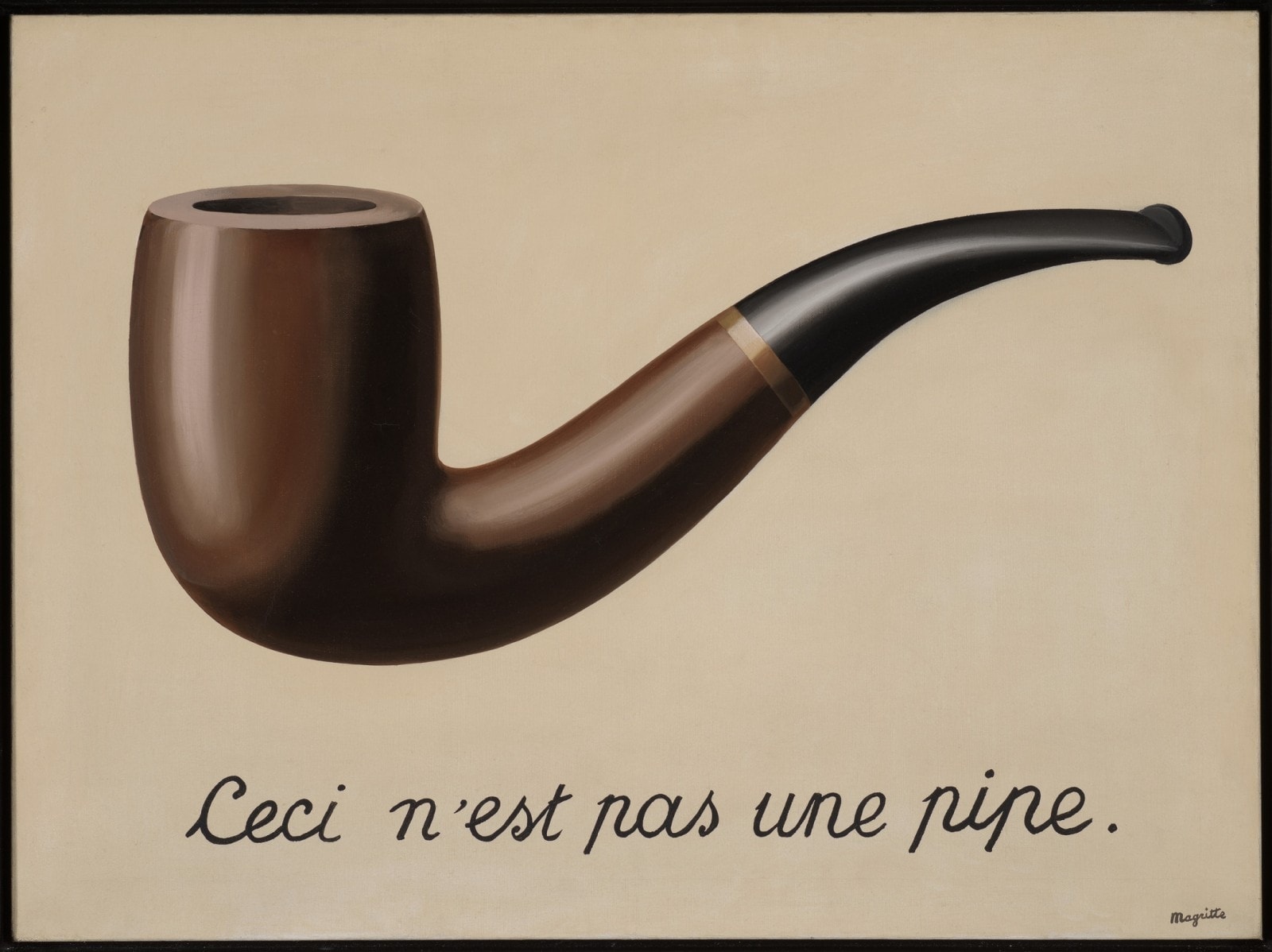
Magritte’s painted pipe is a coolly precise image that denies being what it so convincingly depicts. By pairing an idealized briar pipe with the phrase Ceci n’est pas une pipe, he turns a familiar object into a device that exposes how pictures and words point to things without ever becoming them. This deceptively simple element helped pivot modern art toward language, concept, and critique.
Historical Context
1929 was a crystallizing moment in Magritte’s exploration of images and language. That year he set down his ideas in Les mots et les images, and The Treachery of Images stages those propositions with billboard clarity: a single, exemplary pipe and a line of cursive that contradicts what the eye believes. The canvas belongs to LACMA, whose entry underscores its advertisement-like presentation—a nod to Magritte’s early work in commercial graphics, where the clean legibility of product plus caption is paramount 1.
MoMA’s materials connect the painting directly to Magritte’s contemporaneous writings, noting how his diagrams and aphorisms about the slippage between words and pictures feed into the pipe-and-text pairing. The layout borrows the didactic authority of signage while withdrawing the guarantees that signs usually deliver. In short, the historical stakes of the painted pipe lie in its precise timing and format: it is the visual counterpart to Magritte’s theorizing in the late 1920s and the most concise demonstration of his word–image problem set 2.
Symbolic Meaning
The pipe operates as a primer in semiotics. It dramatizes the split between the signifier (image and inscription) and the signified (a physical, smokeable pipe). Encyclopaedia Britannica frames the juxtaposition as proof that both words and pictures are systems of reference, not the thing itself 3. Michel Foucault, in This Is Not a Pipe, reads Magritte’s staging as the unmaking of the calligram: image and name refuse to coincide, preventing any naïve fusion of seeing and saying 4. Smarthistory likewise emphasizes the tug-of-war between visual conviction and linguistic authority, a tension that makes viewers police their own assumptions about representation 5.
Magritte’s own clarification—one cannot stuff or light the pictured pipe—sharpens the point: representation is not identity 6. This simple lesson ripples outward. The pipe becomes a hinge between Surrealism’s poetics of estrangement and later Conceptual Art’s turn to language and idea, echoed across the work of artists from Broodthaers to Ruscha 35. Within the Surrealist milieu, where slogans like “Poetry is a pipe” circulated, Magritte’s element functions as a cool rebuttal, relocating poetry from resemblance to thought—where the picture’s authority must be earned, not assumed 8.
Artistic Technique
Magritte renders the pipe with smooth, catalog-like naturalism: soft gradients model the briar bowl and ebonite stem; contours are crisp; brushwork is subdued to near invisibility. Set against an even beige ground, the object floats without cast shadow, stripped of context so it reads as an archetype rather than a particular brand or specimen 15.
Below, a line of neat, impersonal cursive behaves like a caption. Critics have noted its schoolbook regularity—more penmanship than personal flourish—which lends the phrase an instructional tone that counters the eye’s trust in the image 7. The entire arrangement borrows the legibility of advertising while withholding its promise of truth, a calculated clarity that makes the ensuing contradiction impossible to miss 15.
Connection to the Whole
The painted pipe is the engine of the painting’s paradox. Its persuasive realism invites assent, while the caption withdraws that assent, forcing a choice between what looks real and what language asserts. This engineered clash is the work’s subject: the gap between depiction, naming, and thing 5.
Because the pipe is isolated, centered, and treated as an ideal type, it can bear the full weight of Magritte’s argument; nothing distracts from the confrontation between image and text. LACMA’s reading positions the canvas as an icon precisely for this clarity, while reference sources link it to Magritte’s long series of word–image experiments that follow 13. The element does not illustrate a paradox—it performs one, making viewers experience how representation persuades, misleads, and finally reveals its own limits.
Explore More from This Painting
This detail is one part of This is Not a Pipe. Use the links below to return to the full interpretation, browse the full set of details, or view the painting's valuation if available.
Sources
- LACMA Collections — The Treachery of Images (This is Not a Pipe)
- MoMA — Magritte: The Mystery of the Ordinary (Words and Images)
- Encyclopaedia Britannica — The Treachery of Images
- Michel Foucault — This Is Not a Pipe (UC Press page/PDF)
- Smarthistory — René Magritte, The Treachery of Images
- Magritte Foundation — Artist statements on representation
- Los Angeles Times (1992) — On Magritte’s signboard image and penmanship
- Centre Pompidou — Exhibition materials on Surrealist context