The Ants on the Watch in The Persistence of Memory
A closer look at this element in Salvador Dali's 1931 masterpiece
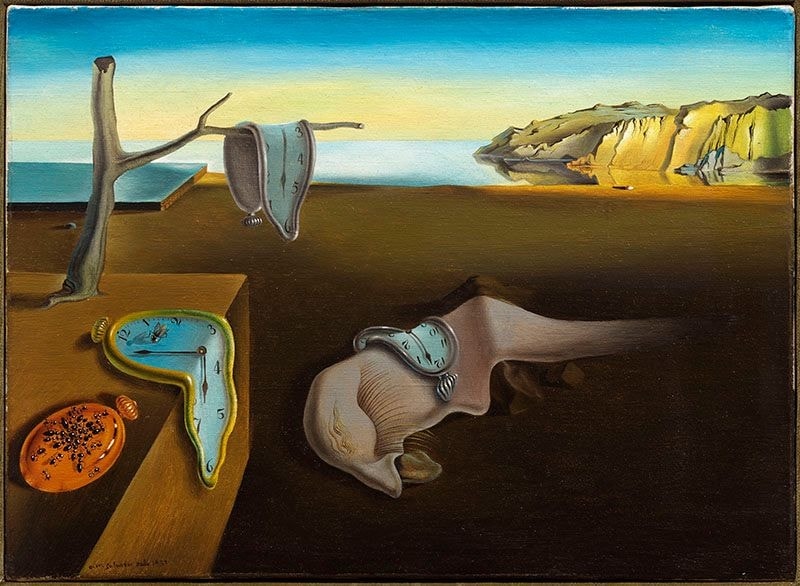
In the lower-left corner of Dalí’s The Persistence of Memory, a copper-colored pocket watch lies face-down as a tight cluster of 25 shiny black ants overruns its case. This lone “hard” watch resists melting, yet it is actively consumed—an image that turns a precision instrument into carrion and makes time itself feel perishable. The swarm is a compact key to Dalí’s Surrealism: seductive, meticulous, and unsettling all at once.
Historical Context
Dalí painted The Persistence of Memory in 1931, the moment he crystallized his Surrealist, paranoiac‑critical method—rendering dream imagery with forensic clarity to destabilize ordinary perception. In this climate, the ants on the orange, face‑down pocket watch reprise a motif that had haunted his imagination since childhood encounters with insect‑covered carcasses and returned in the Surrealist film he co‑created two years earlier, Un Chien Andalou, where a hand crawls with ants 12. The swarm therefore arrives not as a casual detail but as a signature emblem within an already formed symbolic vocabulary.
Placed on the only non‑melting watch, the ants also respond to a period ambition: to fuse the rational and the irrational by yoking engineering’s pride—mechanical time—to nature’s agents of putrefaction. MoMA’s guide specifies a “cluster of 25 shiny black ants” on a “copper‑colored pocket watch,” underscoring Dalí’s documentary exactitude even as he courts dream logic 1. Wikipedia’s overview, echoing museum and scholarly consensus, situates these ants within Dalí’s lifelong fascination with decay and its visceral triggers in his youth 2.
Symbolic Meaning
The ants function as a portable memento mori. In earlier vanitas paintings, artists signaled mortality with flies, rot, and extinguished candles; Dalí updates that tradition by letting insects overrun a refined timepiece, implying that clock‑time is not merely measured but mortal—vulnerable to corruption and ultimately consumed 54. Smarthistory notes the ants appear to be “eating” or irresistibly drawn to the watch, sharpening the sense that time itself decays, rather than simply records decay 4.
Across Dalí’s oeuvre, curators at the Dalí Museum summarize ants as signs of death and putrefaction, but also as conduits for desire and anxiety—the Freudian undercurrents prized by Surrealism 3. On this watch, those associations fuse: the gleam of polished metal attracts the insects that signify rot, entwining attraction with repulsion. Phaidon similarly reads the ants (and the nearby fly) as creatures of carrion, tying Dalí’s still life of time to the baroque drama of vanitas 5. In short, the swarm literalizes entropy while tapping the unconscious—Dalí’s way of showing that beneath civilized precision instruments lies the body’s fate, gnawed by appetite and change 345.
Artistic Technique
Dalí paints the ants and their copper‑colored host with a painstaking, mirror‑smooth surface that heightens illusion—his “paralyzing tricks of eye‑fooling” precision. MoMA identifies “25 shiny black ants” massed over the closed case, their lacquered bodies catching pinpoint highlights against the warm, polished metal, a material contrast that makes both insect and object snap into focus 1. The swarm’s tight oval footprint reads almost like a burn or bruise on the watch, achieved through minute touches of black and umber, edged with crisp contours that suggest legs and glints without visible brushwork.
Composed at the lower left, the cluster anchors the foreground and sets a hard, glossy texture against the painting’s other surfaces—the melting watches, the flayed biomorph, and the powdery plain—an opposition MoMA’s curatorial commentary connects to Dalí’s relish for forms “in a state of becoming, unbecoming” 6.
Connection to the Whole
The painting stages two failures of time: most watches liquefy, while the lone rigid one is devoured. By assigning the ants to the only non‑melting watch, Dalí shows that “objective” time cannot hold; it either droops in dream or rots in reality, collapsing the authority of the clock from both ends 24. This double bind concentrates the Surrealist program—precision wedded to the irrational—so that an elegant pocket watch becomes a site of carrion, and vision toggles between seduction and disgust 16.
As a compositional device, the swarm’s dark punctuation balances the light‑struck cliffs and sky, while its visceral charge deepens the work’s vanitas thread alongside the fly and barren branch. The result is a hyper‑lucid dreamscape where memory “persists” even as life and matter decay—a tension widely noted in museum and scholarly commentary 167.
Explore More from This Painting
This detail is one part of The Persistence of Memory. Use the links below to return to the full interpretation, browse the full set of details, or view the painting's valuation if available.
Sources
- MoMA audio guide: The Persistence of Memory (work overview and element details)
- Wikipedia: The Persistence of Memory (context, motifs, watch contrast)
- The Dalí Museum: Ants as symbols across Dalí’s oeuvre
- Smarthistory: Dalí’s The Persistence of Memory (interpretive essay)
- Phaidon: The Persistence of Memory explained (vanitas, insects, decay)
- MoMA audio (Anne Umland): Curatorial commentary on dissolution and forms “becoming, unbecoming”
- Artsy Editorial: Understanding The Persistence of Memory (themes and iconography)