The Dead Tree in The Persistence of Memory
A closer look at this element in Salvador Dali's 1931 masterpiece
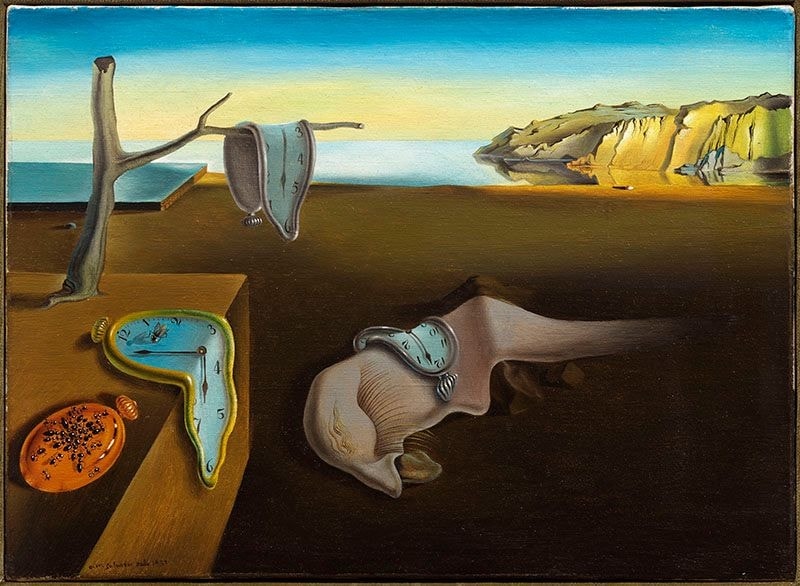
At the painting’s left edge, a leafless olive trunk rises from a geometric block, its brittle branch cradling a melting watch. This stark ‘dead tree’ moors Dalí’s dreamscape in his Mediterranean homeland while transforming a symbol of longevity into a quietly shocking emblem of time’s erosion and memory’s strain.
Historical Context
Dalí painted The Persistence of Memory in 1931, at the height of his Surrealist experimentation, yet he grounded its dream logic in forms from his native Catalonia. MoMA’s audio guide identifies the form as the bare, gray trunk of an olive tree with a thin branch that supports one of the soft watches, and emphasizes its uncanny emergence from a rectilinear, man‑made block 1. By assigning the task of ‘bearing time’ to a desiccated olive limb, Dalí fused local landscape memory with Surrealist destabilization.
The choice of an olive was not casual. In Dalí’s home terrain around Portlligat and Cape Creus, olives are among the few resilient trees that survive the hard wind and rocky soil; the Dalí Museum highlights his descriptions of this sparse, rugged environment and its olive groves as the mental stage set for his visions 2. Read against this context, the barren olive becomes a distilled sign of place and recollection. It anchors the image in the Empordà landscape while sharpening the painting’s central tension between persistence and decay, executed with Dalí’s cool, clinical naturalism 12.
Symbolic Meaning
The tree is not generic: sources tied to the work recognize it as an olive, here rendered leafless and lifeless, with a soft watch drooping from its branch 1. In Mediterranean iconography the olive connotes peace, longevity, and wisdom—qualities the Fundació links to regional identity and memory; their Portlligat program explicitly frames the olive as an emblem of permanence and memory of place 3. Dalí flips that expectation. The symbol of endurance appears exhausted, its dry limb made to carry a liquefying instrument of time. The juxtaposition is pointed rather than decorative.
Dalí knits this inversion to a quietly vanitas register: MoMA notes the ants and fly elsewhere in the panel—traditional signs of decay—so the ‘dead’ olive participates in a network of memento mori that undercuts clockwork modernity 1. The motif’s persistence confirms its weight: in the later Disintegration of the Persistence of Memory (1954), the same dead olive reappears and is then fractured, signaling that Dalí considered it a structural sign, not a prop 6. While Dalí publicly resisted pinning down fixed meanings, the convergence of Mediterranean emblem, lifeless state, and the literal support of melting time yields a coherent reading: memory endures, but under the pressure and entropy of lived time 4.
Artistic Technique
Dalí renders the tree with the exactitude of realist painting—glass‑smooth oils, crisp contours, and miniaturist modeling—so the irrational appears photographically credible 4. The trunk is a cool, desaturated gray, turned gently by light and shadow; the spindly branch reads brittle, just capable of carrying the soft watch’s weight. He plants this natural form into a rectilinear block, an intentional nature‑geometry graft that heightens dream dislocation 5.
The restrained palette—ochres and browns for earth and plinth, blue for sea and watch face, and the gray of the trunk—keeps the focus on edge quality and value transitions, making the watch’s droop across the branch feel tactile and inevitable 1. Compositionally, the upthrust trunk and cantilevered branch create a left‑side armature that both frames the horizon and introduces a tense diagonal for the suspended clock.
Connection to the Whole
The dead olive is the painting’s hinge between nature and mechanism: a barren limb literally bears time’s collapse. By rooting the branch in a man‑made block, Dalí stages a friction between organic and constructed orders that structures the entire scene 5. The element also anchors the Catalan seacoast setting—memory’s theater—through a specifically local tree, aligning the work’s title with the landscape’s mnemonic charge 3.
Visually, the left‑side trunk counterbalances the distant headland and the biomorphic form at center, while the suspended watch pulls the eye along the branch toward the horizon. In concert with the ants and fly elsewhere in the panel, the dead olive intensifies the painting’s vanitas current: time liquefies, mechanisms fail, and yet the emblem of place remains, paradoxically persistent even in barrenness 1.
Explore More from This Painting
This detail is one part of The Persistence of Memory. Use the links below to return to the full interpretation, browse the full set of details, or view the painting's valuation if available.
Sources
- MoMA — Audio guide for The Persistence of Memory
- Dalí Museum (St. Petersburg) — Dalí’s Empordà: Exploring the Landscape
- Fundació Gala–Salvador Dalí — Portlligat activity (olive as emblem of permanence and memory of place)
- Encyclopaedia Britannica — The Persistence of Memory
- Smarthistory — Salvador Dalí, The Persistence of Memory
- Wikipedia — The Disintegration of the Persistence of Memory