The Fetal Face in The Persistence of Memory
A closer look at this element in Salvador Dali's 1931 masterpiece
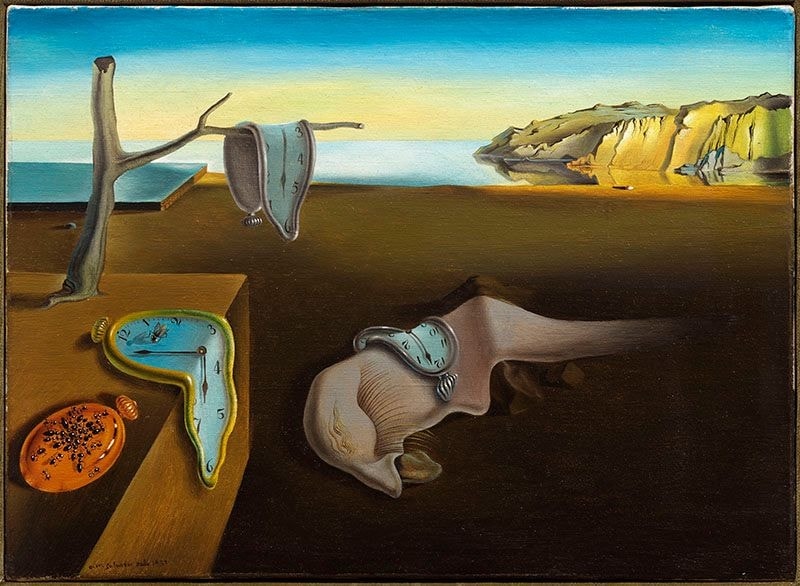
At the center of The Persistence of Memory lies a pallid, biomorphic head—often read as Dalí’s own sleeping profile—over which a soft watch slumps like skin. This uncanny "fetal face" anchors the painting’s dream-logic, fusing the artist’s inner self with Surrealism’s most famous emblem of liquefied time.
Historical Context
Dalí painted The Persistence of Memory in 1931, just as he refined his Surrealist program of rendering the unconscious with clinical precision. He called his approach the paranoiac‑critical method, a way to seize irrational associations and paint them with the cool finish of reality. The Museum of Modern Art underscores the work’s intimate scale and hyper‑focused description—qualities that make the central head startlingly vivid within an otherwise desolate beachscape 1.
Britannica situates the painting within Dalí’s early‑1930s breakthrough, linking its imagery to his fascination with Freud and with the pliability of perception. In this context, the face-like form emerges as a distilled emblem of the dreaming self—the lucid but irrational “eye” through which the scene is generated. Dalí’s contemporaneous statements about transforming dream visions into believable pictures, and his early 1930s experiments with double imagery, converge here to justify the inclusion of a sleeping profile as the engine of the composition 2.
Symbolic Meaning
The central creature is a distorted human face in profile, a recurring motif in Dalí’s work that derives from an autobiographical mask seen in The Great Masturbator (1929). Britannica identifies the head as such, encouraging a direct reading as Dalí’s own abstracted self‑portrait 2. Smarthistory draws attention to the closed eye and extravagant lashes—conventions of sleep—so the head functions not as a corpse but as a dreamer, the figure from whom the entire scene emanates 3.
Reina Sofía’s discussion of the 1929 head as a self‑personification reinforces this lineage: the biomorphic head is Dalí’s stand‑in for psychic interiority 4. Journalist and critic Stanley Meisler makes the point bluntly, calling the form a “deflated head of Dalí,” a vulnerable, collapsed ego exposed to the elements 6. Read this way, the watch drooping across the cheek is not incidental; it visualizes time losing rigidity precisely where consciousness yields to dream. The head’s limp, embryo‑like posture amplifies the Surrealist proposition that reverie precedes reason. In tandem with the ants and soft watches—motifs of decay and temporal flux—the sleeping profile asserts that memory persists not through clock time but through the elastic, generative theater of the unconscious 23.
Artistic Technique
Dalí renders the head with the cool finish of his "hand‑painted dream photographs": seamless tonal modeling, crisp contours at the lashes and nose, and a porcelain sheen that makes the irrational look optically true 15. The small panel heightens the illusion—minute transitions of pinkish‑gray flesh turn smoothly into shadow, while the watch’s blue face clings to the cheek like a second skin. Against the warm, sand‑colored ground and cobalt sky, the head’s pallor reads as both corporeal and otherworldly. The precise, airless light flattens distance and suspends motion, allowing the head to hover between object and apparition.
Connection to the Whole
Placing the sleeping head at the center makes it the painting’s organizing device: the dreamer generates the desert stage on which time melts. MoMA’s description emphasizes how a soft watch slumps directly over the cheek, yoking Dalí’s meditations on time to an embodied psyche 1. Britannica’s account of the work’s themes—fluid time, memory, and decay—aligns with this placement: the clocks deform most radically where consciousness recedes, turning the profile into a literal touchpoint between perception and temporality 2. The result is a tightly argued image in which the world’s stillness, the far cliffs, and the ticking objects are all calibrated around the sleeper’s inward gaze.
Explore More from This Painting
This detail is one part of The Persistence of Memory. Use the links below to return to the full interpretation, browse the full set of details, or view the painting's valuation if available.
Sources
- MoMA audio guide: Salvador Dalí, The Persistence of Memory
- Encyclopaedia Britannica: The Persistence of Memory
- Smarthistory: Salvador Dalí, The Persistence of Memory
- Museo Reina Sofía: Visage du Grand Masturbateur (1929) collection text
- The Dalí Museum: Hand-Painted Dream Photographs
- Stanley Meisler, Smithsonian Magazine: The Surreal World of Salvador Dalí