The Melting Watches in The Persistence of Memory
A closer look at this element in Salvador Dali's 1931 masterpiece
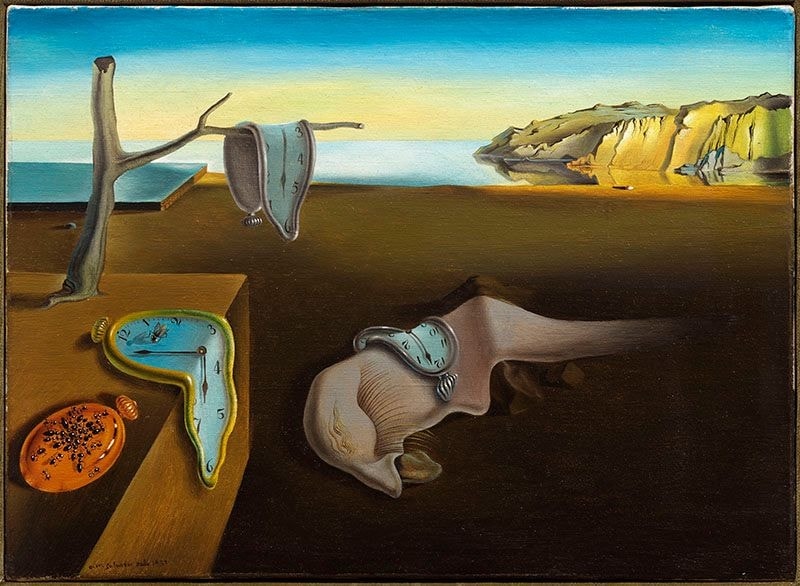
Dalí’s melting watches turn the most rigid tool of modern life into soft, drooping membranes, making the impossible look eerily plausible. Rendered with photographic precision, they visualize a world where mechanical time dissolves into the pliable durations of dream and memory.
Historical Context
Painted in 1931, The Persistence of Memory emerges at the height of Surrealism’s ambition to picture the unconscious. Dalí had recently formulated his paranoiac‑critical method, cultivating hallucinatory images that he then rendered with ice‑cold clarity. The painting’s best‑known motif—the soft pocket watches—was born, he later joked, from seeing very soft Camembert cheese after dinner, a sly origin story that perfectly fits Surrealism’s union of the banal and the uncanny 12.
The motif quickly became Dalí’s calling card. Shown to U.S. audiences in 1932 and acquired by The Museum of Modern Art in 1934, the work circulated as a compact manifesto of Surrealist vision. On MoMA’s small panel (24.1 × 33 cm), the watches stage a collapse of ordinary measurement within a sunlit, hyper‑legible space—an image that resonated with a generation fascinated by psychoanalysis, modern time discipline, and disorienting new theories of reality 12.
Symbolic Meaning
The melting watches mock the rigidity of chronometric, clock‑driven life. By turning a hard, mechanical instrument soft and dysfunctional, Dalí dramatizes time’s loss of authority in the dream state—its expansion, stasis, or collapse into psychic duration. Britannica summarizes the image as a direct affront to the regularity of measured time, while Smarthistory underscores the painting’s suffocating stillness in which even the seconds seem to have congealed 23.
Dalí’s symbolic vocabulary sharpens this critique. The closed, face‑down orange watch is invaded by ants—his recurring sign of decay—implying that even “objective” time rots away 2. The four watches show different hours, visualizing subjective time and modern anxiety about controlling it, as noted by the Dalí Foundation 4. Art‑historically, the watches epitomize Dalí’s soft/hard dialectic: making “soft” versions of “hard” things to unsettle our faith in fixed reality. Dawn Adès has read them as an unconscious emblem of the relativity of space and time; Dalí, characteristically elusive, alternated such high‑theory echoes with his Camembert quip, keeping meaning productively unstable 8. Together these signs insist that memory and dream trump any external schedule—the clock melts while inner durée persists 2348.
Artistic Technique
Dalí renders the soft watches with meticulous, enamel‑smooth brushwork on a small panel, so their metal rims gleam and their shadows fall convincingly even as the forms sag over a ledge, a dead branch, and a biomorphic head 1. He called this ideal “hand‑painted dream photographs,” a method of producing hallucinatory clarity by traditional craft 5. MoMA’s audio describes the “paralyzing tricks of eye‑fooling”: crisp edges, calibrated highlights on the bezels, and the cool Mediterranean light that makes the impossible look factual 6. The result is a paradox of touch—silky, drooping surfaces rendered with old‑master precision—where painterly exactitude itself becomes a vehicle for unreality 156.
Connection to the Whole
The melting watches are the hinge on which the entire composition turns. By making the clock—the instrument meant to stabilize work and life—go limp, Dalí converts time into an unreliable measure of reality, a thesis MoMA’s exhibition text states plainly 7. Around them, every cue intensifies temporal paradox: different hours on different watches 4, a frozen seascape and distant cliffs under crystal light, and a dozing, biomorphic head that anchors the scene in dream logic where measurement fails 3. In this still world, decay (ants) and drift (the sliding watch) replace schedule and progress, so the painting stages a contest between mechanical time and the persistence of memory—and memory wins 743.
Explore More from This Painting
This detail is one part of The Persistence of Memory. Use the links below to return to the full interpretation, browse the full set of details, or view the painting's valuation if available.
Sources
- The Museum of Modern Art, collection record: Salvador Dalí, The Persistence of Memory (1931)
- Encyclopaedia Britannica: The Persistence of Memory
- Smarthistory: Salvador Dalí, The Persistence of Memory
- Fundació Gala‑Salvador Dalí: Loan text on The Persistence of Memory (2009)
- The Dalí Museum: Hand‑Painted Dream Photographs
- MoMA Audio Guide (Anne Umland) on The Persistence of Memory
- MoMA Interactive: Modern Art Despite Modernism – Dalí
- Wikipedia (for widely cited Adès interpretation): The Persistence of Memory