How Much Is A Charge of Cuirassiers Worth?
Last updated: May 7, 2026
Quick Facts
- Methodology
- comparable analysis
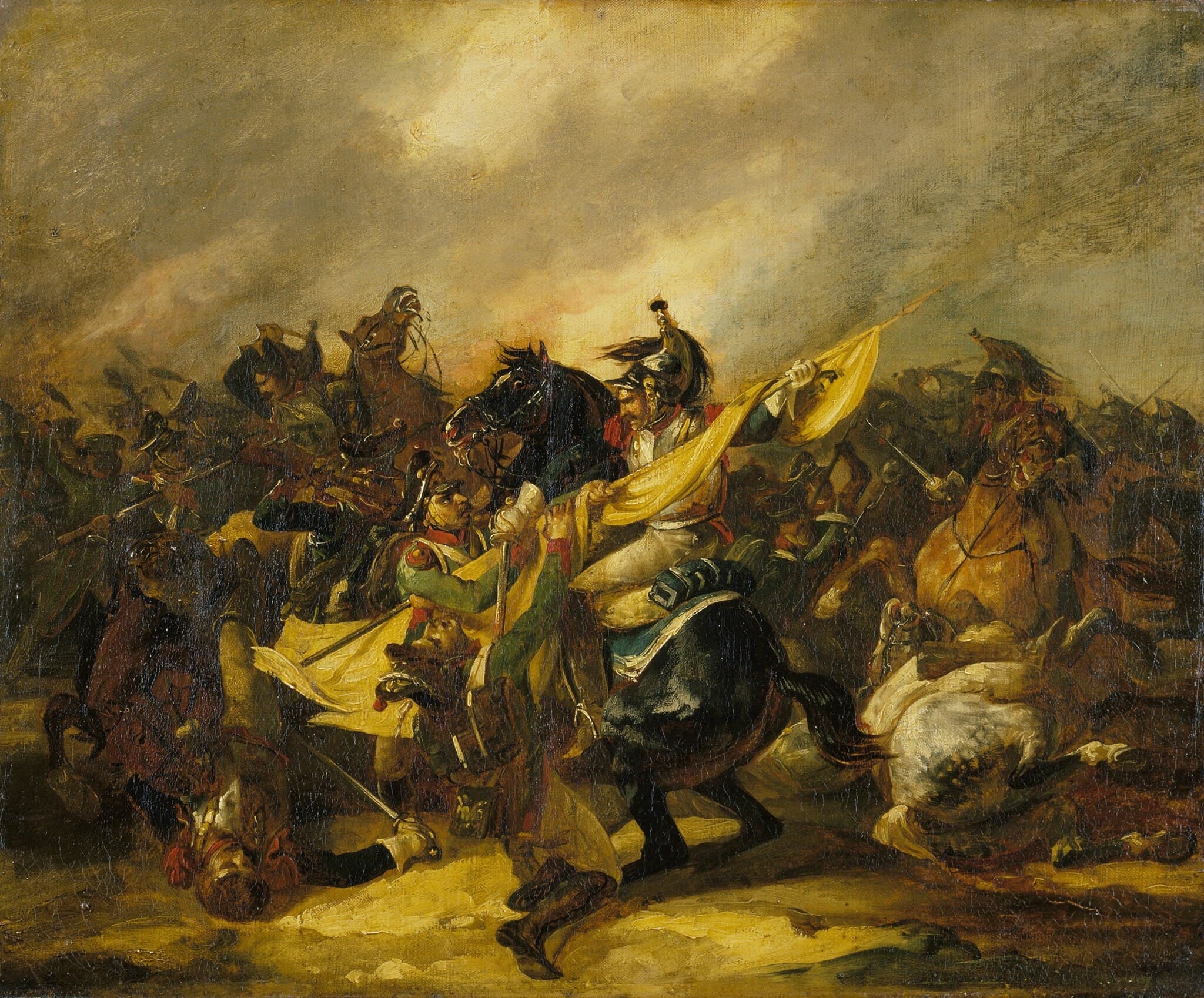
For the Wallace Collection oil A Charge of Cuirassiers (c.1822–23, inv. P274), my working market valuation is USD 500,000–2,000,000. This range assumes the work is accepted as an autograph small Géricault oil of the known quality; values move materially higher only if new scholarship or technical evidence upgrades its importance.
Valuation Analysis
Valuation conclusion: Based on the painting’s dimensions, subject, known Wallace Collection provenance (inv. P274) and the modern market for Théodore Géricault’s small oils and studies, I estimate a market range of USD 500,000–2,000,000 for a hypothetical sale on the open market under current conditions. This estimate is conditional on the painting’s continued acceptance as an autograph Géricault and assumes the typical finish and condition of the Wallace example [1].
How this range was derived: Géricault is a highly collectible but thinly supplied artist; his auction ceiling is demonstrated by the Yves Saint Laurent / Pierre Bergé Christie’s sale (Portrait of Alfred and Elisabeth Dedreux, 2009), a multi‑million result used as a market ceiling for top‑tier, museum‑quality canvases [2]. By contrast, authenticated small oils and studies by Géricault that come to market typically trade in the low‑to‑mid six‑figure or sub‑million bands; drawings and minor studies frequently sell in the low four‑to‑five‑figure ranges, creating a strong price gap between monumentally important works and smaller cavalry studies [3]. The Wallace picture’s modest dimensions (c.38.1 × 45.8 cm) and its long‑standing museum ownership place it firmly in the small‑oil category, which is why the practical market estimate sits in the USD 500k–2M band rather than at the multimillion auction record level.
Upward and downward modifiers: The single largest driver that could move this range upward is demonstrable, contemporary scholarship and technical authentication that elevate the work to a major or unique place in Géricault’s development (for example, showing direct preparatory relation to a canonical composition, or new technical evidence of autograph execution). Conversely, any unresolved attribution questions, significant condition problems, or indications of heavy restoration would push the value down substantially toward the lower range or below. Museum ownership (Wallace) is strong provenance and lowers attribution risk, but it also makes the painting effectively non‑market unless deaccessioned—an unlikely but relevant caveat [1].
Practical next steps: For a sale‑ready valuation: obtain high‑resolution photography, a full condition/conservation report, infra‑red and X‑ray imaging, pigment and canvas/weave analysis, and written opinions from leading Géricault specialists/catalogue raisonné authors. Major salerooms or specialist dealers should be engaged for a confidential presale estimate and advice on export/patrimony implications. The estimates above should be treated as a working market window pending those steps and any new scholarship or technical findings [3][4].
Key Valuation Factors
Art Historical Significance
Medium ImpactGéricault’s cavalry pictures and equestrian studies are respected within his oeuvre but are typically considered secondary to his landmark history paintings (notably The Raft of the Medusa). A small, well‑executed cavalry canvas can be academically and commercially desirable, particularly if it fills a gap in scholarship or is demonstrably preparatory for a larger composition. However, absent such elevating scholarship, cavalry studies generally command lower prices than the artist’s iconic works. Therefore, significance supports a mid‑to‑upper range only when bolstered by exhibition/publication and catalogue raisonné inclusion.
Attribution & Authenticity
High ImpactAttribution is the single most consequential factor. Market confidence in Géricault attributions depends on consensus among specialists, inclusion in catalogues raisonnés, and corroborating technical analysis (IRR, X‑ray, pigment/ground analysis). The 2024 exhibition and associated attribution debates demonstrate how contested authorship can depress buyer confidence. A clear, demonstrable autograph attribution materially lifts value; any unresolved doubts reduce liquidity and price by multiples. For this Wallace work, museum provenance helps attribution, but independent technical confirmation still materially affects market value.
Provenance & Museum Ownership
High ImpactLongstanding Wallace Collection ownership (acquired into the Hertford holdings mid‑19th century) is a major positive for provenance and scholarly pedigree: it reduces questions about modern forgery and strengthens institutional validation. That provenance increases confidence and would support the mid‑to‑upper end of the market band were the object to come to market. Conversely, museum ownership also means the painting is effectively off‑market and would only appear via deaccession or a rare private sale—events that are legally and reputationally complex and therefore infrequent.
Condition & Physical Characteristics
Medium ImpactThe painting’s modest size (c.38.1 × 45.8 cm) and the level of finish are central to pricing: smaller, sketch‑like oils typically sell below grand finished canvases. Condition matters: stable paint, minimal inpainting, and an original or period stretcher increase desirability; evidence of heavy restoration, major relining, or paint loss reduces value. A full conservation report and technical imaging are required to quantify these effects precisely and can swing the estimate within or outside the USD 500k–2M window.
Market Demand & Comparables
Medium ImpactGéricault’s market is characterized by rarity and episodic demand. Top lots (museum‑quality works) can fetch multi‑millions (notably the 2009 Christie’s sale), but most market activity is in drawings and small oils where realized prices are far lower. The current market climate favors ‘flight to quality’ and verified provenance; consequently, well‑provenanced, catalogued small oils can reach mid‑six figures to low millions, while uncertain attributions trade at a discount. These dynamics underpin the USD 500k–2M working range.
Sale History
Entered Hertford/Wallace Collection holdings (museum ownership)
Christie's, Paris (Yves Saint Laurent & Pierre Bergé sale)
Theodore Gericault's Market
Théodore Géricault (1791–1824) is a canonical French Romantic painter whose securely attributed oils are scarce and institutionally held. His market is characterized by infrequent, high‑visibility sales for top works and steady, lower‑value trade in drawings and small oils. The auction record (notably a 2009 Christie's sale) demonstrates the ceiling for museum‑quality canvases, but most market transactions fall well below that level due to limited supply and the concentration of masterpieces in public collections.
Current Market Trends
The market for 19th‑century French Romanticism is currently quality‑driven and cautious: institutional validation, robust provenance and technical authentication are decisive. Recent exhibitions have raised interest in Géricault’s equestrian work but have also shown how attribution controversies can temper buyer confidence, reinforcing the need for strong scholarly and technical backing before a high estimate can be sustained.
Sources
- Wallace Collection – Object entry: A Charge of Cuirassiers (inv. P274)
- Christie's press: Yves Saint Laurent & Pierre Bergé sale (2009) – Géricault result
- Barnebys / realized prices summaries for Théodore Géricault (small oils, drawings)
- The Art Newspaper: reporting on Géricault exhibition and attribution debate (2024)
- Le Monde: coverage of experts' dispute over Géricault exhibition (2024)