How Much Is Horse Attacked by a Lion Worth?
Last updated: June 6, 2026
Quick Facts
- Insurance Value
- $24.0M (Assistant estimate using replacement-cost methodology (c.20% above high auction estimate))
- Methodology
- comparable analysis
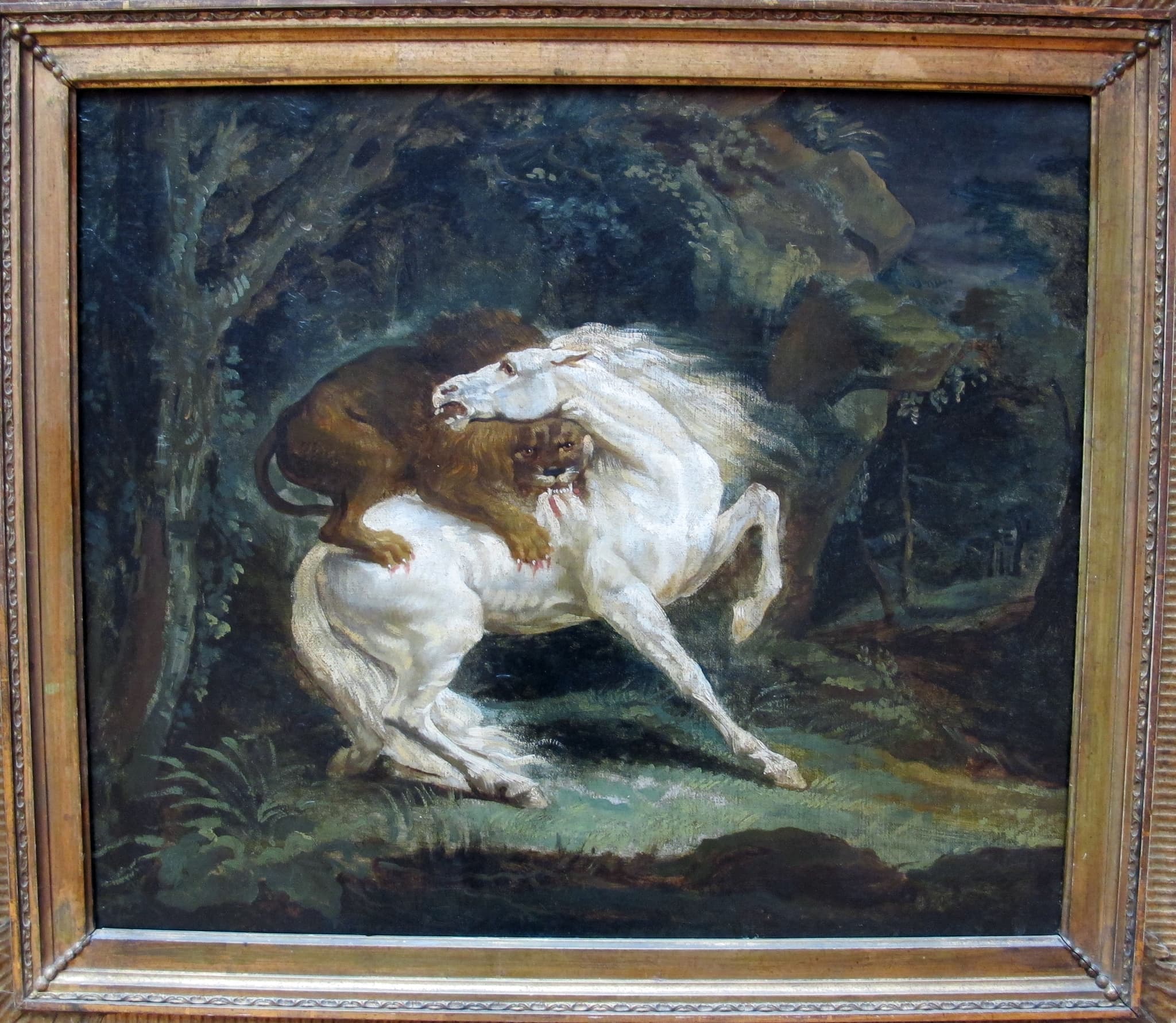
Assuming a fully accepted, finished autograph oil of Géricault’s Horse Attacked by a Lion were privately held and brought to market, we estimate fair market value at $12–20 million. The range is anchored to the artist’s auction record for oils, the extreme scarcity of autograph canvases, and recent strength for top equestrian works on paper. Smaller, sketch-like oils, drawings, or lithographs of the motif would value substantially lower.
Valuation Analysis
What is being valued. The Louvre owns an autograph oil of this motif (Cheval attaqué par un lion; 54 × 65 cm), which is not marketable as French state property. This estimate therefore models what a comparable prime, fully accepted autograph oil of the same subject, scale, and finish would bring at auction today if privately held. The subject is emblematic within Géricault’s Romantic bestiary and has significant scholarly and collecting appeal [1].
Method and key comparables. The high end of the range is anchored to Géricault’s world auction record for an oil (Portrait d’Alfred et Elisabeth Dedreux, €9,025,000 incl. premium, Christie’s Paris, 2009; c.$11.6m on the day), adjusted for market growth and scarcity of autograph oils [2]. Additional market anchors include the seven‑figure result for an equine oil (Cheval de Napoléon, Sotheby’s New York, $1.968m) demonstrating liquidity for strong horse subjects in oil [3], and the recent top‑tier performance of equine works on paper (e.g., Chevaux au pâturage… €496,650; ≈$536k with premium, Drouot, 17 Feb 2026) underscoring robust demand for best‑in‑class sheets [4]. Lithographs of the related image typically trade in the low thousands, helping define the floor for printed iterations [5].
Why $12–20 million. Prime autograph oils by Géricault in private hands are exceptionally rare, and the lion‑attacking‑horse theme is both aesthetically dramatic and academically canonical. A securely attributed, well‑preserved, literature‑listed canvas of substantial presence would command intense competition. The $12–20m band situates a fresh, fully accepted picture at or above the artist’s historic price ceiling once inflation and scarcity are considered, while recognizing that the subject, though iconic, is not on the singular cultural plane of The Raft of the Medusa [2].
Sensitivity by type/finish. If the work were a smaller or bozzetto‑like oil, a $3–8m expectation is appropriate; for autograph drawings or wash studies of the motif, recent Paris results suggest roughly $200,000–700,000+, depending on size, medium, and publication [4]. Period lithographs of Cheval dévoré par un lion typically realize $500–5,000+, state and condition dependent [5]. Studio, circle, or 19th‑century copies in oil can fetch mid‑five to low‑six figures, with rare outliers higher when historically notable.
Risk and validation. The chief swing factor is attribution. Recent public debates around Géricault attributions in Paris highlight the premium on ironclad literature (Bazin/Eitner/Chenique), condition, and technicals; any uncertainty can reduce value by an order of magnitude [6]. Confusion with George Stubbs’s separate Lion Attacking a Horse series must also be avoided. Assuming full scholarly acceptance, strong provenance, and good condition, the $12–20m range reflects current market positioning for a museum‑quality autograph oil of this subject.
Key Valuation Factors
Art Historical Significance
High ImpactThe lion-attacking-horse motif is a signature Romantic subject for Géricault, encapsulating his fascination with dynamic animal combat, anatomy, and drama. He returned to it across media, and the Louvre’s canvas is a touchstone in his post-Napoleonic exploration of nature’s ferocity. This subject carries strong cross-collecting appeal (Romanticism, equestrian art, animalier tradition) and sits near the apex of his non-Raft oeuvre. As a recognized image with substantial literature across drawings, prints, and at least one autograph oil in a major museum, a comparable prime oil would be regarded as a significant work in the artist’s corpus, supporting a price near or above his oil record.
Attribution and Literature
High ImpactValue hinges on unambiguous attribution. Works fully endorsed by leading scholars and included in the literature (e.g., Bazin, Eitner; catalogue entries; museum or major exhibition citations) trade at substantial premiums. The 2024 Paris debates about Géricault attributions underscore heightened scrutiny; even minor doubts can shift a painting from ‘autograph’ to ‘workshop/circle,’ collapsing value. A definitive dossier—provenance from the 19th century onward, technical imaging (IR/UV/X-ray), conservation reports, and clear references—underwrites the top of the $12–20m range. Absent this, the value would decrease materially, even for a visually compelling example.
Rarity and Market Liquidity
High ImpactAutograph oils by Géricault in private hands are few, and prime subjects scarcely appear. That scarcity, combined with global appetite for iconic Romantic imagery, creates a supply-driven premium when credible works emerge. Recent seven-figure results for equestrian oils and six-figure highs for finished horse drawings confirm depth of demand. In practice, new-to-market, well-documented canvases attract international bidding, with Paris often the natural venue. This rarity supports a valuation at or above prior oil benchmarks when the piece is fresh, well published, and in strong condition. Conversely, oversupply is not a risk here; the primary risk is authenticity and condition.
Condition and Conservation
Medium ImpactSurface preservation, original canvas dimensions, and the extent of retouching or overpaint are determinative. The vigorous handling typical of Géricault’s oils means abraded passages or discolored restorations can materially mute the dramatic contrasts that buyers prize, compressing estimates. Clean, legible impasto and intact contours in the horse and lion are especially important. A recent, reputable conservation report and imaging that show stable structure, legible underdrawing/pentimenti, and minimal invasive repairs would be expected at this level. Condition issues could push a painting from the high to the low end of the estimate—or out of the autograph category entirely if they obscure key characteristics.
Medium, Scale, and Finish
Medium ImpactWithin this motif, fully finished, exhibition-quality oils of substantial presence command the highest prices. The Louvre canvas (c.54 × 65 cm) demonstrates that even moderately scaled oils can be museum-class; larger, theatrically lit versions would likely price at the upper end. Sketch-like oils, bozzetti, or fragments, while academically valuable, trade at discounts relative to finished canvases. Works on paper cluster far below oils: strong wash drawings and watercolors can achieve mid- to high-six figures today, while printed versions sit in the low thousands. Where a subject sits along this finish/scale spectrum is a primary determinant of value.
Sale History
Horse Attacked by a Lion has never been sold at public auction.
Theodore Gericault's Market
Théodore Géricault (1791–1824) is a blue-chip pillar of early French Romanticism with an extremely thin supply of autograph oils in private hands. His world auction record for an oil—Portrait d’Alfred et Elisabeth Dedreux—stands at €9,025,000 including premium (Christie’s Paris, 2009; about $11.6m at the time), which remains the key benchmark for major canvases. Equestrian subjects are a recognized strength: a notable equine oil sold at Sotheby’s New York for $1.968m, and best-in-class horse drawings and watercolors have reached mid- to high-six figures in Paris, signaling deep collector demand. Lithographs are far more accessible. Overall, buyers prize ironclad provenance, literature inclusion, and condition; uncertainty on attribution is penalized.
Comparable Sales
Portrait d'Alfred et Elisabeth Dedreux
Theodore Gericault
Artist’s world auction record for an oil painting; establishes the ceiling for major autograph oils by Gericault even though the subject differs. Useful benchmark if valuing an autograph oil of 'Horse Attacked by a Lion.'
$11.6M
2009, Christie's Paris
~$17.2M adjusted
Chevaux au pâturage, ou Le Cheval bai et le cheval blanc (ink and watercolor)
Theodore Gericault
Top-end equine work on paper by the same artist; demonstrates current market strength for best equestrian subjects. Relevant if valuing a drawing/wash study of the lion‑attacking‑horse motif.
$536K
2026, Hôtel Drouot, Paris (Villemur.art)
~$526K adjusted
Recto: Cheval de trait londonien… Verso: figures (watercolor over black chalk)
Theodore Gericault
Equine study on paper from Gericault’s prime horse investigations; indicates mid‑market pricing for quality horse sheets.
$127K
2025, Artcurial Paris
Le Derby (watercolor with white heightening)
Theodore Gericault
Same artist, equestrian subject; shows liquidity for attractive but less monumental horse compositions on paper.
$73K
2024, Hôtel Drouot, Paris (Thierry de Maigret)
~$75K adjusted
Current Market Trends
Despite a softer global art market in 2024, historical categories showed resilience into 2025–26, with Old Masters/19th century seeing revived demand and Paris consolidating its role as a key venue. TEFAF reported healthy interest in historical material, and recent Paris auctions posted strong totals for works on paper, including new highs for quality sheets. For Géricault specifically, equestrian subjects continue to outperform, but 2024’s attribution controversies increased due-diligence expectations. Net effect: buyers are selective but competitive for securely attributed, well-published works; pricing spreads have widened between top-tier, documented pieces and those with condition or attribution questions—an environment that favors a museum-quality autograph oil of a signature subject.
Sources
- Musée du Louvre – Cheval attaqué par un lion (collections entry)
- Christie’s Paris – Yves Saint Laurent & Pierre Bergé Collection results (2009 press release)
- Sotheby’s – Equestrian Art feature (notes Géricault oil at $1,968,000)
- Gazette Drouot – Les collectionneurs piaffaient pour Géricault (Feb 17, 2026 sale report)
- The Metropolitan Museum of Art – Cheval dévoré par un lion (lithograph)
- Le Monde – Experts squabble over Géricault exhibition (attribution debates, 2024)