How Much Is Portrait of a Kleptomaniac (Monomane du Vol) Worth?
Last updated: May 7, 2026
Quick Facts
- Methodology
- comparable analysis
MSK Gent holds Théodore Géricault’s Portrait of a Kleptomaniac (accession 1908‑F), so it is effectively not on the market [1]. If hypothetically offered and confirmed autograph with strong condition and provenance, a reasoned market range is US$500,000–$3,000,000, with the most likely outcome in the low millions for a well‑documented example.
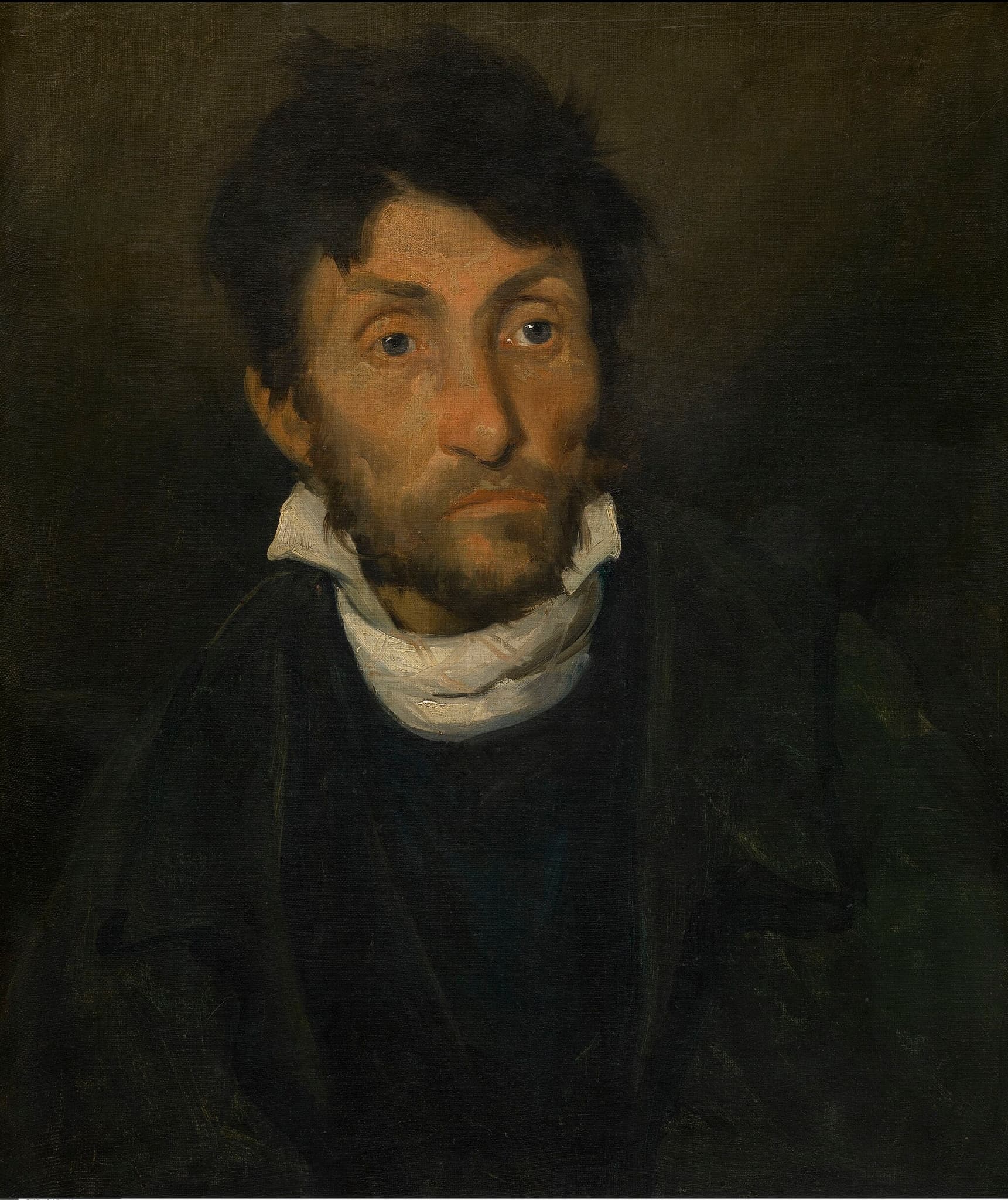
Portrait of a Kleptomaniac (Monomane du Vol)
Theodore Gericault • Oil on panel
View more by Theodore Gericault →Valuation Analysis
Identification & market status: Théodore Géricault’s Portrait of a Kleptomaniac (Le Monomane du vol), c.1820–23, is recorded in the collection of the Museum of Fine Arts, Ghent (accession 1908‑F) and has no modern public auction record — i.e., it is institutionally held and not market‑circulating [1].
How the range was derived: The stated estimate of US$500,000–US$3,000,000 is a scenario valuation based on comparables and market behavior for Géricault works. The artist’s top auction result (Portrait d’Alfred et Elisabeth Dedreux, Christie’s Paris, 2009) establishes an upper peer benchmark for exceptional, securely attributed oils by Géricault [2]. By contrast, studies and drawings offered at major houses in recent years have realized in the mid‑five‑figures (e.g., Bonhams 2023; Christie’s 2026), indicating a marked spread between study‑level material and museum‑quality autograph paintings. The proposed band places a well‑provenanced, good‑condition Monomane study above the works‑on‑paper bracket but below the rare, salon‑scale portraits that have achieved multi‑million highs.
Key value drivers: Attribution/authentication, condition and restoration history, documented provenance and exhibition/publication record, and any legal/patrimony or export constraints are the primary determinants that would move the painting toward either end of the range. A fully authenticated, technically supported autograph with prominent exhibition history and clear provenance would push toward the top end (low millions). A work with uncertain attribution, heavy restoration or weak provenance would fall toward the low end (several hundred thousand or less).
Institutional reality & practical note: Because the work is accessioned by MSK Gent (1908‑F) it is functionally off the market for private acquisition and carries significant institutional value that is not captured by auction metrics. If MSK Gent were ever to consider deaccession, international houses and museums would weigh cultural patrimony and export considerations before permitting market sale; these procedural and legal barriers further reduce the practical likelihood of a market transaction.
Recommended next steps to refine value: obtain the MSK Gent provenance file and any accession correspondence; secure high‑resolution photography and a condition/conservation report; commission technical imaging (IRR/X‑ray/pigment analysis); and seek written opinions from recognized Géricault specialists or a catalogue raisonné authority. If a market action were contemplated, a confidential review by the 19th‑century paintings departments at Christie’s and Sotheby’s would produce a house estimate informed by condition and provenance.
Key Valuation Factors
Art Historical Significance
High ImpactThe Monomanes portraits occupy an important niche in Géricault’s late oeuvre: psychologically intense, quasi‑clinical studies executed around 1820–1823 for the psychiatrist Étienne Georget. They are highly regarded by curators and historians for their contribution to portraiture and the history of psychiatry, and surviving autograph oils are relatively scarce in private hands. That scholarly value translates into institutional demand — museums prize these works — which supports price resilience for securely attributed oils. However, the series is a ‘minor’ market subject compared with Géricault’s large history paintings, so the work’s academic importance is balanced by narrower commercial appetite than for grand, salon‑scale canvases.
Attribution & Authentication
High ImpactA confirmed autograph attribution to Géricault is decisive. Market uplift is substantial when technical analysis (pigment and ground study, IRR, X‑ray) and authoritative specialist opinions support attribution and when the painting appears in a catalogue raisonné or major exhibition. Conversely, disputed attributions or ambiguous workshop‑circle status materially depress prices. Recent scholarly debates (e.g., attribution discussions surrounding Géricault exhibitions in 2024) demonstrate buyers’ sensitivity to expert consensus; auction houses demand rigorous provenance and technical back‑up before recommending high pre‑sale estimates.
Condition & Conservation History
Medium ImpactPhysical condition directly affects market value. Typical issues for early‑19th‑century oils include varnish discoloration, overpainting, craquelure and panel/canvas deformation; the presence, extent and quality of past restorations create measurable discounts. A stable, well‑documented conservation history with minimal invasive treatment will support the upper end of the estimate; heavy restoration, inpainting or structural instability shifts value downward. A full conservation report and photographic documentation are essential for market confidence and accurate pricing.
Provenance & Exhibition History
High ImpactLong, documented provenance and inclusion in major exhibitions or catalogues raisonnés materially increase market value. Institutional ownership or early entrance into museum collections lends scholarly legitimacy but typically removes works from the market; if a deaccession were ever proposed, the painting’s museum provenance would both enhance price potential and invite scrutiny under cultural patrimony rules. Published exhibition history and bibliographic citations make a noteworthy positive pricing delta—collectors pay a premium for works that are published and exhibited.
Market Liquidity & Legal Constraints
High ImpactThe secondary market for early‑19th‑century French painting is specialist and relatively shallow: top‑quality works attract institutions and a concentrated set of private collectors, while liquidity for lesser‑documented pieces is limited. National patrimony, export controls and institutional deaccession policies can restrict or prevent cross‑border sales, particularly for French cultural objects. Because many Monomane portraits are already museum‑held, supply is constrained — supporting values for available, well‑provenanced examples but limiting transactional frequency and buyer competition.
Sale History
Portrait of a Kleptomaniac (Monomane du Vol) has never been sold at public auction.
Theodore Gericault's Market
Théodore Géricault (1791–1824) is a canonical figure of French Romanticism whose market is characterized by scarcity of autograph oils and concentrated institutional demand. His masterpiece The Raft of the Medusa anchors scholarly prominence; individual portraits and studies surface infrequently at auction. The artist’s auction record (a high‑profile portrait sold in 2009) demonstrates the potential upside for securely attributed oils, while drawings and studies typically trade in the mid‑five‑figures. Provenance, condition and scholarly acceptance (catalogue raisonné citation, expert opinion) are the dominant determinants of value.
Comparable Sales
Portrait d’Alfred et Elisabeth Dedreux
Théodore Géricault
World‑record modern auction for a securely attributed, museum‑quality Géricault oil — establishes the upper bound for autograph paintings by the artist; same artist and period though different subject/scale.
$11.5M
2009, Christie's (Paris)
~$16.9M adjusted
Étude d’ensemble pour Le Radeau de la Méduse (study)
Théodore Géricault
Study by the same artist offered at auction — similar category to other Géricault studies/works on paper and closer to the liquidity/price band for non‑major works; useful as a lower‑end market comparator.
$91K
2023, Bonhams / Cornette de Saint Cyr (Paris)
~$94K adjusted
A sleeping fishmonger (Le marchand de poissons endormie)
Théodore Géricault
Recent sale of a Géricault study/drawing at a major house — demonstrates the contemporary market for works on paper by Géricault and reinforces that study‑level results cluster in the low five‑figures.
$70K
2026, Christie's (New York)
~$69K adjusted
Current Market Trends
The 19th‑century/Old Masters market remains specialist and selective: museum‑quality works hold value, while lesser‑provenance pieces face limited demand. Recent years have shown steady institutional interest in Géricault drawings and small oils, and 2024 exhibitions revived scholarly attention but also highlighted attribution disputes that make buyers cautious. Overall, well‑documented, museum‑quality Géricault works are likely to remain collectible, while liquidity for unattributed or poorly provenanced pieces is constrained.
Sources
- MSK Gent — collection entry: Portrait of a Kleptomaniac (accession 1908‑F)
- Christie's — Portrait d’Alfred et Elisabeth Dedreux (Yves Saint Laurent & Pierre Bergé sale, 23 Feb 2009)
- Bonhams / Cornette de Saint Cyr — Étude d’ensemble pour Le Radeau de la Méduse (22 Jun 2023) — sale record
- Christie's — A sleeping fishmonger (Le marchand de poissons endormie), sale result (5 Feb 2026)
- Le Monde — coverage of 2024 Géricault exhibition and attribution debates