How Much Is Portrait of a Kleptomaniac Worth?
Last updated: June 5, 2026
Quick Facts
- Methodology
- extrapolation
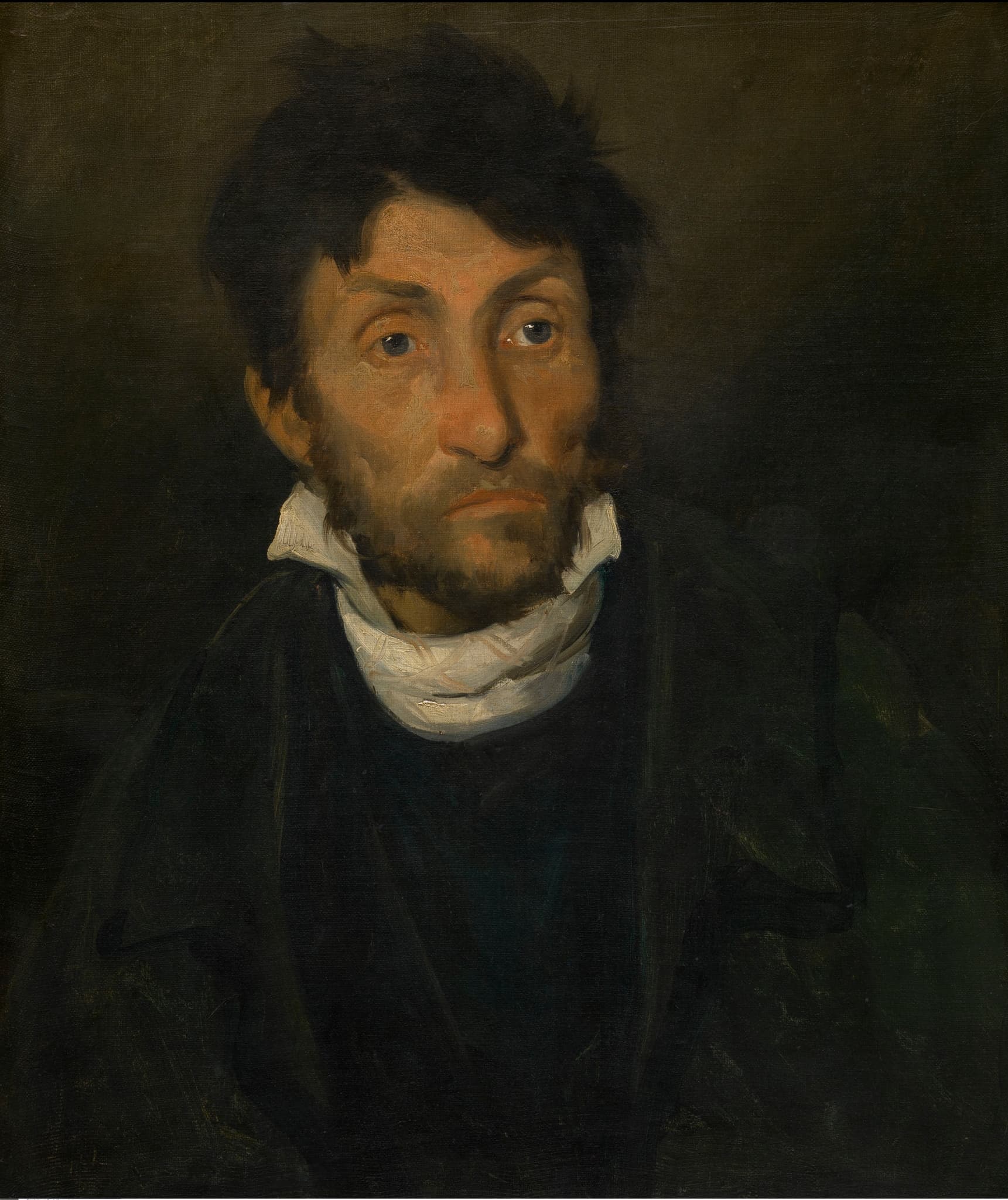
Portrait of a Kleptomaniac (c.1822–23) is a canonical work from Géricault’s famed ‘portraits of the insane’ and is housed at the Museum of Fine Arts, Ghent. Although not a market object, we estimate that, if fully unencumbered and offered today, it would achieve $30–50 million, reflecting its art-historical primacy and the extreme scarcity of autograph Géricault oils.
Valuation Analysis
Estimated fair-market value (hypothetical): $30–50 million. Portrait of a Kleptomaniac (Le Monomane du vol) is one of the most important images from Géricault’s late “portraits of the insane.” The painting is held by the Museum of Fine Arts, Ghent (MSK Gent; inv. 1908‑F), acquired in 1908 after a Paris sale and subsequently kept in the museum’s collection [1]. As a museum-held masterpiece, it is not a market object; however, an informed valuation can be derived by extrapolating from the artist’s auction record, the work’s exceptional status within the oeuvre, and cross-artist benchmarks for 19th‑century museum-caliber portraits.
Method and anchors. Géricault’s painting auction record—Portrait d’Alfred et Élisabeth Dedreux—made €9,025,000 ($11.6m) at Christie’s Paris in 2009 [2]. Adjusted for inflation, that implies a ~mid‑to‑high‑teens million baseline today for a major but non-iconic portrait by the artist. Portrait of a Kleptomaniac commands a significant premium over that baseline: it is a cornerstone of Géricault’s late output and an emblem of early 19th‑century engagement with psychiatry, reproduced and discussed across art-historical literature. Cross‑artist comparables show what the market pays for truly canonical 19th‑century portraiture when supply appears: Manet’s Self‑Portrait with Palette fetched $33.2m in 2011 (≈$45m today), illustrating the headroom for blue‑chip masters at auction.
Market signals for demand. While top-tier Géricault oils almost never trade, recent public sales of authenticated works on paper demonstrate robust, international demand: a high‑quality watercolor brought €496,650 at Drouot in 2026, and other sheets have performed solidly in Paris since 2024 [3][4]. These results corroborate depth of interest for vetted material and support the premise that a masterpiece‑level oil—if ever available—would attract trophy‑level bidders across regions.
Rationale for the $30–50m bracket. The range is built upward from the inflation‑adjusted 2009 record, then calibrated for the painting’s art‑historical centrality, iconicity within a celebrated series, and extreme scarcity of autograph Géricault oils outside institutions. The lower bound (~$30m) reflects a conservative premium to the adjusted record for an undeniably major subject; the upper bound (~$50m) aligns with pricing observed for museum‑caliber 19th‑century portraits by top French masters when rare opportunities arise, and anticipates competition in a cross‑category trophy market.
Practical considerations. The estimate assumes an unencumbered, fully exportable picture in strong condition with unambiguous attribution and literature. In reality, the work is museum‑held, and any deaccession/export constraints would shape venue and buyer pool. Within those assumptions, however, a $30–50 million outcome is well supported by the artist’s standing, the painting’s significance, and recent market behavior for best‑of‑category historical works [1][2][3][4].
Key Valuation Factors
Art Historical Significance
High ImpactPortrait of a Kleptomaniac is a signature image from Géricault’s celebrated late series of ‘portraits of the insane,’ a body of work that has shaped scholarship on Romantic portraiture and the intersection of art and emerging psychiatric science. Its status in the literature and frequent reproduction make it one of the most recognizable Géricault portraits after The Raft of the Medusa’s orbit. This centrality drives demand from top private collectors and institutions alike, and supports a substantial premium over the artist’s typical portraiture. In valuation terms, its art-historical weight is the single most important driver elevating it above the inflation-adjusted auction record for a Géricault oil.
Rarity and Supply
High ImpactAutograph oils by Géricault are exceptionally scarce due to his short life, with most major works long since absorbed into European museum collections. The Monomaniacs series, in particular, is concentrated in institutions (Ghent, Lyon, Louvre, Winterthur, Springfield), and the canonical portraits have not traded in the modern market. This supply dynamic compresses available comparables, but it also amplifies pricing power for any unencumbered, top-tier work. In a trophy-driven market where scarcity is prized, the absence of close substitutes for a museum-caliber Géricault portrait strongly supports a pricing range in the high eight to low nine figures were such a work to be offered.
Market Benchmarks and Cross-Artist Anchors
Medium ImpactGéricault’s painting auction record stands at €9.025m ($11.6m, 2009), which inflates to a mid-to-high-teens million baseline today for a significant oil. For a canonical masterpiece, we look across to 19th-century peers to calibrate upside: Manet’s Self-Portrait with Palette achieved $33.2m in 2011 (≈$45m in today’s dollars), underscoring the market’s willingness to pay for museum-grade French portraiture. This cross-artist anchoring, combined with the artist’s own record and the painting’s stature, supports an extrapolated $30–50m range for Portrait of a Kleptomaniac, assuming optimal sale conditions and global exposure.
Provenance, Scholarship, and Institutional Status
Medium ImpactThe painting’s secure provenance—purchased in Paris in 1908 and continuously held by MSK Gent—coupled with its firm place in the literature, underpins confidence in attribution and long-term significance. Institutional holding both validates the work’s importance and typically removes it from market circulation. If ever deaccessioned and legally exportable, these strengths would translate into buyer confidence and aggressive bidding. Conversely, state protections or export/licensing constraints could limit venue choice and bidder eligibility. Our estimate presumes an unencumbered sale; under real-world museum or export constraints, realized price may skew within the range depending on access to the broadest buyer pool.
Sale History
Galerie Georges Petit, Paris (Vente Chéramy)
Acquired at the Chéramy sale (often listed under the title 'Le Fou assassin') by the Friends of the Museum of Fine Arts, Ghent and gifted to MSK in 1908.
Theodore Gericault's Market
Théodore Géricault is a blue-chip pillar of French Romanticism with a thin supply of autograph oils and a market concentrated in drawings, oil studies, and the occasional minor painting. The artist’s painting auction record is €9.025 million ($11.6m) set in 2009 at Christie’s Paris for the Dedreux double portrait, and drawings regularly achieve six-figure prices with select sheets now reaching the high six figures. Recent activity in Paris (Drouot, Artcurial) confirms steady, international demand for well-attributed works on paper, while the near-total institutionalization of masterwork oils constrains direct comparables. This scarcity means headline prices for any rediscovered or deaccessioned oil can significantly exceed historic auction anchors.
Comparable Sales
Portrait d’Alfred et Élisabeth Dedreux
Théodore Géricault
Closest public sale of a major, autograph Géricault oil portrait (early 19th c.). While not from the Monomaniacs series, it is an important portrait from a similar period and is the artist’s auction record—thus a primary market anchor.
$11.6M
2009, Christie's Paris (Yves Saint Laurent & Pierre Bergé Collection)
~$17.1M adjusted
Chevaux au pâturage (watercolor)
Théodore Géricault
High-quality, securely attributed work on paper by Géricault with strong recent competition in Paris; useful to gauge current liquidity and demand for the artist even though the medium/scale differ from an oil masterwork.
$587K
2026, Hôtel Drouot, Paris (Villemur.art)
~$572K adjusted
Recto: London Draft Horse with Harness; Verso: London Figures (watercolor over black chalk)
Théodore Géricault
Solid recent Paris auction for a documented Géricault sheet from a key period; supports the active mid-market for authenticated works and provides a secondary reference for current price bands.
$128K
2025, Artcurial Paris (Salon du Dessin)
Le Derby (watercolor heightened with white)
Théodore Géricault
Recent Paris sale of an autograph Géricault watercolor; not directly comparable in medium or gravitas, but it helps illustrate the breadth of demand and pricing for authenticated works.
$73K
2024, Hôtel Drouot, Paris
~$76K adjusted
Self-Portrait with Palette (Autoportrait à la palette)
Édouard Manet
Museum-caliber 19th‑century French portrait that traded publicly at the top end; included to bracket what the market pays for canonical portraiture by blue‑chip 19th‑c. masters when supply is extraordinary (cross‑artist anchor).
$33.2M
2011, Sotheby's New York
~$45.1M adjusted
Current Market Trends
The 19th-century French segment has remained resilient through recent market cycles, with Paris consolidating its role for Old Masters and 19th‑century sales. Auction houses report strong participation for vetted, documented works and select trophy pieces, even as broader Contemporary markets recalibrate. Géricault-specific demand has been visible in rising prices for authenticated works on paper since 2024–26, signaling collector readiness to stretch for quality and provenance. In this context, a canonical, museum-caliber Géricault portrait would be positioned for intense, cross-category bidding, with scarcity and art-historical stature driving value more than repeat-sale comparables.
Sources
- MSK Gent Collection Entry: Portrait of a Kleptomaniac (Inv. 1908‑F)
- Christie’s Press Release: Yves Saint Laurent & Pierre Bergé Collection (artist record, 2009)
- Gazette Drouot: Les collectionneurs piaffaient pour Géricault (Feb 17, 2026 result)
- Gazette Drouot: Fois deux pour un ‘Derby’ by Géricault (Mar 20, 2024 result)
- Wikipedia: Portrait of a Kleptomaniac (object location and series context)