How Much Is Riderless Racers at Rome (Riderless Racers) Worth?
Last updated: May 7, 2026
Quick Facts
- Methodology
- comparable analysis
Assuming the object is an authenticated Théodore Géricault oil‑on‑paper study (and not the Walters accession 37.189), my market estimate is USD 150,000–750,000. If the sheet is the Walters museum work it is not market‑available; exceptional provenance or exhibition/literature history could push value into the low millions while poor condition or contested attribution would reduce it substantially.
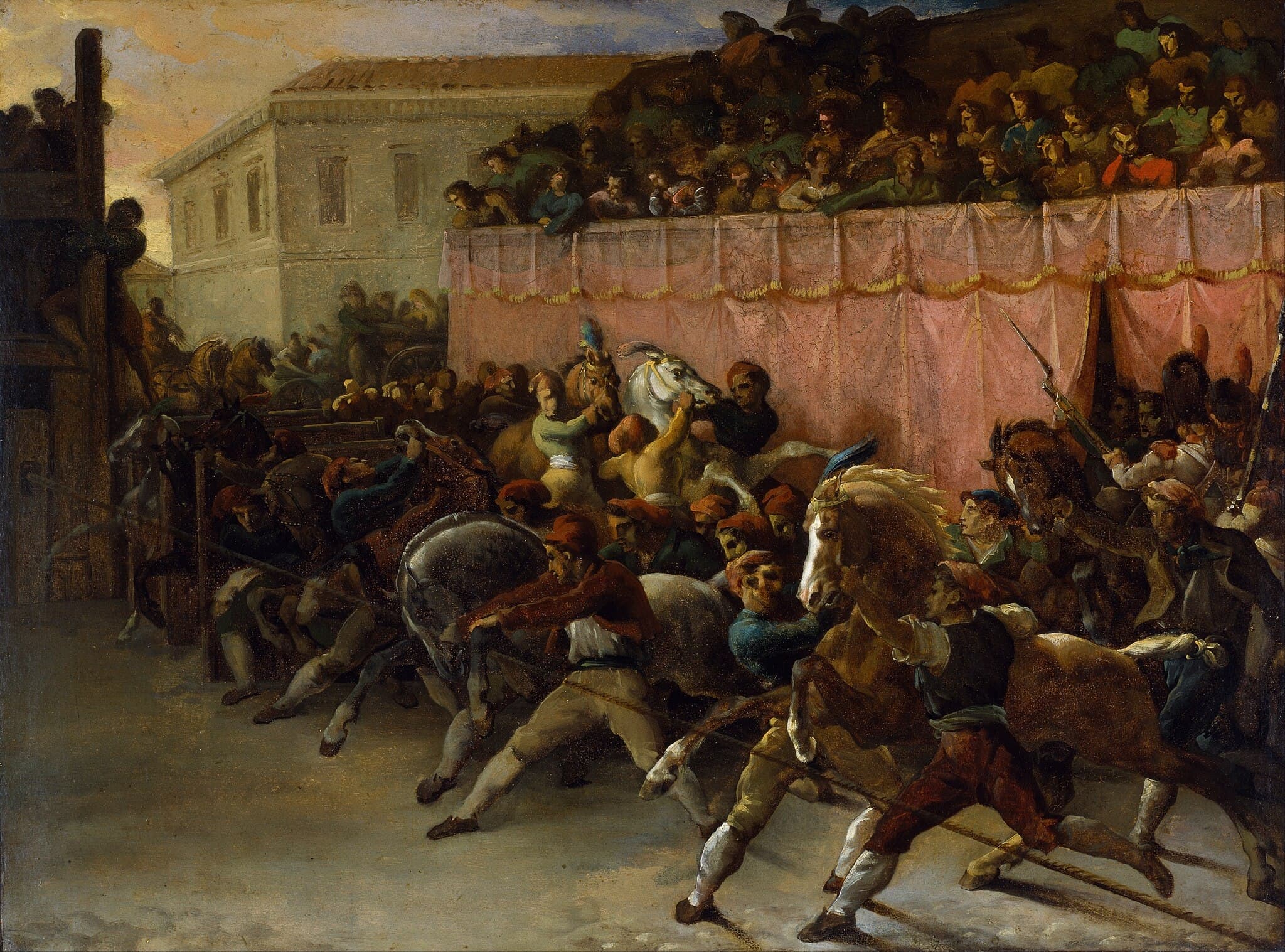
Riderless Racers at Rome (Riderless Racers)
Theodore Gericault, 1817 • Oil on paper mounted on canvas
View more by Theodore Gericault →Valuation Analysis
Assuming the object under consideration is an authentic Théodore Géricault oil‑on‑paper study (and is not the Walters Art Museum sheet, accession 37.189, which is a museum‑held work), the market value I estimate is USD 150,000–750,000. The Walters' Riderless Racers at Rome (dated 1817; oil on paper mounted on canvas; 44.9 × 59.5 cm) is catalogued and conserved by that institution and therefore not market‑available [1]. For a privately held, comparable study this valuation reflects the support (paper mounted on canvas), typical conservation discounting, the artist's rarity on the market, and relevant sale comparables.
The valuation is based on a comparable‑analysis methodology. At the top end, finished, provenance‑rich studio canvases by Géricault have realized multi‑million dollar results at auction — notably the 2009 Christie’s sale of Portrait d’Alfred et Elisabeth Dedreux — which sets a theoretical upside for the artist [2]. By contrast, recent sales of small oils and studies have realized in the low five figures or below, as illustrated by a 2026 small oil sale and multiple work‑on‑paper outcomes; these comparables compress realistic expectations for small studies [3][4].
Medium and condition are decisive price drivers. Oil painted on paper and later mounted on canvas is inherently more vulnerable than oil on a primed canvas: risks include paper deformation, adhesive failure, flaking and solvent‑sensitive retouches. Conservation interventions can be extensive and expensive; the market typically applies a discount to accommodate restoration risk and residual instability.
Provenance and literature substantially modify value. The Walters example is well‑provenanced — traced from the posthumous Géricault studio sale through notable 19th‑century collections and into Henry Walters’ holdings — and has been published and exhibited, which explains its institutional acquisition and retention [1]. A private sheet that demonstrates comparable descent and appears in major catalogues or exhibitions would push toward the upper part of the estimate; absence of such documentation will move a market price firmly toward the lower bracket.
Attribution certainty and scholarly consensus are equally crucial. The recent bicentenary programming and related debates have sharpened expert scrutiny; disputed or amateurly documented attributions typically result in conservative estimates by dealers and auctioneers, or refusal to accept consignment without further technical study [5]. Obtaining infrared reflectography, X‑ray, and pigment analysis together with a specialist’s written opinion materially improves marketability and can unlock higher estimate bands.
Conclusion and recommended next steps: verify whether the object you have matches the Walters accession 37.189 (dimensions, imagery and museum records) before pursuing valuation or sale; if it is different, secure high‑resolution images, request a conservator’s condition report, obtain targeted technical analysis, and solicit a written opinion from a recognised Géricault specialist or major auction house. With authenticated attribution, secure provenance and stable condition, a marketable Riderless Racers study by Géricault in oil on paper mounted on canvas would reasonably be estimated at USD 150,000–750,000; exceptional provenance or inclusion in scholarship/exhibitions could elevate a fair market price into the low millions, while condition problems or uncertain attribution will reduce it, possibly substantially.
Key Valuation Factors
Art Historical Significance
Medium ImpactThéodore Géricault is a central figure of French Romanticism and his equestrian studies occupy an important place within his oeuvre, reflecting both anatomical observation and dramatic motion. However, a riderless‑races composition executed as an oil study on paper is typically categorized as a working study rather than a canonical history painting; such works hold scholarly interest but seldom attain the institutional status of major canvases. As a result, art‑historical significance for market purposes is moderate: the artist’s name elevates collectability, but the study’s documentary role and small‑scale, experimental character limit the intrinsic historical premium unless the sheet can be tied to a major preparatory sequence or a documented commission.
Provenance & Exhibition History
High ImpactProvenance and exhibition history are among the strongest single determinants of market value. A clear descent from Géricault’s studio sale, subsequent reputable collectors or inclusion in 19th‑century sales catalogues provides institutional legitimacy that underwrites higher bids; the Walters example demonstrates how well‑documented provenance plus conservation records and exhibition listings justify museum acquisition and effectively remove the work from the market [1]. Conversely, a sheet without documented ownership history or any record in catalogues raisonnés will be treated cautiously; dealers and houses will reduce estimates or require technical proof and scholarship before marketing at significant levels. Publication in monographs or inclusion in major exhibitions materially increases institutional interest and buyer confidence.
Medium & Condition
High ImpactThe support and current condition are primary commercial considerations. Oil on paper mounted on canvas has inherent conservation liabilities: the paper can be brittle or distorted, ground adhesion may fail at the interface, and varnish or retouching can be uneven; these issues directly affect legibility and saleability. Buyers price in the risk and the likely cost of conservation when bidding, often applying a discount relative to a comparable oil on canvas. A professionally stabilized sheet with minimal loss and documented restoration can reclaim considerable value; conversely, visible instability or extensive overpainting will reduce market interest and may prevent sale at mid‑market levels.
Market Comparables & Rarity
Medium ImpactGéricault oils in original condition are rare on the secondary market, which creates a polarized pricing structure. High‑end examples with impeccable provenance and catalogue presence have realized in the multi‑million range, while small studies and drawings commonly trade in the low thousands to mid five figures; recent house sales and curated family group consignments illustrate both extremes [2][4]. For a Riderless Racers oil‑on‑paper study, the scarcity of suitable comparables increases valuation uncertainty: confident pricing depends on matching technical, size and provenance parameters to known sales. Sellers should expect a wide estimate range and to submit the work to multiple specialist departments for accurate positioning.
Attribution Certainty & Scholarly Consensus
High ImpactAttribution certainty is a premium variable: authenticated works supported by technical study and endorsement from established Géricault scholars or major museums command notably higher prices. The market has become more conservative after recent public debates over attributions, meaning a confident scholarly imprimatur is often required to achieve mid‑ to high‑estimate results [5]. Conversely, works lacking consensus are frequently sold as 'attributed to' or 'circle of', which materially reduces value and buyer interest. For this Riderless Racers composition, obtaining a written specialist opinion and inclusion in a catalogue raisonné or exhibition catalogue are the most direct ways to convert scholarly recognition into tangible market value.
Sale History
Riderless Racers at Rome (Riderless Racers) has never been sold at public auction.
Theodore Gericault's Market
Théodore Géricault occupies a prominent position in 19th‑century French painting; his technical bravura and pioneering Romantic compositions ensure sustained institutional interest. However, the market is highly segmented: large, finished canvases are largely in museum collections and rarely come to market, producing extraordinary prices when they do, while the public market is dominated by works on paper and small studies that trade at much lower levels. Recent auction history shows a polarized distribution — a single 2009 high‑value sale sets the ceiling, whereas routine small oils or drawings tend to realise in the low thousands to mid‑five figures. Provenance, condition and catalogue‑raisonné inclusion determine whether a work crosses into the higher brackets.
Comparable Sales
Portrait d’Alfred et Elisabeth Dedreux
Théodore Géricault
Same artist; finished, museum‑quality oil that establishes the auction upper bound for Géricault — useful to define the high end of market potential.
$11.5M
2009, Christie's, Paris (Yves Saint Laurent / Pierre Bergé sale)
~$16.2M adjusted
Le marchand de poissons endormi (Sleeping Fishmonger)
Théodore Géricault
Recent sale of a small oil by Géricault — demonstrates realized prices for modest, studio‑scale oils on the secondary market and helps define the lower end for small finished oils.
$70K
2026, Christie's, New York
~$68K adjusted
D'après Théodore Géricault — Étude de figure (charcoal & white chalk)
After Théodore Géricault
Work on paper (study/after) with a very modest realisation; useful as a floor/comparable for works on paper or weakly attributed pieces that lack strong provenance.
$900
2023, Bonhams / Cornette de Saint Cyr (auction)
~$950 adjusted
Current Market Trends
The high end of the art market has cooled and buyers are exhibiting a 'flight to quality,' favouring works with impeccable provenance, exhibition histories and technical documentation. For Géricault specifically, institutional interest in drawings and small oils has increased post‑bicentenary, but that renewed scrutiny also produced contested attributions and greater buyer caution. As a result, well‑documented, conserved and scholarly‑endorsed works can still attract strong prices, while unprovenanced or condition‑compromised sheets face longer sales processes and lower estimates. Auction houses are conservative in their estimates, requiring technical vetting for works offered as original Géricaults. Overall, disciplined due diligence is paramount for sellers and buyers.
Sources
- Walters Art Museum — Riderless Racers at Rome (object 37.189)
- Christie's — Portrait d’Alfred et Elisabeth Dedreux (sale listing, 2009)
- Heni — Coverage of a small Géricault oil sale (Le marchand de poissons endormi, 2026)
- The Art Newspaper — Coverage of Sotheby's/Elmore family Géricault offerings (2023)
- Le Monde — Reporting on attribution debates around Géricault exhibitions (2024)