How Much Is Severed Heads Worth?
Last updated: June 5, 2026
Quick Facts
- Methodology
- comparable analysis
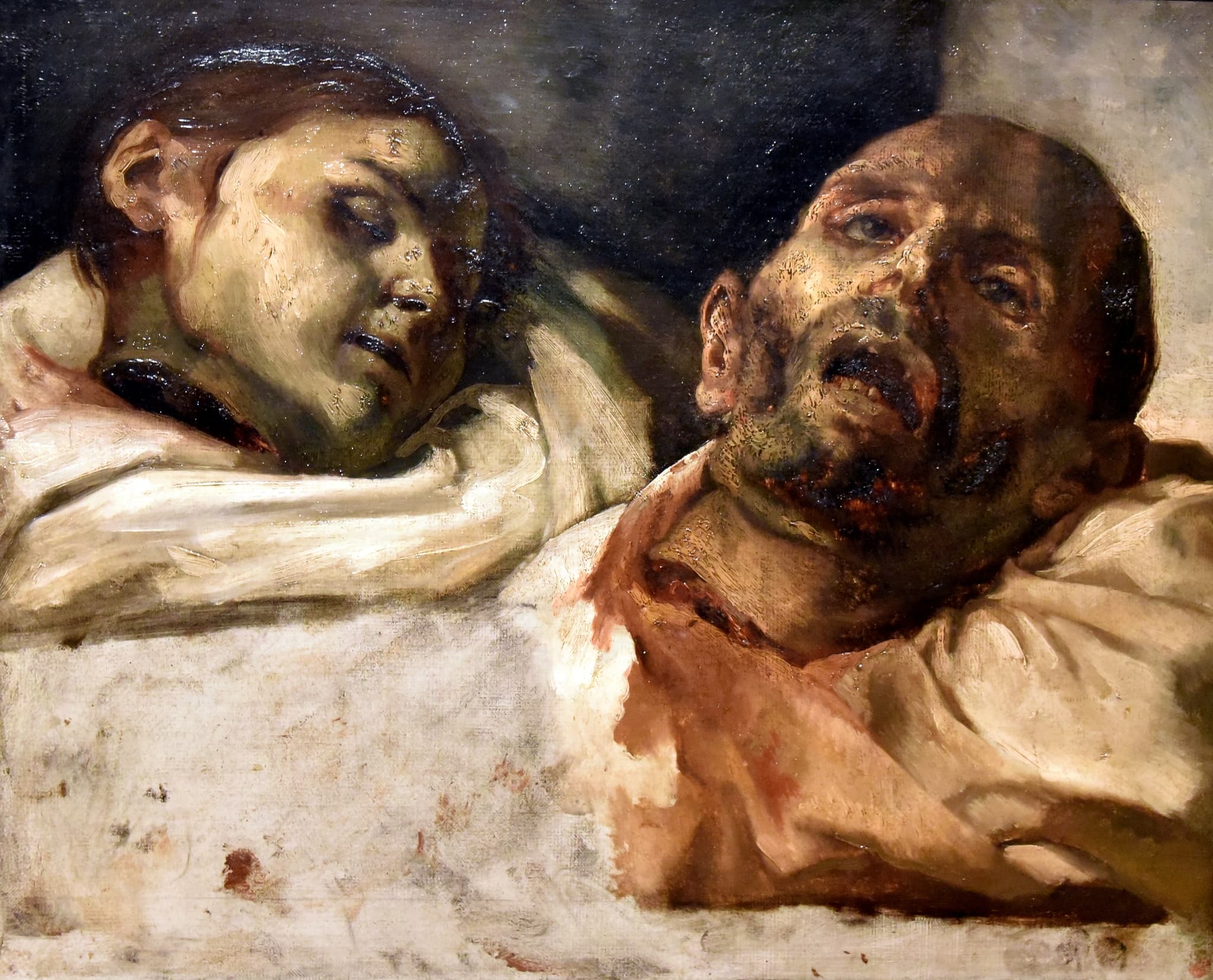
Severed Heads (Têtes de suppliciés, c.1818–19) is a canonical, Raft-period oil by Théodore Géricault, with the best-known example held by the Nationalmuseum, Stockholm, and no public sale history. Based on the artist’s top painting benchmark and current demand for securely attributed works, an autograph oil of this subject and quality would likely command $8–18 million today.
Valuation Analysis
Scope and object. This valuation addresses Théodore Géricault’s Severed Heads (Têtes de suppliciés, c.1818–1819) at the level of an autograph oil of the Stockholm type and quality. The canonical example (approx. 50 × 61 cm) has resided in the Nationalmuseum, Stockholm, since 1918 and has no public auction history; any sale would therefore involve a hypothetical autograph variant or a deaccession with marketable title [1].
Methodology and range. We anchor the estimate to the artist’s strongest painting benchmark—Christie’s Paris (YSL/Bergé), 23 February 2009, where Portrait d’Alfred et Élisabeth Dedreux achieved €9.025m including fees (≈$11.5m then; ≈$17.5m in 2025–2026 dollars)—and adjust for subject category, size, date, and present market depth [2]. Given the extreme scarcity of autograph oils, the Raft-period dating, and the study’s canonical status, we estimate $8–18 million inclusive of buyer’s premium under competitive conditions.
Demand drivers. Géricault’s autograph oils are exceptionally rare on the open market; most major paintings are institutionally held. Severed Heads is art-historically central—linked to the cadaver studies around The Raft of the Medusa and emblematic of Romantic preoccupations with mortality. Its image circulated in the 19th century and remains a touchstone in scholarship, enhancing connoisseur demand despite the macabre theme [1]. While recent public activity has concentrated in works on paper, strong prices for authenticated sheets (e.g., a watercolor at Drouot realized ~€496,650/$587k on 17 Feb 2026) confirm resilient appetite for securely attributed, exhibition‑ready material by the artist [3].
Risk and positioning. The subject’s grisly tenor narrows the buyer pool relative to society portraiture, yet its iconic status within the oeuvre offsets this for top collectors and institutions. In today’s “two‑speed” historical art market, iron‑clad attribution, literature, and condition are decisive. Ongoing attribution debates around Géricault underscore why prime, fully documented works command premiums and why any uncertainty would depress outcomes [4].
Path to the upper/lower bound. Results at the upper end (≈$15–18m) presuppose: unimpeachable attribution (catalogue‑raisonné/expert endorsements), pristine condition and structure, early or continuous provenance, and a robust exhibition/publication record. Works with moderate condition issues or lighter documentation would center in the mid range (≈$10–14m), while smaller, less finished oils or examples with attribution/condition caveats would gravitate to the lower bound (≈$8–10m). On balance, the $8–18m range situates Severed Heads among Géricault’s most valuable market‑eligible subjects while remaining consistent with the artist’s established auction peak and the present, selective demand environment.
Key Valuation Factors
Art Historical Significance
High ImpactSevered Heads is a canonical study within Géricault’s Raft-period investigations of anatomy and mortality, tying directly to the research underpinning The Raft of the Medusa. It is among the artist’s most reproduced and discussed images, frequently cited in Romanticism scholarship and studies of medical imagery in art. That intellectual centrality elevates the work beyond a mere preparatory exercise: it is a signature expression of early French Romanticism’s psychological and corporeal concerns. High scholarly importance typically translates into durable demand from museums and blue‑chip private collectors, supporting values that rival or exceed comparably sized oils on more conventional subjects.
Rarity and Market Supply
High ImpactAutograph oils by Géricault are extraordinarily scarce on the open market; the majority of significant paintings reside in museums. The best-known Severed Heads has been in the Nationalmuseum since 1918, with no public auction history. When a work of Raft-period date and quality surfaces, competition intensifies due to pent‑up institutional and connoisseur demand. This structural scarcity justifies anchoring estimates to the artist’s top auction benchmarks and explains why prime oils can leapfrog the mid‑seven‑figure band into low‑eight figures, even in selective markets. Scarcity also amplifies premiums for excellent condition, clear title, and comprehensive literature/exhibition histories.
Attribution and Condition Certainty
High ImpactRecent public debates over attributions in the Géricault field highlight a key risk factor: buyers reward works with airtight scholarly consensus, technical analysis, and publication trails, while even modest doubts can move prices by millions. For Severed Heads, achieving the upper range presupposes fully accepted authorship (catalogue raisonné and expert endorsements), conservation stability, and minimal restoration. Conversely, structural issues (lining tension, abrasion, overpaint) or gaps in documentation would materially reduce the outcome. The current legal and market climate favors conservatively catalogued, vetted works, which is why due diligence and technical reporting are indispensable components of valuation.
Subject Matter and Buyer Base
Medium ImpactThe macabre theme narrows the generalist buyer pool compared with portraits or equestrian subjects; some collections avoid explicitly grisly imagery. However, within the top tier of Géricault collectors and curators, this subject is a touchstone precisely because it encapsulates the Romantic confrontation with mortality and the artist’s process. That connoisseur cachet offsets the taste risk, particularly when the work is tightly linked to the Raft project and thoroughly documented. Net effect: subject matter slightly moderates liquidity relative to comparably important portraits but does not preclude low‑eight‑figure pricing when other premium factors (date, quality, provenance) align.
Sale History
Severed Heads has never been sold at public auction.
Theodore Gericault's Market
Géricault is a blue‑chip early French Romantic master with a tightly held supply of autograph oils; most major canvases are in museums. His auction record remains the YSL/Bergé Christie’s Paris sale of 2009, when the Dedreux double portrait realized €9.025m including fees (about $11.5m then and roughly $17.5m in today’s dollars). Since 2024, public activity has centered on authenticated drawings and watercolors, which have achieved from the tens of thousands to mid‑six figures, with standout sheets near $600k. When a credible autograph oil appears, pricing can reach the low‑eight figures, with outcomes driven by provenance, attribution certainty, Raft‑period relevance, and condition.
Comparable Sales
Portrait d’Alfred et Élisabeth Dedreux
Théodore Géricault
Best hard benchmark for an autograph oil by Géricault from the Raft-period years; shows market ceiling for top-quality oils by the artist when fresh and well-provenanced.
$11.5M
2009, Christie's Paris (Collection Yves Saint Laurent & Pierre Bergé)
~$17.5M adjusted
Chevaux au pâturage, ou Le Cheval bai et le cheval blanc (ink and watercolor)
Théodore Géricault
High recent price for a securely attributed sheet; confirms strong demand for authenticated, exhibition‑ready works by Géricault tied to core themes (horses) and Romantic period.
$587K
2026, Hôtel Drouot, Paris (Villemur.art)
~$576K adjusted
Preparatory wash for Entrance to the Adelphi Wharf (1821) (wash drawing)
Théodore Géricault
Rediscovered, securely attributed sheet from the London period close in date to Severed Heads; indicates appetite and pricing for strong, documented studies.
$216K
2024, Bruno Roquigny, Saint‑Valery‑en‑Caux
~$223K adjusted
Le Derby (watercolor heightened with white)
Théodore Géricault
Recognized watercolor by Géricault with strong subject appeal; a recent public comp showing current liquidity and price for authenticated works on paper.
$73K
2024, Thierry de Maigret, Hôtel Drouot, Paris
~$75K adjusted
A Sleeping Fishmonger (Le marchand de poissons endormie) (autograph drawing for a lithograph)
Théodore Géricault
Small, autograph work tied to Géricault’s print practice; recent Classic Week result illustrating lower band for minor yet authenticated works.
$70K
2026, Christie's New York
~$68K adjusted
Current Market Trends
The historical art market remains “two‑speed”: trophy‑level, securely attributed works with strong provenance outperform, while secondary material softens. Despite a broader auction reset in 2024, Old Masters and 19th‑century categories showed relative resilience into 2025–2026 when quality was high. In Géricault’s case, ongoing attribution debates have heightened diligence and funneled demand toward works with iron‑clad scholarship and technical backing. Rediscoveries and exhibition‑ready pieces continue to spark competition, while museum‑grade oils—when available—command premiums due to extreme scarcity. Net: selective but deep demand supports low‑eight‑figure pricing for prime oils; authenticated works on paper remain liquid at robust mid‑five to mid‑six‑figure levels.