How Much Is The 1821 Derby at Epsom (Horse Race) Worth?
Last updated: May 7, 2026
Quick Facts
- Methodology
- comparable analysis
The painting Course de chevaux (traditionally titled The 1821 Derby at Epsom), inv. MI 708, is in the Musée du Louvre (acquired 1866) and therefore has no modern auction price. If hypothetically offered on the open market, a defensible range based on institutional provenance, scale and the artist's sparse oil market is US$6,000,000–15,000,000.
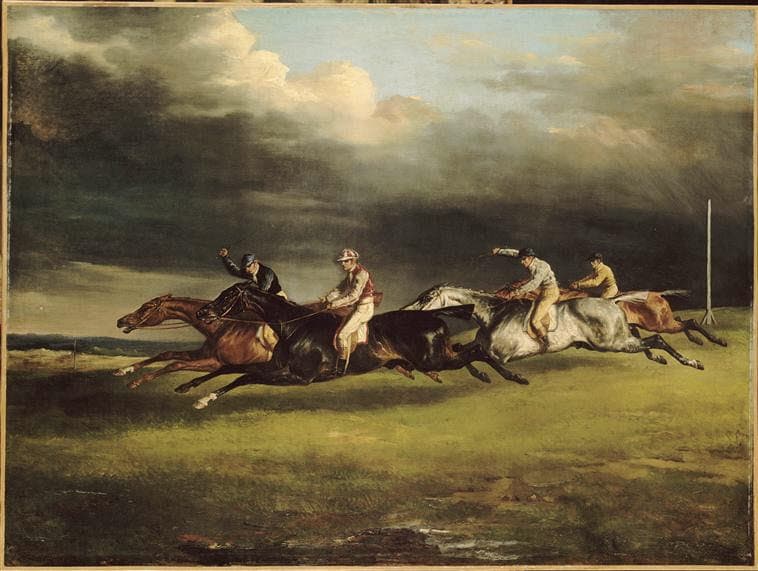
The 1821 Derby at Epsom (Horse Race)
Theodore Gericault, 1821 • Oil on canvas
View more by Theodore Gericault →Valuation Analysis
The painting Course de chevaux, dit traditionnellement Le derby de 1821 à Epsom (inv. MI 708) is in the permanent collection of the Musée du Louvre, acquired by the French state in 1866 and therefore has no modern public‑auction record [1]. Because the picture has remained institutional property for 150+ years, there is no contemporary hammer price to use; this valuation is a hypothetical market estimate derived from auction comparables, museum context and specialist‑market behaviour.
As a ca. 0.92 × 1.23 m oil on canvas depicting an equestrian subject from Géricault’s English period, the work has intrinsic attributes of a display‑scale autograph painting: size, subject matter, and early museum acquisition that together support a valuation materially higher than drawings or small studies. Nevertheless, the precise market placement depends on three determinative inputs: (1) confirmed autograph attribution and cataloguing, (2) a full conservation and condition report, and (3) documented exhibition and publication history. Commissioning technical analysis (X‑ray, infrared reflectography, pigment and ground analysis) and securing a written specialist opinion are prerequisites to narrowing the range below.
For a market benchmark, the clearest modern auction ceiling is the Christie’s Paris sale of Portrait d'Alfred et Elisabeth Dedreux (2009), reported at €9,025,000 (≈ $11.7M at the time), which is widely cited as Géricault’s auction high and establishes a realistic upper bound for prime museum‑quality oils [2]. By contrast, recent trade in 2023–2024—most notably Sotheby’s dispersion of the Elmore family Géricault sheets—demonstrates that the active market for this artist is concentrated in works on paper and small oils, which tend to trade in the mid‑to‑upper six‑figure band rather than at multi‑million levels [3].
Balancing the Louvre ownership, the painting’s scale, and the scarce supply of authenticated Géricault oils, the defensible hypothetical open‑market range if MI 708 were to be sold is USD 6,000,000–15,000,000. The lower bound reflects a market where the picture is secure in attribution but has limited exhibition history or requires conservation; the upper bound represents the price that a major institution or a well‑funded private buyer might pay for a fully authenticated, exhibition‑grade Géricault with strong provenance and technical validation.
Key value drivers that could move the price: documented loan history to major retrospectives and early catalogue citations will push value upward; discovery of studio participation, heavy restoration, or weak provenance will depress value. Operationally, because the Louvre is the current owner, sale is improbable; nevertheless, the range above is appropriate for insurance, loan negotiation or a hypothetical market test.
Recommendation: before any financial commitment, obtain high‑resolution photography, a curator’s provenance extract from Louvre archives, and technical reports; then brief a senior specialist at Christie’s, Sotheby’s or Artcurial to produce a formal pre‑sale estimate and/or an insurer’s replacement‑cost valuation.
Key Valuation Factors
Art Historical Significance
High ImpactThéodore Géricault is a central figure of French Romanticism and the Derby subject ties directly to his English visit (1820–21) and his equestrian studies. As a finished oil of display scale, MI 708 would be of substantial interest to curators and historians because it illuminates his treatment of movement, anatomy and English sporting culture in the late phase of his short career. Scholarly importance raises institutional demand and underpins higher market valuations when authenticity and provenance are secure. This factor therefore exerts a high positive influence on the painting’s market value.
Provenance & Institutional Ownership
High ImpactThe Louvre acquisition (1866) is a significant provenance strength: early museum purchase implies curatorial recognition and reduces attribution risk. Public‑collection provenance is a premium attribute for buyers and insurers because it suggests archival records, exhibition opportunities and sustained oversight. Conversely, museum ownership reduces supply—works held in major institutions rarely appear on the market, which increases desirability but makes actual sale unlikely. Overall, the Louvre provenance strongly supports a multi‑million valuation and is therefore high impact.
Condition & Conservation
High ImpactCondition is a principal determinant of market value for historic oils. A full conservator’s report must evaluate varnish state, paint loss, structural stability, prior lining or relining and extent of overpainting. Evidence of heavy restoration or non‑period interventions can materially depress market value, while an original, stable surface supports premium pricing. Technical imaging (infrared, X‑ray) will also help confirm autograph practice. Because these findings directly change buyer confidence and necessary conservation outlay, condition is high impact on the final valuation.
Rarity & Market Scarcity
High ImpactAuthenticated, museum‑scale oils by Géricault are scarce: he died young and many of his important works entered public collections early. Scarcity amplifies value for any authenticated, exhibition‑ready oil, particularly one with strong provenance. However, scarcity also means comparables are thin and price discovery can be volatile—exceptional works can attract institutional competition and high prices, while uncertain attributions tend to sell for far less. For MI 708, rarity adds strong upward pressure and is therefore a high‑impact factor.
Market Comparables & Demand
Medium ImpactDirect auction comparables for Géricault oils are limited; the 2009 Christie’s Dedreux sale is the modern benchmark for a high‑quality oil, while recent Sotheby’s sales show stronger liquidity for works on paper. Demand for museum‑quality Géricaults is concentrated among institutions and specialist collectors rather than speculative buyers. Because the small comparables set widens the valuation band, this factor is medium impact: essential for benchmarking but constrained by limited recent supply.
Sale History
The 1821 Derby at Epsom (Horse Race) has never been sold at public auction.
Theodore Gericault's Market
Théodore Géricault (1791–1824) holds a secure place in 19th‑century French painting; his Raft of the Medusa anchors his art‑historical stature. Market characteristics include a scarcity of autograph oils, high scholarly interest and concentrated institutional demand. Drawings and watercolours trade more frequently and typically achieve five‑ to six‑figure results; rare finished oils can reach single‑ to low‑double‑digit millions where provenance, condition and exhibition history are strong. The 2009 Christie’s Dedreux sale is commonly referenced as the artist’s auction high and sets a practical ceiling for the very best oils.
Comparable Sales
Portrait of Alfred and Elisabeth Dedreux
Théodore Géricault
Direct match by artist; finished oil and the artist's modern auction high — establishes the market ceiling for a museum‑quality Géricault oil.
$11.7M
2009, Christie's Paris (Yves Saint Laurent / Pierre Bergé sale)
~$17.4M adjusted
Portrait of Zoë Elmore (lot, Elmore family group)
Théodore Géricault
Same artist and equine/family provenance group, but a work on paper (smaller, less monumental) — useful to gauge demand/price band for high‑quality Géricault sheets and small compositions.
$400K
2024, Sotheby's (Elmore family: Master Works on Paper sale, Jan 31–Feb 1 2024) — house estimate midpoint used
~$405K adjusted
Two horses in a stable (lot, Elmore family group)
Théodore Géricault
Same subject (horses) and artist; smaller scale/medium (drawing/watercolour) — indicates mid‑to‑upper six‑figure demand for high‑quality studies versus multi‑million for finished oils.
$150K
2024, Sotheby's (Elmore family: Master Works on Paper sale, Jan 31–Feb 1 2024) — estimate midpoint used as directional comparator
~$152K adjusted
Elmore family group (highest published estimate across offered Géricault lots)
Théodore Géricault
Aggregate market interest indicator for a single‑owner run of Géricault works on paper — useful as a collection‑level ceiling for studies, not a realized single‑oil comparable.
$1.4M
2024, Sotheby's (press: highest published estimate for the Elmore Géricault group, €1.2M converted at 1 EUR = 1.175 USD)
~$1.4M adjusted
Current Market Trends
Current market conditions for 19th‑century French painting are steady but less speculative than contemporary segments. Supply of museum‑quality Géricault oils is negligible, so prices are driven by institutional competition and connoisseur demand; works on paper are the most liquid category. The market rewards clear attribution, documented provenance and strong condition; uncertainty in any of these areas materially reduces realizations.