How Much Is The Charging Chasseur (An Officer of the Imperial Horse Guards Charging) Worth?
Last updated: May 7, 2026
Quick Facts
- Methodology
- comparable analysis
The Charging Chasseur (c.1812) is held by the Musée du Louvre (inv. INV 4885) and is effectively not market‑available—treated as inestimable for practical sale. Hypothetically, a museum‑quality, legally transferable Géricault equestrian oil of this composition would be preliminarily valued at USD 15,000,000–60,000,000, subject to provenance, condition, legal exportability and technical confirmation.
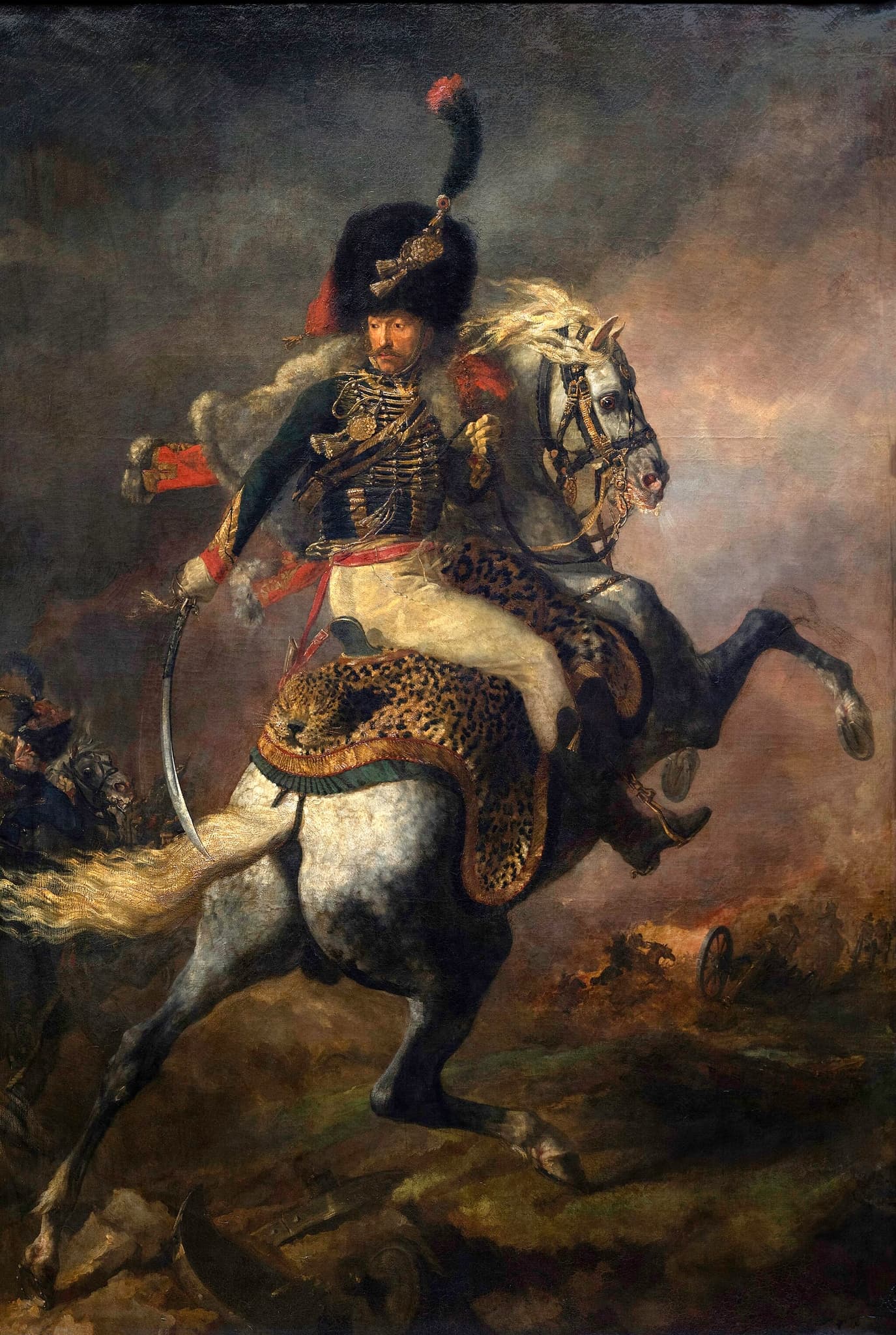
The Charging Chasseur (An Officer of the Imperial Horse Guards Charging)
Theodore Gericault • Oil on canvas
View more by Theodore Gericault →Valuation Analysis
Context and availability: The Charging Chasseur (Officier de chasseurs à cheval de la Garde impériale, c.1812) is part of the Musée du Louvre's permanent collection (inv. INV 4885) and is protected under French national patrimony; as such it is effectively not market‑available and should be treated as inestimable in any practical sense of sale or export [1]. This valuation therefore presents both the institutional/legal reality and a hypothetical market frame: if a museum‑quality, authenticated Géricault equestrian oil of this composition and condition were to be offered on the open market under clean legal circumstances, the preliminary estimated auction range is USD 15,000,000–60,000,000.
Methodology: The appraisal is based on a comparable_analysis anchored to the very limited universe of public sales for authenticated Géricault oils and high‑quality works on paper, adjusted for scarcity, provenance and legal constraints. The clearest public anchor is Christie's Paris sale of Portrait d'Alfred et Elisabeth Dedreux (2009), which realised €9,025,000 (≈ $11.5M at sale; roughly $17M when adjusted to current market levels), and the 2008 Ramel portrait (≈ $7.2M sale; inflation adjusted ≈ $10.6M) [2]. Additional input comes from the market behaviour of Géricault drawings and small oils, which trade much lower, underscoring the gulf between studies and museum‑quality canvases.
Why the low estimate (~$15M): The lower bound sits modestly above the inflation‑adjusted sale anchors because Charging Chasseur, while historically significant and a characteristic early mature equestrian work, is generally considered secondary to the Raft of the Medusa in public renown. The low estimate assumes sound attribution, conserved original paint, and no export/legal obstacles but also reflects the reality that very few Géricault oils have been offered to price‑discovery markets in the modern era.
Why the high estimate (~$60M): The upper bound is an aspirational, tournament scenario that requires exceptional condition, fresh, high‑profile scholarship and publication, flawless provenance, and legal transferability to provoke institutional and private bidding competition at the very top end. Scarcity of comparable museum‑quality Géricault oils means that under perfect market conditions an auction could overshoot mid‑teens pricing by multiples; however such outcomes are speculative and hinge on circumstances rarely present for national‑collection works.
Practical caveats and next steps: Because the Louvre canvas is state property, French patrimony rules and likely export controls would preclude a conventional open sale; in that real‑world sense the work is inestimable and my numeric range should be read as a market hypothesis only. To refine this into a formal insured or saleable figure one must confirm the Louvre accession and complete provenance, obtain full conservation and technical reports (IR, X‑ray, pigment analysis), and secure legal advice on exportability and patrimony status [1][2]. I can produce a detailed comps spreadsheet and a draft inquiry to the Louvre on request.
Key Valuation Factors
Art Historical Significance
High ImpactThe Charging Chasseur is an important early mature painting by Géricault (c.1812) that exemplifies his energetic handling and interest in equestrian and military subjects. Although it is not his single most famous work (that status belongs to The Raft of the Medusa), it is a canonical example in studies of early 19th‑century French Romanticism and is frequently reproduced and cited in scholarship. Art‑historical importance is a primary value driver for museum‑quality 19th‑century pictures: it increases institutional interest, exhibition potential, and curatorial demand, all of which translate into higher market valuations when a comparable work is legitimately transferable.
Provenance & Ownership
High ImpactThe painting's current ownership by the Musée du Louvre (inv. INV 4885) provides the strongest possible institutional provenance, which under normal market circumstances would enhance buyer confidence and price. However, state/museum ownership also means legal protections and patrimony status that typically block sale and export; the same provenance that adds scholarly gravitas simultaneously neutralizes marketability. For a hypothetical sale of a comparable canvas, clean, published provenance through reputable collections or a single‑owner dispersal would be essential to accessing the high end of the market.
Condition & Technical State
Medium ImpactCondition and technical authentication materially affect realised value. Stable original paint, minimal overpainting, and an unbroken conservation history support top prices; conversely, major restorations or structural damage can depress bids substantially. Scientific analysis (infrared reflectography, x‑ray, pigment and canvas analysis) also reduces attribution risk—critical in a scarcity‑driven market. Because I do not have access to the Louvre's conservation dossier for INV 4885, condition is treated here as a medium‑impact variable: pivotal to the final monetised value but dependent on verifiable technical reports.
Market Scarcity & Demand
High ImpactGéricault's large oils are extremely rare on the open market because most important canvases are held in institutions. This supply scarcity concentrates bidding among a small pool of museums and deep private collectors, generating a scarcity premium when a bona fide oil appears. Recent market activity has been dominated by drawings and small studies; that pattern magnifies the value differential between studies and museum‑quality oils. The combination of limited supply and focused demand means scarcity is a high‑impact factor shaping the steep bands in the hypothetical estimate.
Legal / Heritage Restrictions
High ImpactFrench patrimony laws, museum accession status and export controls are decisive for any major French work. A Louvre accession implies state protection and the practical impossibility of conventional sale or export without exceptional ministerial authorisation. Even if a comparable canvas were privately owned, national treasure declarations or export barriers could block international transfer. These legal constraints can render a market valuation moot in practice; they are therefore among the most influential single factors when assessing monetisation prospects.
Sale History
The Charging Chasseur (An Officer of the Imperial Horse Guards Charging) has never been sold at public auction.
Theodore Gericault's Market
Théodore Géricault (1791–1824) is a canonical figure of French Romanticism whose market dynamic is defined by severe scarcity of museum‑quality oils and steady demand from institutions and specialist collectors. Major canvases are largely museum‑held, so public auction anchors are rare; the clearest modern anchor is Christie's 2009 sale of Portrait d'Alfred et Elisabeth Dedreux (realised €9,025,000) [2]. Drawings and small studies are the most frequently traded category and typically sell in the five‑ to six‑figure range, while large, securely attributed oils command multimillion‑dollar results when they appear.
Comparable Sales
Portrait d’Alfred et Elisabeth Dedreux
Théodore Géricault
Same artist; large, museum‑quality oil offered at major auction and the clearest public price anchor for Géricault oils (high‑profile provenance).
$11.5M
2009, Christie's, Paris
~$17.0M adjusted
Portrait of Ramel
Théodore Géricault
Same artist and period; a major oil that demonstrates mid‑range realised pricing for high‑quality Géricault oils on the open market.
$7.2M
2008, Christie's, New York (Important Old Master Paintings sale)
~$10.6M adjusted
Chevaux au pâturage
Théodore Géricault
Same artist and equestrian subject (closely thematically related to Charging Chasseur) but medium is watercolour/drawing rather than a large oil—useful to show demand for equestrian studies.
$589K
2026, Hôtel Drouot, Paris
~$581K adjusted
A sleeping fishmonger (Le marchand de poissons endormie)
Théodore Géricault
Small oil/study by the same artist sold at a major house—illustrates the gulf between small studies and museum‑quality oils in realised prices.
$70K
2026, Christie's, New York
~$69K adjusted
D'après Théodore Géricault — étude de figure (after Géricault study)
After / Studio of Théodore Géricault
Minor/study work (after Géricault) showing the very low end of the market for workshop/attributed pieces and prints/drawings.
$896
2023, Bonhams / Cornette de Saint‑Cyr (day sale)
~$937 adjusted
Current Market Trends
The 19th‑century/Old Masters market is a specialist segment with episodic strength: single‑owner dispersals and museum exhibitions periodically revive interest and price competition. Recent years have seen renewed scholarly attention to Géricault and selective strong results for drawings and family‑collection offerings; however top‑end activity remains volatile and highly dependent on provenance, attribution certainty, and legal exportability. Scarcity of transferable oils keeps price anchors relatively stable but leaves wide tail risk for individual lots.