The Dead Son in The Raft of the Medusa
A closer look at this element in Theodore Gericault's 1818–1819 masterpiece
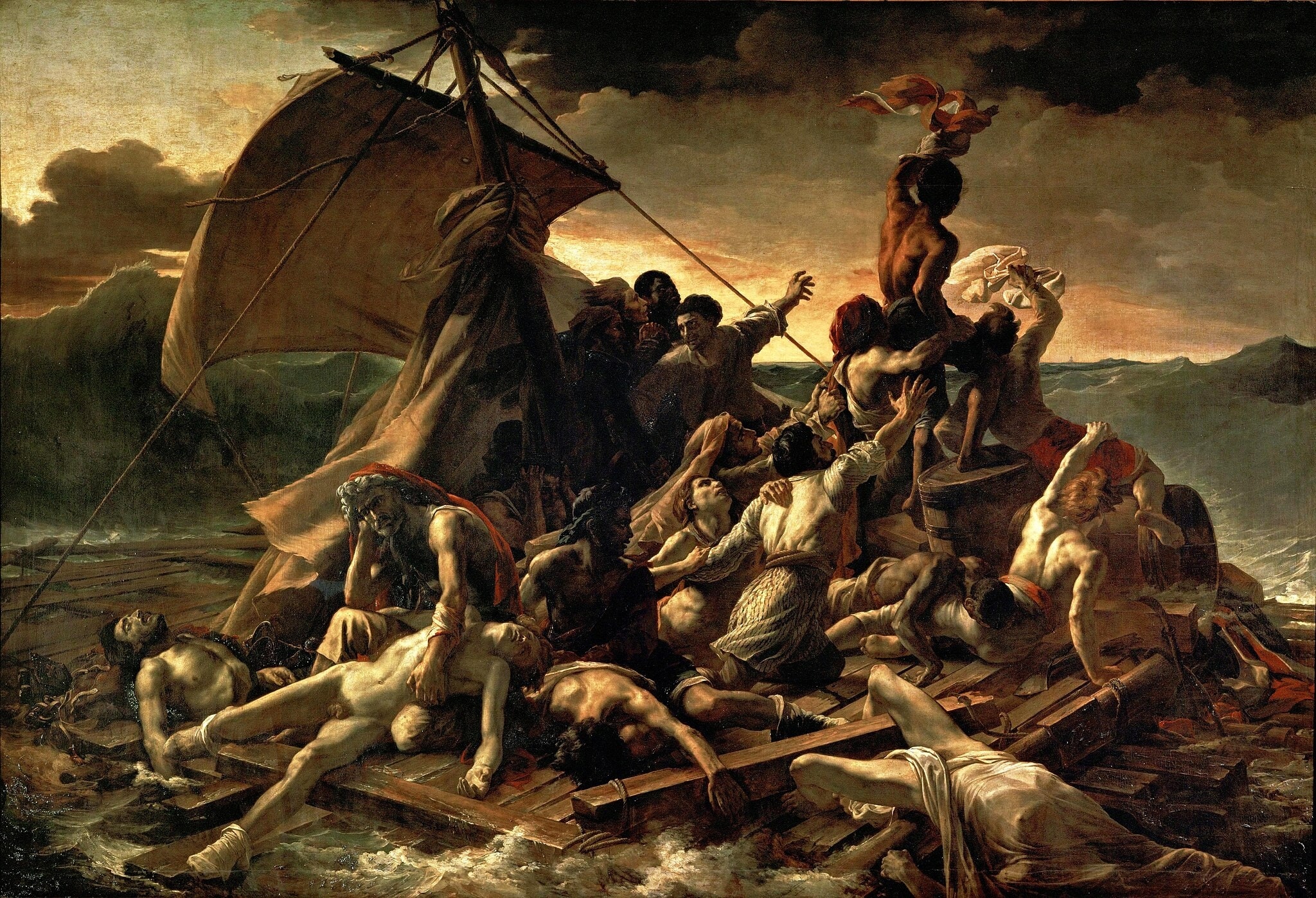
At the raft’s lower left, a grey‑bearded man cradles the pallid body of a youth—the so‑called “Dead Son.” Géricault devised this pair to concentrate the shipwreck’s human cost into a single, unforgettable emblem, setting a grave counterpoint to the beacon of hope at right. Their presence turns reportage into history painting, where private grief becomes a public reckoning.
Historical Context
Painted in 1818–1819 in response to the 1816 wreck of the French frigate Méduse, Géricault’s Raft of the Medusa drew on a journalist’s rigor: he interviewed survivors, read their accounts, built models of the raft, and made exhaustive figure studies to convey the catastrophe with unflinching immediacy 1. To ground the spectacle in felt experience, he invented a father cradling a lifeless youth placed at the raft’s edge—the motif later dubbed the “Dead Son.” French museum educators identify the older man’s hand‑to‑head gesture as the classical attitude of Despair, and they stress that this father–son unit is Géricault’s own compositional creation within the larger reconstruction 2.
While the painting arises from specific political scandal under the Bourbon Restoration, this particular grouping transforms the news into a universal scene of mourning. By anchoring grief in a recognizable familial bond, Géricault fused modern eyewitness detail with the moral gravity of grand manner history painting, ensuring that the Méduse tragedy would be read not only as a botched naval episode but as a study in human loss 12.
Symbolic Meaning
The “Dead Son” functions as the painting’s emblem of absolute grief. The father’s bowed head and slack embrace announce the classical topos of Despair, deliberately set against the right‑hand cluster straining toward a distant ship; together they stage a moral spectrum from death to provisional hope 12. Smarthistory situates this rhetoric within high‑art precedents—Dante’s Ugolino and his children among them—showing how Géricault refracts current events through time‑tested motifs to universalize suffering 1.
Yet the symbol is sharpened by documentary resonance. Survivor narratives mention the death of a twelve‑year‑old boy on the raft and an officer clasping a sailor‑boy during mutiny; Géricault distills such episodes into a single, legible vignette, transforming scattered testimonies into a Pietà‑like, secular icon 58. French and museum sources consistently read the pair as the painting’s didactic counterweight: where the waving figures propose tenuous salvation, the father‑and‑son demand mourning—an image of loss that refuses to be redeemed by the mere prospect of rescue 23. The motif thereby bridges fact and allegory, Romantic intensity and classical pathos, making grief the ethical ground of the entire composition 18.
Artistic Technique
Géricault seats the pair at the base of the canvas’s left pyramid, a compositional “low anchor” from which the eye climbs toward the signaling group—an engineered rise from shadow to light 13. He renders both bodies as monumental nudes modeled with Michelangelesque weight, informed by morgue and hospital study and by direct work from cadavers, which lends the son’s corpse its greenish, ashen pallor 46.
A restricted, somber palette and raking chiaroscuro strike the figures from the left, isolating the boy’s waxen skin against the raft’s tarry planks and the father’s muted red drapery 14. Géricault heightens verisimilitude through “trivial” specifics—the youth’s stockings collapsed at his ankles—signs of lived bodies rather than allegorical abstractions 2. Even the bitumen‑rich passages, now darkened, contribute to the work’s severe tonal harmony, intensifying the scene’s mortuary hush 4.
Connection to the Whole
Placed at the lower left, the “Dead Son” anchors the painting’s zone of death and despair, ensuring that the canvas cannot be read as a triumphant rescue picture. From this weighty nadir, the composition arcs toward the right‑hand wave of figures signaling a distant ship, binding the viewer’s gaze to a narrative of oscillating loss and hope 13.
Emotionally, the father’s inward collapse declares the work’s ethical stance: most lives on the raft ended in anonymous grief, and any glimmer of salvation is measured against that fact 1. The group’s mute lament becomes the painting’s conscience, converting a Restoration scandal into a durable history image in which modern reportage is chastened by a timeless, Pietà‑like call to mourn 21.
Explore More from This Painting
This detail is one part of The Raft of the Medusa. Use the links below to return to the full interpretation, browse the full set of details, or view the painting's valuation if available.
Sources
- Smarthistory, “Théodore Géricault, Raft of the Medusa”
- Panorama de l’art (RMN/GrandPalais), “Le Radeau de La Méduse”
- Louvre, “Les Enquêtes du Louvre” podcast transcript (Côme Fabre)
- Histoire par l’image (RMN/Ministry of Culture), “Le Radeau de la Méduse”
- Savigny & Corréard, Narrative of a Voyage to Senegal
- Princeton University Art Museum, Flayed Cadavers: Study for the Raft of the Medusa
- The Met, Six studies for Corréard and Savigny
- Mary Slavkin, “The Raft of the Medusa, The Fatal Raft and the Art of Critique” (Kritikos)