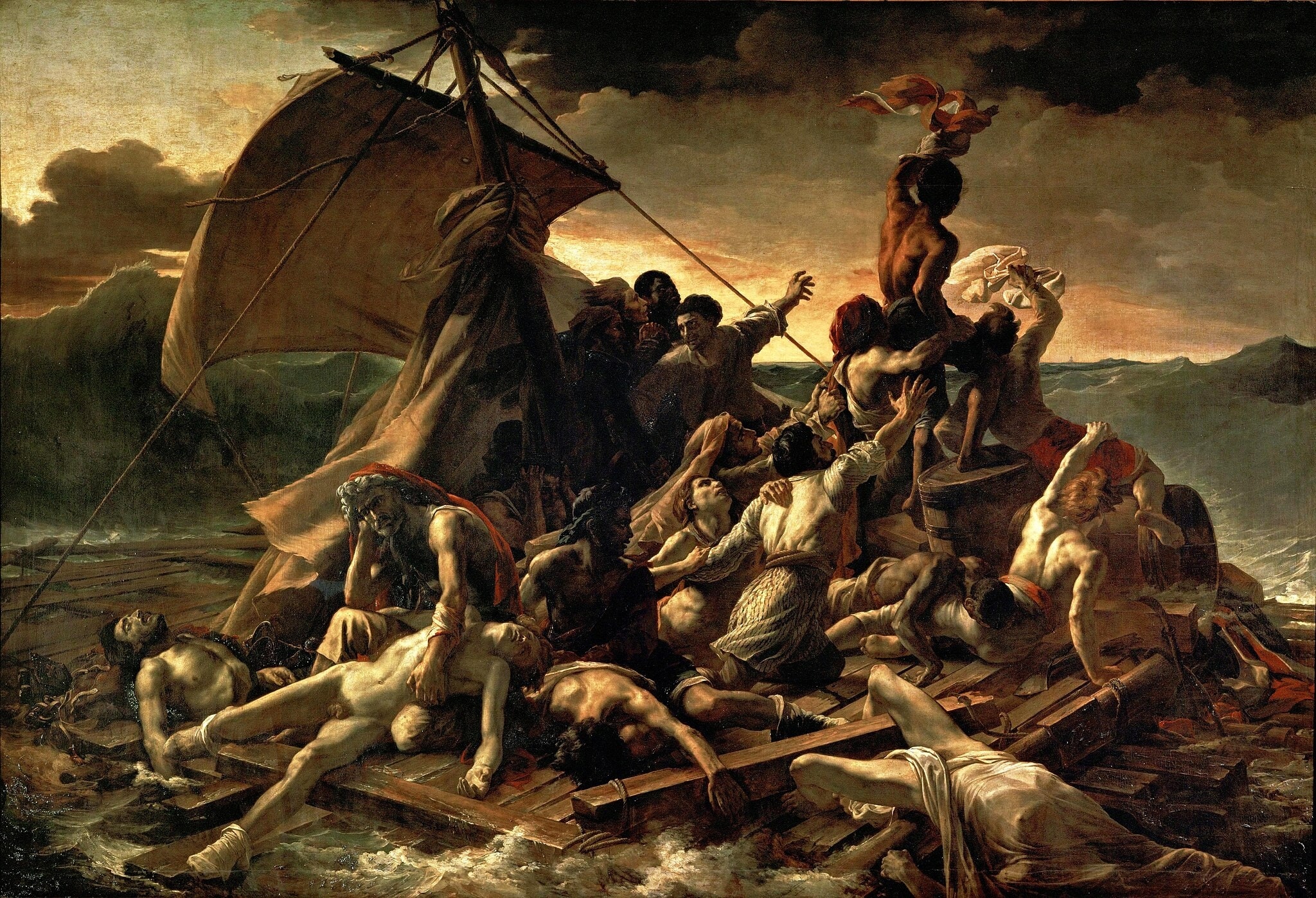
The Raft of the Medusa

by Theodore Gericault

The Raft of the Medusa stages a modern catastrophe as epic tragedy, pivoting from corpses to a surge of collective hope. The diagonal mast, torn sail, and a Black figure waving a cloth toward a tiny ship compress the moment when despair turns to precarious rescue [1][2].

Fast Facts

Year
1818–1819
Medium
Oil on canvas
Dimensions
491 x 716 cm
Location
Musée du Louvre, Paris
The Raft of the Medusa by Theodore Gericault (1818–1819) featuring Diagonal mast and torn sail, Apex signaler with waving cloth, Distant rescue ship (Argus), Pyramid of bodies

Click on any numbered symbol to learn more about its meaning

Meaning & Symbolism

Géricault builds the scene as a moral and political argument. The raft’s bodies are arranged as a rising pyramid that culminates in the figure standing on a barrel, back lit by a bruised dawn, who whips a cloth toward the almost-lost silhouette of the Argus at the right horizon; beneath him, hands and torsos strain upward in a wave of shared intention. At the opposite corner lie slack, green-lit corpses and a grieving elder cradling a youth, a deliberate allusion to lamentation imagery that marks the human cost of bureaucratic failure. The diagonal mast and wind-torn sail tilt the entire field, fixing the raft in a state of engineered instability and channeling energy from left desolation to rightward hope. Light chisels wet flesh with Caravaggesque clarity, but the sea and sky remain tonally close to the bodies, binding nature’s indifference to human vulnerability. The composition’s arc—from death to the signal of life—asserts that rescue is not bestowed; it is willed into possibility by a fragile, collective surge 124. The painting’s politics are inseparable from its form. In 1816 the frigate Méduse, captained through patronage and incompetence, stranded more than a hundred fifty people on a makeshift raft; only fifteen were rescued after thirteen days, a number that shrank further thereafter 23. Géricault interviewed survivors, built a model raft with their help, and studied corpses to achieve anatomical truth—not to sensationalize, but to claim authority for a modern subject usually excluded from grand manner painting 134. By granting anonymous castaways the scale and heroism of antiquity, he converts scandal into indictment. The apex signaler—placed at the literal and figurative summit of the composition—embodies agency rather than passivity; his leadership counters period stereotypes and has been read as a pointed intervention in debates around slavery and freedom in the Restoration era 4. That choice reframes the raft as a micro-society whose redemption depends on the coordinated action of those most imperiled. Yet Géricault refuses simple consolation. The Argus is so small it nearly disappears into the horizon haze; the wave that lifts the right-hand cluster could also drown them. This ambiguity is the painting’s ethical core: hope is present, but provisional, contingent on vigilance and solidarity. The overstretched, idealized muscles are not triumphalist; they are instruments of exhaustion, literalizing the costs of endurance. Critics have noted how the artist privileges pictorial truth over reportage—storm, anatomy, and gesture are intensified to disclose a truth about responsibility and survival that raw documentation cannot convey 25. In doing so, The Raft of the Medusa inaugurates a Romantic claim that contemporary history, rendered with epic gravity and psychological heat, can confront the failures of power while honoring shared humanity. Its lasting force comes from this dual fidelity: to the facts of a specific disaster and to the larger, enduring drama of people who, in the face of indifferent seas and negligent states, manufacture their own, tenuous horizon of rescue 12345.

Explore Deeper with AI

Ask questions about The Raft of the Medusa

Popular questions:

Powered by AI • Get instant insights about this artwork

💬 Ask questions about this artwork!

Interpretations

Iconography: Lamentation Without Salvation

The foreground elder cradling a youth borrows from Renaissance lamentation and pietà conventions, translating sacred grief into secular indictment. This iconographic graft converts what would be a devotional endpoint into a political beginning: grief as evidence against authority. The group anchors the leftward basin of death that powers the rightward surge, making mourning a hinge between loss and mobilization. By refusing a central Christ-figure or overt redemption, Géricault retools Christian pathos for modern catastrophe, insisting that consolation—if any—must be manufactured by human solidarity, not divine rescue 12.

Source: Louvre; Encyclopaedia Britannica

Race & Agency (Abolitionist Lens)

At the apex, a Black figure commands the signal, a compositional and political summit that inverts Restoration stereotypes of Black passivity. Far from a token presence, his elevated placement, dynamic contrapposto, and role as visual fulcrum assert agency-as-heroism within a modern catastrophe. Museum scholarship notes how this choice resonated with contemporary debates on slavery and freedom, positioning the raft as a site where racialized bodies enact leadership rather than submission 1. Early art-historical readings identified this as a deliberate confrontation with prevailing imagery, making the Black signaler the work’s focal protagonist 4. Subsequent studies have deepened this view, showing how Géricault’s modeling (linked to the sitter Joseph) engages the politics of representation, recasting Blackness as the motor of collective survival rather than its burden 5.

Source: Louvre; Berger & Johnson; Alhadeff

Formal Analysis: Dual Pyramids and Engineered Instability

The canvas organizes bodies into counter-thrusting masses: a descending wedge of death at left and an ascending wedge of hope at right, both driven by the tilted mast and wind-torn sail. This not only choreographs attention to the tiny Argus but also spatializes ethics: despair is horizontally spread, hope is vertically willed. The raft’s near-diagonal alignment and the shearing horizon generate a systemic unsteadiness—an intentional Romantic dynamism that abolishes stable ground and binds viewer empathy to precarious balance. Light articulates wet musculature with Caravaggesque precision, while the sea’s tonality bleeds into flesh, eroding boundaries between figure and environment. The result is a formal machine that converts compositional force into moral momentum, pivoting spectators from resignation toward fragile action 12.

Source: Louvre; Encyclopaedia Britannica

Reception History: From Salon Scandal to London Spectacle

Exhibited as Scène de naufrage (1819), the painting’s modern dead and political subtext shocked the Salon, where grand manner scale had rarely been spent on anonymous victims of a recent scandal. The Bourbon Restoration context made the subject volatile; the captain’s patronage appointment had become a national embarrassment. In London (1820), however, the same elements read as thrilling modernity, drawing large crowds and a new reputation for Géricault 2. The trans-Channel reception underscores how publics construct meaning: in Paris, the work indicted state incompetence; in Britain, it fed a hunger for sensational yet serious contemporary history, intersecting with anti-slavery discourse and the Romantic cult of the sublime. The painting thus functioned as both political lightning rod and cultural export 2.

Source: Encyclopaedia Britannica

Method & Ethics: Morgue Studies and “Truth to Art”

Géricault’s inquiry was forensic: he interviewed survivors, built a model raft with their help, and studied corpses at Beaujon hospital to refine the physiognomy of drowning and decay 1. Yet he does not mimic reportage; he intensifies storm, musculature, and gesture to articulate what Julian Barnes calls pictorial truth—a truth that discloses moral stakes beyond documentary exactitude 6. This hybrid method claims authority for a modern subject typically barred from high art, while also guarding against voyeurism through an ethos of earned specificity. The painted bodies, idealized yet exhausted, become instruments of knowledge: anatomy as evidence; composition as argument. The result is a visual ethics in which accuracy serves judgment, and embellishment serves accountability 16.

Source: Louvre; The New Yorker (Julian Barnes)

Political Theory: Shipwreck as State Failure and Public Testimony

The Méduse disaster—grounding, raft castoff, cannibalism, and belated rescue—was precipitated by political appointment and negligence, then amplified by survivor narratives that ignited public outrage 23. Géricault leverages this chain: the painting visualizes how systems fail and how citizens answer with collective action. By monumentalizing anonymous castaways, he transforms scandal into civic indictment, aligning the raft with an emergent public sphere where testimony (Savigny, Corréard) and image (the Salon canvas) co-produce accountability. The micro-society on the raft models a counter-politics: agency from below, leadership by the imperiled, and hope as a shared labor. This is not consolation but pressure on governing power through modern media—print and paint—operating in tandem 23.

Source: Encyclopaedia Britannica; Savigny & Corréard

Nature and the Sublime: The Sea as Co‑Protagonist

The ocean is not backdrop but adversary. Tonal proximity among sea, sky, and bodies dissolves hierarchies, making human flesh read as weathered matter and the elements as sentient pressures. The distant Argus nearly vanishes, and the wave that lifts also threatens to engulf—the Romantic sublime as oscillation between awe and annihilation. This ambiguity enforces vigilance: hope is conditional, granted only by sustained attention and collective will. The sublime here is ethical, not merely scenic; it compels action by staging indifference. Viewers experience the raft’s peril as their own unstable footing, a phenomenological cue that turns spectators into implicated witnesses rather than passive onlookers 26.

Source: Encyclopaedia Britannica; The New Yorker (Julian Barnes)

Related Themes

About Theodore Gericault

Theodore Gericault (1791–1824) trained in the neoclassical studio system but absorbed Baroque dynamism and Michelangelesque anatomy, channeling them into modern, emotionally charged subjects. His short career—from cavalry scenes to the monumental Raft and later studies of psychological extremes—helped define French Romanticism and influenced Delacroix and later modernists [2].
View all works by Theodore Gericault