The Pyramid of Bodies in The Raft of the Medusa
A closer look at this element in Theodore Gericault's 1818–1819 masterpiece
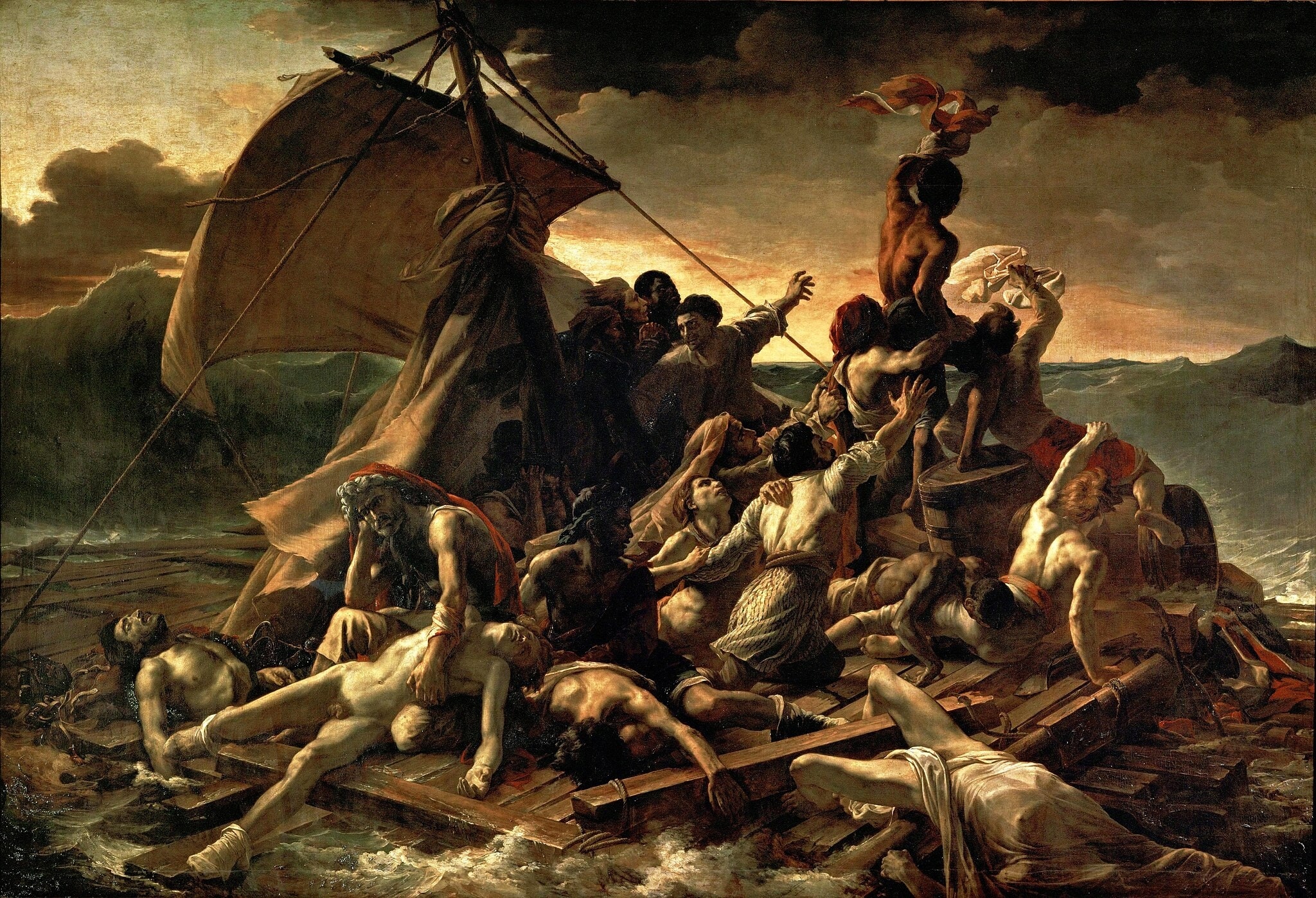
Géricault’s “pyramid of bodies” surges from a heap of corpses to a single figure waving a cloth toward the tiny Argus, transforming wreckage into a crescendo of hope. By crowning this modern tragedy with a Black signaler, the artist fuses classical grandeur with urgent politics, fixing the painting’s gaze—and ours—on survival and agency.
Historical Context
Painted in 1818–1819, The Raft of the Medusa confronts the 1816 shipwreck of the French frigate Méduse, a national scandal of the Bourbon Restoration. Rather than depict officers or named heroes, Géricault monumentalized anonymous survivors and structured them as a rising mass—the Louvre calls it the “pyramid of bodies”—that culminates in a man signaling a distant rescue ship, the Argus 1. This architecture of figures let him turn raw reportage into modern history painting: a public indictment of governmental failure staged with the authority of classical form. Smarthistory describes the canvas as organized by two interlocking pyramids, with the ascending group carrying the drama to its peak at the signaler 2.
Géricault’s choice of a contemporary catastrophe, rendered at grand scale, shocked viewers habituated to antique subjects. By stacking living bodies over the dead and driving the eye to the apex, he compressed the aftermath of starvation, mutiny, and abandonment into a single, decisive instant of appeal—an image that married topical outrage to the visual rhetoric of salvation 12.
Symbolic Meaning
The ascending pyramid stages a passage from death to life: at the base lie the inert and despairing; above them, men who have just perceived the ship; at the summit, the signaler who converts sight into action. This literal climb becomes an allegory of communal hope, the living physically leveraging the dead to mount a last call to rescue. Smarthistory reads the upward thrust as a compositional and emotional crescendo; the Louvre frames it as the guiding armature that leads the eye to the climactic gesture 12.
Géricault also reassigns the apex of heroism. The standing figure at the peak—a Black man—commands the painting’s highest, most illuminated point, a decision loaded in an era roiled by debates over slavery and freedom. Museum texts and scholarship register this prominence as ethically and politically charged: the summit honors Black agency at the very moment of possible deliverance, embedding abolitionist sympathy within the work’s central symbol 13.
By importing a classically authoritative pyramidal scheme into a current event, the artist recasts who may occupy the top of history painting’s hierarchy. The pyramid thus operates as a moral engine: it asserts dignity amid state-inflicted catastrophe and argues that collective action—rather than aristocratic command—animates salvation 23.
Artistic Technique
Géricault engineers the pyramid through interlocking diagonals—torsioned backs, outstretched arms, and angled planks—that funnel sight upward to the waving cloth 2. Harsh, episodic light slashes across the raft from the left, modeling bodies in deep chiaroscuro while others recede into penumbra; this staging sculpts the mass and quickens its ascent 4. Though the subject is modern, the anatomy is classically idealized—the apex figure recalls antique prototypes—anchoring radical content in authoritative form 12.
Empirical study underwrites the pyramid’s tactile realism: morgue visits, flayed-cadaver drawings, and life studies yield the clammy weight and interlocked limbs that build the structure’s base and middle tiers 5. Preparatory sheets in the Louvre focus on the “standing Black man,” confirming the deliberate crafting of the peak that crowns the composition 9.
Connection to the Whole
The pyramid is the painting’s backbone. It organizes the sprawling raft into a legible arc that escorts viewers from the foreground’s corpses to the charged apex of action, transforming chaos into narrative direction 2. At the peak, the signaler points to the barely visible Argus, compressing the painting’s time to the razor’s edge of rescue and tying every figure’s fate to one collective gesture 7.
By fusing classical scaffolding with contemporary victims, the pyramid turns a news disaster into a high-history canvas that indicts governmental incompetence while asserting human agency. Its summit—both literal and ethical—focuses the work’s politics of hope, a reading reinforced by the Louvre’s emphasis on the apex figure’s significance within abolition-era debate 12.
Explore More from This Painting
This detail is one part of The Raft of the Medusa. Use the links below to return to the full interpretation, browse the full set of details, or view the painting's valuation if available.
Sources
- Musée du Louvre – The Raft of the Medusa (highlights page)
- Smarthistory – Théodore Géricault, Raft of the Medusa
- BYU Religious Studies Center – Synthesis citing Lorenz Eitner on structure and apex symbolism
- Panorama de l’art (RMN–Grand Palais) – Analytical fiche on lighting and staging
- Princeton University Art Museum – Flayed Cadavers: Study for the Raft of the Medusa
- The Metropolitan Museum of Art – Six studies for Corréard and Savigny
- Royal Museums Greenwich – Object record noting the Argus
- Encyclopaedia Britannica – The Raft of the Medusa
- Musée du Louvre, Département des Arts graphiques – Study for the standing Black man (Etude… pour le Noir dressé)