The Signaling Figure in The Raft of the Medusa
A closer look at this element in Theodore Gericault's 1818–1819 masterpiece
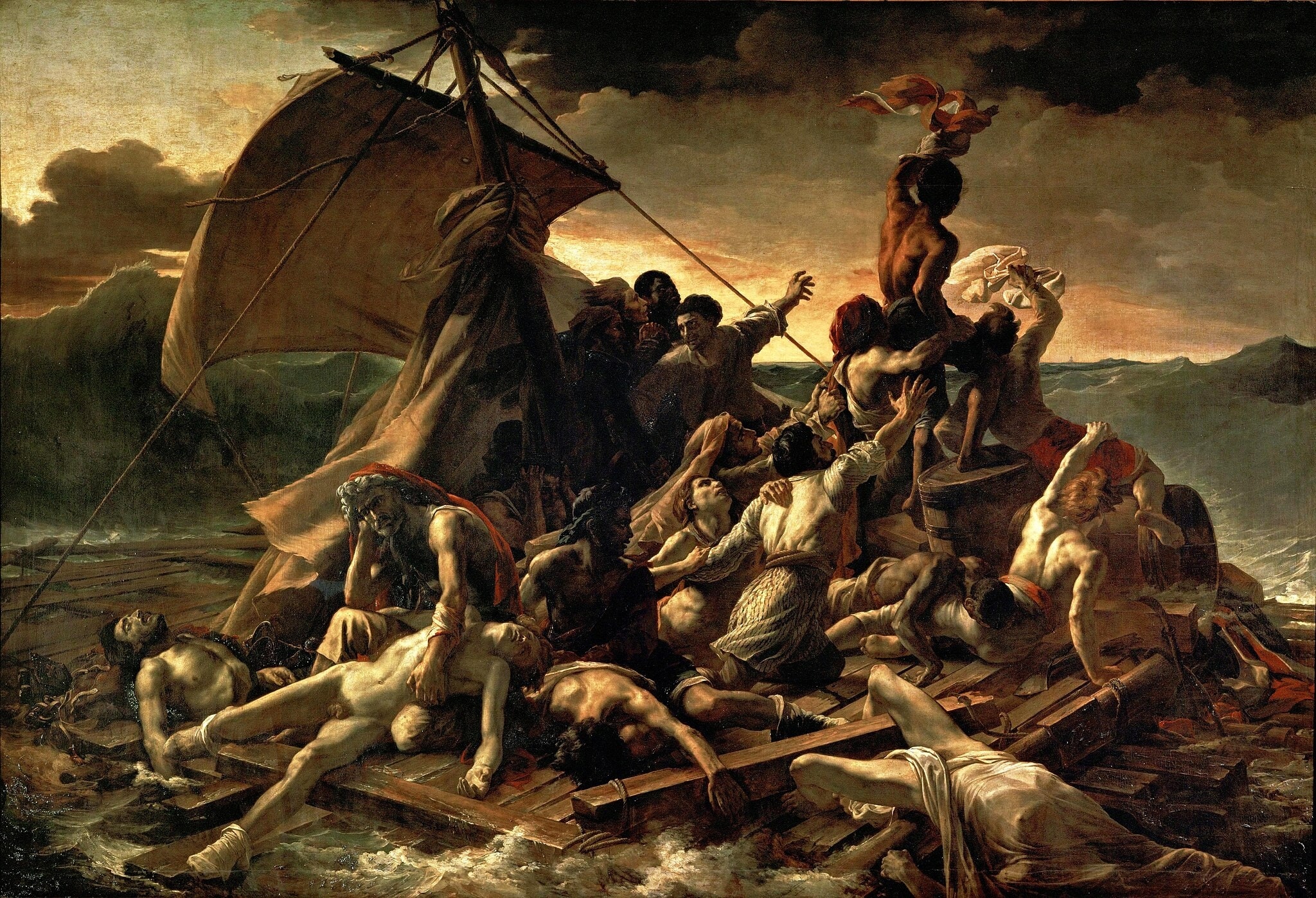
At the raft’s upper right, a Black sailor surges to the summit of a human pyramid and whips a cloth toward the tiny Argus on the horizon. This signaling figure concentrates the painting’s desperate energy into a single cry for rescue while recasting who can embody heroism in grand history painting. He is the lightning rod where survival, politics, and modern feeling collide.
Historical Context
Géricault painted The Raft of the Medusa in 1818–1819 after reconstructing the 1816 shipwreck of the French frigate Méduse, whose incompetent, politically connected captain stranded 150 people on a makeshift raft; only fifteen survived. Determined to anchor his drama in fact, the artist interviewed survivors, examined the raft’s plan, and fixed on the moment when the castaways first sighted the brig Argus and tried to signal it. The ship initially sailed on before returning roughly two hours later, sharpening the scene’s knife‑edge between salvation and loss 12.
At the Restoration Salon of 1819, the subject exploded as a scandal. It exposed Bourbon misrule while modernizing history painting with eyewitness testimony and contemporary politics. Within that charged frame, the climactic signal becomes the painting’s moral and narrative hinge: a collective appeal hurled from the wreckage toward a ship—and a state—that has already failed them once, yet might still redeem them 12.
Symbolic Meaning
At the apex stands a Black sailor, modeled from the celebrated Haitian-born professional model Joseph, elevated on a barrel and brandishing a cloth—the work’s emblem of last collective hope. Orsay’s curators describe the scarf as the survivors’ final, shared signal, a visual banner that gathers the raft’s remaining strength into a single, desperate call 3. By placing a Black protagonist at the summit of a grand machine of history painting, Géricault overturns racial hierarchies embedded in the genre and aligns the composition with abolitionist and liberal currents in post‑Revolutionary France 56.
The apex group—interlaced Black and white bodies straining in the same direction—projects interracial solidarity in the wake of the slave‑trade debates and Haitian independence, recoding heroism as communal rather than aristocratic 56. Yet the signal also carries Romantic ambivalence: the Argus has not yet saved them and, in fact, first passes out of reach. The triumphant silhouette therefore doubles as a figure of uncertainty, dramatizing modern life’s oscillation between hope and its potential betrayal 14.
Artistic Technique
Géricault crowns one of two interlocking pyramids with the signaler, driving a diagonal surge from the dead and despondent at lower left to the rallying survivors at upper right. The figure’s back—posed with classical authority and often linked to the Belvedere Torso—shows the artist’s anatomical rigor, honed through sustained life studies and morgue drawings that lend the muscles tensile credibility 17.
A restricted amber‑green tonality and emphatic chiaroscuro carve the body against stormy sky and sea, while the red‑white cloth flashes as a chromatic flare, concentrating the eye at the apex and intensifying urgency. Set on a barrel at the raft’s edge, the figure is literally and compositionally elevated, a beacon constructed from and for the collective below 13.
Connection to the Whole
The signaling figure is the canvas’s narrative fulcrum. Every arm, gaze, and plank seems to tilt toward his raised cloth and beyond it to the speck of the Argus, converting scattered bodies into a single vector of appeal. Against the counter‑pyramid of corpses, he stakes a claim for life that is hard‑won rather than assured 12.
By elevating a Black sailor as the emblem of shared deliverance, Géricault fuses reportage with ethical argument. The gesture indicts a faltering Restoration order even as it affirms human fraternity, making the signal both a lighthouse for the survivors and a political beacon for viewers of 1819—and for us 25.
Explore More from This Painting
This detail is one part of The Raft of the Medusa. Use the links below to return to the full interpretation, browse the full set of details, or view the painting's valuation if available.
Sources
- Smarthistory, The Raft of the Medusa overview
- Louvre Museum, object record: The Raft of the Medusa (INV 4884)
- Musée d’Orsay, Black Models: from Géricault to Matisse
- The Morgan Library & Museum, Géricault: Head of a Black Man
- EPMO (Orsay/Orangerie) press dossier: Le modèle noir de Géricault à Matisse
- Fondation pour la mémoire de l’esclavage, reading of abolitionist symbolism
- Princeton University Art Museum, Géricault: Flayed Cadavers study