How Much Is The Wounded Cuirassier (Wounded Cuirassier Leaving the Field of Battle) Worth?
Last updated: May 7, 2026
Quick Facts
- Methodology
- comparable analysis
The large 1814 Salon version of The Wounded Cuirassier is held by the Musée du Louvre and is effectively off‑market; market estimates are therefore modelled from rare public auction anchors and recent realized prices for Géricault works. Using the 2009 Christie’s auction benchmark for an autograph oil and recent activity in works on paper, a defensible market‑equivalent range for a confirmed, securely attributed Salon‑scale autograph is $8M–$30M, contingent on condition, provenance and catalogue‑raisonné acceptance.
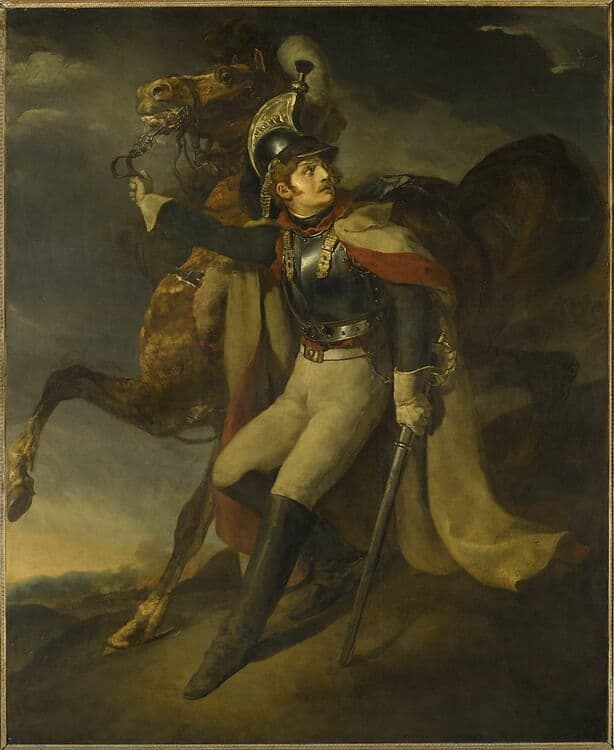
The Wounded Cuirassier (Wounded Cuirassier Leaving the Field of Battle)
Theodore Gericault, 1814 • Oil on canvas
View more by Theodore Gericault →Valuation Analysis
Context: The Wounded Cuirassier (Le Cuirassier blessé quittant le feu), 1814, exists in its large Salon version in the Musée du Louvre and is therefore effectively off‑market. Museum ownership both elevates the work’s cultural and scholarly importance and removes direct, frequent auction comparables, so market estimates must be anchored to rare public sales and institutional benchmarks [1].
Method and anchors: This valuation uses comparable analysis anchored principally to the strongest modern public auction benchmark for an autograph Géricault oil—Portrait d'Alfred et Élisabeth Dedreux (Christie’s Paris, 2009, €9,025,000)—together with realized prices for well‑provenanced studies and small oils that have transacted more recently. Because grand Géricault canvases rarely appear at auction, the 2009 sale functions as a conservative market anchor while mid‑six‑figure results for sheets and studies indicate where active price discovery currently occurs [2].
Estimate and rationale: Based on the foregoing, a defensible market‑equivalent valuation range for a confirmed autograph, Salon‑scale Wounded Cuirassier in sound condition with strong provenance and catalogue‑raisonné acceptance is $8,000,000–$30,000,000. The lower bound reflects likely realizations for securely attributed but less singular early military canvases or works with notable conservation interventions. The upper bound covers a scenario in which scholarship, fresh technical confirmation, and intense institutional or private interest combine to position the work at the very top tier—approaching or exceeding historical auction anchors when scarcity is factored in.
Key drivers and caveats: Attribution certainty (catalogue‑raisonné entry) is the single largest determinant of value; condition and restoration history materially affect saleability; provenance and exhibition history (Louvre ownership is a major positive yet practically removes the work from market turnover) add substantial premium; and market timing and buyer appetite for 19th‑century Romantic masterpieces will modulate final price. Technical analysis (X‑ray/IRR/pigment study) and published scholarship are prerequisites to converting a modelled range into a firm insurance or sale valuation.
Recommendation: For any formal sale or insurance action, secure catalogue‑raisonné confirmation, commission in‑hand technical and conservation reports, and request an in‑hand appraisal from nineteenth‑century specialists at a major auction house. This estimate is a comparable‑analysis synthesis using museum and auction anchors and should be updated once in‑hand documentation is available [1][2].
Key Valuation Factors
Art Historical Significance
High ImpactThe Wounded Cuirassier occupies an important place in Géricault’s early military repertoire and in the artist’s development prior to his larger social‑history works. As the large 1814 Salon canvas in the Musée du Louvre, it carries outsized scholarly and cultural weight: institutional ownership by the Louvre confers maximum public value and recognition. That significance elevates any insurance or institutional valuation above the level of a comparable private study, but because such canonical works are rarely tradable, their market equivalents must be modelled from the limited set of recorded public sales and institutional benchmarks. In practice, art‑historical importance supports a premium while simultaneously constraining liquid market comparables.
Attribution Certainty
High ImpactAttribution is the single largest price driver for Géricault. A securely attributed, catalogue‑raisonné‑listed autograph canvas commands a large premium; conversely, any doubt—claims of workshop involvement, later copy, or contested authorship—can reduce realizable value by an order of magnitude. For this painting, scholarly consensus and technical confirmation (pigment analysis, brushwork comparison, IRR/X‑ray correlations with known Géricault practice) would transform a modelled estimate into a firm market or insurance valuation. Given the artist’s contested corpus in recent exhibitions, authoritative scholarship is indispensable.
Condition & Conservation
High ImpactCondition and the history of conservation significantly alter market value. Heavy retouching, structural instability, or extensive relining can deter major buyers and reduce insurability. Conversely, a stable paint layer with conservative, well‑documented restoration supports premium pricing. For large Salon canvases the cost and visibility of conservation interventions are increased, and prospective insurers or buyers will require detailed conservation reports and treatment records. A technically clean, well‑conserved state materially increases the probability of the higher end of the valuation band.
Provenance & Exhibition History
High ImpactClear, published provenance and a strong exhibition/publication history add substantial value. Louvre ownership is a powerful provenance indicator that elevates academic interest and insurance considerations; it also makes market availability unlikely. Provenance linking back to early collectors, royal or institutional acquisitions, and inclusion in major exhibitions or catalogues raisonnés directly support higher valuations. Conversely, gaps in provenance or evidence of illicit export or contested title materially depress market confidence and price.
Market Scarcity & Demand
High ImpactSupply of autograph Géricault oils is extremely constrained—most major canvases are museum‑held—so scarcity is a persistent upward pressure on value. Demand is selective: institutions, specialist collectors, and high‑net‑worth buyers compete for rare large oils, while the active market predominantly trades works on paper and small oils. Recent auction results for high‑quality sheets and occasional small oils demonstrate robust interest; however, buyer caution around attributions tempers speculative bidding. The interplay of extreme scarcity and selective, informed demand sets a high potential ceiling but also produces wide price dispersion.
Sale History
The Wounded Cuirassier (Wounded Cuirassier Leaving the Field of Battle) has never been sold at public auction.
Theodore Gericault's Market
Théodore Géricault is a cornerstone figure of French Romanticism; his canonical masterpieces (notably The Raft of the Medusa) are museum anchors and effectively off‑market. When autograph oils do appear publicly they attract institutional and high‑net‑worth interest and can realize multi‑million‑dollar results, though the market’s primary trading layer is works on paper and small oils. Attribution sensitivity, limited supply, and strong scholarly interest create a market where securely documented works command premiums, while disputed or workshop‑attributed pieces sell more modestly. The 2009 Christie’s sale of the Dedreux portrait remains the modern auction benchmark for an autograph oil.
Comparable Sales
Portrait d'Alfred et Élisabeth Dedreux
Théodore Géricault
Highest modern public‑auction benchmark for an autograph Géricault oil — large, museum‑quality painting with strong provenance and sale context; best anchor for top‑end value.
$11.6M
2009, Christie's, Paris (The Collection of Yves Saint Laurent & Pierre Bergé sale)
~$16.6M adjusted
Watercolour of Two Horses (reported)
Théodore Géricault
Subject matter (horses/equestrian study) closely relates to the equestrian elements of The Wounded Cuirassier; example of high demand for well‑provenanced Géricault works on paper and mid‑six‑figure pricing.
$584K
2026, Villemur Art / Gazette Drouot auction (reported)
~$566K adjusted
A Sleeping Fishmonger (Le marchand de poissons endormie)
Théodore Géricault
Small study/painting example showing lower‑tier liquidity for Géricault works; useful to set expectations for studies/small oils vs. a large Salon canvas.
$70K
2026, Christie's, New York (reported)
~$68K adjusted
Current Market Trends
Current market dynamics favor well‑documented, museum‑quality works on paper and rare small oils; grand canvases remain largely institutional and therefore absent from routine price discovery. Recent seasons (2023–2026) showed strong selective demand for authenticated sheets and a heightened emphasis on catalogue‑raisonné confirmation after high‑profile attribution debates. Scarcity at the top keeps potential ceilings high, but buyer caution and attribution scrutiny produce wide valuation spreads and the need for in‑hand technical verification.
Sources
- Musée du Louvre collection entry: 'Cuirassier blessé, quittant le feu' (Louvre collection notice)
- Christie’s: Portrait d'Alfred et Élisabeth Dedreux, The Collection of Yves Saint Laurent & Pierre Bergé (Paris sale catalogue / lot entry)
- Brooklyn Museum collection entry: Study for The Wounded Cuirassier (accession 43.81)
- Sotheby’s: 'Gericault — La Collection Elmore' (master works on paper catalogue, Jan 2024) — market context for recent trades