How Much Is Congregation Leaving the Reformed Church in Nuenen Worth?
Last updated: May 19, 2026
Quick Facts
- Insurance Value
- $45.0M (Internal appraisal analysis based on market comparables (2021–2026))
- Methodology
- comparable analysis
Hypothetical fair‑market value for Van Gogh’s Congregation Leaving the Reformed Church in Nuenen is $22–32 million. This reflects a premium for its biographical resonance and museum‑grade provenance, yet a discount to the brighter 1887–90 works that command the artist’s top prices. Recommended insurance/replacement value: $45 million.
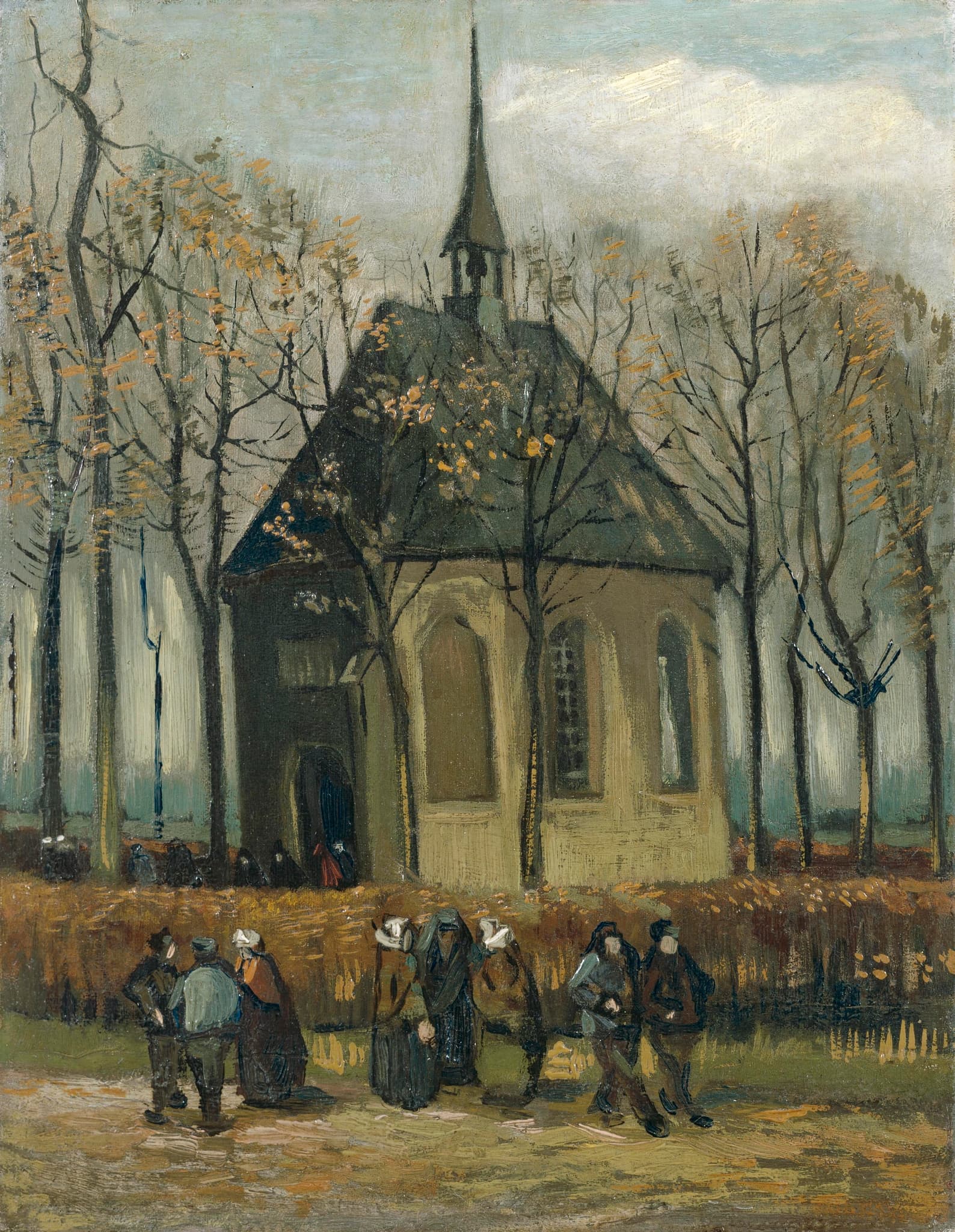
Congregation Leaving the Reformed Church in Nuenen
Vincent van Gogh, 1884; reworked 1885 • Oil on canvas
Read full analysis of Congregation Leaving the Reformed Church in Nuenen →Valuation Analysis
Overview. Congregation Leaving the Reformed Church in Nuenen (1884; reworked late 1885, oil on canvas, 41.3 × 32.1 cm, F25/JH521) is an important early Dutch‑period painting closely tied to Van Gogh’s biography: it depicts the Nuenen church where his father preached, and he modified the work after his father’s death. The painting belongs to the Van Gogh Museum and became widely known following its 2002 theft, 2016 recovery, and 2017 return to view [5].
Method and estimate. The $22–32 million range is derived from a tight set of recent, directly relevant comparables. Small‑to‑mid format oils from the highly sought 1887 Paris year provide the clearest price beacons, though they typically trade above Dutch‑period works: Coin de jardin avec papillons realized $33.2 million at Christie’s New York (May 2024) [2]; Les canots amarrés sold for about $32.4 million in Hong Kong (September 2024) [3]; and Jardin devant le Mas Debray brought $23.3 million at Sotheby’s New York (May 2023) [4]. By contrast, a Dutch‑period head from 1885—close in date and palette—sold privately to a museum for roughly €8.6 million (≈$9.1 million) in 2024, anchoring the lower tier for this period [6].
Positioning. Situated between those poles, the Nuenen church scene commands a premium to simple Dutch head studies due to its multi‑figure composition, narrative resonance (his father’s church; reworking after bereavement), distinguished provenance, and high public profile, yet it warrants a discount to the luminous 1887–90 works that dominate Van Gogh’s market. We therefore center value in the mid‑$20 millions, with upside into the low $30s under optimal evening‑sale conditions (global marketing, third‑party guarantee, and full exportability).
Market context and ceiling. Van Gogh’s auction record—$117.2 million for an 1888 Arles landscape—illustrates the steep period‑and‑subject gradient that separates early Dutch works from the late, iconic masterpieces [1]. The present estimate reflects that gradient while acknowledging persistent scarcity and deep global demand for any painting by the artist. Given replacement difficulty and likely private‑sale premia for an institutionally provenanced Van Gogh, we recommend an insurance/replacement value of $45 million.
Important note. The work is museum‑held and effectively not for sale; the values above are hypothetical, assuming lawful deaccession and exportability. They are grounded in recent public benchmarks and standard adjustments for period, subject, scale, and provenance.
Key Valuation Factors
Art Historical Significance
High ImpactPainted in Nuenen in 1884 and reworked in late 1885, this canvas is a key document of Van Gogh’s Dutch period and family biography. It depicts the church where his father preached and was modified after his father’s death—an intensely personal context that heightens scholarly interest. Within the oeuvre, the work illuminates Van Gogh’s evolution from the somber Dutch palette toward the expressive maturity of Arles and Saint‑Rémy. While not a canonical late masterpiece, it is notably more consequential than a study or head: it is a composed, multi‑figure scene with narrative intent, giving it greater weight among early works and supporting a mid‑tier valuation within Van Gogh’s market.
Period and Palette (Dutch/Nuenen, 1884–85)
Medium ImpactMarket demand for Van Gogh peaks with the luminous Arles–Saint‑Rémy years (1888–90); early Dutch works, characterized by an earth‑toned palette and more somber mood, trade at a discount. Recent auction data confirm a step‑change from 1883–85 to 1887–90 pricing. This painting’s palette and date place it clearly in the earlier, less commercially favored tier, tempering its value relative to bright Paris and Provence subjects. However, as a composed narrative scene—rather than a small head or study—it sits above the lower end of Dutch‑period pricing. The period effect moderates the estimate but does not suppress it given overall Van Gogh scarcity.
Subject and Iconicity
Medium ImpactThe subject—a congregation leaving a village church—is thematically resonant, linking art and faith in Van Gogh’s life, yet it lacks the marquee appeal of Sunflowers, starry skies, irises, or signature Provençal landscapes. Collectors tend to pay premiums for instantly legible, decorative, and widely reproduced motifs from 1887–90. This composition’s narrative and cultural specificity confer scholarly depth and a biographical premium, but its less decorative character and darker tonality limit crossover appeal at the very top end of the market. As a result, it supports strong mid‑tier pricing without approaching the records established by iconic late subjects.
Provenance, Exhibition History, and Public Profile
High ImpactThe painting’s continuous association with the Van Gogh family/Foundation and its place in the Van Gogh Museum confer museum‑grade provenance—a powerful value driver. Its theft in 2002, recovery in 2016, and celebrated return to view in 2017 gave it exceptional global visibility. Institutional credit lines, extensive scholarly citation, and a long exhibition history can bolster bidder confidence and support premiums relative to comparable early works lacking such pedigree. If ever deaccessioned and legally exportable, these attributes should catalyze deep bidding, particularly among buyers who prioritize historic importance and unimpeachable ownership history.
Scale, Condition, and Marketability
Medium ImpactAt roughly 41 × 32 cm, the work is a modest, wall‑friendly format—commercially positive but less imposing than larger canvases that command higher prices. Following its recovery, the painting returned to public display, signaling institutional confidence in its condition. While buyers of masterpieces scrutinize surfaces closely, nothing publicly suggests condition issues that would materially depress value. In marketing terms, the biographical story, museum provenance, and celebrated recovery enhance salability; the darker tonality limits pure decorative demand but is offset by the narrative and scholarly appeal, placing the work squarely in a strong mid‑tier auction bracket.
Sale History
Congregation Leaving the Reformed Church in Nuenen has never been sold at public auction.
Vincent van Gogh's Market
Vincent van Gogh is among the most sought‑after names in art, with extremely limited supply and deep global demand. His public auction record stands at $117.2 million for an 1888 Arles landscape (Christie’s, 2022), underscoring the premium for luminous, late‑period subjects [1]. Recent sales show durable liquidity for smaller oils: Coin de jardin avec papillons (1887) achieved $33.2 million (Christie’s, 2024) [2], while Les canots amarrés realized about $32.4 million in Hong Kong (Christie’s, 2024) [3]. Solid mid‑tier results around $20–25 million (e.g., Jardin devant le Mas Debray at $23.3 million, Sotheby’s, 2023) confirm robust depth below the trophy level [4]. This structure creates a clear, data‑driven framework for valuing earlier works like the Nuenen church scene.
Comparable Sales
Coin de jardin avec papillons
Vincent van Gogh
Same artist; small-to-medium oil from the highly sought 1887 Paris year; intimate garden subject (decorative, accessible). Useful upper-bracket proxy for modest-format oils vs. Nuenen’s earlier, darker palette.
$33.2M
2024, Christie's New York
~$34.1M adjusted
Les canots amarrés
Vincent van Gogh
Same artist; 1887 Paris-period, modest scale, bright palette; demonstrates current global demand (Asia) for mid-size, non-iconic Van Goghs—good pricing proxy above Nuenen-period works.
$32.4M
2024, Christie's Hong Kong
~$33.3M adjusted
Jardin devant le Mas Debray
Vincent van Gogh
Same artist; small-to-mid format oil (1887 Paris) with garden/landscape subject. A strong, recent benchmark just below the top Paris-period mid-size tier—likely above a somber 1884/85 Nuenen work.
$23.3M
2023, Sotheby's New York
~$24.8M adjusted
Street Scene in Montmartre
Vincent van Gogh
Same artist; 1887 Paris work of modest dimensions with an urban subject. Lower price anchor among recent small-format oils; helpful floor relative to an earlier, darker Nuenen scene.
$15.4M
2021, Sotheby's Paris
~$18.5M adjusted
Orchard with Cypresses
Vincent van Gogh
Same artist; 1888 Arles landscape (larger, luminous, peak period). Not a direct comp in period/subject, but an essential ceiling benchmark for pricing Van Gogh oils.
$117.2M
2022, Christie's New York
~$130.1M adjusted
Head of a Woman (Gordina de Groot)
Vincent van Gogh
Same artist; 1885 Nuenen/Dutch-period oil, near the subject painting in date, palette, and scale (head study vs. village/religious scene). Useful lower anchor for Dutch-period oils.
$9.1M
2024, Private sale (Noordbrabants Museum)
~$9.4M adjusted
Current Market Trends
Impressionist & Post‑Impressionist masterpieces have benefited from a multi‑year “flight to quality,” as collectors prioritize blue‑chip, historically canonized names. After a softer 2024, marquee evening sales rebounded with strong bidding for fresh, well‑provenanced works, while demand broadened geographically, including Asia for top Impressionist/Modern. Within Van Gogh’s market, the period and subject gradient remains pronounced: late Arles/Saint‑Rémy works dominate the top tier, with bright 1887 Paris oils anchoring the mid‑$20M to low‑$30M band. Early Dutch‑period paintings trade below that tier but are underpinned by scarcity and institutional interest, supporting firm mid‑teen to low‑tens pricing for studies and higher teens to low‑30s for more consequential compositions.
Study print
Study this painting as a print
Pair the full artwork with a museum-style study sheet focused on one meaningful detail.
Sources
- The Art Newspaper – Van Gogh record at Paul Allen sale (2022)
- Christie’s Press Release – 20th Century Evening Sale totals; Van Gogh at $33.2m (2024)
- The Art Newspaper – Christie’s Hong Kong report; Van Gogh at c.$32.4m (2024)
- Sotheby’s – Van Gogh overview referencing Jardin devant le Mas Debray at $23.3m (2023)
- Wikipedia – Congregation Leaving the Reformed Church in Nuenen
- Euronews – Dutch museum buys Van Gogh Head of a Woman (Gordina de Groot) for €8.6m (2024)