How Much Is View of the Sea at Scheveningen Worth?
Last updated: May 19, 2026
Quick Facts
- Methodology
- comparable analysis
Based on tightly matched early‑period comparables, we estimate Vincent van Gogh’s View of the Sea at Scheveningen (1882) at $12–18 million. The rare storm‑tossed Scheveningen subject, strong provenance, and museum profile justify a premium over standard Hague‑period works, while the early date, small scale, and oil‑on‑paper support cap the value well below late‑1880s masterworks.
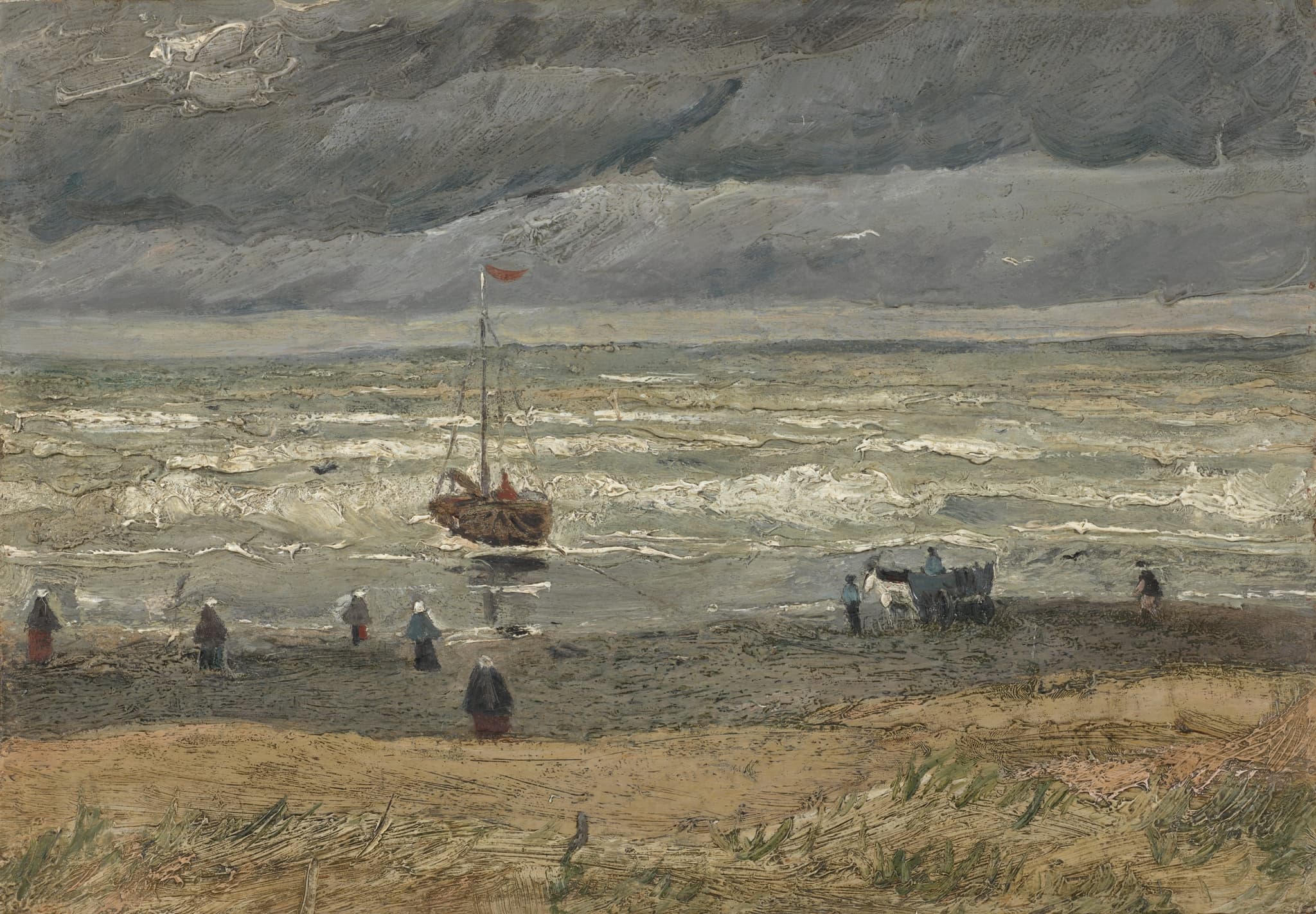
View of the Sea at Scheveningen
Vincent van Gogh, 1882 • Oil on paper, mounted on canvas
Read full analysis of View of the Sea at Scheveningen →Valuation Analysis
Conclusion: A reasoned, market-consistent valuation for Vincent van Gogh’s View of the Sea at Scheveningen (1882) is $12–18 million. The work is a rare early seascape painted en plein air in stormy weather, with sand embedded in the paint—attributes well documented by the Van Gogh Museum, which holds the picture and has exhibited it since its recovery after the 2002 theft [1][6]. While the painting is not for sale, this range reflects what it would likely realize if hypothetically deaccessioned and brought to a marquee evening auction with full international marketing.
Method: We anchored the estimate to the closest period-and-subject comparables. Most notably, Van Gogh’s Beach at Scheveningen in Calm Weather (also August 1882) made about $2.8 million with fees at Sotheby’s New York in 2022, providing a direct benchmark within the same month, place, and early Hague period [2]. A further relevant yardstick is Raccommodeuses de filets dans les dunes (1882), an early Dutch dunes scene that achieved €7.07 million (≈$8.27 million) at Artcurial in 2018—a record at the time for a Dutch-period landscape [3]. The subject painting’s dramatic storm, greater renown, and celebrated institutional profile credibly command a premium to both of these results, but its early date, small format (c. 36 × 52 cm), and oil-on-paper support constrain the ceiling.
Positioning within the Van Gogh market: Late 1888–1890 canvases define the pricing apex for the artist (e.g., Orchard with Cypresses at $117.2 million in 2022) and are not period-comparable to an 1882 Hague work [4]. Even strong Paris-period (1887) pictures routinely trade at multiples of early Dutch works (e.g., boats on the Seine sold in Hong Kong in 2024 for about $32.2 million), underscoring the steep period premium collectors pay for the mature style [5]. Against this market structure, a $12–18 million bracket appropriately reflects the subject painting’s enhanced desirability within its early cohort without drifting into late-period territory.
Other considerations: Museum stewardship and the painting’s notoriety from the 2002 theft and 2016 recovery add profile and buyer confidence, assuming the post-recovery conservation is stable and fully documented [1][6]. Conversely, the oil-on-paper-on-canvas construction and modest scale are known price moderators for early Van Goghs. Netting these factors—and assuming sale at a top venue with third‑party financial backing—the $12–18 million range is the most defensible synthesis of period-appropriate comparables and current blue‑chip demand dynamics.
Key Valuation Factors
Art Historical Significance
High ImpactPainted in August 1882 during Van Gogh’s Hague period, this is a rare early seascape executed in stormy weather, reportedly with grains of sand embedded in the paint—an evocative trace of its plein‑air genesis. The picture documents Van Gogh’s early mastery of tonal realism and his engagement with the fishing village of Scheveningen, a subject of national cultural resonance in the Netherlands. It is widely reproduced and frequently discussed, not least because of the 2002 theft and 2016 recovery, and it is presented by the Van Gogh Museum as a significant highlight of the artist’s early career. This combination of rarity, narrative power, and institutional endorsement strongly supports demand.
Period and Rarity within the Oeuvre
High ImpactCollectors place the greatest financial premiums on Van Gogh’s late 1888–1890 works; early Dutch-period oils typically transact at discounts. Within the Hague period, however, fully realized seascapes are scarce, and storm scenes rarer still. The closest twin is the 1882 Calm Weather Scheveningen seascape, which sold for about $2.8 million in 2022, while an 1882 dunes landscape reached roughly $8.3 million in 2018. Given this painting’s more dramatic subject and higher profile, it reasonably commands a premium over those benchmarks. Still, the early date and palette anchor its valuation well below the late-1880s masterpieces that dominate Van Gogh’s price ceiling.
Medium, Scale, and Condition
Medium ImpactThe work is oil on paper mounted on canvas at a modest size (approximately 36.4 × 51.9 cm). Among Van Gogh’s paintings, prime large-format oils on full canvas command stronger prices. An oil‑on‑paper support can introduce structural considerations that some buyers discount against, even when expertly conserved. The painting suffered a well‑publicized theft in 2002 but was recovered and conserved before returning to display at the Van Gogh Museum. Museum care and a clear conservation history mitigate risk, yet the medium and scale remain moderating factors relative to the headline late‑period canvases that set auction records.
Provenance, Exhibition, and Notoriety
High ImpactThe provenance is exemplary: early family ownership, a documented 1903 gallery sale, and a bequest to the State of the Netherlands, with long-term placement at the Van Gogh Museum. Continuous institutional visibility, comprehensive cataloguing, and frequent reproduction heighten buyer confidence. The painting’s theft and high‑profile recovery amplified its public recognition and media profile, a marketing advantage that tends to translate into stronger bidding when comparable works reach the block. While deaccession is unlikely, if hypothetically offered with a first‑class guarantee by a top auction house, the provenance and fame would help maximize competitive demand.
Comparable Early-Period Prices and Market Liquidity
Medium ImpactTwo tight comparables frame value: the 1882 Calm Weather Scheveningen seascape at about $2.8m (2022) and the 1882 dunes landscape at roughly $8.27m (2018). These establish a data-backed floor and mid-point for early Dutch-period oils with maritime/fishing subjects. Meanwhile, Paris- and Provence-period canvases continue to realize $20–60m+ at major venues, illustrating—but not dictating—relative discounting for 1882 work. In today’s ‘flight to quality’ climate for blue-chip Modern art, early but distinctive Vander Gogh material remains liquid, provided the subject is compelling and the provenance impeccable; this supports a premium within the early-period band, calibrated here at $12–18m.
Sale History
Kunstzalen Oldenzeel (Rotterdam)
Documented gallery sale in January 1903 for 2,500 Dutch guilders (≈US$1,005 in 1903). Exact day in month not recorded. Source: Van Gogh Museum provenance.
Vincent van Gogh's Market
Vincent van Gogh is an ultra–blue‑chip artist with a deep, global collector base and strong institutional demand. His auction record stands at $117.2 million for Orchard with Cypresses (Christie’s, 2022), and high‑quality works from the Paris and Provence periods routinely command prices from the mid‑eight figures upward. Recent sales across 2023–2025 affirm a bifurcated but resilient market: strong, guarantee‑backed late‑1880s canvases can attract trophy bidding, while distinctive drawings and mid‑tier paintings achieve rationalized but healthy results. Supply is inherently thin; works with excellent provenance, clear condition, and compelling subjects are quickly absorbed by top collectors in the US, Europe, and Asia, often with third‑party financial backing.
Comparable Sales
Beach at Scheveningen in Calm Weather
Vincent van Gogh
Same artist; same month and place (Scheveningen, August 1882); early Hague‑period oil seascape—closest subject/period match to the storm scene.
$2.8M
2022, Sotheby's New York
~$3.1M adjusted
Raccommodeuses de filets dans les dunes (Fishing Net Menders in the Dunes)
Vincent van Gogh
Same artist; 1882 Hague‑period dunes scene tied to Scheveningen’s fishing life; early Dutch oil and among the strongest early‑period results.
$8.3M
2018, Artcurial Paris
~$10.7M adjusted
Jardin devant le Mas Debray
Vincent van Gogh
Same artist; 1887 Paris‑period landscape. Not the same period but shows the premium accorded to post‑Hague transitional works relative to 1882 material.
$23.3M
2023, Sotheby's New York
~$24.7M adjusted
Les canots amarrés
Vincent van Gogh
Same artist; 1887 Paris‑period boats/water subject. Useful to illustrate subject affinity but also the substantial period premium over 1882 Hague works.
$32.2M
2024, Christie's Hong Kong
~$32.8M adjusted
Piles de romans parisiens et roses dans un verre (Romans parisiens)
Vincent van Gogh
Same artist; 1887 Paris‑period still life that set a new high for a Paris‑period Van Gogh in 2025. Serves as an upper‑anchor for market strength, though not period‑comparable.
$62.7M
2025, Sotheby's New York
Orchard with Cypresses
Vincent van Gogh
Artist’s auction record (1888, Arles). Included only to indicate the ceiling for blue‑chip Van Gogh; not a period/subject comp for an 1882 Hague seascape.
$117.2M
2022, Christie's New York
~$127.7M adjusted
Current Market Trends
The Impressionist & Modern/Post‑Impressionist category softened in 2024 but rebounded at the top end in 2025 amid a broader ‘flight to quality.’ Masterpieces with pristine provenance and curatorial endorsement drew deep international bidding, with Asia an increasingly important demand center. At the same time, less iconic material repriced or required guarantees to transact efficiently. For van Gogh, late‑period canvases led the charge, while earlier works performed best when subject, narrative, and provenance stood out. In this environment, an early but rare and storied seascape is well placed to outperform standard Dutch‑period peers, albeit within the clear discount band to 1887–1890 trophies.
Study print
Study this painting as a print
Pair the full artwork with a museum-style study sheet focused on one meaningful detail.
Sources
- Van Gogh Museum: View of the Sea at Scheveningen (s0416N1990)
- The Art Newspaper: A crate of 40 Van Gogh paintings was once sold for less than $1 (includes 2022 Scheveningen sale result)
- Deutsche Welle: Early Van Gogh landscape sold in Paris auction for record €7 million
- The Art Newspaper: A Van Gogh record—Orchard with Cypresses soars to $117m at Paul G. Allen auction
- South China Morning Post: Van Gogh painting auctioned in Hong Kong for US$27.6 million
- FBI: Van Gogh Museum Robbery — Top Ten Art Crimes