How Much Is The Church at Auvers Worth?
Last updated: June 4, 2026
Quick Facts
- Methodology
- comparable analysis
The Church at Auvers is a late, instantly recognizable Van Gogh from June 1890, painted weeks before his death and housed in the Musée d’Orsay. Using top-tier Van Gogh benchmarks—most notably the $117.2m 2022 record and historic late‑period trophies—this work would likely command $180–220 million in a fully unconstrained sale. Although inalienable under French law, its hypothetical market value sits firmly above the artist’s current auction record.
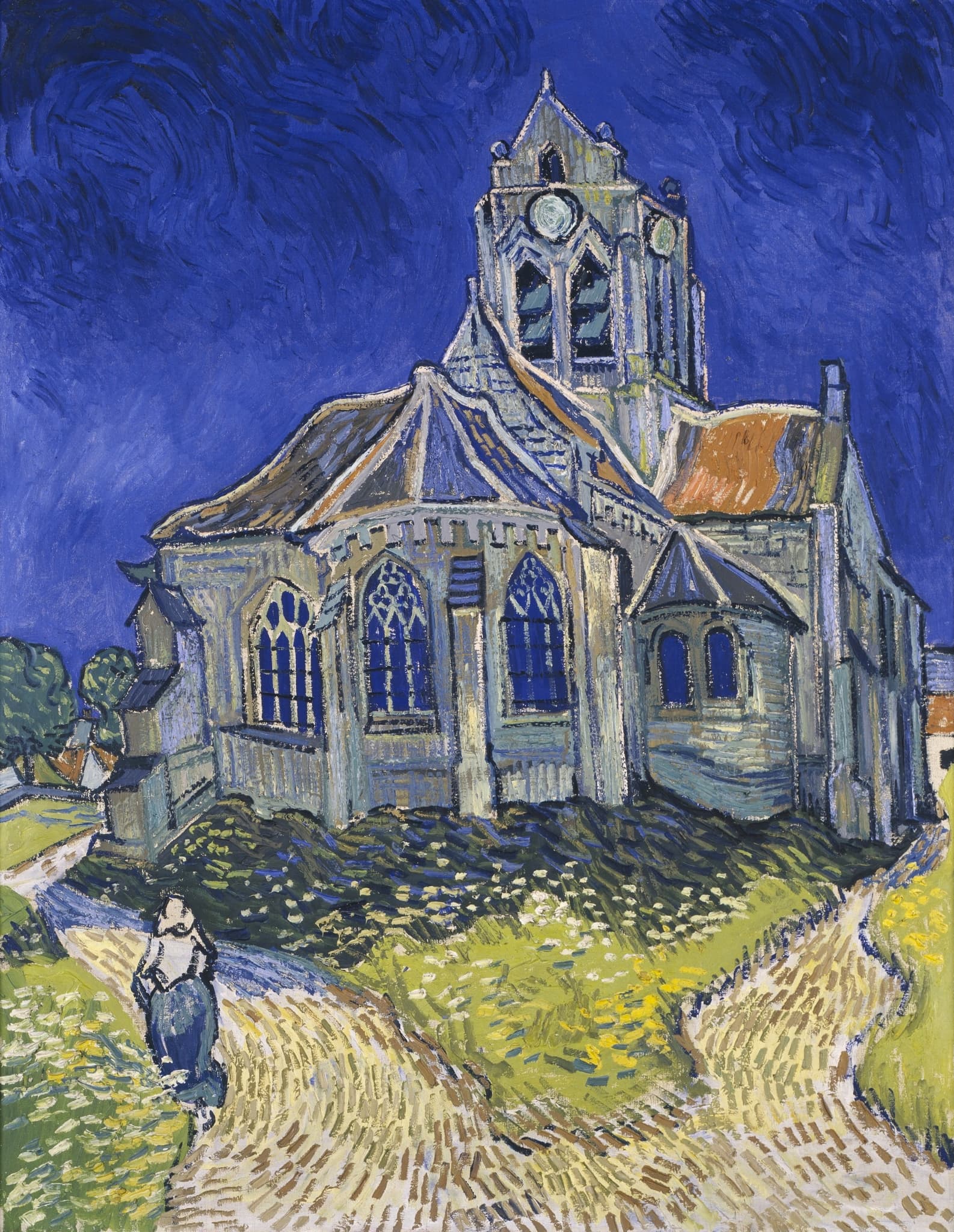
The Church at Auvers
Vincent van Gogh, 1890 • Oil on canvas
Read full analysis of The Church at Auvers →Valuation Analysis
Conclusion: Under standard fair‑market conditions (unencumbered title, exportability, excellent condition, marquee auction placement), Vincent van Gogh’s The Church at Auvers (June 1890; oil on canvas, 93 × 74.5 cm) would likely achieve $180–220 million. The painting is a late, iconically reproduced image from Auvers, weeks before the artist’s death, and belongs to the Musée d’Orsay’s inalienable French national collection—so any valuation is necessarily hypothetical [1][2].
Comparables and pricing anchor points: Van Gogh’s standing auction record is $117.18 million for Orchard with Cypresses (Christie’s, 2022), establishing the modern reference point for late‑period, high‑impact landscapes [3]. Other strong, recent‑era late works include Cabanes de bois parmi les oliviers et cyprès (Saint‑Rémy, 1889) at $71.35 million (Christie’s, 2021) and L’Allée des Alyscamps (Arles, 1888) at $66.33 million (Sotheby’s, 2015), which bracket the high tier for museum‑grade Van Gogh landscapes outside of record-setting anomalies [4][5].
Historic trophy context and upward extrapolation: Two canonical precedents frame the trophy ceiling: Portrait of Dr. Gachet (Auvers, 1890) at $82.5 million in 1990—roughly $200+ million in today’s dollars—and Irises (Saint‑Rémy, 1889) at $53.9 million in 1987—about $150+ million in today’s dollars [6][7]. Against these anchors, The Church at Auvers benefits from exceptional recognizability, a unique subject within the artist’s oeuvre, and the charged late style that attracts global demand.
Why $180–220m: This range exceeds the $117.2m 2022 record to reflect the painting’s late‑Auvers date, singular subject, image fame, and museum‑caliber status, while remaining disciplined relative to inflation‑adjusted trophy landmarks (Dr. Gachet and Irises) [3][6][7]. Within today’s trophy‑led Modern market, fresh, iconic Van Goghs can catalyze deep, cross‑border bidding. A competitive sale with a strong guarantee could plausibly push the work to the top of the range; in a frenzy it could challenge even higher prints. Conversely, even conservative outcomes would likely remain well above $150m given the strength of late Van Gogh comparables and enduring global demand [4][5].
Important note: The work is in the French national collection and legally inalienable; this estimate models a hypothetical, unconstrained market scenario for benchmarking purposes only [2].
Key Valuation Factors
Art Historical Significance
High ImpactPainted in June 1890, The Church at Auvers belongs to the artist’s final Auvers period—an apex of stylistic intensity and historical interest. Its subject is singular within Van Gogh’s oeuvre: a full, independent depiction of the Auvers church rendered with the vibrating brushwork, saturated cobalt-violet palette, and dynamic contouring emblematic of his last weeks. The canvas has become one of the most widely reproduced images of the period, frequently illustrating scholarship and public exhibitions. This combination of late date, iconic visibility, and unique motif places the work among the most coveted categories of Van Gogh production, raising it into the tier of masterpieces that set or challenge artist-wide benchmarks for value.
Period and Iconicity
High ImpactLate Auvers and immediately preceding Saint‑Rémy works represent the most sought-after period for Van Gogh collectors, with the best examples uniting expressive touch, high-key color, and psychologically charged imagery. The Church at Auvers offers a readily legible, instantly identifiable composition that resonates far beyond specialist circles, similar to the museum‑famous Irises and the celebrated Arles/Saint‑Rémy landscapes. Its scale (roughly 93 × 74.5 cm) supports wall power and display impact, yet remains manageable for collectors and institutions. The painting’s ubiquity in publications and exhibitions deepens its cultural footprint, which is a critical premium driver at the $100m+ level where narrative clarity and recognizability materially influence bidding depth.
Market Benchmarks and Liquidity
High ImpactRecent high‑end Van Gogh results include the $117.18m auction record for Orchard with Cypresses (2022), alongside $60–70m+ sales for museum‑grade Arles/Saint‑Rémy works over the past decade. Historic trophies—Dr. Gachet (1990) and Irises (1987)—inflate to roughly $200m+ and $150m+, respectively. Against these guideposts, a late, iconic Auvers subject with unique imagery rationally prices above the 2022 record and within the $180–220m band. Liquidity at this level is anchored by global, cross‑category collectors, institutional interest, and top-tier guarantors. While supply is chronically tight, new peaks in adjacent blue‑chip Modern names demonstrate robust absorption capacity for singular masterpieces, even in mixed macro climates.
Rarity, Supply, and Ownership Context
Medium ImpactTop-caliber late Van Gogh paintings are exceptionally scarce and are largely held by museums or legacy collections. The Church at Auvers is in the French national collection at the Musée d’Orsay and is legally inalienable, which means no realistic market availability under current law. For valuation, we assume a hypothetical scenario in which the work could transact and export freely. In that context, its rarity (a unique, high‑visibility Auvers subject with museum provenance) would concentrate demand and encourage aggressive underwriting. The supply dynamics of late Van Gogh canvases—few available, even fewer with this degree of fame—support a premium above more generic or earlier works, reinforcing the $180–220m range.
Provenance, Exhibitions, and Condition Assumptions
Medium ImpactThe painting’s provenance runs through the Gachet family before its acquisition by the French national museums, and it has been widely exhibited and published—key drivers of confidence at the trophy tier. Museums typically do not disclose detailed public condition reports; this estimate assumes excellent structural and surface condition consistent with a work displayed at a leading institution and loanable to major shows. Any undisclosed structural issues, overcleaning, or significant retouching would pressure the estimate downward; conversely, confirmation of exemplary condition, stable materials, and minimal past intervention would support the upper end of the range. Exhibition history and scholarly saturation continue to amplify visibility and long‑term value.
Sale History
The Church at Auvers has never been sold at public auction.
Vincent van Gogh's Market
Vincent van Gogh remains among the most coveted artists globally, with deep, diversified demand and chronically limited supply of major paintings. The artist’s standing auction record is $117.18 million for Orchard with Cypresses (Christie’s, 2022), while several other works have realized $60–70+ million over the last decade—underscoring consistent appetite for high‑quality late landscapes and emblematic still lifes. Historic trophies like Portrait of Dr. Gachet (1990) and Irises (1987) anchor long‑run expectations at nine‑figure levels when inflation‑adjusted. Collectors prize late Arles/Saint‑Rémy/Auvers works for their expressive power and image recognition, and institutions remain active stewards and borrowers. In a marquee setting with guarantees, blue‑chip Van Goghs reliably catalyze global bidding and press attention.
Comparable Sales
Orchard with Cypresses
Vincent van Gogh
Same artist; top-tier Provence landscape (1888) featuring a major late motif (cypresses); record-setting result that brackets the trophy end of Van Gogh’s market and is close in scale and ambition to an iconic late landscape like The Church at Auvers.
$117.2M
2022, Christie's New York
~$126.9M adjusted
Cabanes de bois parmi les oliviers et cyprès
Vincent van Gogh
Same artist; late Saint-Rémy (Oct 1889), just months before Auvers; shares the high-key palette, impasto, and cypress/olive-grove landscape language that directly precedes the Auvers period; strong, recent late-period benchmark.
$71.3M
2021, Christie's New York
~$83.5M adjusted
L’Allée des Alyscamps
Vincent van Gogh
Same artist; major Arles landscape from 1888, widely exhibited and highly coveted; comparable large-format landscape with vivid color and iconic series status—useful for bracketing pricing of museum-caliber Van Gogh landscapes.
$66.3M
2015, Sotheby's New York
~$88.9M adjusted
Nature morte, Vase aux marguerites et coquelicots
Vincent van Gogh
Same artist; same year (1890, Auvers period) with blue-chip provenance; while a still life rather than a landscape/architecture subject, it’s a direct 1890 benchmark for late-career desirability and pricing.
$61.8M
2014, Sotheby's New York
~$82.8M adjusted
Portrait of Dr. Gachet
Vincent van Gogh
Same artist; Auvers, 1890—the exact final-period context as The Church at Auvers; one of the most iconic Van Gogh images ever sold publicly; long-standing ceiling-setting comp for late Auvers masterpieces.
$82.5M
1990, Christie's New York
~$200.5M adjusted
Irises
Vincent van Gogh
Same artist; Saint-Rémy, 1889—an immediately pre-Auvers, universally iconic work; large-format, museum-grade canvas whose long-standing trophy result helps frame values for the most recognizable late Van Goghs.
$53.9M
1987, Sotheby's New York
~$150.4M adjusted
Current Market Trends
Within Impressionist and Modern art, the highest end remains trophy‑led: fresh, museum‑quality works with strong provenance and recognizability command robust competition despite cyclical softening in mid‑market segments. The 2022–2026 period has reaffirmed this dynamic, with a Van Gogh record at $117.2m and sustained nine‑figure results for peer blue‑chip Modern masters. Supply remains the limiting factor; single‑owner collections and institution‑caliber consignments unlock peak pricing. While macro volatility can widen pricing bands, demand for canonical late‑19th‑century masterpieces is deep, global, and less volatile than ultra‑contemporary sectors. Against this backdrop, a singular late Auvers Van Gogh would be positioned to outperform the artist’s recent benchmarks in a fully competitive sale.
Study print
Study this painting as a print
Pair the full artwork with a museum-style study sheet focused on one meaningful detail.
Sources
- Musée d’Orsay – L’église d’Auvers-sur-Oise, vue du chevet (object record)
- Code du patrimoine (France), Article L451-5 – Inalienability of public museum collections
- Christie’s – Paul G. Allen Collection sale results (Van Gogh record, 2022)
- Christie’s Press – The Cox Collection results (Van Gogh, Nov 2021)
- Sotheby’s – L’Allée des Alyscamps (result, May 2015)
- The New York Times – Van Gogh’s ‘Dr. Gachet’ brings $82.5 million (May 16, 1990)
- Sotheby’s – Why Van Gogh’s Irises broke the world record in 1987