The Church at Auvers

by Vincent van Gogh

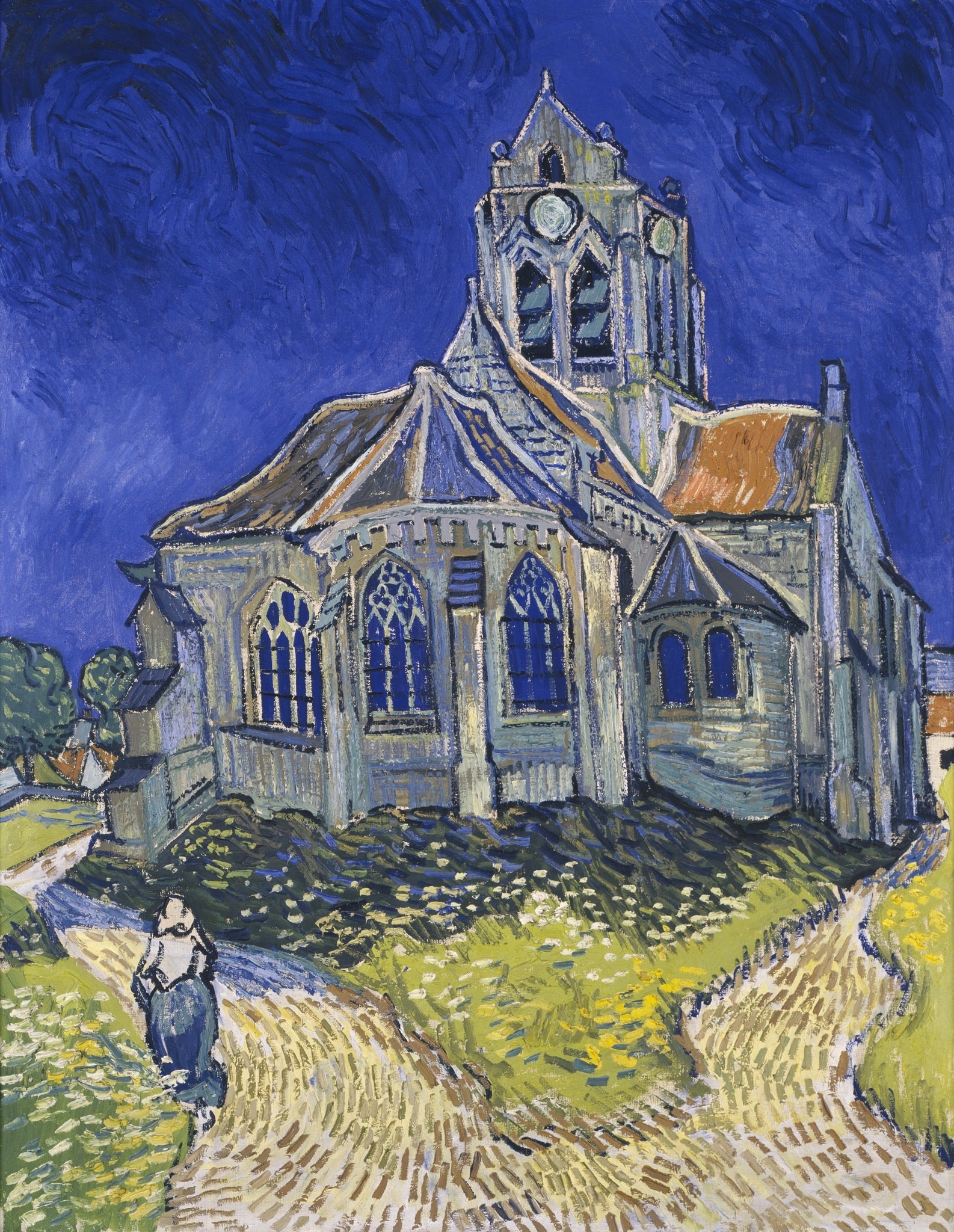
In The Church at Auvers, Vincent van Gogh turns a modest Gothic church into a restless, living form against a cobalt sky. Two forked paths, a lone passerby, and windows sunk in ultramarine shadow stage a tension between the glowing world outside and the dim, unresponsive building within [1][2].

Study Print Studio

Create a personal study print

Build a companion study sheet around the part of this painting that speaks to you most. Choose a detail, shape an interpretation, and walk away with something personal and display-worthy.

Fast Facts

Year
1890
Medium
Oil on canvas
Dimensions
93 × 74.5 cm
Location
Musée d’Orsay, Paris
See all Vincent van Gogh paintings in Paris
The Church at Auvers by Vincent van Gogh (1890) featuring Forked paths, Dark ultramarine windows, Cobalt, swirling sky, Orange roof flashes

Click on any numbered symbol to learn more about its meaning

Meaning & Symbolism

Van Gogh composes from a low vantage so the church swells and tilts, its buttresses and tracery flexing in thick strokes as if the building were caught in a slow convulsion. The sky is a single, saturated field of cobalt threaded with darker whorls, a pressure dome that makes the structure quake. This is not a record of Gothic masonry but a deliberate expressive distortion: the nave leans, the roof angles break, and the contour lines are chiseled in blue‑violet so that edges hum against the sky. Van Gogh told his sister that in this canvas “the building appears purplish (violet) against a sky of deep simple cobalt blue,” with windows like “ultramarine patches,” and the roof “violet and partly orange” 2. The painting matches this program exactly: the windows swallow light; the rusty orange flashes on the roof spark against complementary blues. Orsay’s curators note that the result departs from Impressionist transcription of light to anticipate Fauvist and Expressionist feeling—architecture as emotion rather than document 1. At ground level, the world is warm and moving. Two sandy paths fork and clasp the church like currents, laid in quick, bricklike dashes that propel the eye around rather than into the building. The verge blooms with citron and sap‑green touches; white flowerheads flicker in the grass where light actually gathers. A small figure in a blue skirt advances along the left path, dwarfed by the heaving mass above yet oriented toward the sunlit bend ahead. The compositional rhetoric is clear: human life and movement flow around the church, not toward its doors. Many scholars read the darkened windows—neither emitting nor reflecting light—as a sign of van Gogh’s ambivalence toward institutional religion, a theme that recurs in his late work, where living color and nature carry spiritual charge while stone remains mute 14. The painting stages that critique without polemic: the church is monumental but shadowed; the paths are modest but bright and chosen. Formally, the painting argues that color is conviction. Van Gogh’s chosen complements—cobalt sky versus orange roof, violet masonry against green verges—do not describe a single hour’s light but declare a mood both reverent and uneasy. The ultramarine panes read like sealed tablets; the orange roof tiles flare like embers that cannot warm the interior. The brushwork insists on this doubleness: thick, directional strokes make the church vibrate with life even as its windows remain inert. In late Auvers, van Gogh compressed weeks into an outpouring of 70‑plus canvases; here that urgency converts a known landmark into a state of mind, poised between the paths that fork and the building that looms 1. As a summation of his Post‑Impressionist project, The Church at Auvers demonstrates why color, line, and perspective can carry existential content—faith, solitude, and the problem of where light resides. It is a picture about choosing a way through the world when the sanctioned house of meaning stands in shadow, and about painting as the medium that renders that choice visible 1234.

Explore Deeper with AI

Ask questions about The Church at Auvers

Popular questions:

Powered by AI • Get instant insights about this artwork

💬 Ask questions about this artwork!

Interpretations

Theological Chromatology

Van Gogh’s palette functions like a theological argument in color. The cobalt dome and violet masonry are not atmospheric reportage but a coded assertion that sanctity has migrated from stone to light-saturated nature. The church’s windows—rendered as ultramarine patches—absorb rather than emit, while the verge and paths scintillate, relocating spiritual vitality to the commons and the road. Recent scholarship terms this a “theological chromatology,” where chroma carries metaphysical stakes: blues signify depth and mystery, oranges the ember of lived warmth, their clash articulating a critique of ecclesial dimness without outright iconoclasm. Van Gogh’s own letter (W22) confirms the intentional complementaries, anchoring interpretation in primary evidence rather than piety or anecdote 241.

Source: MDPI Religions (2024); Musée d’Orsay; Van Gogh letter W22

From Impression to Expression

This canvas marks a decisive post‑Impressionist turn: away from fleeting optical effects toward constructed, value‑laden color and line. The church is architecturally “true” only in outline; its buttresses flex and edges throb in blue‑violet, a willful deformation that anticipates Fauvism and Expressionism. What matters is not the incident of light but the pressure of feeling—registered in the cobalt field’s compression and the counter‑flare of orange tiles. In doing so, Van Gogh asserts color as an autonomous vector of meaning, extending Delacroix’s complementaries into an ethical register. Orsay’s curators explicitly position the work beyond Impressionist transcription, a bridge to twentieth‑century avant‑gardes that would take emotional intensity and chromatic dissonance as first principles 15.

Source: Musée d’Orsay; Britannica (Post‑Impressionism)

Liturgical Orientation and the Chevet

Van Gogh selects the church’s chevet (east end)—the apse and radiating chapels—rather than the portal, sidestepping any frontal theology of entry. By picturing the sanctuary’s exterior mass as a wavering, shadow‑held volume and letting the paths clasp it, he reorients devotional emphasis: not toward ingress and rite, but toward circulation and lived passage. In medieval terms, the chevet indexes sacramental center; here it appears estranged from light, its iconographic gravity displaced into the landscape’s chroma and motion. The choice of viewpoint doubles as critique and poetics of place: a parish monument seen from the side of everyday life, where meaning is made on the move 19.

Source: Musée d’Orsay (object title and curatorial text); Église d’Auvers encyclopedic entry

Vantage, Scale, and Choice

Juxtaposed with the later “View of Auvers with Church” (RISD), which subordinates the church to a village panorama, this close‑up treats architecture as psychic weather. The low vantage inflates the edifice, yet the forking tracks refuse centripetal pull, routing attention around its shadow. Read together, the pair shows Van Gogh testing how scale and viewpoint recalibrate meaning: from communal topography to existential confrontation and, finally, to elective paths. The comparison underscores that the church’s darkness is not inevitable but composed—an effect intensified at proximity and relieved at distance—turning vantage into an ethics of seeing and going 61.

Source: RISD comparative work (via Wikipedia entry); Musée d’Orsay

Urgency of the Auvers Interval

Painted within days of arriving in Auvers and weeks before his death, the work bears the stamp of a condensed, high‑velocity practice: 70‑plus canvases in roughly nine weeks. That tempo manifests formally in directional, bricklike strokes that propel paths and make masonry tremble—technique as symptom of lived urgency. Biographically, Van Gogh had just left the asylum at Saint‑Rémy; the picture converts convalescent uncertainty into a composed dilemma between movement and monument. The solitary figure registers scale and psychic distance without anecdote. Rather than a confession, it is a procedure: compress time, intensify complements, and externalize pressure as architecture on the verge of motion 18.

Source: Musée d’Orsay; Britannica (Van Gogh biography)

Color as Ethical Technology

Van Gogh’s stated program—violet church against deep simple cobalt, roofs partly orange, ultramarine panes—functions as an ethical technology: complementary color makes conflict legible without narration. The orange‑blue opposition sparks but does not reconcile; it is deliberatively non‑naturalistic, rejecting a single hour’s light for a stance. The result is not symbol in the allegorical sense but instrument: hue and saturation adjudicate between enclosure and passage, heaviness and lift. The Van Gogh Museum’s Auvers materials corroborate how, in the final months, chroma became the vehicle for conviction rather than description, aligning the work with a modern idea of painting as decision 23.

Source: Van Gogh Museum (Auvers materials); Van Gogh letter W22

Related Themes

About Vincent van Gogh

Vincent van Gogh (1853–1890) developed a radical, emotion‑driven use of color after moving from Paris to Arles in 1888, seeking southern light and an artists’ community. In Arles he created the Sunflowers series to decorate the Yellow House ahead of Gauguin’s visit. His late work fused impasto, high chroma, and symbolic motifs that shaped modern painting [2][5].
View all works by Vincent van Gogh

More by Vincent van Gogh
Café Terrace at Night by Vincent van Gogh

Café Terrace at Night

Vincent van Gogh (1888)

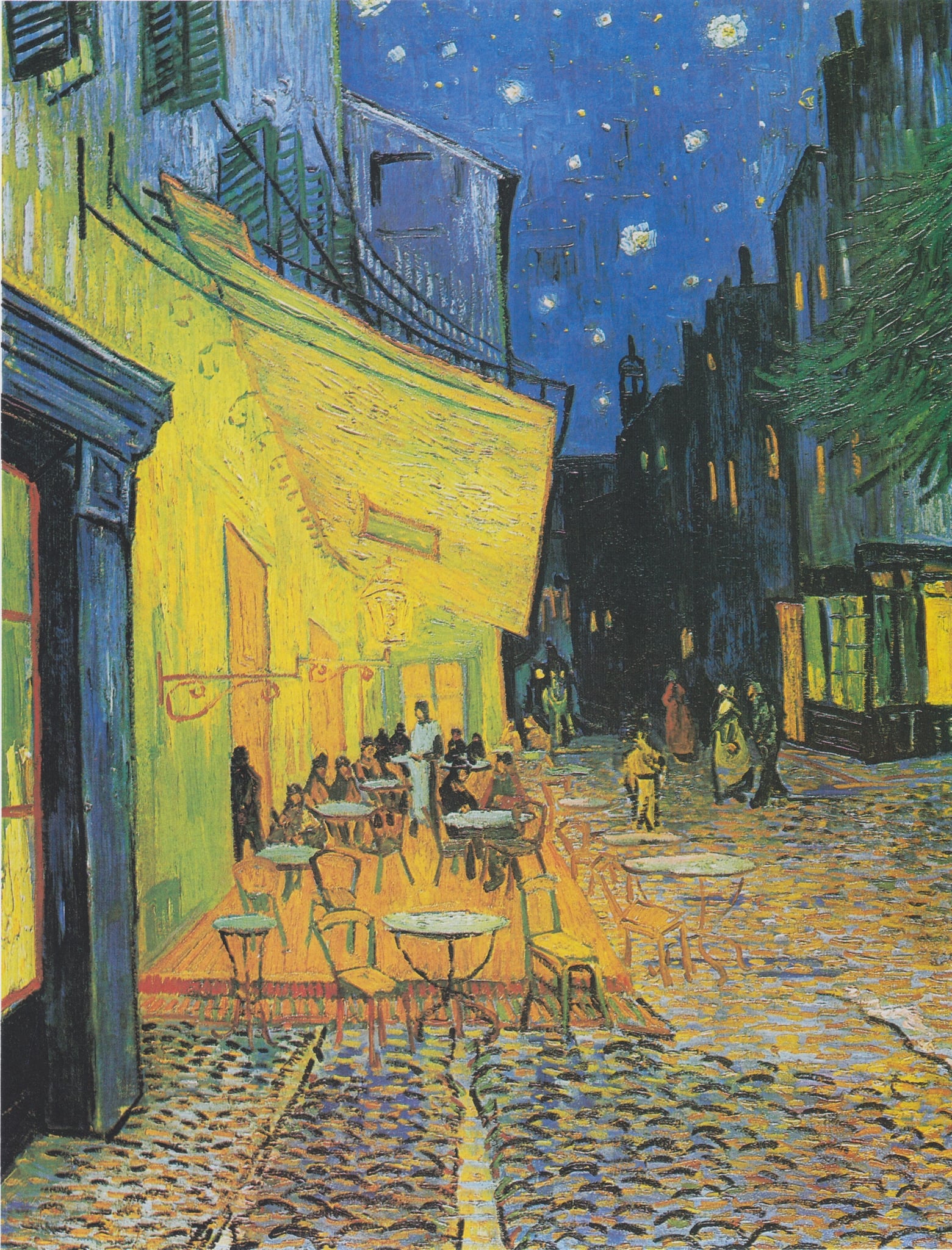
In Café Terrace at Night, Vincent van Gogh turns nocturne into <strong>luminous color</strong>: a gas‑lit terrace glows in yellows and oranges against a deep <strong>ultramarine sky</strong> pricked with stars. By building night “<strong>without black</strong>,” he stages a vivid encounter between human sociability and the vastness overhead <sup>[1]</sup><sup>[2]</sup>.
Red Cabbages and Onions by Vincent van Gogh

Red Cabbages and Onions

Vincent van Gogh (1887)

In Red Cabbages and Onions, Vincent van Gogh turns everyday produce into a drama of <strong>complementary color</strong> and <strong>restless brushwork</strong>. Hot red contours cinch violet cabbages and pale yellow bulbs against a cool, striated blue table, while a mustard‑yellow patch in the upper right tilts the space and sharpens the chromatic clash. The result asserts ordinary food as a locus of <strong>resilience</strong> and <strong>experimentation</strong> <sup>[1]</sup><sup>[2]</sup>.

Irises by Vincent van Gogh

Irises

Vincent van Gogh (1889)

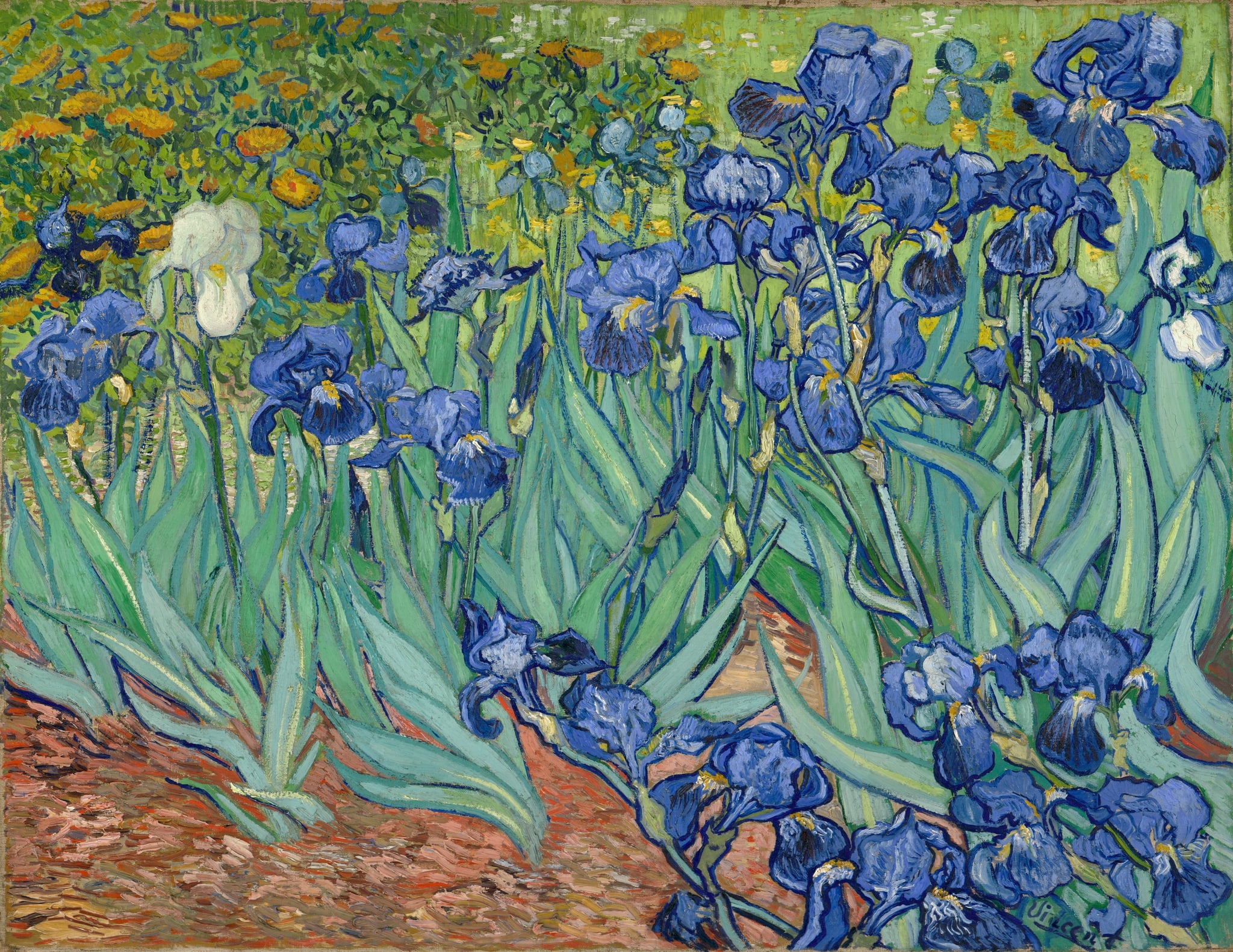
Painted in May 1889 at the Saint-Rémy asylum garden, Vincent van Gogh’s <strong>Irises</strong> turns close observation into an act of repair. Dark contours, a cropped, print-like vantage, and vibrating complements—violet/blue blossoms against <strong>yellow-green</strong> ground—stage a living frieze whose lone <strong>white iris</strong> punctuates the field with arresting clarity <sup>[1]</sup><sup>[2]</sup>.
Sunflowers by Vincent van Gogh

Sunflowers

Vincent van Gogh (1888)

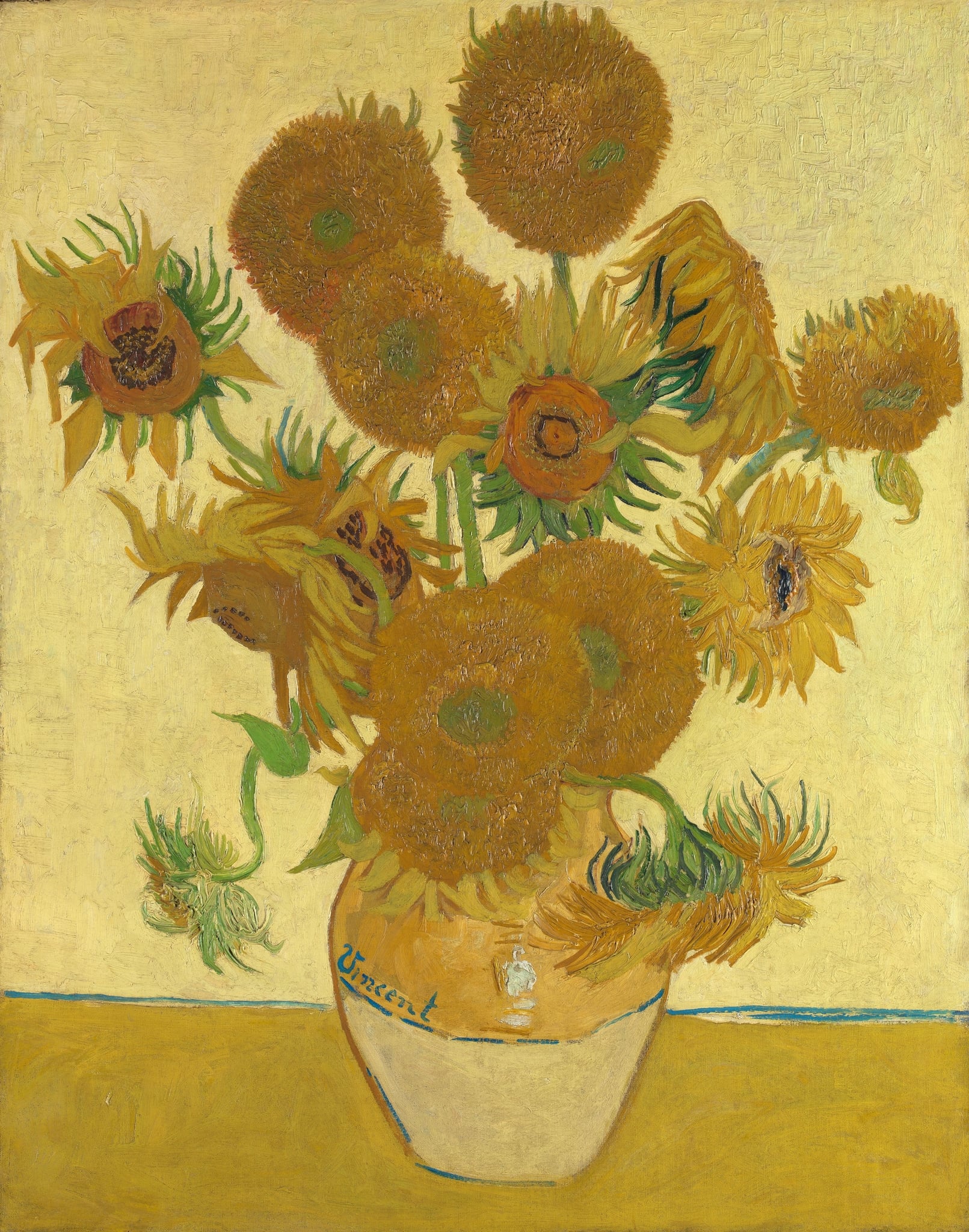
Vincent van Gogh’s Sunflowers (1888) is a <strong>yellow-on-yellow</strong> still life that stages a full <strong>cycle of life</strong> in fifteen blooms, from fresh buds to brittle seed heads. The thick impasto, green shocks of stem and bract, and the vase signed <strong>“Vincent”</strong> turn a humble bouquet into an emblem of endurance and fellowship <sup>[1]</sup><sup>[2]</sup>.

Garden with Courting Couples: Square Saint-Pierre by Vincent van Gogh

Garden with Courting Couples: Square Saint-Pierre

Vincent van Gogh (1887)

In Garden with Courting Couples: Square Saint-Pierre, Vincent van Gogh turns a small Montmartre park into a stage where <strong>spring</strong>, <strong>intimacy</strong>, and <strong>urban leisure</strong> converge. Short, shimmering strokes fuse pink chestnut blossoms, curving paths, and paired figures into one pulse of <strong>renewal</strong> and <strong>togetherness</strong> <sup>[1]</sup><sup>[2]</sup>.

In the Café: Agostina Segatori in Le Tambourin by Vincent van Gogh

In the Café: Agostina Segatori in Le Tambourin

Vincent van Gogh (1887 (Jan–Mar))

Van Gogh casts Agostina Segatori at a tiny, tambourine‑like café table, turning Le Tambourin into a <strong>stage of modern life</strong>. Cool greens and greys make the red <strong>flame‑plume hat</strong> and the foaming <strong>beer</strong> flare, while folded arms and a set‑aside <strong>parasol</strong> register private fatigue amid public display <sup>[1]</sup><sup>[2]</sup><sup>[3]</sup>.