Privacy and Presence in Impressionism
Both born in 1841 and central to the first Impressionist exhibition, Morisot and Renoir made modern leisure the stage on which seeing itself is tested. They share a language of broken color and open air, yet use it for different ends: Morisot defends partial, protected visibility; Renoir builds sociable harmony and touch. The pairings below show how each artist makes the viewer either negotiate permission or join the circle.
Comparison frame: How do Morisot and Renoir use paint to govern access—Morisot to preserve interiority, Renoir to create shared presence—and what does that say about how modern life should be seen?
Quick Comparison
| Topic | Berthe Morisot | Pierre-Auguste Renoir |
|---|---|---|
| Deepest shared concern | Turn perception in time into subject; modern life as high art | Turn perception in time into subject; modern life as high art |
| What paint is for | To preserve interiority and regulate access | To create shared presence and choreograph sociability |
| Governing devices | Veils, parasols, mirrors, thresholds (boats, balconies) | Hands, glances, music, patterned touch and gesture |
| Brushwork/structure | Feathery, open edges; contour often withheld | Luminous color plus clearer contours after mid‑1880s |
| Treatment of faces | Averted, blurred, or withheld to keep privacy intact | Clarified heads and hands as anchors of harmony |
| Typical setting | Managed outings and interiors at the threshold of public life | Café terraces, dance floors, salons—public sociability |
| Viewer’s role | Respect a boundary; look with tact | Join the scene; feel touch, rhythm, and warmth |
| Representative works | Woman at Her Toilette; The Cradle; Summer’s Day | Dance at Bougival; Young Girls at the Piano |
Shared Ground
Morisot and Renoir are peers at Impressionism’s creation: both born in 1841, both exhibiting in the inaugural show of 1874, and both shifting the center of ambitious painting from history to the here-and-now. They make optical immediacy—broken color, responsive brushwork, plein‑air effects—not a surface style but a way to carry meaning. In their hands, seeing becomes the subject: water, foliage, fabric, and skin register time as sensation.
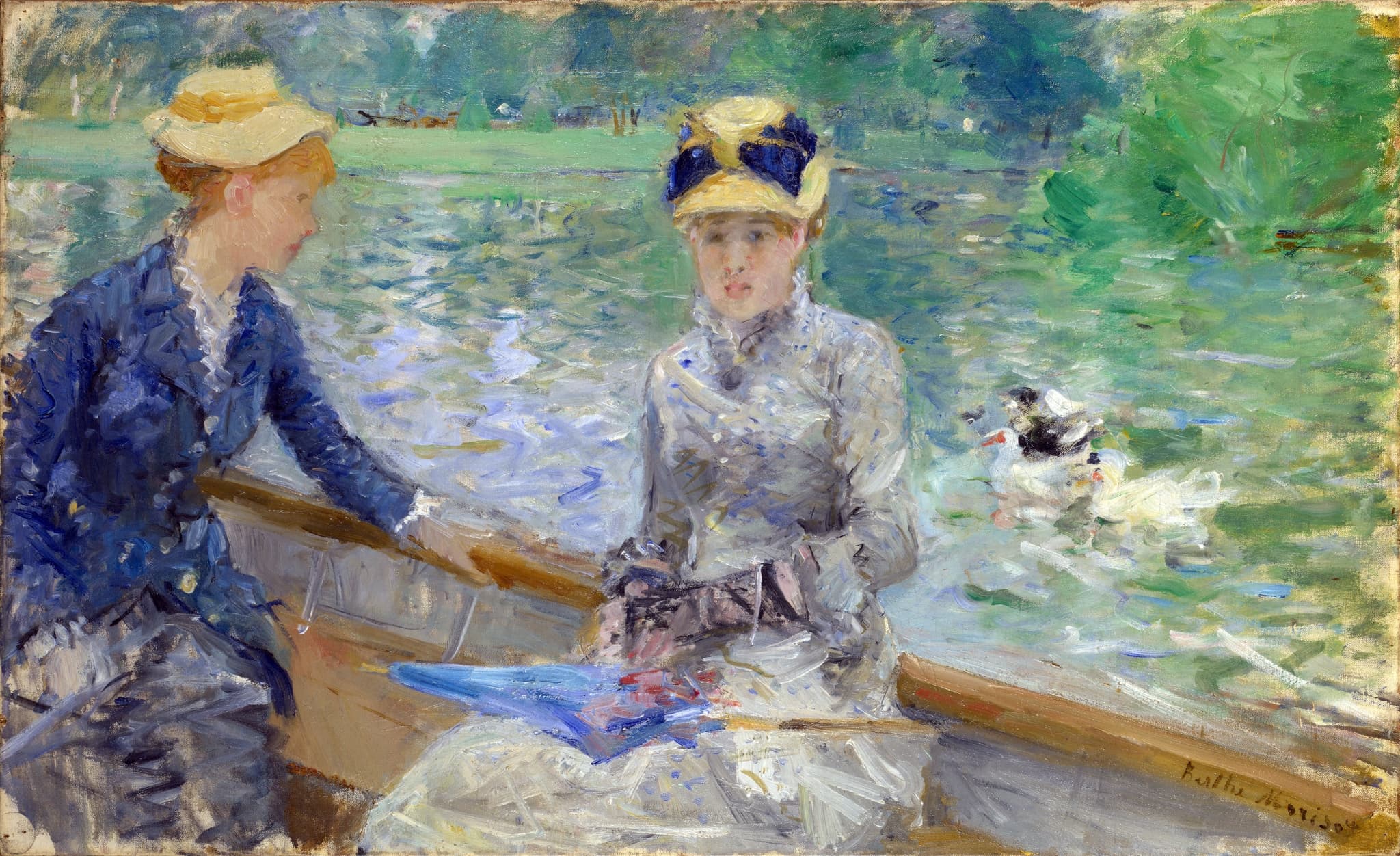
They repeatedly turn to modern sociability and to women in contemporary settings where figure and environment are bound by light. Morisot’s Summer’s Day folds two boaters into the lake’s flicker; Renoir’s dance and café scenes stage touch, heat, and noise as visual rhythms. Interiors also matter: Morisot’s toilette pictures and Renoir’s musical lessons translate cultivation into atmosphere—powder, glass, satin, and song.
Each works from the social spaces available to them. Morisot transforms the sanctioned sphere of women—interiors, family, and managed public outings—into modernity’s stage, often using thresholds like balconies, verandas, and boats. Renoir, emerging from artisan training and drawn to urban leisure, elevates café terraces, suburban dance floors, and domestic music-making to grand-painting scale. Across harbors and piazzas alike, both test how painting can hold fleeting life without hardening it: Morisot’s harbor reads as time made visible; Renoir’s Venice dissolves basilica and crowd into civic light. Their shared ground is this conviction that modern experience—measured in glances, breezes, reflections—deserves the dignity of high art.
Decisive Difference
Their split lies in what they think painting should do with access. Morisot builds an ethics of attention: her facture protects subjectivity through withheld faces, dissolved edges, and mediating screens. In The Cradle a lifted veil regulates the viewer’s approach; in Woman at Her Toilette the mirror refuses a legible reflection and the sitter turns away. Even in Summer’s Day, public leisure is buffered—parasols, compressed space, and feathery edges keep the women answerable to themselves. The viewer negotiates permission; intimacy remains intact inside an atmosphere.
Renoir, by contrast, builds an aesthetics of sociability. He organizes color and gesture so viewers feel invited in—hands, music, and dappled light choreograph proximity. Dance at Bougival fuses a life‑size couple into a vortex of red‑blue chords and touch; Young Girls at the Piano clarifies profiles, hands, and furniture to picture culture as shared harmony. Around the mid‑1880s he explicitly tightens drawing—the so‑called Ingres period—seeking durability in contour while keeping chromatic luminosity. This classicizing turn stabilizes sensation into legible, communal presence.
Put simply: Morisot uses paint to keep a person’s interior life protected as we look; Renoir uses paint to make togetherness palpable. The divergence is not stylistic fussiness but a philosophy of seeing. It calibrates how each artist believes painting should “hold” experience—Morisot as a breathable veil, Renoir as a welcoming embrace.
Paired Works
Leisure in public greenery: distance vs. closeness
Focus question: When modern life moves outdoors, does painting keep a buffer or pull us in?
Summer's Day vs Dance at Bougival
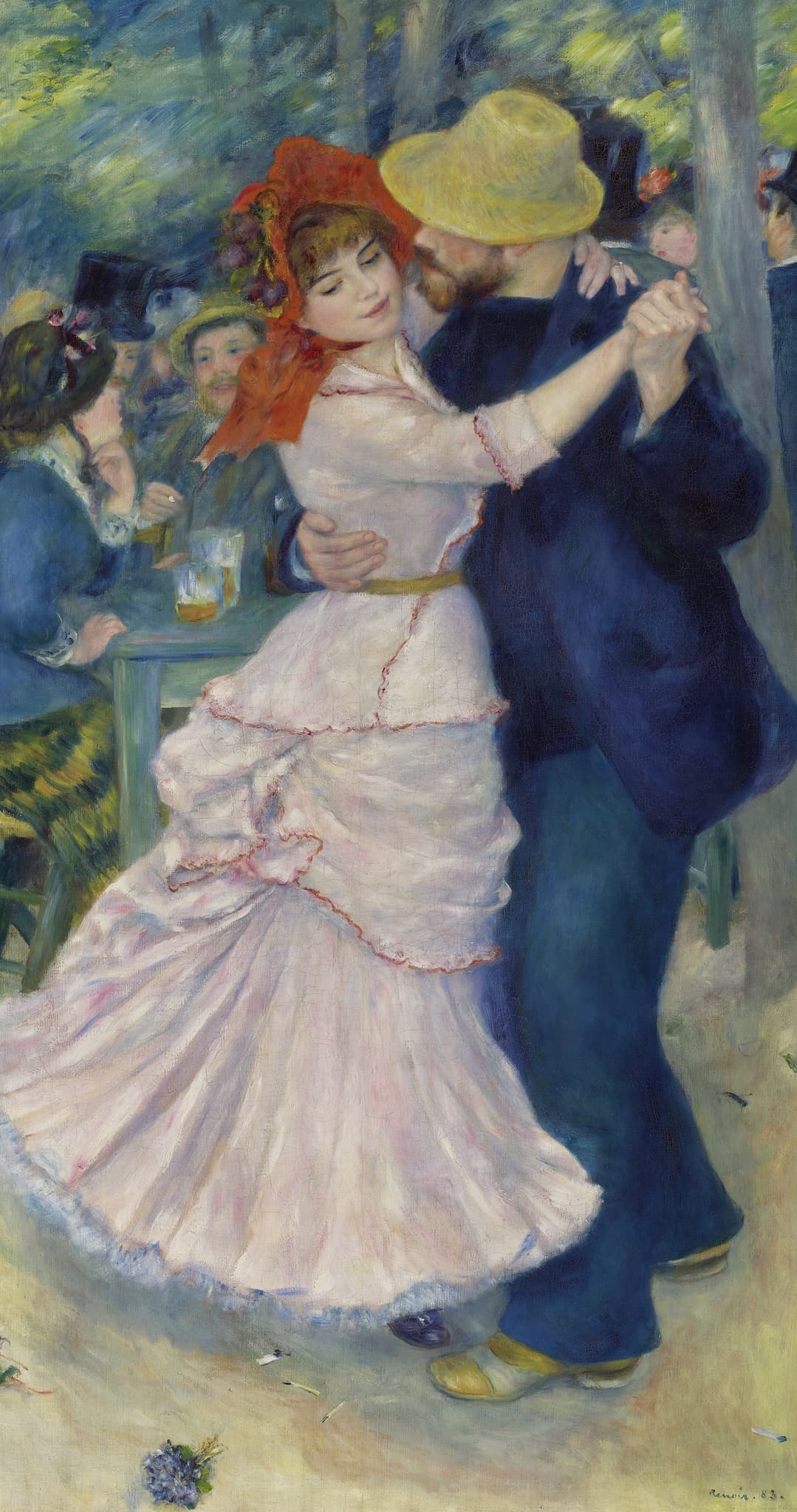
Morisot’s boaters sit inches from the picture plane yet remain self-contained: the parasol bridges their laps like a shield, edges feather into the lake, and one figure averts her gaze. Space is compressed; sound seems hushed. The painting makes spectatorship conditional—we witness a shared outing but not an exhibition of selves. Renoir’s suburban dancers do the opposite. At life size, their clasped hands and the woman’s scarlet bonnet pull us into a turning core; discarded matches, a fallen bouquet, and a sweating glass extend our senses into the scene. Color contrasts—red against ultramarine—bind the couple and signal tempo. Where Morisot’s rippling water absorbs the figures, Renoir’s choreography projects their warmth into public space. The pair lays out two claims for outdoor modernity: a buffer that keeps autonomy intact, and a vortex that converts leisure into communal exhilaration.
Interiors of cultivation: privacy vs. harmony
Focus question: How do mirror and music shape what we’re allowed to see indoors?
Woman at Her Toilette vs Young Girls at the Piano
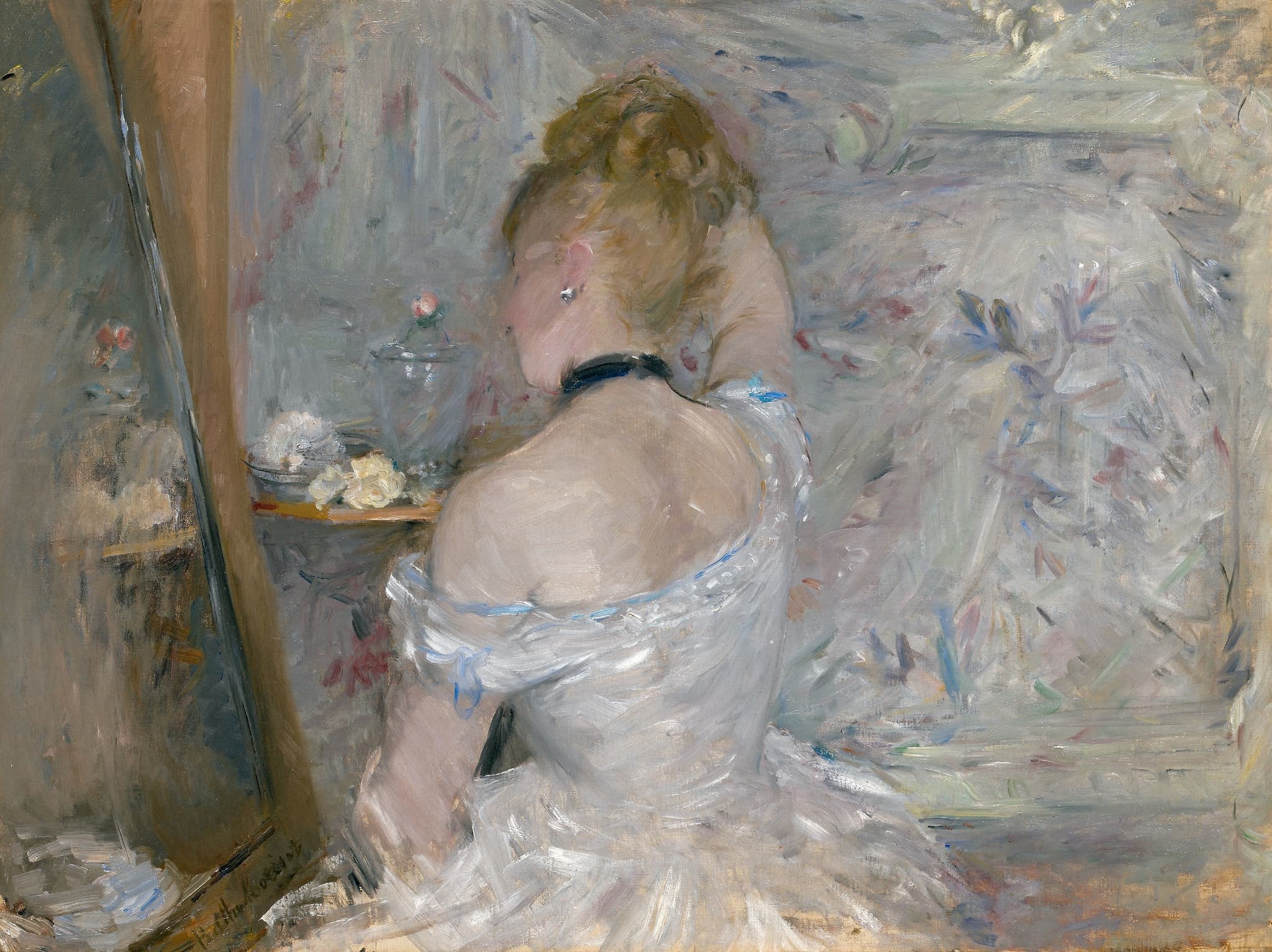
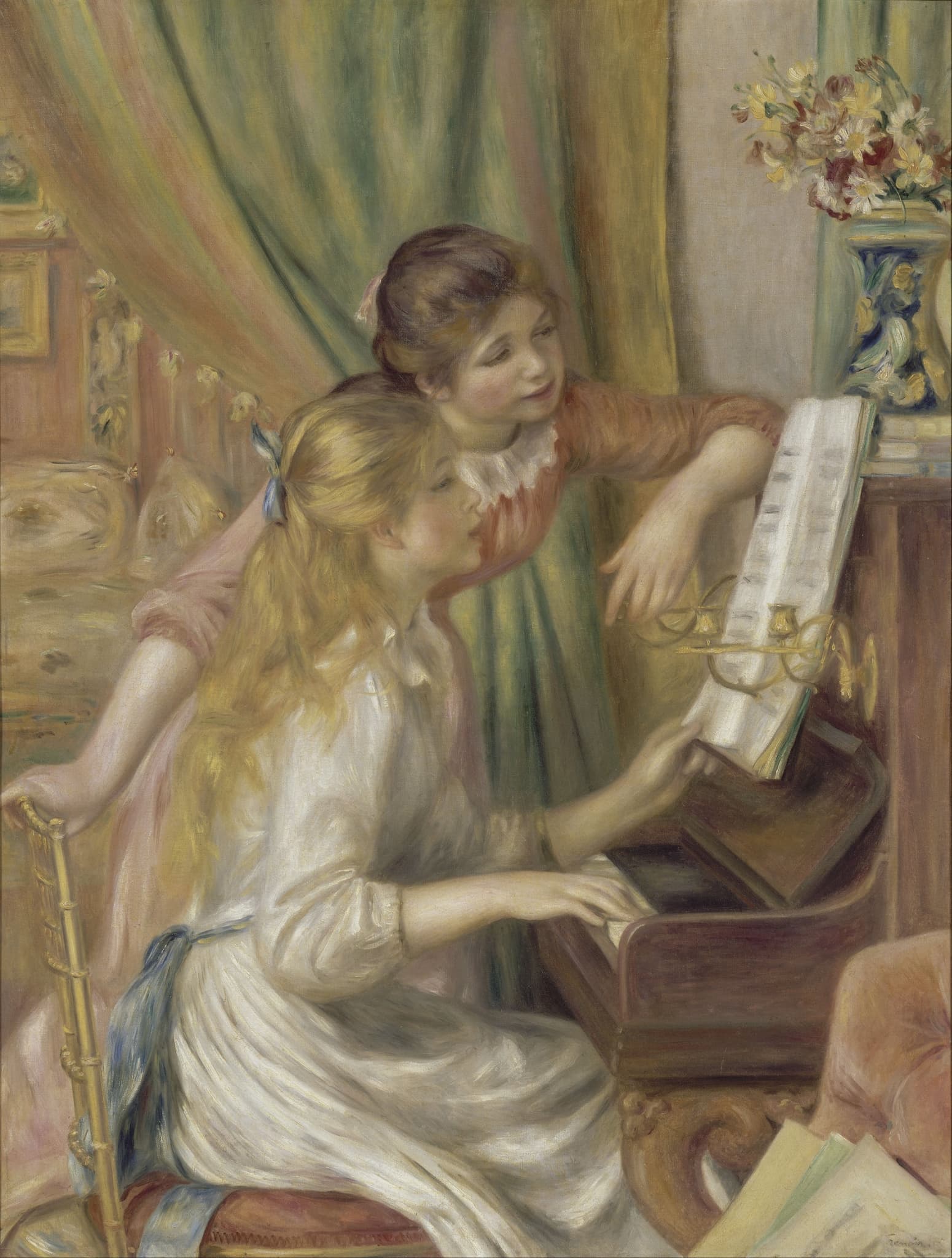
Morisot’s toilette scene withholds: the sitter turns away; the mirror dissolves into a milky echo of objects, not identity. Feathery grays and lilacs keep edges open so the figure remains within her own weather of light. Self‑fashioning is shown as process and the viewer is kept tactfully at bay. Renoir’s lesson clarifies what Morisot blurs. Profiles, hands, music stand, and polished wood are legible; bodies rhyme with furnishings to picture discipline as grace. The canvas also carries public ambition—repeated versions for a state acquisition—so finish and balance act like a social promise. Together, these interiors show contrary logics of visibility: Morisot protects a private self in flux; Renoir stages culture as a practiced duet the viewer can share.
Children and care: boundary vs. charm
Focus question: Is nurture pictured as structure or as presence?
The Cradle vs Girl with a Watering Can
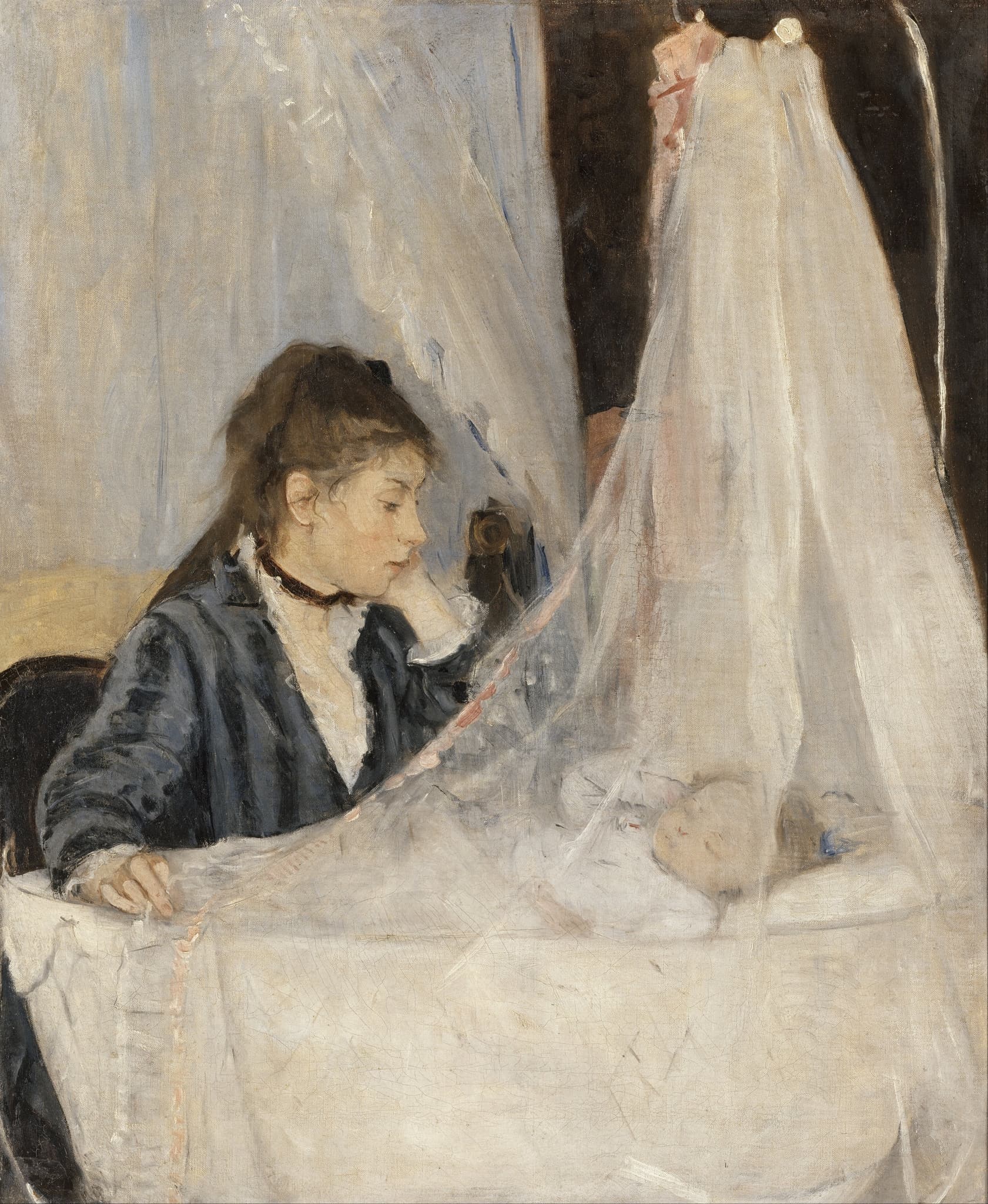
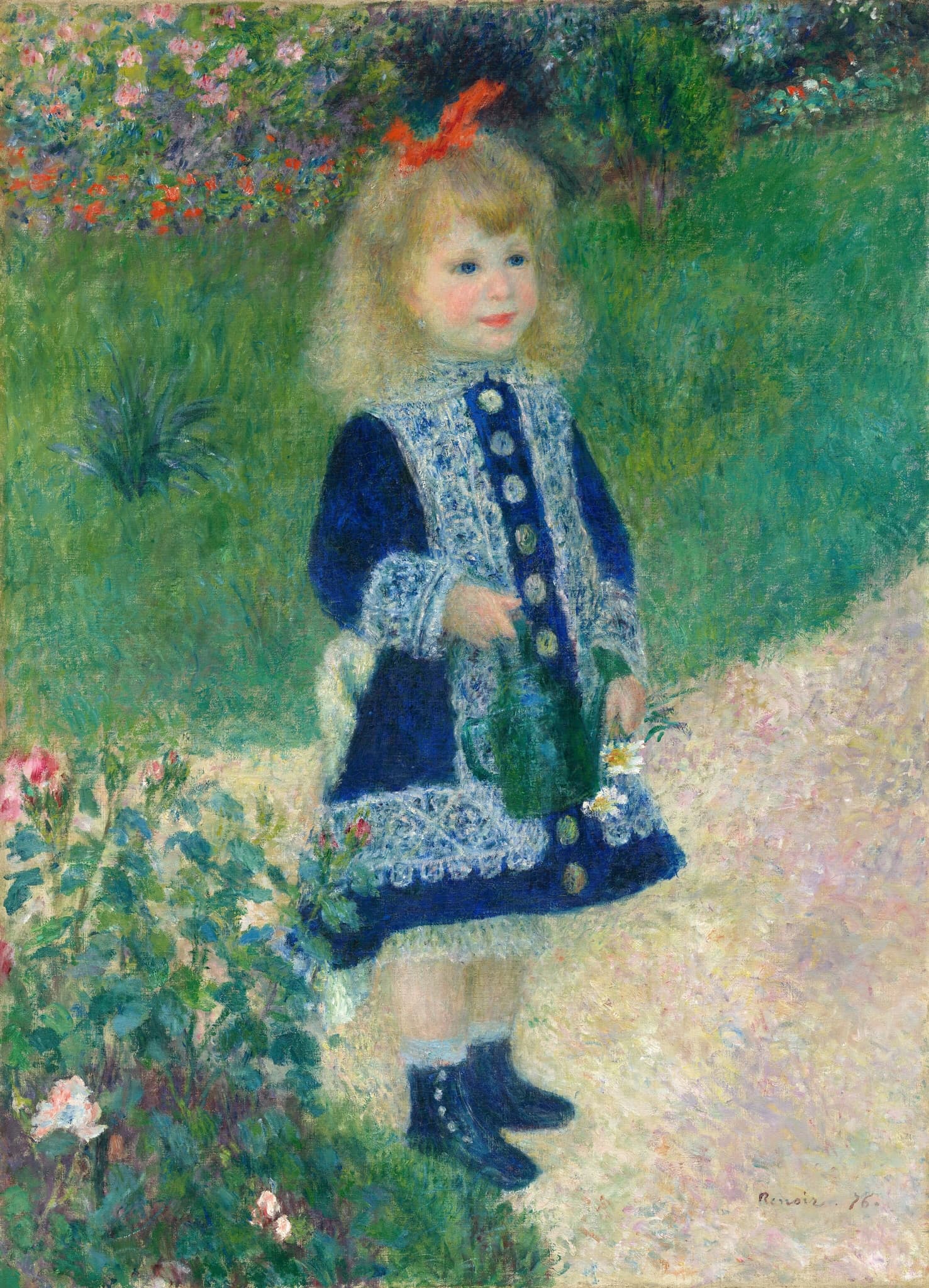
Morisot builds care into the picture’s architecture: a lifted veil draws a diagonal from watcher to child, enclosing sleep within a luminous cocoon. Whites and blues breathe; finish is withheld; access is moderated in real time. The viewer’s desire to see meets a parent’s right to protect. Renoir centers a crisply modeled face against a prismatic garden haze, triangulating blue dress, red bow, and green can. Innocence appears as presence—alert, composed, cared for—while the garden dissolves into light. The can and daisies turn nurture into a gentle emblem of domestic virtue. The comparison clarifies that Morisot makes protection itself the form, while Renoir idealizes the cared‑for child as a radiant node within shared, cultivated space.
Civic light: threshold vs. crowd
Focus question: How do city views balance solitude and the democratic street?
The Harbour at Lorient vs The Piazza San Marco, Venice
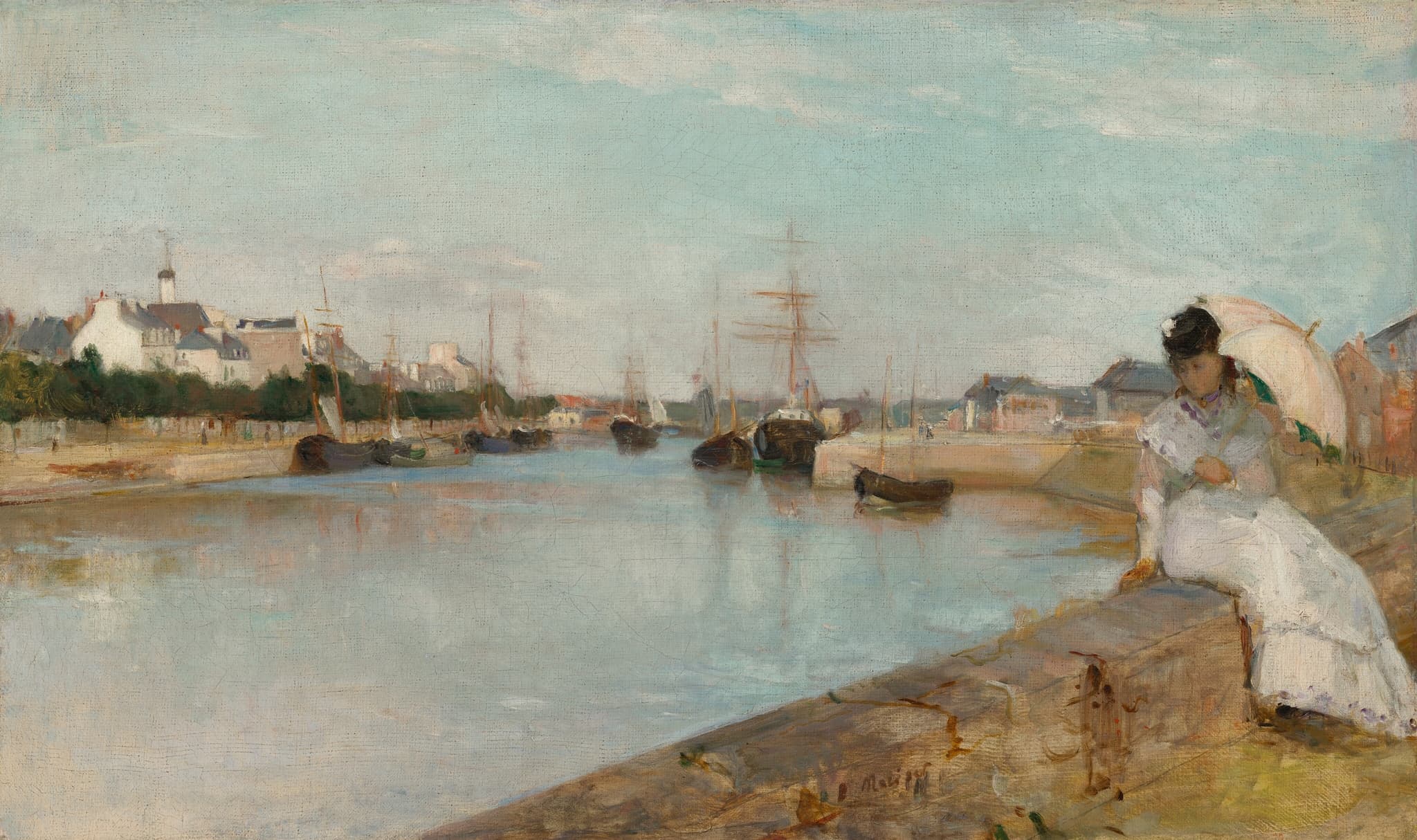
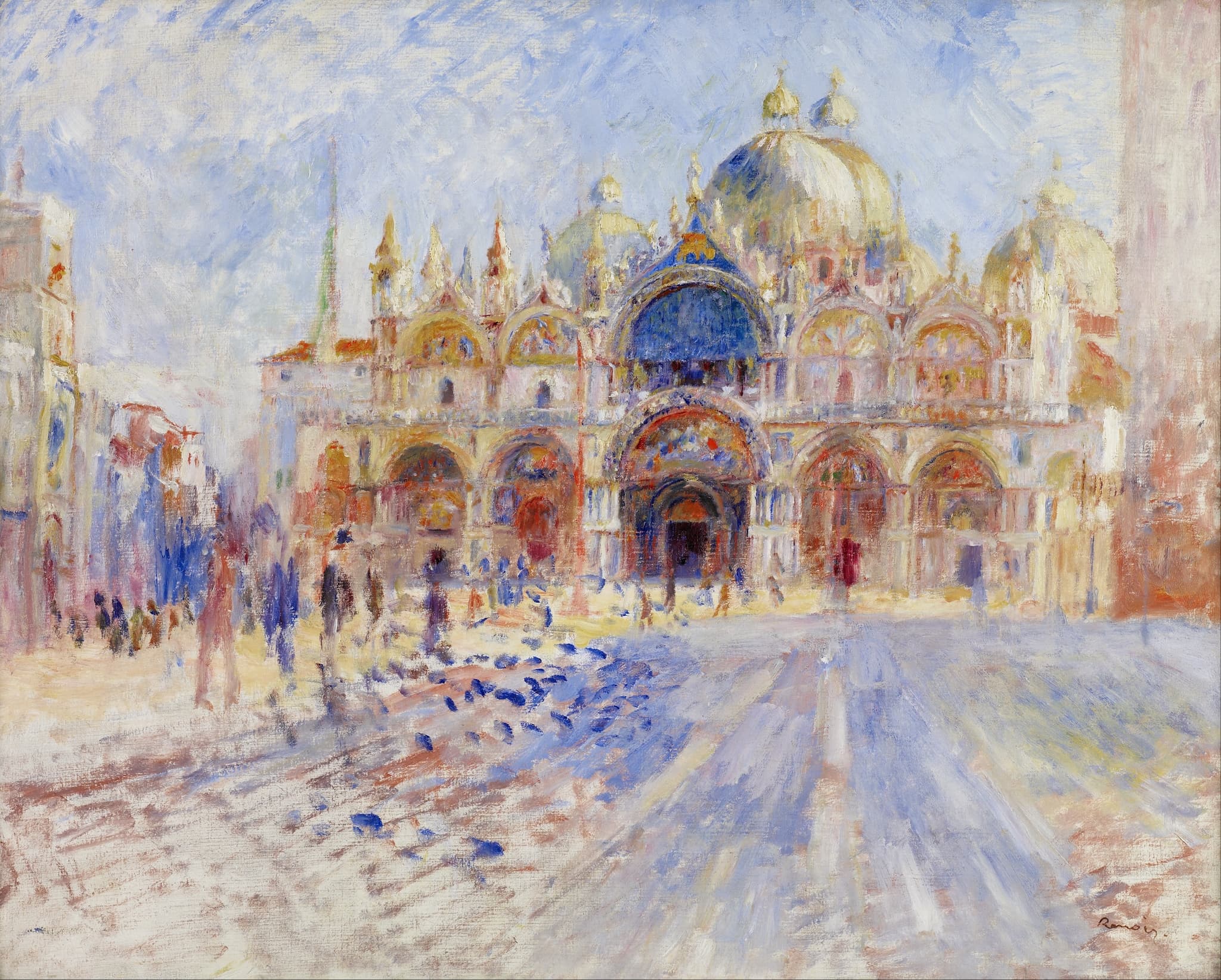
Morisot seats a solitary woman at the quay’s edge; the harbor reads as time—boats idle, reflections tremble, a breeze lifts the parasol. The threshold setting fuses public place and private reverie, with open brushwork that keeps forms porous. Renoir transforms Venice’s basilica into atmosphere: domes and mosaics vibrate; the crowd is a field of pulses; blue‑violet shadows stripe the square. Architecture becomes what light does to stone and people, a democratic stage of shared looking. One canvas honors the individual’s inwardness at the city’s lip; the other dissolves distinctions into civic shimmer. Both depend on optical immediacy, but they answer differently to the question of whom the city is for—one mind at a time, or a crowd together in light.
Why This Comparison Matters
This comparison isolates two durable answers to a modern problem: what kind of access does looking grant? Morisot shows how painting can defend subjectivity—especially women’s—without retreating from public life, using veils, mirrors, and open edges to stage consent as part of seeing. Renoir shows how painting can make sociability feel real, coordinating color, touch, and gesture so viewers sense they belong to the moment. Together they expand Impressionism from a technique into an ethics: when to respect a boundary; when to join a rhythm.
That axis travels well. It clarifies why some images invite participation while others ask restraint; it refines how we read everyday scenes—at a café table, in a nursery, on a dance floor. It also explains later choices across modern art, from intimate interiors to public festivals, where the tension between privacy and presence continues to organize what pictures can do. Learning to see that distinction is a practical skill for museum visitors and a key to understanding the stakes of Impressionism beyond style.
Related Links
Sources
- National Gallery of Art – 1874: The Birth of Impressionism (context)
- National Gallery, London – Berthe Morisot, Summer’s Day (object page)
- Art Institute of Chicago – Woman at Her Toilette (object page)
- Musée d’Orsay – The Cradle (object page)
- National Gallery of Art, Washington – The Harbor at Lorient (object page)
- MFA Boston – Dance at Bougival (object page)
- Musée d’Orsay – Young Girls at the Piano (object page)
- Musée de l’Orangerie – Renoir’s Ingres period context (Femme nue dans un paysage)
- National Gallery of Art, Washington – Girl with a Watering Can (object page)
- Minneapolis Institute of Art – The Piazza San Marco, Venice (object page)