Serial time or coded harmony?
Both artists rebuild vision from small, separate touches of paint. Signac turns Divisionism into a programmable harmony that promises luminous order; Pissarro treats seeing as lived time, measured across weather, light technologies, and season. This page clarifies their strongest shared ground and the split that changes what their paintings ask us to notice.
Comparison frame: How do Signac’s coded color systems and Pissarro’s serial city views propose two different ways that painting can make perception itself visible?
Quick Comparison
| Topic | Camille Pissarro | Paul Signac |
|---|---|---|
| Core proposition | Design sensation by regulating pure hues and contrasts | Witness change by tracking light, weather, and traffic over time |
| Working method | Divisionist system; dots/tiles calibrated to guarantee luminosity | Freed brush in the 1890s; Divisionism tested, then loosened |
| Composition | Planar, stabilized scaffolds (masts, cylinders, quays) | Layered planes and tree “screens” that keep air in motion |
| Modern motifs | Ports, rivers, gasworks as vehicles for color logic | Boulevards, factories, gardens as lived ecologies and flows |
| View of time | Timeless decorative harmony; order over anecdote | Serial difference across hours and seasons; flux as subject |
| Color/line theory | Charles Henry’s correlations guide rhythm and affect | Brush rhythm over coded ornament; sensation from touch |
| Institutions/politics | Leader at the Indépendants; anarchist milieu | Anarchist sympathies; democratic attention to the ordinary |
| Fate of Divisionism | Permanent commitment; system is the message | Tool among others; set aside when it impedes change |
Shared Ground
Signac and Pissarro meet where modern painting becomes an experiment in constructing sight from parts. In the mid‑1880s both join the Divisionist enterprise—separating pure hues into discrete touches so the eye, not the palette, does the mixing. The label “Neo‑Impressionism,” coined in 1886, formalizes this shared project; Signac will later codify its premises in his treatise, arguing that calibrated contrasts and gradations can secure harmony and luminosity. For each, technique is a wager about perception itself: what can carefully arranged fragments of color make the eye build?
They also share a modern field of proof. Pissarro uses boulevards, gardens, and factories to test how weather, crowd flow, and new lighting technologies alter what we see; Signac turns ports, rivers, and gasworks into prismatic structures where color order carries as much meaning as motif. Both move through anti‑academic, anarchist‑adjacent networks and support artist‑run exhibition models, linking optical experiment to social ideals of openness. In their hands, modern life is not just a subject but a laboratory: the boulevard’s lamps and the harbor’s masts become measuring devices for color and rhythm. However different their endings, the starting premise holds for both—vision is built, not received, and small marks can reprogram how the world appears.
Decisive Difference
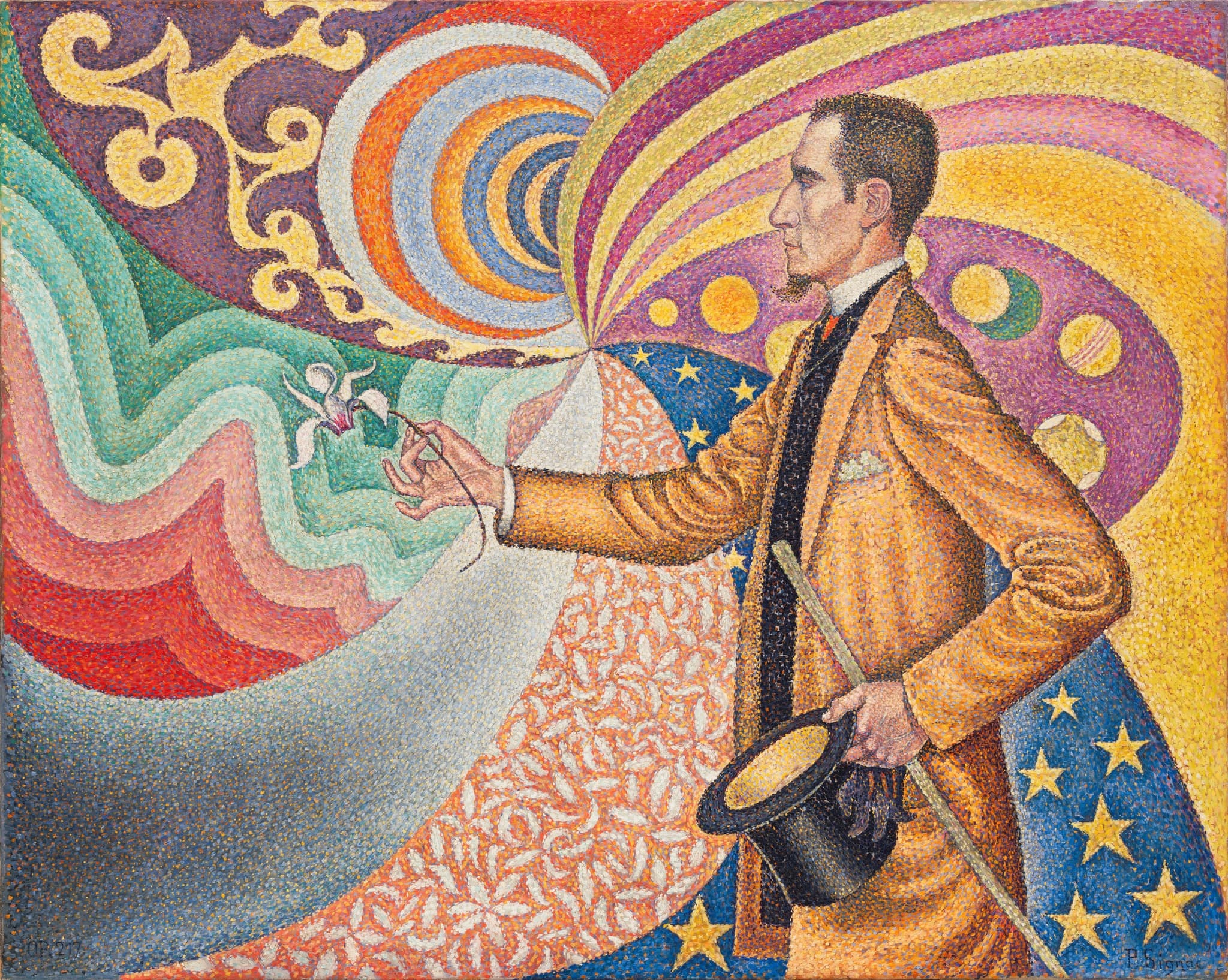
For Signac, painting proves that harmony can be designed. Divisionism is an aesthetic system: lay down separate, saturated hues; regulate their intervals; and a stable, radiant order will follow. The painter’s hand submits to an optical plan. Influenced by theories that correlate line and color to emotion, Signac often chooses planar, rhythmic scaffolds—masts, quays, gasometers—on which to “tune” chromatic chords. In portraits and ports alike, meaning rides on the coded interplay of complements, arabesques, and measured gradations. The result is decorative in the serious sense: an architecture of color that aspires to guaranteed luminosity and a timeless poise.
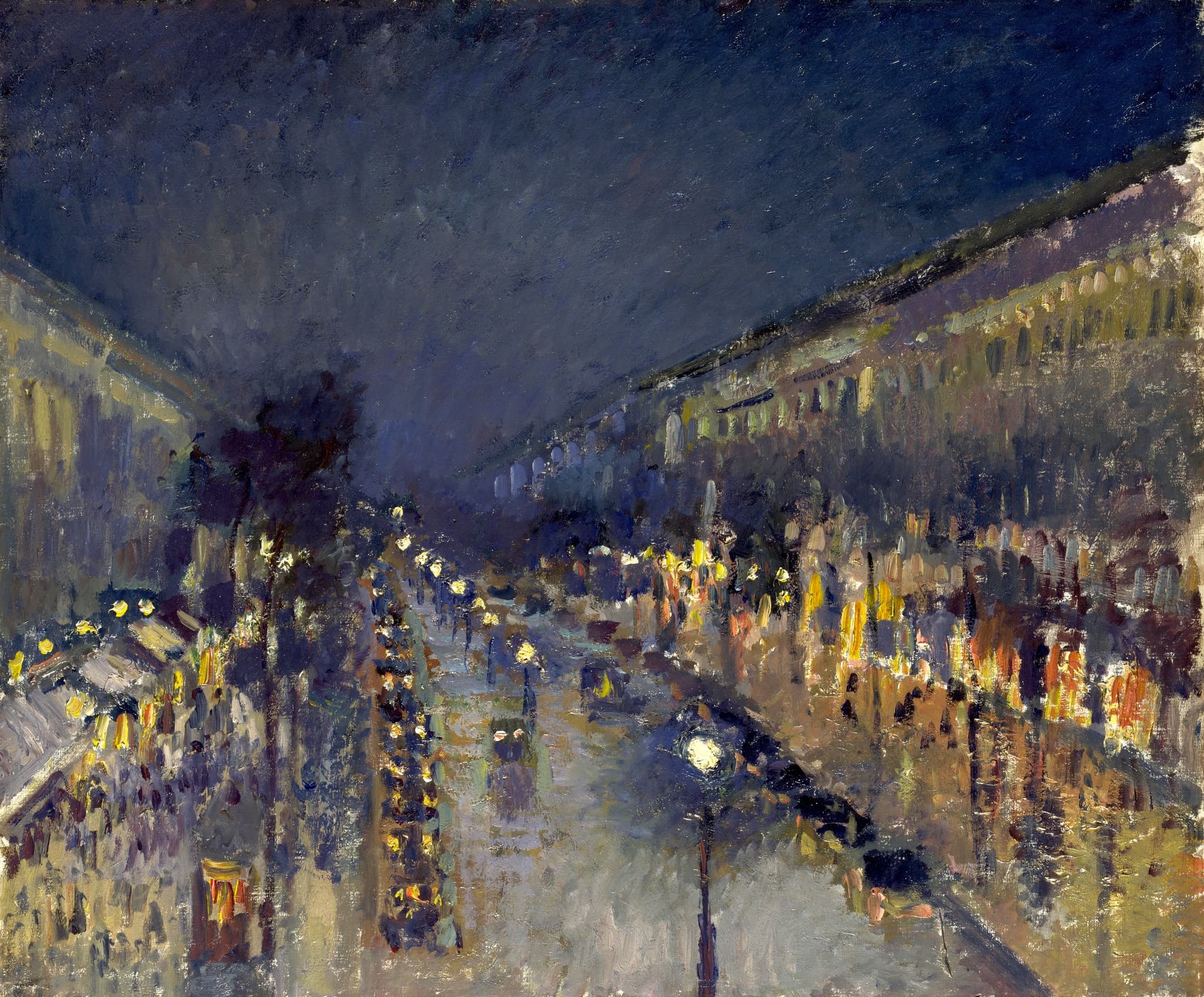
Pissarro treats painting as time held in view. Even when he tests Divisionism in the late 1880s, he ultimately loosens the method so brushwork can register change—weather skimming stone, traffic dissolving into rhythm, electric arcs against gaslit windows. His high‑window series in Paris makes the street a comparative instrument: one motif, many conditions. Difference becomes the subject, not a deviation from a plan. Where Signac programs sensation, Pissarro witnesses variation; where Signac stabilizes space to carry color order, Pissarro builds layered planes and “screens” that keep atmosphere alive. The split is not dots versus dabs. It is a philosophy of seeing: designed harmony versus experienced time.
Paired Works
Coded color vs serial night
Focus question: What changes when color is programmed (Signac) rather than tracked across lived time (Pissarro)?
Portrait of Félix Fénéon vs Boulevard Montmartre at Night
Industry: module or milieu?
Focus question: Does industry become a color module (Signac) or a lived ecology (Pissarro)?
Gasometers at Clichy vs The Factory at Pontoise
Harbor chords vs village structure
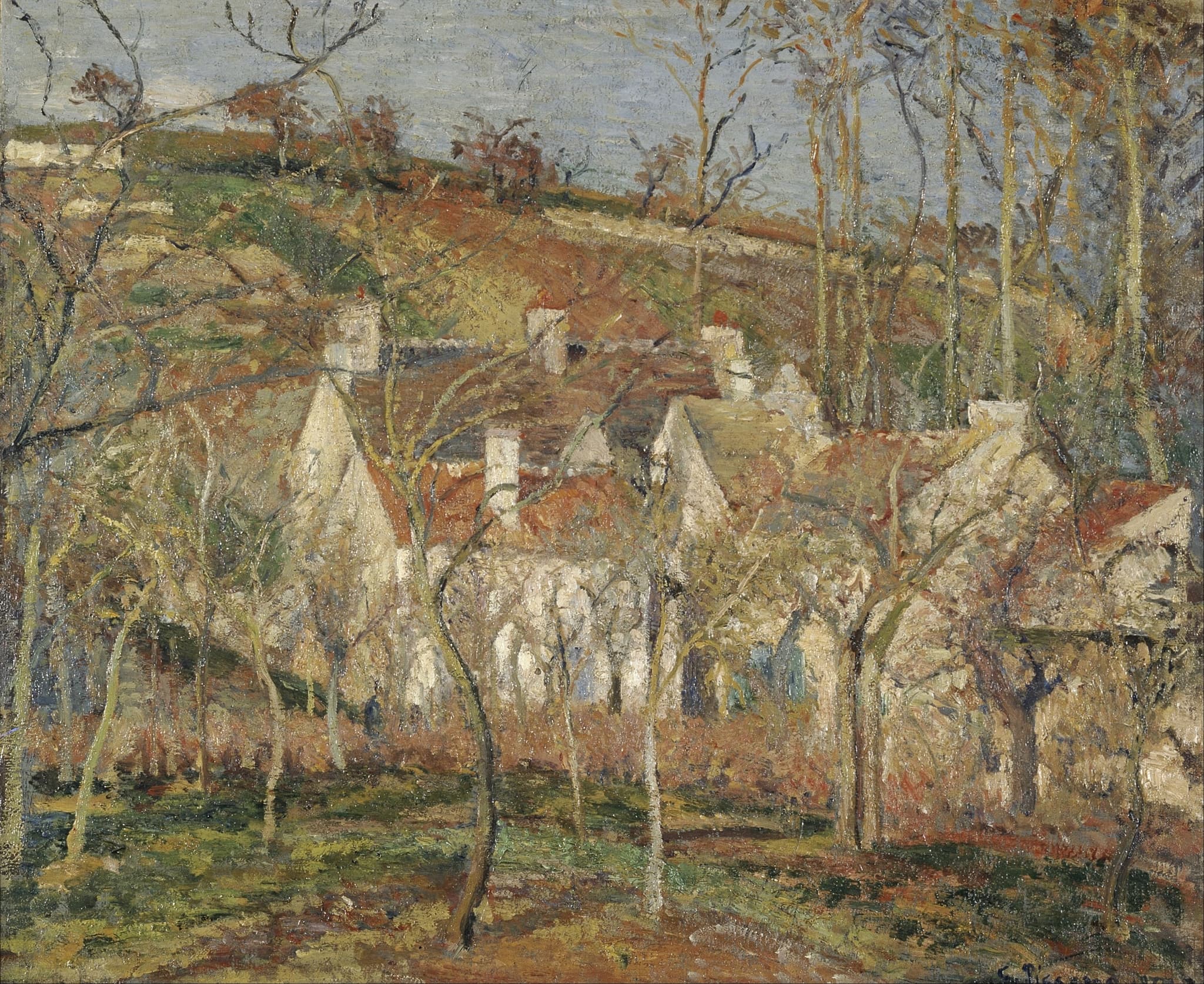
Focus question: How do color harmony (Signac) and everyday structure (Pissarro) build stability differently?
The Port at Sunset, Opus 236 (Saint‑Tropez) vs Red Roofs
Why This Comparison Matters
This comparison names two durable options for modern pictorial thinking. Signac’s program—separate, regulate, harmonize—feeds later design languages where color structure carries content, from Fauvist saturation to abstract color‑chord painting. It models how sensation can be engineered and shared, a democratic promise tied to independent exhibiting and anti‑academic ideals. Pissarro’s serial method—one motif under changing conditions—prefigures photographic sequences, documentary film, and data‑driven ways of seeing cities. It argues that knowledge arises by comparing moments, not by imposing a plan.
For viewers, the stakes are practical. Signac teaches how calibrated contrasts can make light; Pissarro teaches how attention to difference can make meaning. One risks missing the unruly particular; the other risks sacrificing steadiness. Knowing the split helps decode countless paintings of ports, boulevards, and factories after 1900: are we looking at designed sensation or witnessed change? Often, the most interesting works balance both. Signac and Pissarro show how.
Related Links
Sources
- The Met – Georges Seurat (1859–1891) and Neo‑Impressionism
- Paul Signac, From Eugène Delacroix to Neo‑Impressionism (1899) – translated excerpts
- MoMA – Paul Signac, Portrait of Félix Fénéon (Opus 217)
- National Gallery, London – Camille Pissarro, The Boulevard Montmartre at Night
- NGV – Paul Signac, Gasometers at Clichy (1886)
- Museum Barberini – Paul Signac, The Port at Sunset, Opus 236 (Saint‑Tropez)
- Musée d’Orsay – Camille Pissarro, Les Toits rouges (Red Roofs)
- Larousse – Société des Artistes Indépendants
- Newfields – Pissarro Technical Report (Divisionism and later practice)