Two ways to make the present visible
Monet and Manet share a modern aim: turn painting into a laboratory for how we see now. Monet fixes a motif and lets weather, hour, and air remake it. Manet builds and edits the modern scene—cropping, staging, and flattening—so we feel how images frame experience.
Comparison frame: How do Monet’s envelopes of light and Manet’s edited modern scenes teach us to see the present?
Quick Comparison
| Topic | Claude Monet | Édouard Manet |
|---|---|---|
| Core subject of perception | Conditions: light, air, and time (the enveloppe) remake form | Framing: edits, staging, and silhouette make meaning |
| Working method | Fixed motifs, serial campaigns; site-built environments (Giverny) | Studio-constructed “snapshots”; decisive croppings and revisions |
| Typical setting | Gardens, rivers, fog, architecture-as-armature (London/Venice) | Cafés, interiors, crowds, and staged public scenes |
| Role of architecture/figure | Anchors atmosphere; people often peripheral or absent | Planar stage for modern types; the figure/silhouette carries charge |
| Treatment of surface | Broken strokes; color-intervals that vibrate across the field | Flat grounds, sharp silhouettes; blacks used as active color |
| Time strategy | Repetition-and-difference across hours and seasons | A constructed instant; pause as dramaturgy |
| Ethic of looking | Train the eye to environmental truth (weather, pollution, light) | Train the eye to editorial truth (power, staging, point of view) |
| emblematic example | The Water Lily Pond; Houses of Parliament | Plum Brandy; The Execution of Emperor Maximilian |
Shared Ground
Monet (1840–1926) and Manet (1832–1883) meet on a shared modern ground: painting is not chiefly for telling old stories but for testing how the present appears. Both convert ordinary, contemporary life into a field where vision is the content. Monet does it by fixing a motif and tracking the variable envelope of light and air; Manet by editing, staging, and cropping modern scenes so we register our own act of looking.
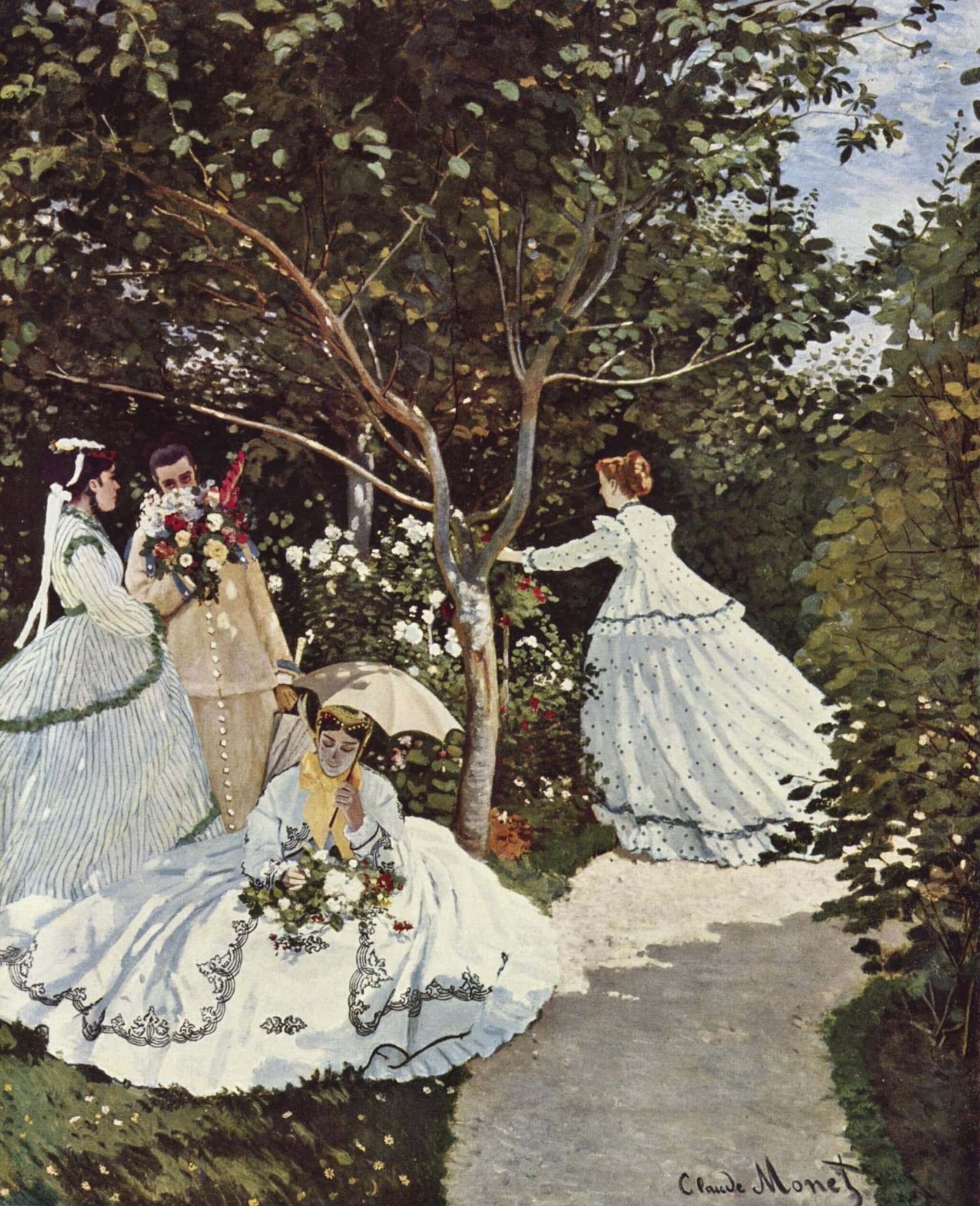
This modernity is legible on the painted surface. Each flattens description to privilege the picture plane. Monet builds vibrating fields of reflection that pull architecture and foliage toward the surface; Manet sets figures against planar, often indeterminate grounds, using abrupt framings and silhouettes that feel cut to shape. The effect is clear even early: Monet’s Women in the Garden, worked outdoors at monumental scale with a trench-and-pulley contrivance, treats white dresses as optical instruments. Manet’s Music in the Tuileries slices a concert crowd into a frieze with no governing center, dispersing attention across hats, parasols, and iron chairs.
Both make attention itself the drama. Monet’s serial projects—Haystacks, Rouen, London, Venice—turn time and weather into the subject. Manet’s interiors and public venues—Plum Brandy, Woman Reading—stage absorption and spectatorship, often built in the studio from props and backdrops. They share sources (old masters, japonisme) but redirect them: Manet adapts Velázquez’s single-figure gravity into flat, modern silhouette; Monet uses bridges and reflective water as armatures for optical ambiguity. The common proposal is steady: to see modern life truly, train vision on the conditions that produce it.
Decisive Difference
For Monet, perception is environmental. He constructs or selects sites where an enveloping field of air and light can be watched over time. Giverny is the emblem: a purpose-built pond and bridge designed to make reflection compete with surface, often withholding the sky so that water becomes a mirror-world. In London and Venice, permanent monuments are treated as silhouettes or scaffolds for atmosphere; the subject is not Westminster or San Giorgio but the particulate haze and chromatic intervals that momentarily create them. Recent optical studies even correlate Monet’s London color/contrast with measurable coal-smog conditions, grounding his lyricism in environmental fact. Permanence appears as a negotiation within flux.
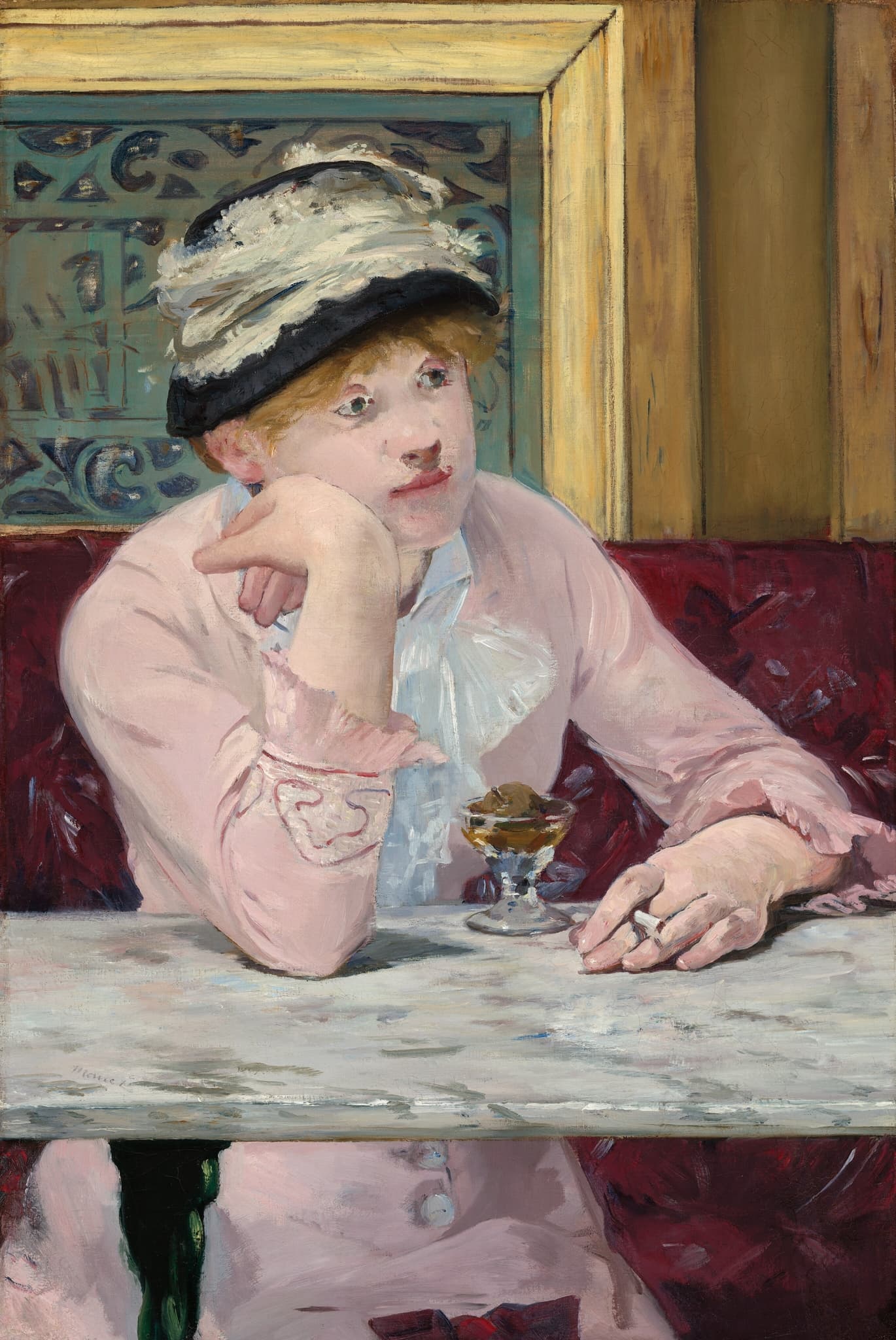
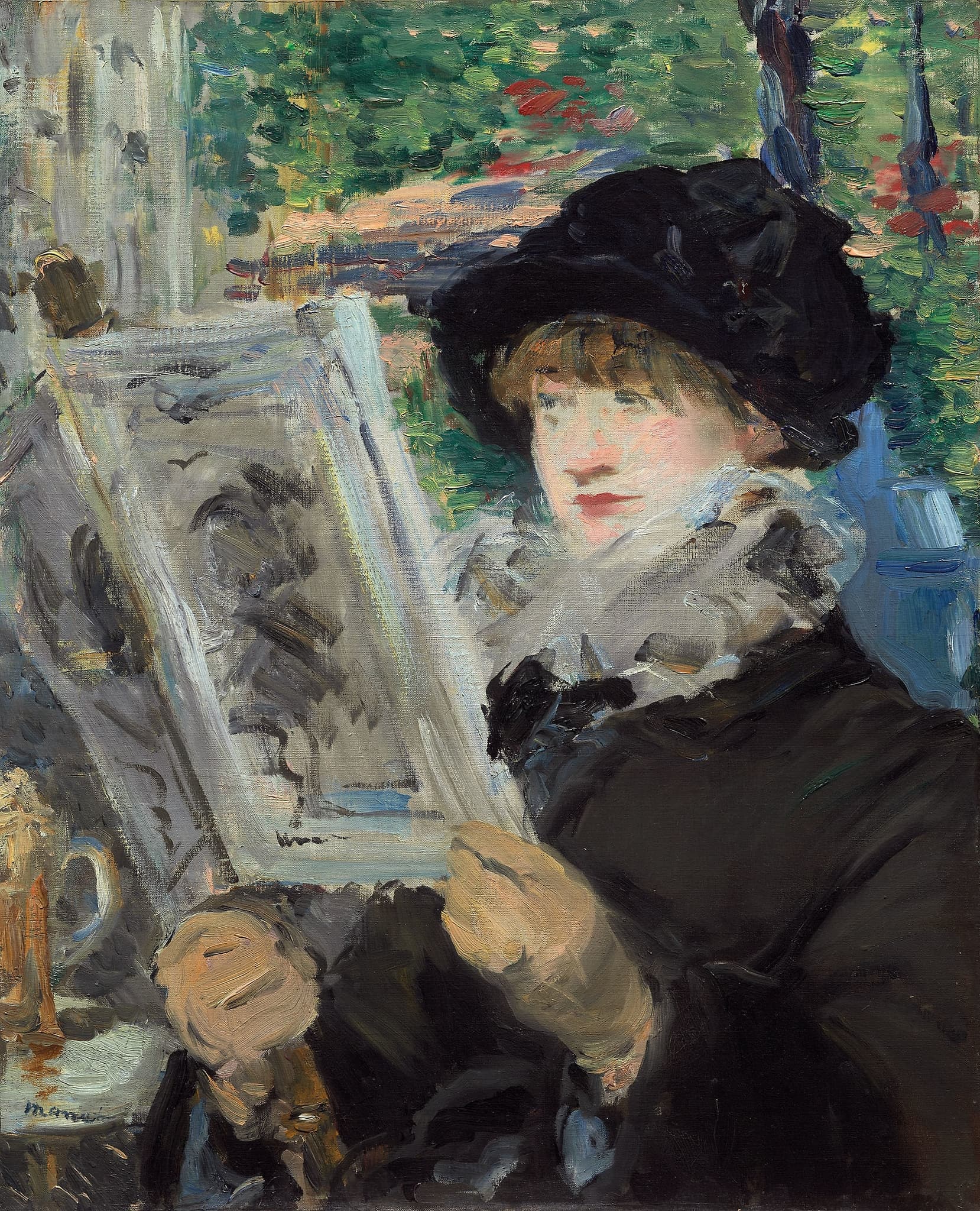
For Manet, perception is an edited encounter. He reconceives modern painting as a set of decisive pictorial edits—cropping, planar backdrops, studio-built “reality”—that reveal how images frame social life and power. The café and the crowd are laboratories: Plum Brandy boxes a city pause into a shallow stage; Woman Reading looks instantaneous but is a studio fabrication, its “garden” a canvas in his own atelier. Even high-stakes politics is recast through editing: The Execution of Emperor Maximilian coolly assembles press evidence into a composition that turns killing into impersonal procedure, placing us beside the squad. Where Monet trains the eye to conditions that make form (weather, hour, envelope), Manet trains the eye to conditions that make meaning (framing, staging, institutional force).
Paired Works
Outdoor modernity, two manifestos
Focus question: What happens when the world outdoors is treated as a laboratory for seeing rather than a backdrop for story?
Women in the Garden vs Music in the Tuileries
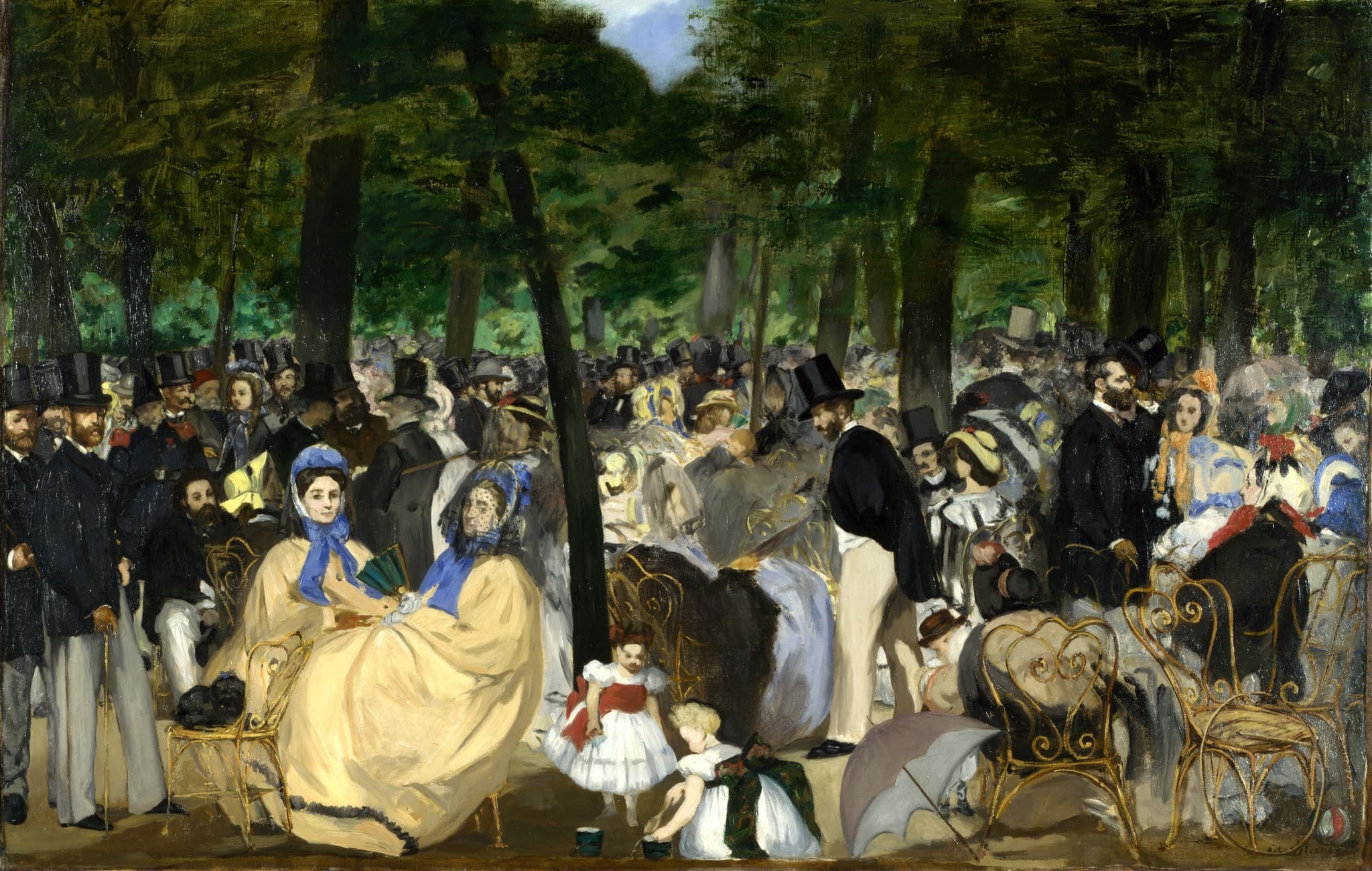
Side by side, these early works propose rival methods for painting modern life outdoors. Monet anchors a single viewpoint in a sunstruck bower and turns white dresses into measuring devices for dappled light; the garden is an optical lab. The famous trench-and-pulley setup that let him move the large canvas up and down on site signals his program: finish dictated by changing light. Foliage and fabric exchange properties—strokes on leaves read like patterns on silk, and vice versa—so attention settles on how light touches things rather than on individual character.
Manet, by contrast, edits a slice of a Sunday concert into a dispersed frieze. There is no narrative center; our gaze ricochets among hats, parasols, and chair backs under chemically bright foliage. The missing band makes music an offstage force that organizes the crowd. Facture is quick and planar, with figures cropped at the edges like a photograph. Monet asks us to compare effects across a fixed motif; Manet asks us to notice how a frame distributes attention in a crowd. Both reject academic hierarchy, but one tests hours and weather, the other tests the modern attention economy.
Intervals: monument in fog vs pause in a café
Focus question: When time stops, do we see changing air—or a constructed instant?
Houses of Parliament vs Plum Brandy
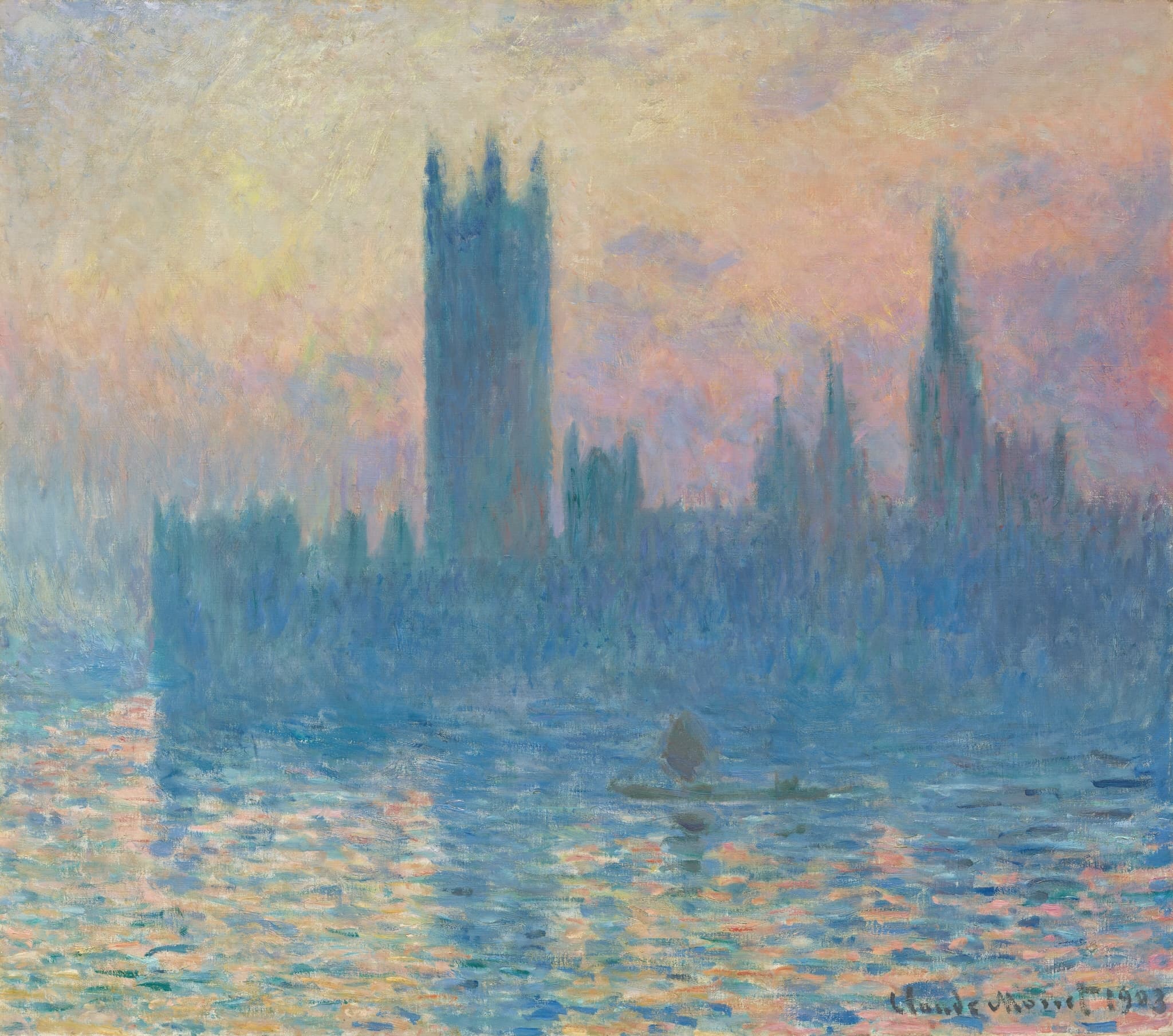
Monet turns Westminster into a dissolving silhouette, where the river and sky fuse in peach, mauve, and gold. Architecture is present as armature; the drama lies in atmospheric intervals—backlit fog, low contrast, and brief color chords keyed to specific hours. Scientific analyses of the London series confirm that such effects align with coal-smog optics, tying the painting’s poetry to measurable environment. Meaning arrives through comparison within a set: many canvases, each tuned to a distinct light envelope.
Manet compresses a different kind of interval. A marble table forms a proscenium; a red banquette and framed panel box the sitter into a shallow stage. An unlit cigarette and a small glass with a preserved plum register suspended action—a modern pause between acts. The scene feels candid but is a studio construction, sharpened by planar design and deliberate cropping. In Monet’s stop-time, the world changes around a fixed silhouette; in Manet’s, the edit makes the moment. Both are modern “nows,” but one is environmental and serial, the other editorial and singular.
Absorption: no figure vs a staged reader
Focus question: How does each artist picture concentrated attention?
The Water Lily Pond vs Woman Reading
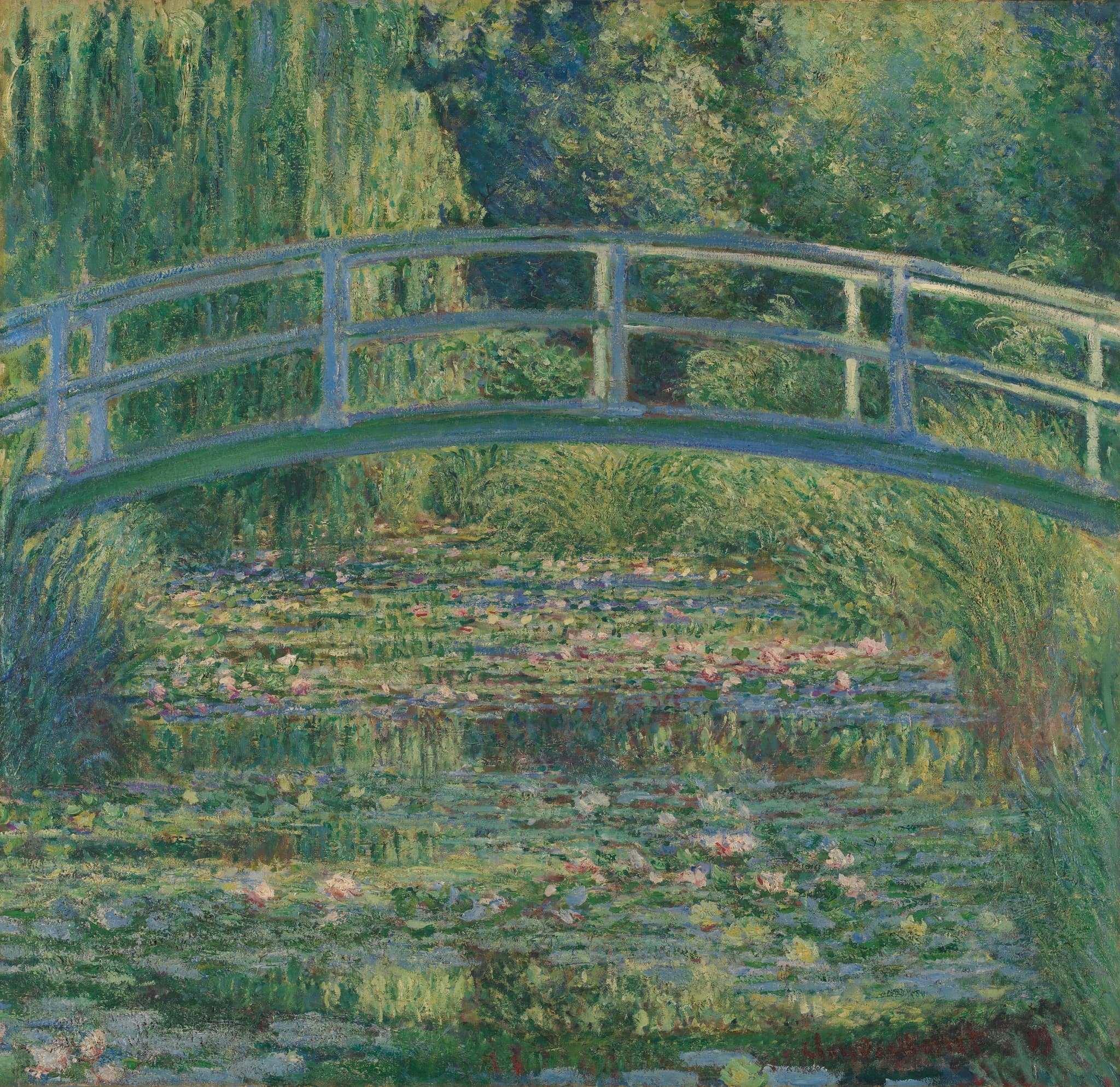
Monet removes the human body so that seeing itself becomes subject. The hand-built Japanese bridge hovers over a surface that withholds the sky; we both look down at lilies and up at reflections, a designed ambiguity that keeps attention inside an envelope of light. The garden is authored—engineered for optical tests—so reflection, not object, delivers meaning. Absorption here is the viewer’s: the eye calibrates color intervals and subtle shifts in depthless space.
Manet offers an absorbed reader who appears caught in a candid instant. But the “garden” behind her is one of his own canvases; the beer glass and journal-on-a-stick are studio props. Cropping and planarity declare the made-ness of the scene even as the luminous profile feels immediate. Absorption becomes a social and pictorial construction—the modern subject protected by a barrier of print in a public world. Monet builds attention through environmental design; Manet builds it through staging and the ethics of the frame.
Season as system vs season as emblem
Focus question: Is ‘spring’ something you watch change, or something you compress into a sign?
Haystacks Series by Claude Monet | Light, Time & Atmosphere vs Jeanne (Spring)
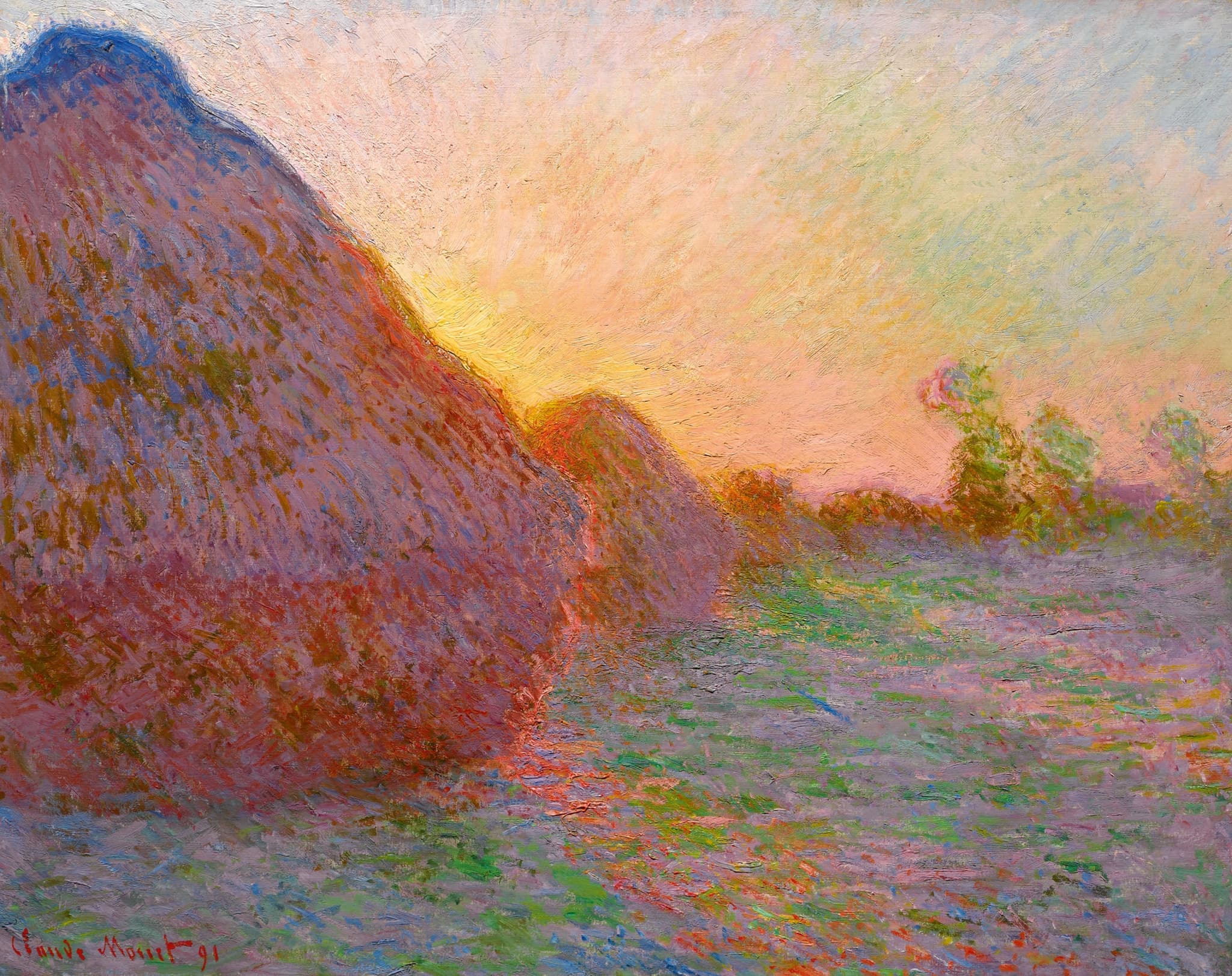
Monet turns a rural motif into a time instrument. Across the Haystacks series, one form repeats while hour, weather, frost, or snow recomposes its color and contrast. The 1891 Durand‑Ruel hanging made the method public: differences of condition are the narrative, and the eye learns season through serial comparison. The stacks are not symbols of spring; they are variables inside a system that reveals how time writes itself on surfaces.
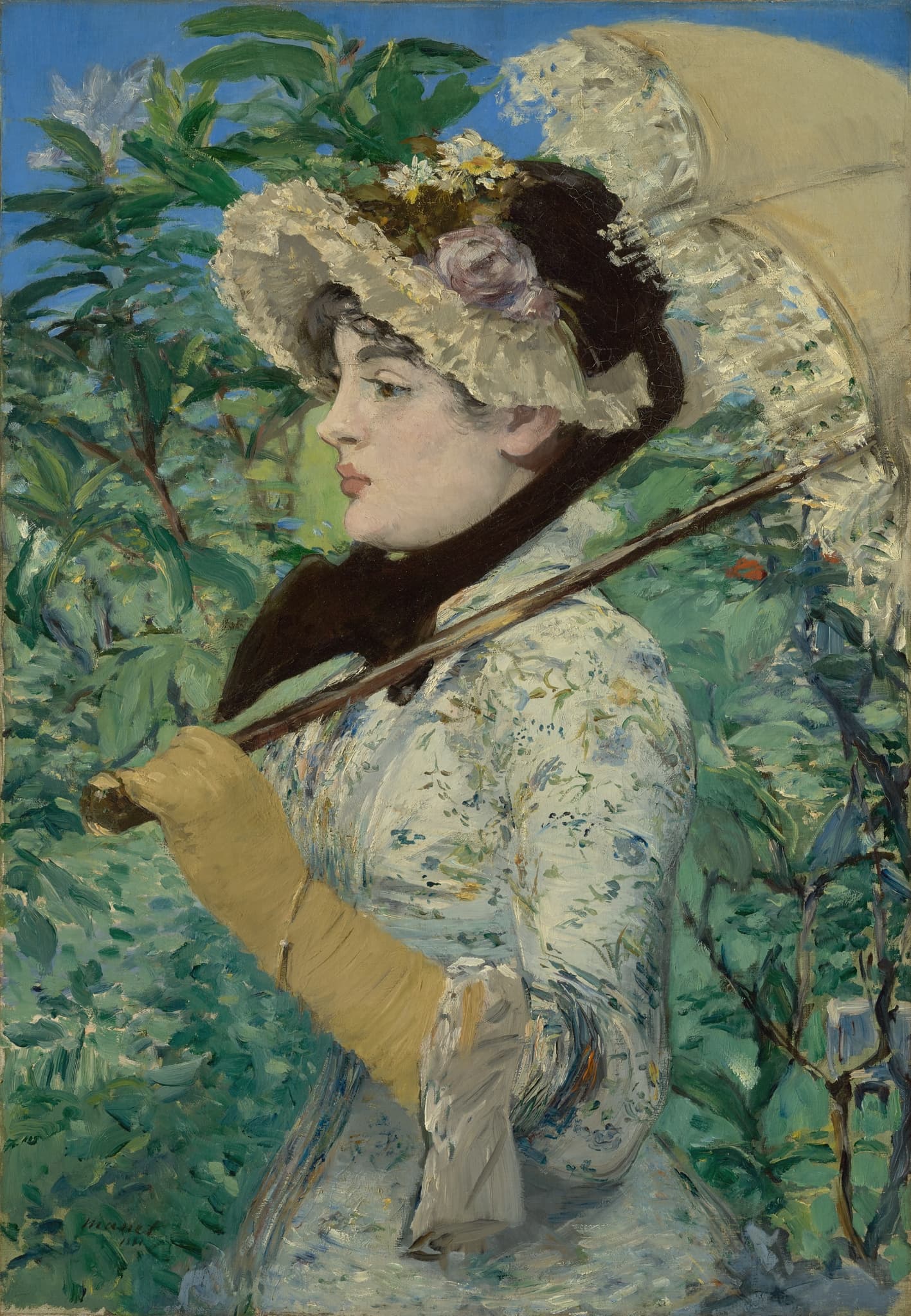
Manet compresses “spring” into a single, allegorical-modern figure. Jeanne’s crisp profile, parasol, and floral hat translate renewal into couture, set against luminous greens that act like a decorative screen. The image is staged in the studio but reads as outdoors; its authority lies in silhouette, planarity, and controlled accents. Where Monet diagnoses season as change over time, Manet crystallizes it as a sign one can wear and instantly read. Both persuade, but by opposite routes: process versus emblem.
Why This Comparison Matters
This pairing clarifies two dominant logics of modern seeing that still shape images today. Monet shows how truth can be environmental: fix a motif, watch conditions shift, and let serial difference carry meaning. That method links aesthetics to ecology and urban atmosphere—from garden reflections to London’s smog—repositioning painting as an instrument for perceiving time and climate.
Manet shows how truth can be editorial: construct the scene, choose the crop, and make spectatorship visible. That stance connects art to the ethics of media—how framing organizes crowds, café life, fashion, and even state violence. Read together, Monet and Manet teach complementary literacies: how to read conditions that make form, and how to read the frames that make meanings. The reward for the viewer is practical and immediate. You learn to notice when air and hour are the message—and when the edit is. That double literacy remains the key to navigating images, from plein-air landscapes to news photos and feeds.
Related Links
Sources
- Musée d’Orsay – Women in the Garden
- Musée d’Orsay – The Fifer
- Art Institute of Chicago – Woman Reading
- National Gallery (London) – The Water-Lily Pond
- PNAS (2023) – Atmospheric pollution and Impressionist optics
- National Gallery (London) – The Execution of Emperor Maximilian
- The Frick Collection – Manet’s Dead Toreador and Bullfight Fragments
- National Gallery (London) – Monet & Architecture
- The Met – Houses of Parliament (Effect of Fog)
- Art Institute of Chicago – Portrait of Manet the Studio Artist (essay)