Instant and Duration
Both artists turn painting into an experiment about seeing. Degas engineers the glance—cropped, oblique, and lit by footlights—inside modern institutions. Cézanne builds slow stability from sequential lookings, using planes of color to hold forms together. Together they show how modern art shifts from depicting events to constructing perception.
Comparison frame: How do Degas’s “instant” and Cézanne’s “duration” reengineer what a painting makes us see?
Quick Comparison
| Topic | Edgar Degas | Paul Cézanne |
|---|---|---|
| Project of painting | Stage the glance; perception as a social event | Construct a harmony; perception as enduring order |
| Time-scale of seeing | Instant: a choreographic cut | Duration: multiple glances reconciled |
| Orientation of meaning | Institutional optics—labor, access, hierarchy | Ontological structure—color, plane, volume |
| Spatial devices | Raked floors, radical crops, off-center horizons | Purposeful misalignments, stacked planes, warm–cool depth |
| Compositional anchors | Double bass, stair, baton binding pit and stage | Dark bottle, trunk, human axis stabilizing shifts |
| Light | Artificial glare (footlights, gaslight) isolates gesture | Diffuse modulation; color builds mass without spotlight |
| Serial method | Opéra, bathers, laundresses as vantage tests | Apples, Bathers, Mont Sainte‑Victoire as structure tests |
| Source of “truth” | Studio-built immediacy from drawings and memory | Studio-built order from long, repeated sittings |
Shared Ground
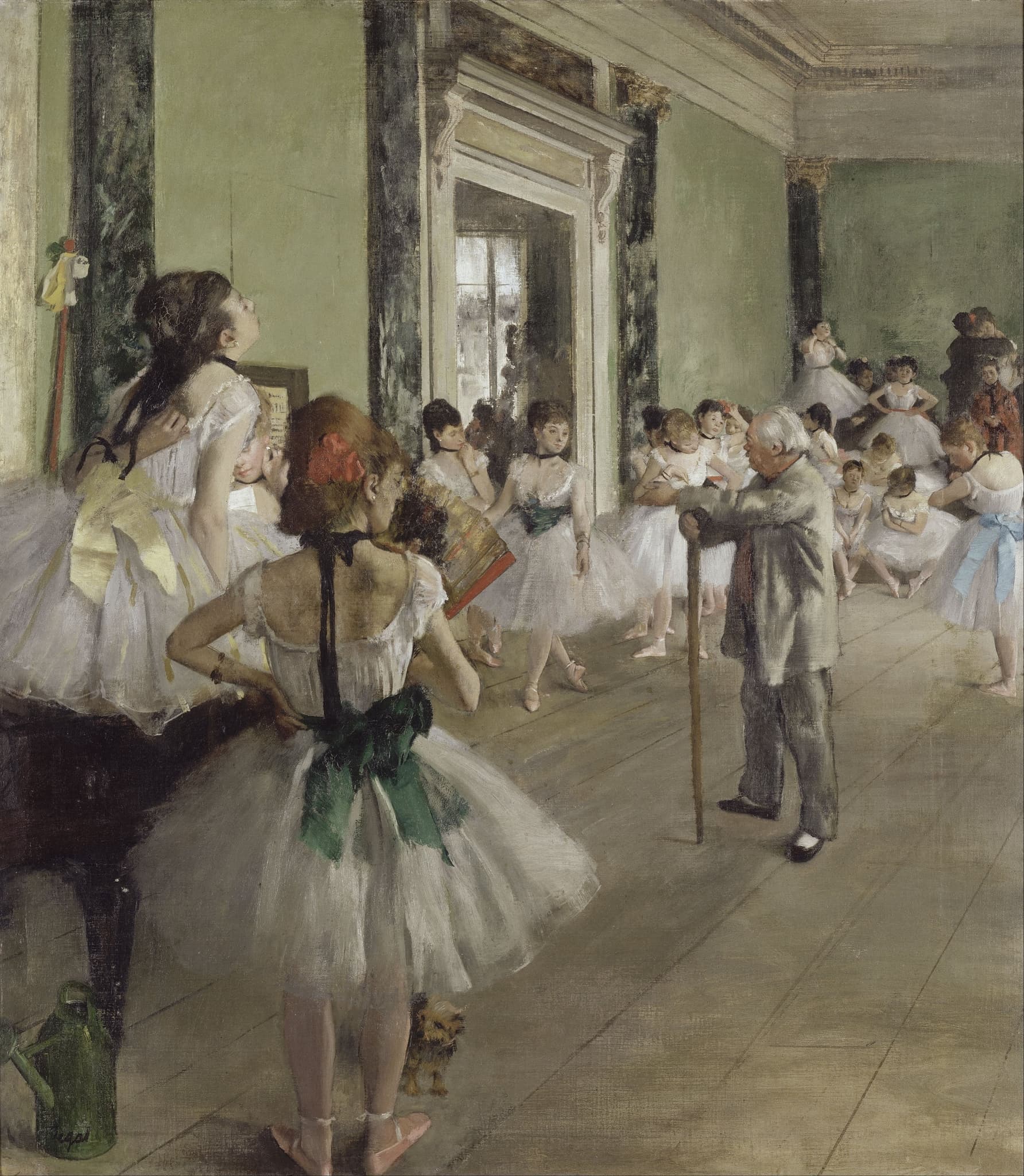
Degas and Cézanne share a decisive premise: a painting is not a story with pictures but a model of how sight works. Each replaces on-the-spot transcription with studio-built truth. Degas recomposes the Opéra from drawings and memory—sometimes after rooms no longer exist—so that a scene like The Ballet Class reads as observed life yet is engineered in the studio. Cézanne likewise constructs pictures across serial sessions: apples, bottles, and jugs are rearranged to test how color and plane can hold a world together, as in The Basket of Apples.
Both think in series. Degas iterates rehearsals, pits, and wings to probe vantage, cropping, and the social choreography of labor and access. Cézanne returns to Mont Sainte‑Victoire, Bathers, and still lifes to calibrate a durable order that survives shifts in viewpoint and time. Their canvases become laboratories: the orchestra pit or tabletop is less subject than instrument.
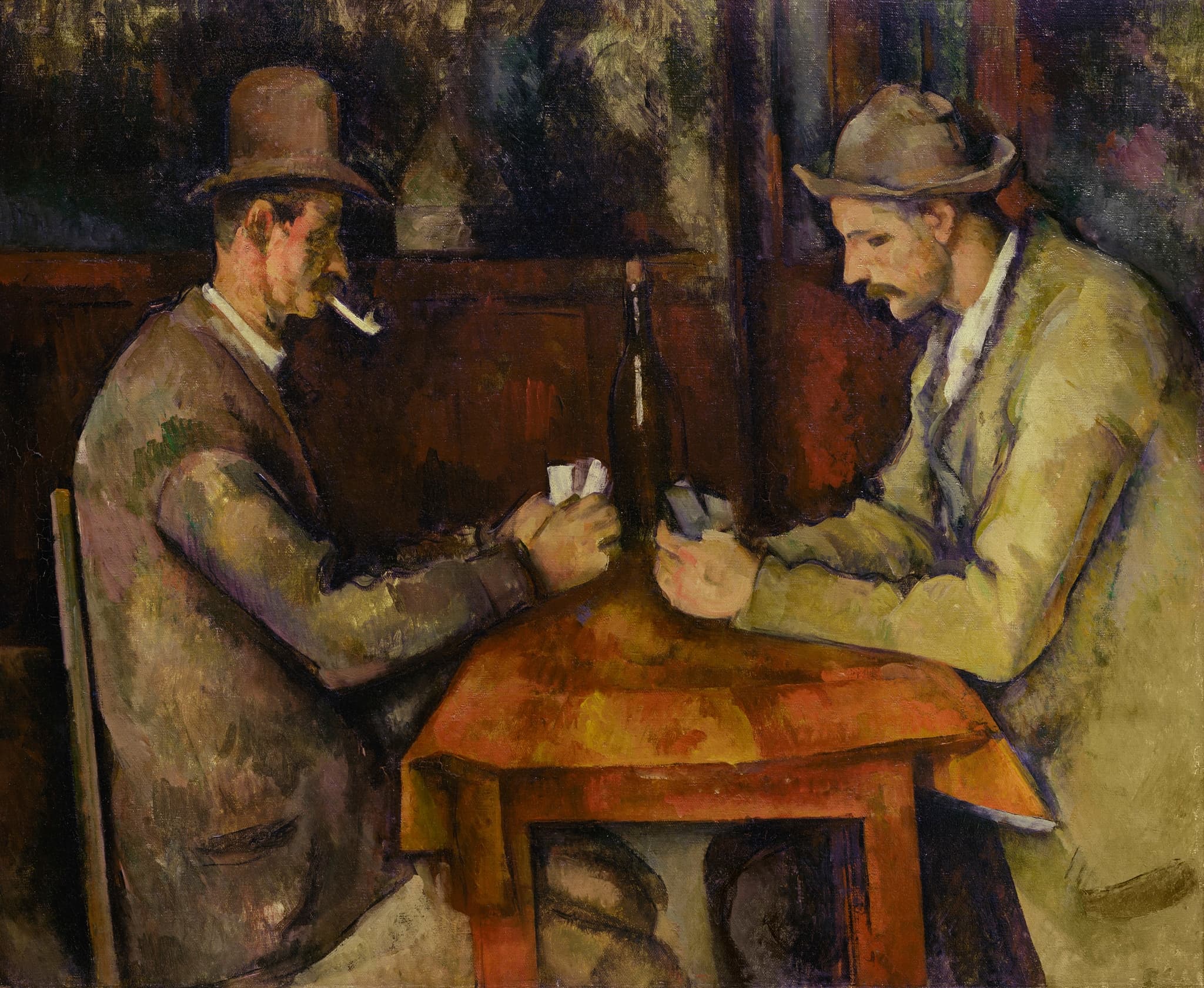
Each artist absorbs and repurposes earlier grammars to solve modern problems. Degas fuses Japanese print diagonals with photographic cropping under artificial light to register how attention actually jumps in theaters and studios; his Opera scenes flip spectacle to labor, the double bass acting as a vertical hinge between systems. Cézanne mines classicizing order (Poussin) to rebuild sensation as structure; a dark bottle in The Card Players or a tree in Mont Sainte‑Victoire stands like a plumb line amid constructive strokes. In both, the result is not anecdote but a testable account of seeing.
Decisive Difference
The split is the time-scale of vision. Degas stages the instant. Angled floors, heads cut by the frame, and the hard glare of footlights compress a moment’s asymmetries into a single, charged glance. Place de la Concorde captures urban non‑encounters by cropping bodies at the edges; The Rehearsal of the Ballet Onstage tilts the stage to expose labor under gaslight while abonnés idle in the wings. Even The Opera Orchestra inverts theater’s hierarchy in an instant cut: the pit swells to fill the frame while dancers survive as fragments above. Degas’s truth is social and immediate: perception under institutional conditions.
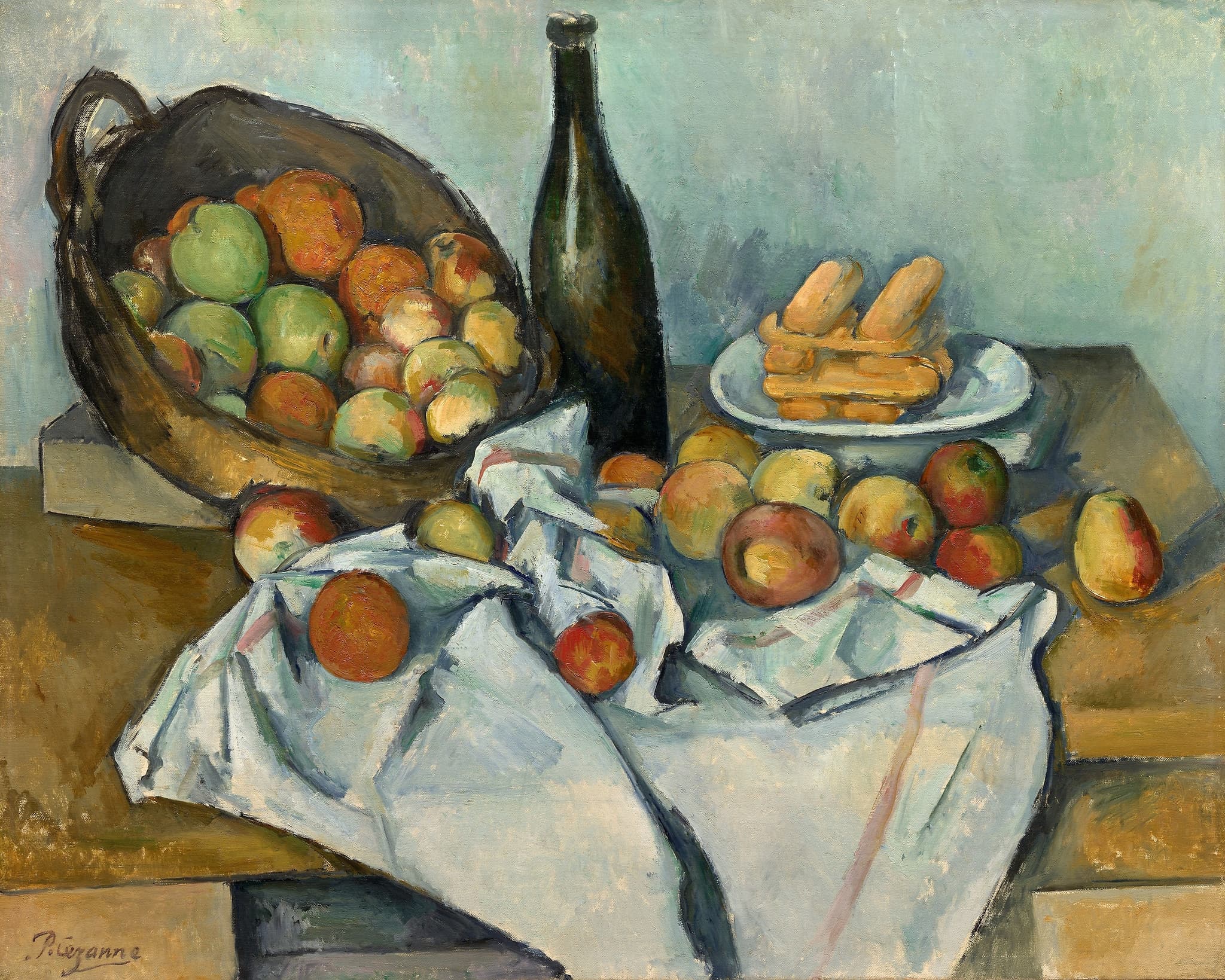
Cézanne builds duration. Purposeful spatial “errors”—leaning bottles, tilting tabletops, multi-view rims—consolidate sequential sightings into one coherent surface. In The Basket of Apples the table’s edges refuse to align and the bottle wavers, yet the painting holds by color-built mass. The Card Players uses a dark bottle as plumb line to stabilize mirrored concentration; Mont Sainte‑Victoire converts mountain and air into interlocking planes, a masonry in paint. Cézanne’s truth is structural and ontological: how color and plane co‑belong so that forms endure. Put simply: Degas choreographs partiality; Cézanne constructs equilibrium. One looks like a cut in time, the other like time sedimented into order.
Paired Works
Routine into Order: The Ballet Class vs The Card Players
Focus question: What happens when everyday routine becomes the organizing principle of a picture?
The Ballet Class vs The Card Players by Paul Cézanne | Equilibrium and Form
Both scenes convert habit into pictorial order. Degas’s studio is a system of intervals—idle waiting, correction, stretch—regulated by the ballet master’s cane. A raked floor and cropped edges deliver the feel of a glance caught between commands. Labor is visible: tutus cloud, bodies sag and brace, and practical props (watering can, music stand) keep aspiration tethered to work. The effect is social and immediate, a room governed by instruction and hierarchy.
Cézanne’s café is a system of balance. The players’ mirrored lean creates a low arch, while a dark bottle stands as a calm axis between them. Coats and hats resolve into interlocking planes; earthy warms and cool violets stabilize the scene like counterweights. The game is less a narrative than a human still life—concentration built into structure. Where Degas stages a pause in supervised time, Cézanne monumentalizes routine by reconciling many moments of looking into one stable order. Cane versus bottle: both are metronomes, but one beats a day’s drill; the other measures equilibrium.
Social Stage vs Natural Vault: Rehearsal Onstage vs Bathers
Focus question: How do many bodies become one system—by institution or by geometry?
The Rehearsal of the Ballet Onstage vs Bathers by Paul Cézanne: Geometry of the Modern Nude
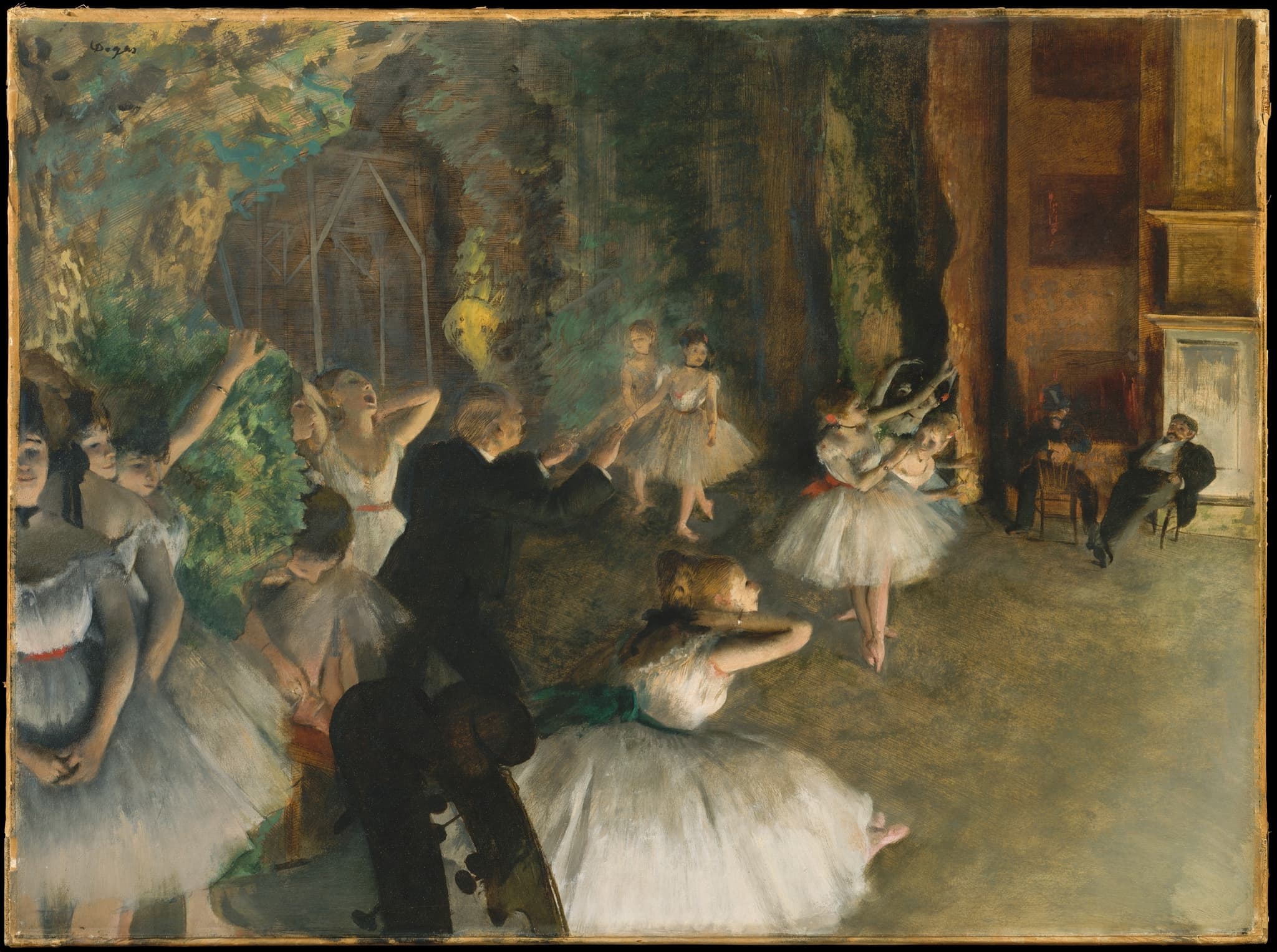
Degas’s stage is a working machine. Footlights flatten color; a conductor’s baton sets tempo; a double bass binds pit to stage. Dancers stretch, yawn, and repeat while abonnés lounge in the wings—labor, supervision, and privilege built into the picture’s diagonal thrust. Cropping and tilt make the rehearsal feel seized in flight, an instant where institution arranges bodies.
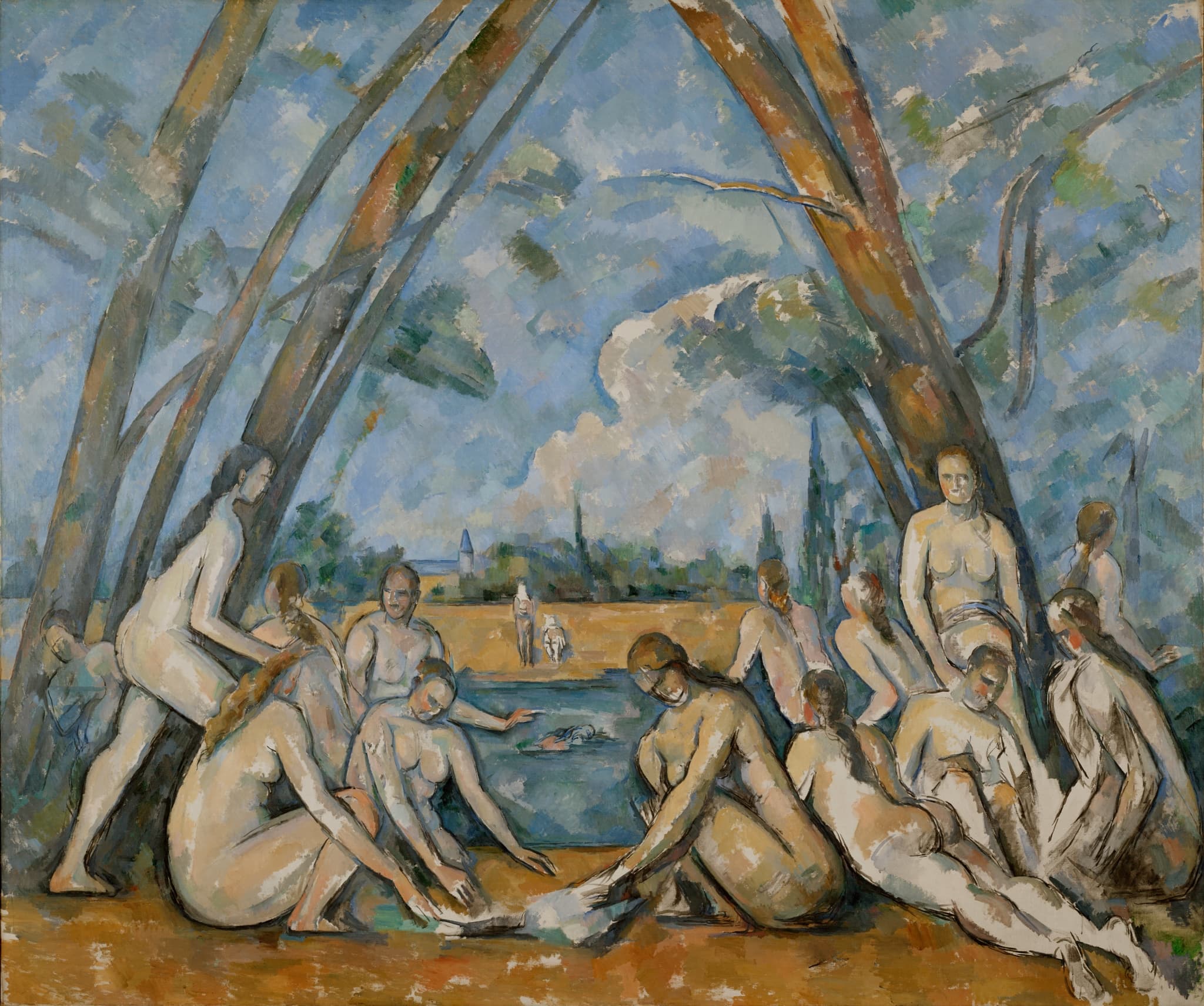
Cézanne’s riverbank is a structural canopy. Trees lean inward to form a natural vault; generalized bodies—cylinders and cones—join ground and sky into one geometric field. Brushstrokes stitch color-patches like masonry, suppressing anecdote and erotic spectacle in favor of co‑belonging. Many figures become one order because intervals of blue and ochre agree. The comparison clarifies the split: Degas organizes a crowd by staging time and power; Cézanne organizes a crowd by stabilizing relations among planes. Social machine versus timeless geometry, instant versus duration.
Urban Glance vs Withheld Center: Place de la Concorde vs House of the Hanged Man
Focus question: What does unease look like when built by cropping versus by structure?
Place de la Concorde vs The House of the Hanged Man
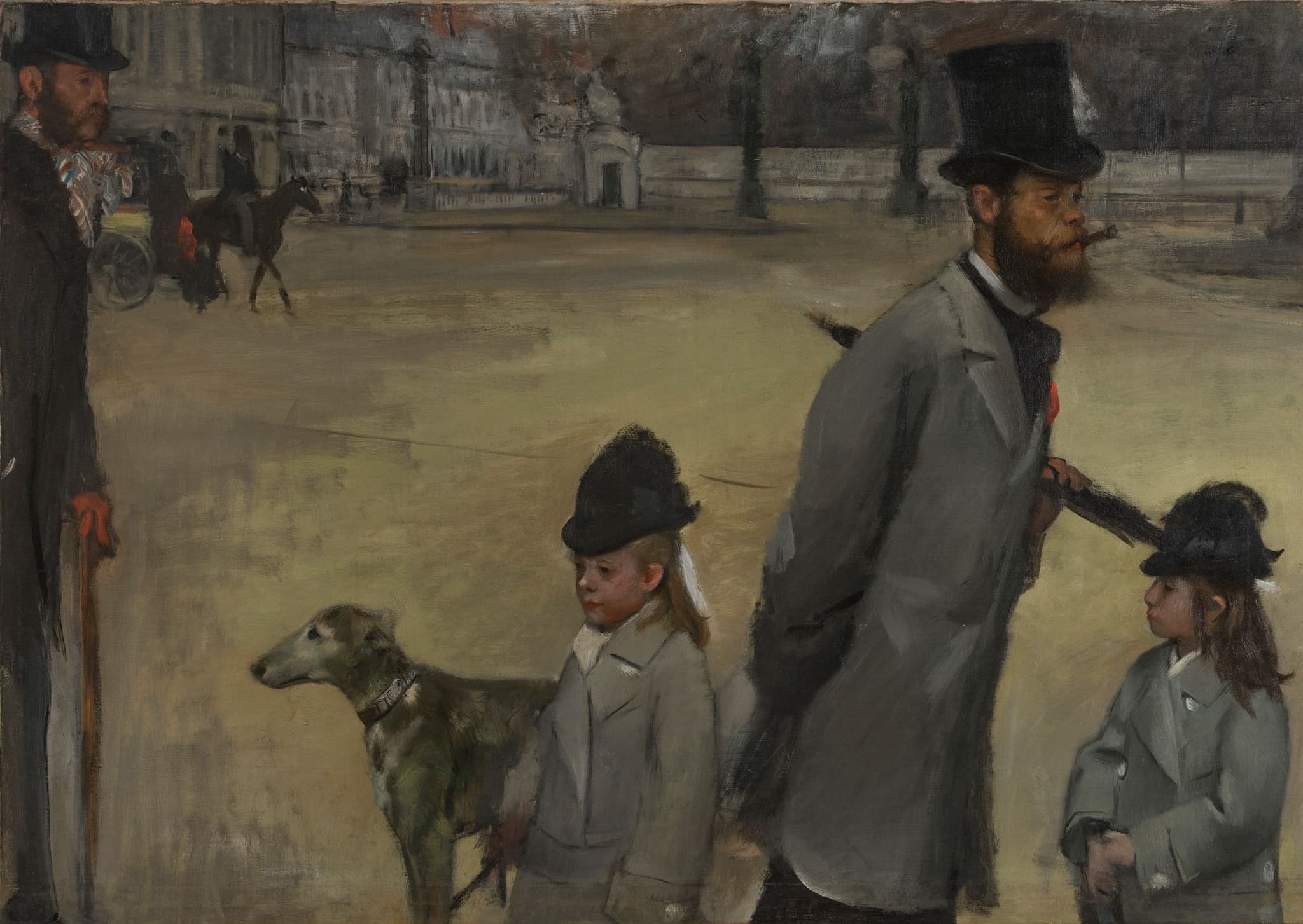
Degas engineers estrangement by subtraction. Heads clip the top edge; a man is sliced at the left margin; figures share a plaza without meeting. A wide, airless field of stone cools the scene, and the cropped frame mimics an urban glance that never settles. Research on the canvas’s trimming underlines that cropping is a deliberate modern condition.
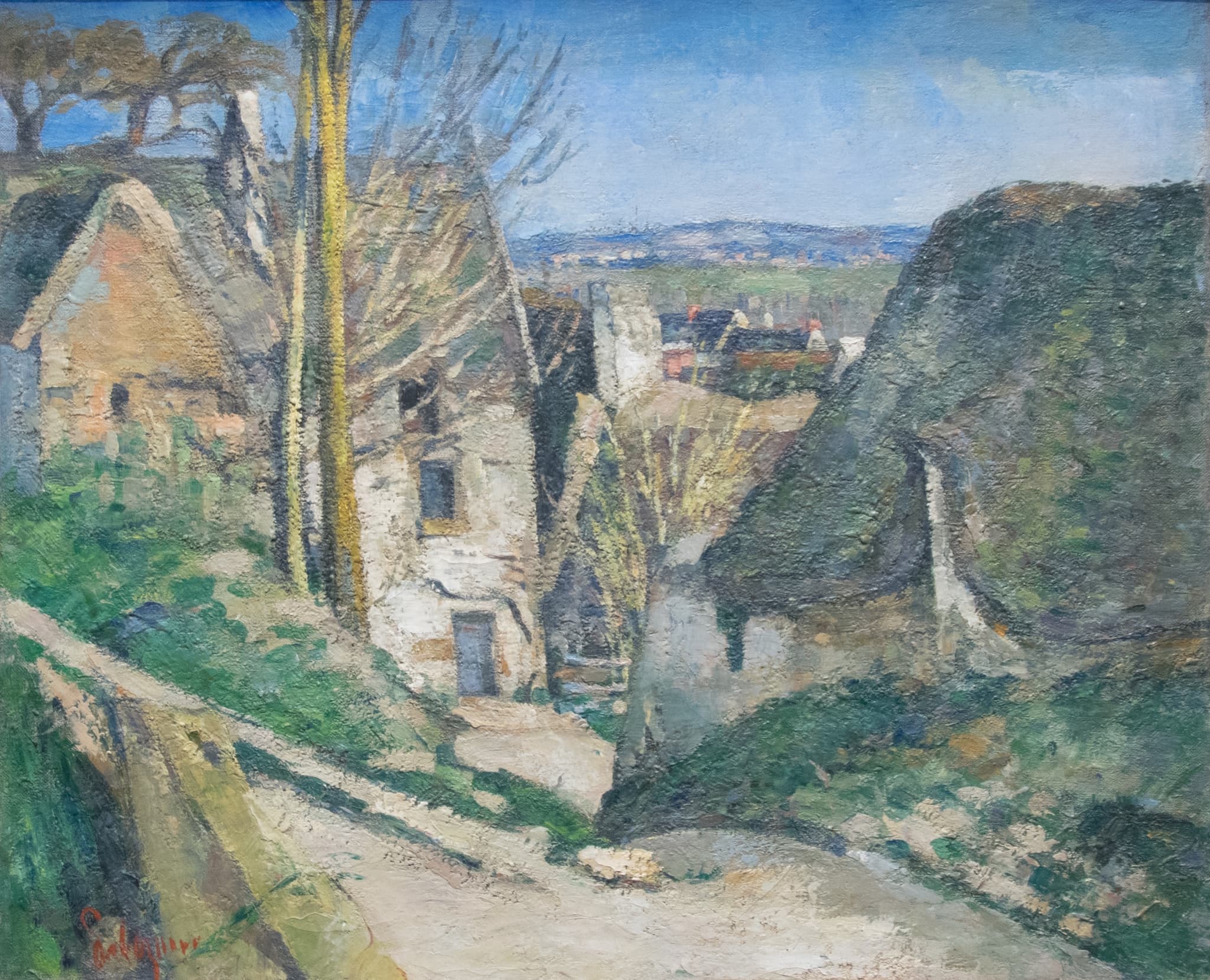
Cézanne builds suspense by convergence. Paths, banks, and rooflines funnel toward a dark V that withholds a center. Blocky, mortar-like strokes lay a village like stone; cool greens and slates fix a chill. No anecdote fulfills the title’s drama; structure does. Degas’s unease is optical and momentary—a missed encounter—while Cézanne’s is compositional and enduring—an absence made gravitational. Two early modern answers to the same mood: the world as fragment versus the world as tense construction.
Axes and Making: Opera Orchestra vs Basket of Apples
Focus question: How do vertical anchors translate labor and looking into order?
The Opera Orchestra by Edgar Degas | Analysis vs The Basket of Apples
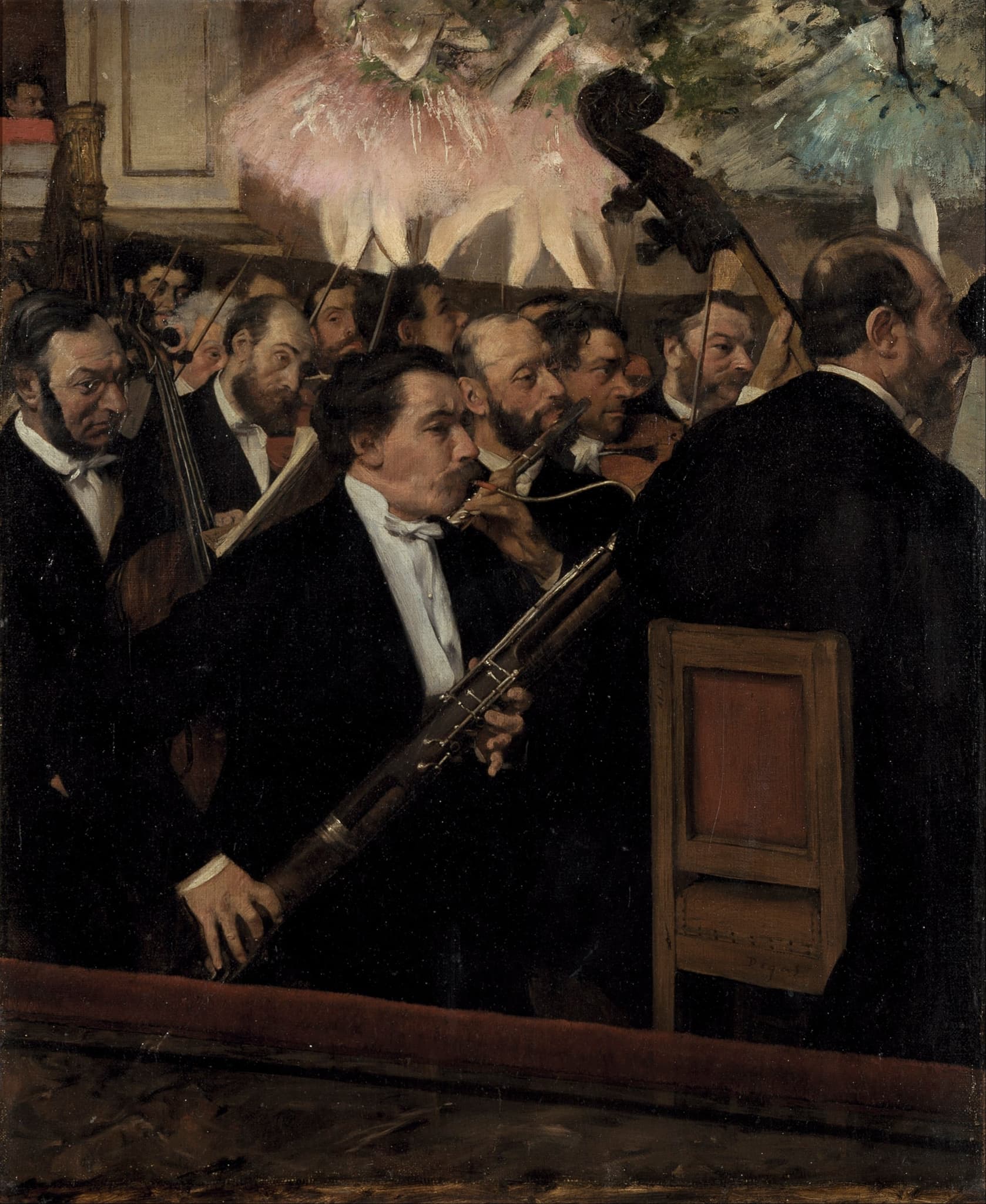
Degas flips spectacle to labor: the pit fills the frame, and a looming double bass acts as a hinge between musicians and the cropped, headless dancers above. Footlights spark faces and shirtfronts, but earthy tones keep the pit a single engine of effort. The image reads like a cut through time—partial, pressurized, and social.
Cézanne stages a tabletop as a test of perception. A dark bottle rises as a plumb line while edges refuse to align and the plate is seen from more than one angle. These “errors” are purposeful: sequential lookings compressed into one surface. Color—cool greens and ochres—builds volume where cast shadow would have stood. Both paintings depend on a vertical anchor (double bass, bottle) and on visible construction, yet their missions diverge: Degas captures work’s instant choreography; Cézanne turns slow seeing into equilibrium.
Why This Comparison Matters
Placing Degas beside Cézanne clarifies two contracts modern painting made with the eye. One says: show how the world arrives—cropped, oblique, under new lights and social arrangements. The other says: build a durable order from perception—let color and plane hold together what sequential looking discovers. These contracts shaped what followed. Degas’s engineered instant underwrites the modern image’s interest in vantage, framing, and spectatorship—from photography’s candid ethos to cinema’s montage. Cézanne’s constructed duration becomes the armature for twentieth‑century structure: Matisse’s decorative order, Cubism’s analytic planes, and every painter who trusts color to do architecture’s work.
For viewers, the comparison is practical. Degas teaches how attention behaves in institutions—what we see and miss when systems choreograph our glance. Cézanne teaches how to read a painting as a set of relations that stabilize experience. Their deepest shared ground—painting as a model of seeing—means that looking at their works can recalibrate how we look at anything else.
Related Links
Sources
- Musée d’Orsay — Degas à l’Opéra (lighting, abonnés, access)
- The Met — The Dancing Class (studio construction admission)
- Actual Problems of Theory and History of Art — Technical study on Place de la Concorde cropping
- Smarthistory — Cézanne, The Basket of Apples (purposeful errors/multi-view)
- National Gallery (London) — Cézanne’s constructive brushwork (technical paper)
- Merleau-Ponty — “Cézanne’s Doubt”
- Musée d’Orsay — The Card Players (series context, central axis)
- Musée d’Orsay — L’Orchestre de l’Opéra (pit, axis, labor)
- The Morgan Library — Degas and Cézanne as experiments in seeing