From witness to emblem
Both artists rewired grand history painting for modern crises. Géricault builds belief through evidence and the stressed body; Delacroix forges conviction through color and allegory that organize a crowd into an image of nationhood. Seeing this split clarifies why their most famous canvases feel equally urgent yet persuade in different ways.
Comparison frame: From witness to emblem: How do Géricault’s corporeal truth and Delacroix’s color‑allegory reshape what painting asks the public to see?
Quick Comparison
| Topic | Eugene Delacroix | Theodore Gericault |
|---|---|---|
| Core proposition | Painting organizes public vision through color and allegory. | Painting testifies to contingency with corporeal evidence. |
| How belief is built | Symbolic clarity; harmonized tricolor and diagonals bind a crowd into a nation. | Empirical study; survivor interviews, model raft, morgue anatomy. |
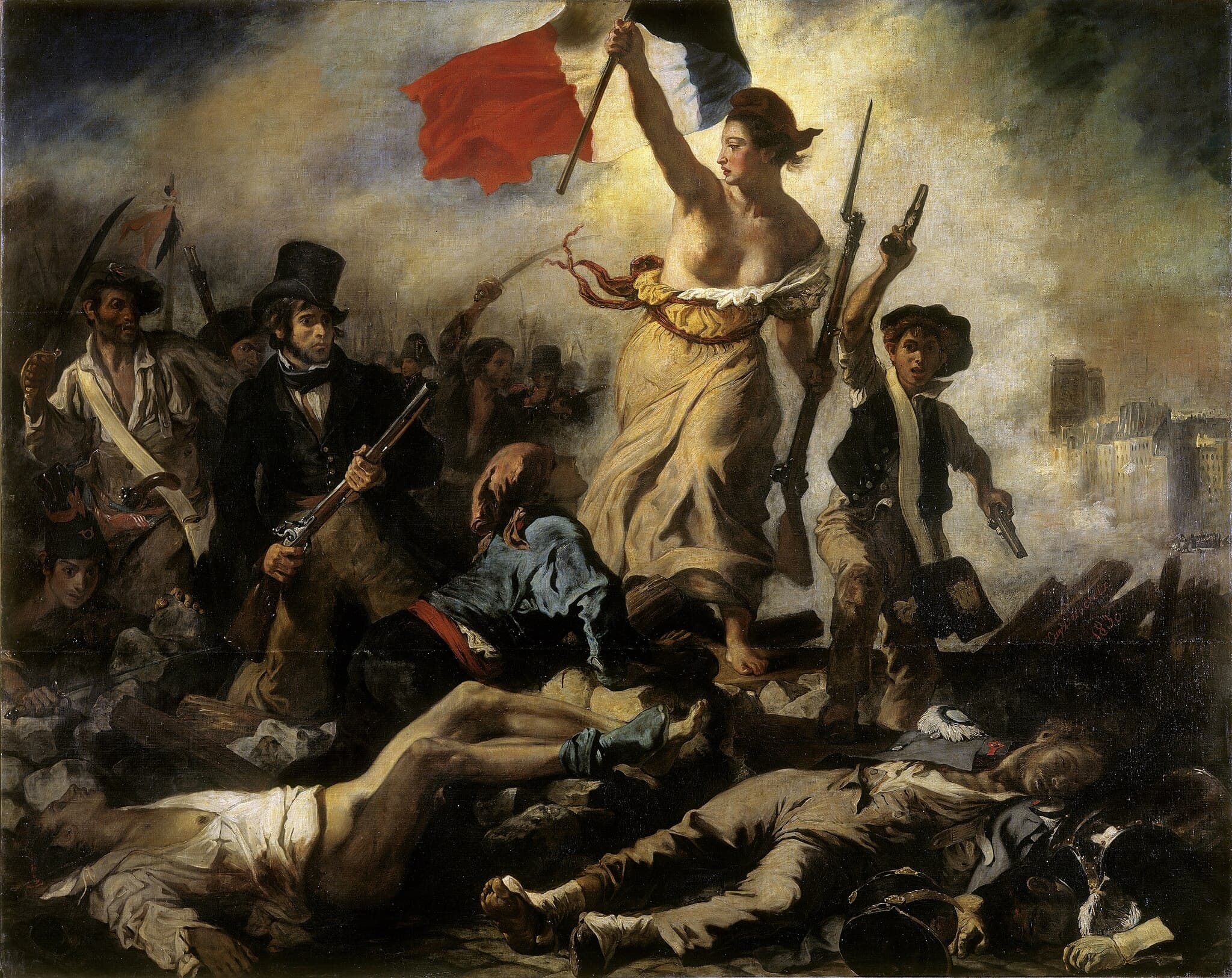
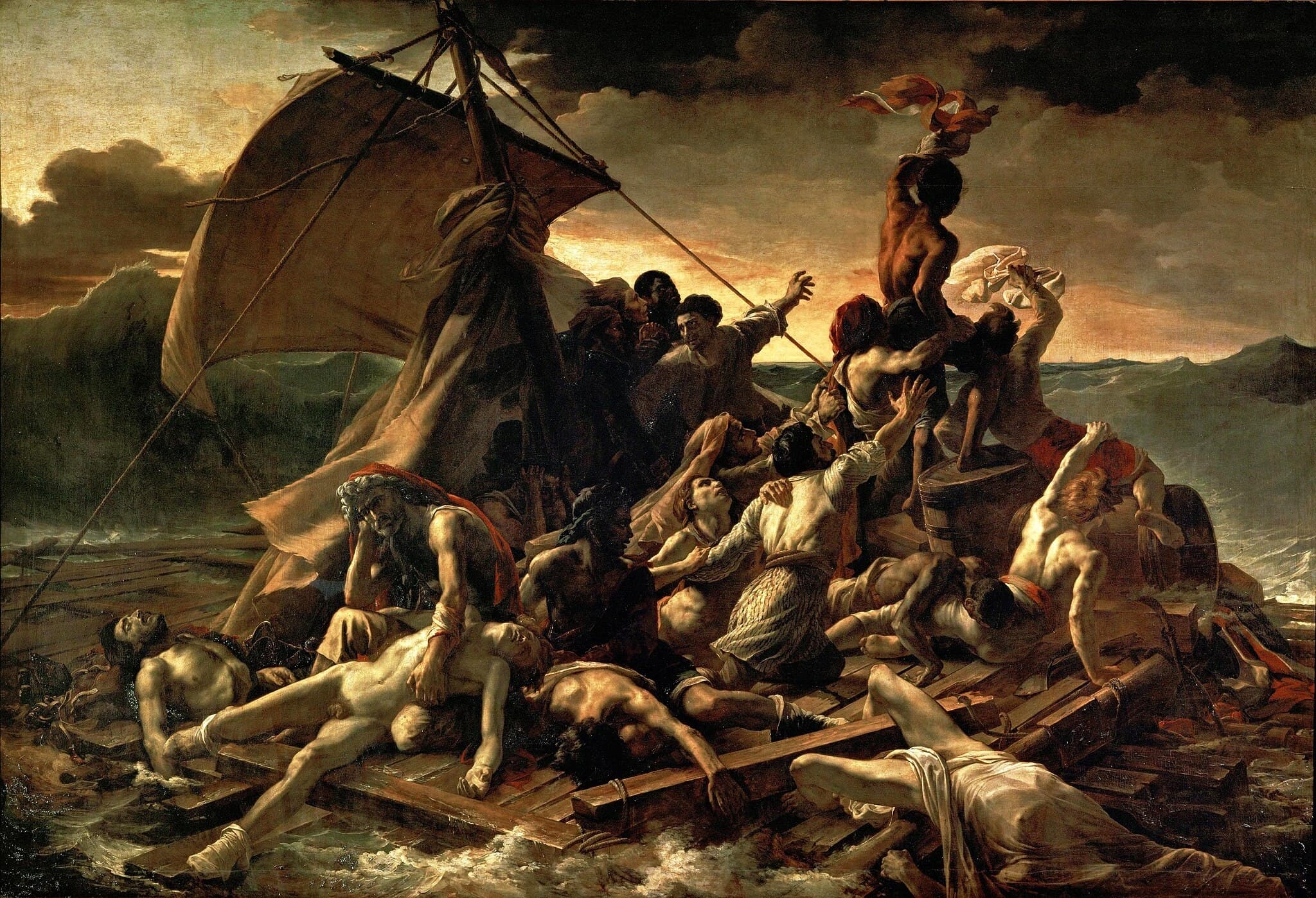
| Apex figure and claim | Marianne with the tricolor—an idea personified. | Black signaler on the raft—agency embodied. |
| Bodies and modeling | Brushy, luminous color unifies varied social types. | Sculptural anatomy and tight chiaroscuro press bodies into proximity. |
| Color and light | Rubens‑inflected colorism; contrasts do ideological work. | Compressed tonal range; light carves fact from gloom. |
| Composition arc | Directed surge toward a rhetorical climax. | Rising pyramid from corpses to fragile hope; rescue not guaranteed. |
| Political address | Mobilizing emblem that converts event into national myth. | Indictment of institutional failure anchored in witness. |
Shared Ground
Delacroix and Géricault share a project: to refit the grand manner of history painting for the pressures of their own day. Each seized on recent, volatile events and gave them epic scale. Géricault’s The Raft of the Medusa (1818–19) turns a 1816 shipwreck and Restoration scandal into a tragic monument; Delacroix’s Liberty Leading the People (1830) converts the July Revolution—painted within months—into a rallying image. Both works were shown at the Paris Salon and ultimately entered the Louvre, signaling that contemporary crisis now warranted the museum’s most public walls.
They also share means. Trained in the same neoclassical atelier (Guérin) and schooled on Rubens and Michelangelo, both artists fused close observation with theatrical structure. Each arranges bodies as arguments: a heap of dead in the foreground grounds a right‑tilting ascent toward a precarious or newly claimed hope at the upper right. Research from life anchors their authority. Géricault interviewed survivors, built a model of the raft, and studied cadavers to secure anatomical truth; Delacroix’s on‑the‑spot studies and later North African notebooks feed large public images whose heat and movement remain legible. In short, both turned crowds and flesh into the grammar of moral claims, making modern history painting answerable to lived experience as well as to the museum’s high traditions.
Decisive Difference
Géricault treats painting as ethical witness under pressure. The Raft of the Medusa is constructed from interviews, a studio raft, and morgue studies so that the viewer confronts contingency rather than ceremony. Its hope is real yet radically uncertain: the Argus is a speck; the wave that lifts could also drown. Light and modeling are used to certify bodies and gestures, not to polish allegory. The apex is a human actor—crucially a Black sailor—whose signal concentrates the painting’s politics into embodied agency. Géricault’s modernism lies in this wager that empirical density can force recognition.
Delacroix treats painting as an instrument that organizes vision through color and allegory. Liberty Leading the People fuses eyewitness detail with a personified Liberty, transforming unruly street combat into a legible national emblem. Color is not garnish but structure: the blue‑white‑red cadence binds a mixed crowd into a single vector, a role clarified by the 2023–24 cleaning that rebalanced tonal contrasts. Delacroix’s diagonals and harmonies choreograph conviction; authority comes from aesthetic clarity rather than documentary procedure. In short, Géricault privileges corporeal truth and precarious agency; Delacroix privileges symbolic clarity and color‑driven persuasion. Both are Romantic, but they ask painting to “make us see” along decisively different channels.
Paired Works
Two pyramids, two truths
Focus question: What changes when the apex is an allegory (Liberty) versus a human signaler (Raft)?
Liberty Leading the People vs The Raft of the Medusa
Nation as figure vs psyche as case
Focus question: How do personification and diagnostic portraiture shape public meaning?
Greece on the Ruins of Missolonghi vs Portrait of a Kleptomaniac
Spectacle and evidence
Focus question: What happens to ‘truth’ when violence is staged as chromatic theater versus forensic presence?
Death of Sardanapalus vs Severed Heads
Baroque energy, two translations
Focus question: How do both artists adapt Old Master motion—Rubens, Stubbs—into modern sensation?
Lion Hunt vs Horse Attacked by a Lion
Why This Comparison Matters
This comparison clarifies two templates for how modern images claim truth in public life. Géricault grounds meaning in the body and in facts gathered under duress—his pictures ask institutions to answer to what flesh has endured. Delacroix grounds meaning in symbol and color that can unify disparate actors—his pictures show how a crowd becomes a public under a shared sign. Both approaches still shape how we read images of crisis, from photojournalism that testifies to harm to posters and screens that mobilize conviction through emblem and palette. Seeing the split makes their kinship sharper: each artist accepts the burden of the present, but one builds recognition from evidence while the other builds consensus from form. That tension—witness versus emblem—became a basic problem for modern art, and it remains a live question for how pictures persuade now.
Related Links
Sources
- Louvre collections: Delacroix, Liberty Leading the People
- Louvre press: 2023–24 conservation of Liberty
- Smarthistory: Géricault, The Raft of the Medusa
- Britannica: The Raft of the Medusa
- Britannica: Liberty Leading the People
- Musée des Beaux‑Arts de Bordeaux: Greece on the Ruins of Missolonghi
- Princeton University Art Museum: Géricault anatomical studies
- Nationalmuseum Stockholm: Delacroix, Lion Hunt
- MSK Gent: Géricault, Portrait of a Kleptomaniac
- Britannica: Pierre‑Narcisse Guérin (shared training)