Outline-driven dream vs color-driven construction
Both Henri Rousseau and Henri Matisse treat painting as a built way of seeing rather than a transcription of appearances. They flatten and simplify to turn pictures into mental fields: Rousseau through precise contour and stage‑like space, Matisse through autonomous color that organizes depth and feeling. Read together, they show how modern painting replaces description with an internal order we learn to see.
Comparison frame: How do Rousseau’s dream‑stage and Matisse’s color‑field each remake what a painting asks us to see?
Quick Comparison
| Topic | Henri Matisse | Henri Rousseau |
|---|---|---|
| What remakes vision | Outline, emblem, equal focus; lucid dream‑stage | Autonomous color builds drawing and depth |
| Primary tool | Hard contour; silhouette planes | Hue intervals; reserve lines; arabesque |
| Space | Shallow, stacked bands; minimal shadows | Near‑planar color fields; interiors/windows |
| Time | Moonlit suspension; action paused | Present‑tense perception; handless clock |
| Source of nature | Jardin des Plantes, zoos, prints; compiled “elsewheres” | Studio/domestic life; Mediterranean light |
| Facture | Enamel‑smooth finish; patterned foliage | Visible brush; late color floods; hovering flats |
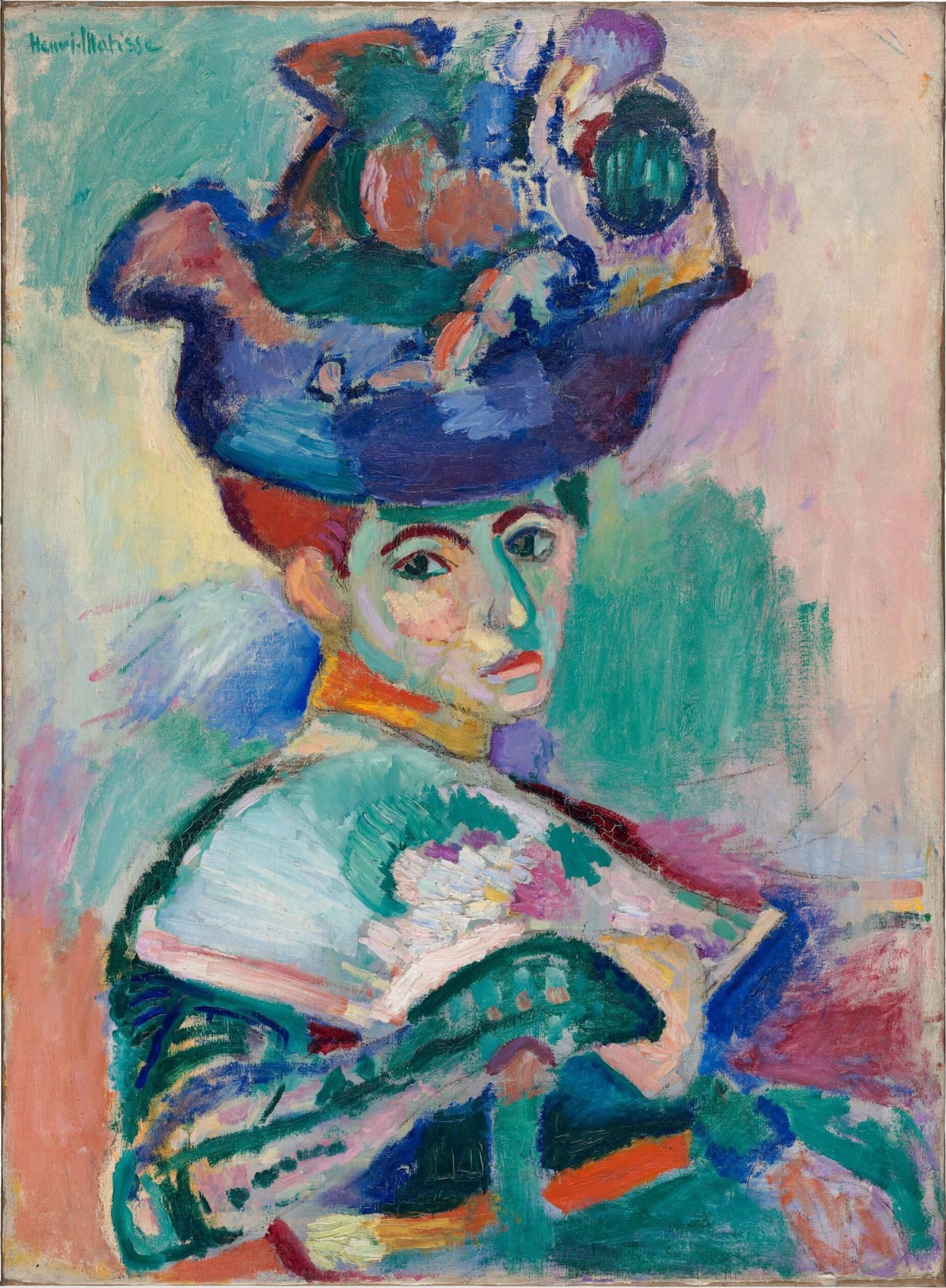
| 1905 sense of ‘wild’ | Savagery as narrative (Hungry Lion) | Savagery as color shock (Woman with a Hat) |
| Viewer effect | Emblematic stillness; narrative held in wait | Immediate chromatic rhythm; presentness |
Shared Ground
Rousseau and Matisse both reject painting as transcription. Each constructs vision from first principles to make the canvas a mental field rather than a window. For Rousseau, clarity comes from exact contour, evenly lit detail, and stage‑like depth: animals, leaves, instruments, and moons receive comparable attention, so meaning reads as emblem rather than anecdote. For Matisse, color is the primary organizer. He lets hue do the work of drawing and space—greens, reds, and pinks establish relations that outrank local description. In this sense both artists argue that a picture’s internal order can be truer than outward likeness.
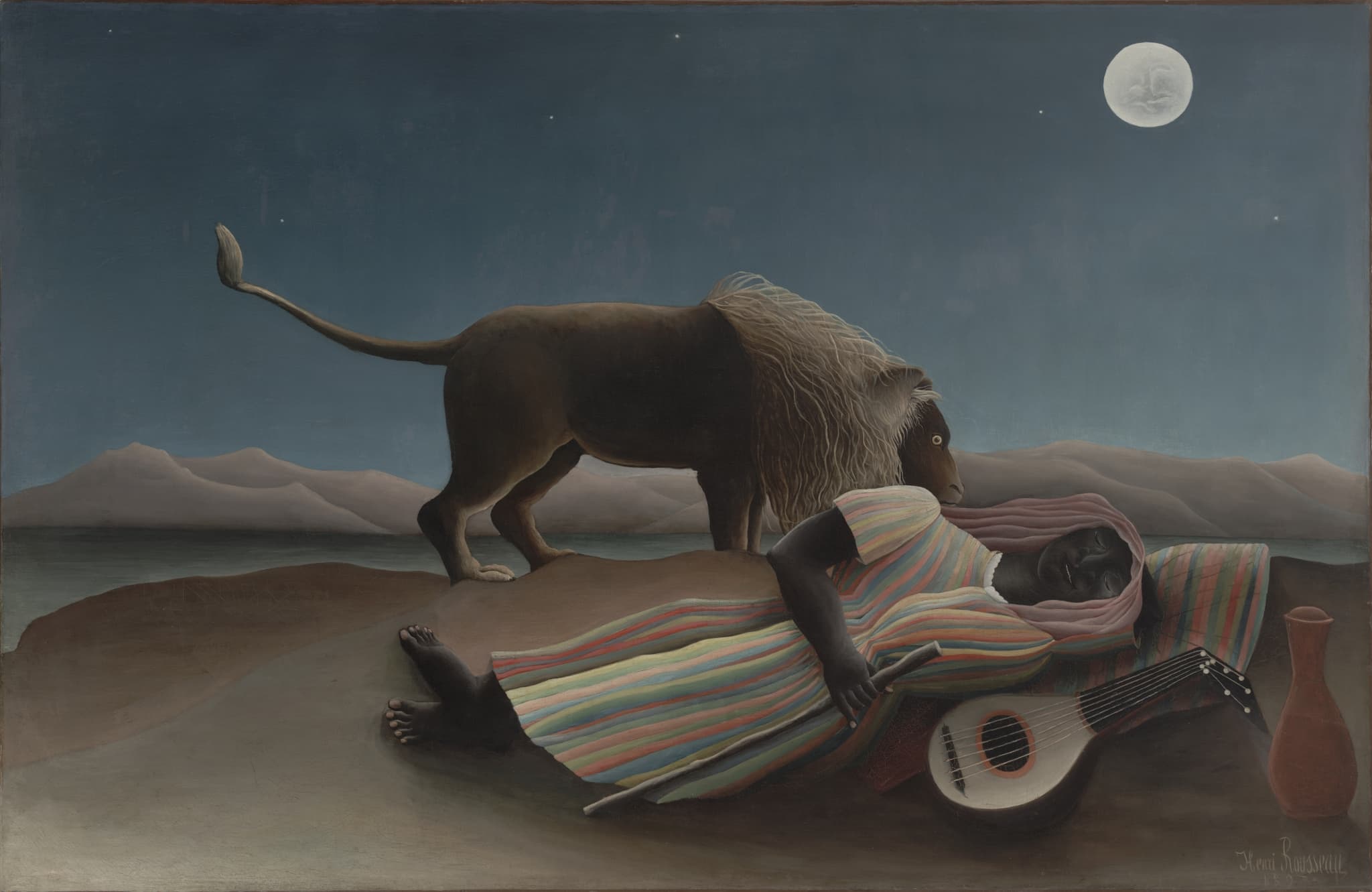
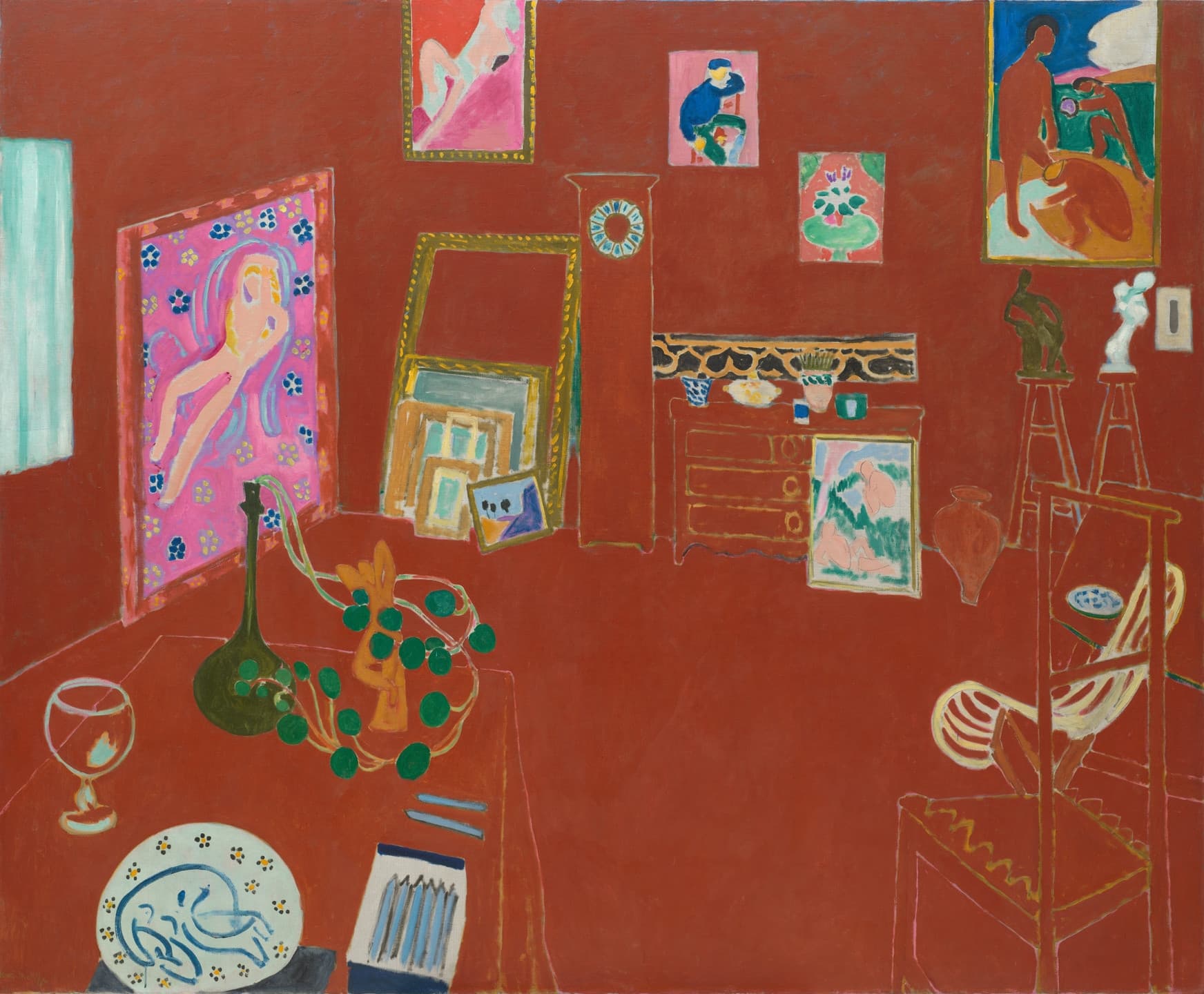
They also treat flatness positively. Rousseau’s deserts and jungles stack as bands or silhouettes, like theatrical sets that escort the eye from foreground emblem to back wall of night. Matisse compresses interiors until walls, floors, and furniture merge into chromatic planes; windows become matrices of color rather than apertures to deep vistas. In signature works, both suspend ordinary time to foreground seeing itself. Rousseau’s nocturnes—most famously the sleeper under a watchful moon—freeze action into a poised truce. Matisse’s studio, suffused in a single red, contains a clock without hands and objects that hover as lines. The result in both cases is not reportage but a state: a lucid dream for Rousseau, a present‑tense field of color for Matisse.
Decisive Difference
The decisive difference is what, for each, remakes vision. Rousseau builds sight around outline and emblem. His forms lock to crisp edges; figures, leaves, instruments, and animals sit in equal focus; weather is diagrammed (a mesh of diagonal rain, a circular moon); and space reads as a shallow, assembled stage. This outline logic produces a lucid dream: narrative is present but suspended, as if the world had paused to let symbols communicate. Even when scenes are invented from zoos, botanical gardens, postcards, and dioramas, their legibility is exact. The contour does not merely describe; it governs the dream’s stillness.
Matisse, by contrast, lets color generate drawing, rhythm, and depth. From the Fauve years onward, hue is independent—greens can model faces, pinks can ground rooms—and in his studio pictures color can even erase architecture. In The Red Studio a late flood of Venetian red dissolves furniture into unpainted “reserve” lines, so drawing is literally the absence of pigment within a color field. Windows become grids of color intervals; shadows dematerialize; a clock loses its hands. What results is not a frozen story but an active present—a world reorganized by chromatic relations. If Rousseau’s outline clarifies a dream, Matisse’s color constructs perception itself.
Paired Works
Suspended interiors of mind
Focus question: Why do both scenes feel outside ordinary time, and how does outline versus color build that effect?
The Sleeping Gypsy vs The Red Studio
Two Arcadias
Focus question: What turns nature into vision in each Arcadia?
The Dream vs Le bonheur de vivre (Joy of Life)
Weather and light, two methods
Focus question: How do patterned contour and chromatic intervals create weather or light?
Tiger in a Tropical Storm (Surprised!) vs Open Window, Collioure
1905: Two meanings of wild
Focus question: At the 1905 Salon d’Automne, how did ‘wildness’ read as narrative versus color?
The Hungry Lion Throws Itself on the Antelope vs Woman with a Hat
Why This Comparison Matters
Placing Rousseau beside Matisse clarifies two durable paths for modern painting. Both flatten space and reject imitation, but they lead the eye to different kinds of truth. Rousseau’s hard contours and equalized focus build a lucid dream in which symbols—moon, leaf, instrument, lion—communicate across a suspended narrative. Matisse’s color decisions create the experience itself: a studio that is more red than room, a window that is more interval than view, a face held together by green.
Understanding this split helps decode much that follows. Later Surrealists inherit Rousseau’s emblematic stillness and staged “elsewhere.” Color‑field painting and postwar design take cues from Matisse’s chromatic structure and decorative cadence. For a viewer, the payoff is practical: you learn to ask not just what a picture shows, but what visual principle is doing the building—outline or hue, emblem or interval. That question makes seeing more exact.
Related Links
Sources
- MoMA Press Release: The Red Studio (2022 conservation findings)
- MoMA Audio: The Red Studio
- MoMA Collection: Henri Rousseau, The Sleeping Gypsy
- MoMA Audio: Henri Rousseau, The Dream
- National Gallery, London: Tiger in a Tropical Storm (Surprised!)
- National Gallery of Art (US): Matisse, Open Window, Collioure
- Barnes Foundation: Matisse, Le bonheur de vivre (Joy of Life)
- SFMOMA: Matisse, Woman with a Hat (provenance and reception)
- Grand Palais: 1905 Salon d’Automne (origin of 'Fauves')
- Henri Matisse, Notes of a Painter (1908)